
On this page
Start here
Quick answer
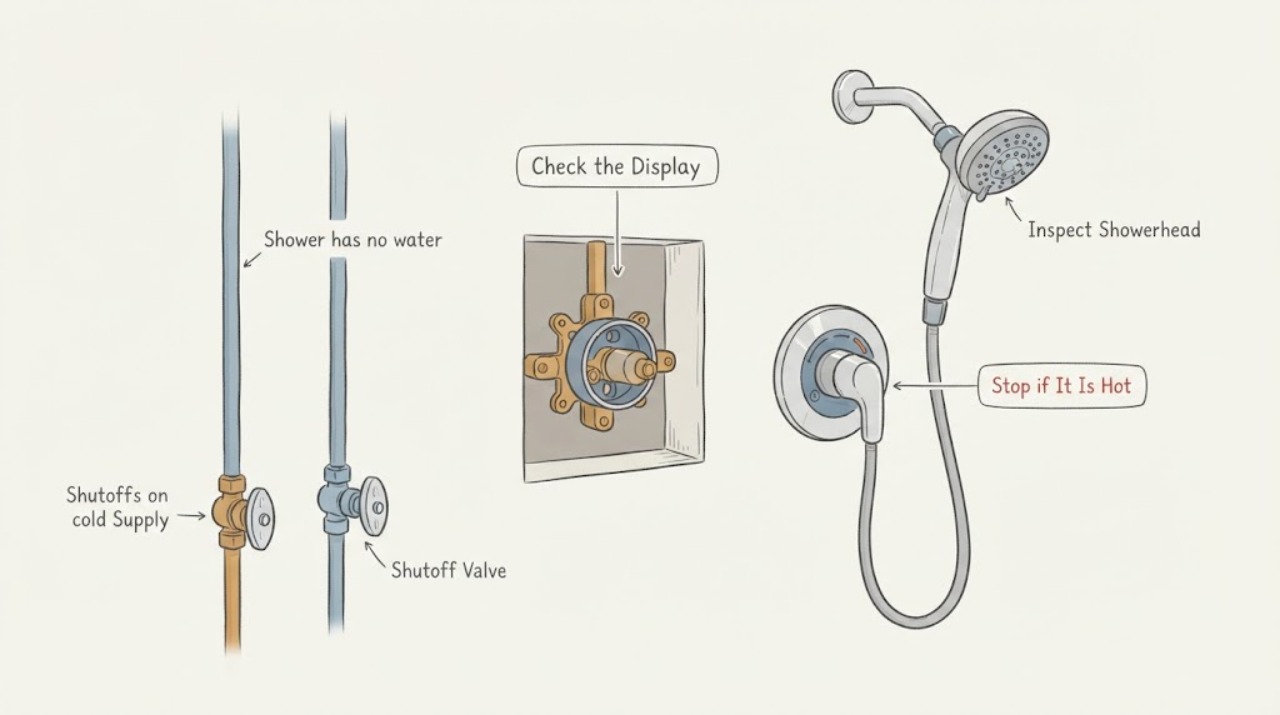
First determine whether the problem is only the shower, only hot or cold water, or the whole home. Check other faucets and a lower-level fixture, compare hot and cold flow, and stop using the shower if water is leaking behind the wall, the floor is unsafe, or an electrical shower/controller is wet or damaged. From normal access, verify that any visible shower shutoff valves are in their usual open position and that the handle or controller is being operated as the model requires. If a tub spout or hose outlet works but the showerhead does not, inspect the accessible showerhead, screen, selector, and hose for mineral buildup, debris, kinks, or a closed diverter; clean or remove only what the manufacturer permits and do not force fittings. If every outlet is dry, several fixtures lose flow, both hot and cold supplies are absent, wastewater backs up, or the valve is behind the wall, stop and arrange qualified plumbing, building-management, or water-utility help.
Before you begin
Safety first
- User checks are limited to fixture comparison, normal controls, safe visible shutoff observation, and gentle manufacturer-approved showerhead/hose inspection; hidden valves, pressurized piping, water heaters, electrical shower equipment, leaks behind walls, and contaminated water require qualified service.
Work through in order
Diagnostic checks
Use only checks that match the exact appliance or system and its official guide.
-
Check 1
Turn the shower control off and check another cold faucet, another hot faucet, and a fixture on the lowest level if safely accessible. Note whether the shower has no flow at all or only a dribble, whether hot and cold are affected equally, and whether any water is leaking, discolored, or backing up.
Expected result: Only the shower has no water; other fixtures also have reduced flow; all cold faucets are dry; cold works but hot does not; or wastewater is backing up.
Next step: For a shower-only, clear-water problem, continue with the local control and outlet checks. For wider loss of flow, hot-water-system concern, or wastewater, reduce water use and arrange the appropriate plumber, property manager, or utility assessment.
Stop if: Stop immediately for wastewater, rapid overflow, active concealed leakage, water near electrical equipment, or an unsafe wet floor.
Why this matters
Why: A shower-only symptom makes the local showerhead, hose, selector, valve, or supply stops more relevant. Multiple fixtures or all cold faucets suggest a home, building, or utility supply issue. Cold-only flow makes the hot-water side more relevant, while wastewater backup is a stop condition.
-
Check 2
From normal access, check whether any external shower shutoff valves are visibly present and in their usual open position, without turning a valve whose position or function is uncertain. Identify the handle, volume control, transfer selector, or electronic controller and follow only the model's normal on/off sequence; do not remove the trim plate or valve cover.
Expected result: A visible supply valve is closed; a volume/transfer control is off; the controller has no power; the handle is being used differently from its model instructions; or controls and visible supplies appear normal.
Next step: Correct only an obvious normal control position according to the model instructions. If the valve is uncertain, the controller is wet/damaged, or water still does not flow, leave the system off as appropriate and arrange qualified service.
Stop if: Do not force or adjust a hidden/uncertain shutoff, remove trim, open an electronic controller, or work on a wet electrical shower.
Why this matters
Why: A closed supply or separate volume control can prevent any water while the plumbing remains intact. A controller with no power may need an electrical or product assessment. A normal control sequence with no flow shifts attention to the outlet or hidden valve path.
-
Check 3
If the showerhead is hand-removable without force and the shower has no unusual leak, inspect the visible spray openings, inlet screen, and connection for mineral buildup or debris. Clean or soak it only with the manufacturer's instructions, use a soft non-abrasive method, and keep the removed parts accounted for; do not enlarge openings or force a corroded connection.
Expected result: The head is visibly blocked and flow returns after approved cleaning; the head is clear but no water reaches it; the screen or connection is damaged; or the head cannot be removed safely.
Next step: Refit an intact head without over-tightening and test briefly for leaks. If no flow remains, the head is damaged, or removal was not safe, stop at the outlet and arrange plumbing or manufacturer service.
Stop if: Do not use a torch, harsh chemical, sharp object, or force on the showerhead, and stop if the shower arm or wall connection moves or leaks.
Why this matters
Why: Buildup at the shower outlet can stop or severely restrict flow when the rest of the shower supply is normal. A clear or damaged head with no flow makes the hose, selector, valve, or supply more likely. A seized connection can damage the shower arm or wall plumbing if forced.
-
Check 4
For a tub/shower or handheld system, use the normal selector or diverter once and observe whether water comes from the tub spout, hose outlet, or another intended outlet. Check a visible handheld hose for kinks or crushing and inspect only accessible selector openings; do not dismantle the diverter or mixing valve.
Expected result: Water flows from the tub spout but not the showerhead; water flows from another outlet but not the selected one; no outlet flows; the hose is kinked or damaged; or water leaks at a joint.
Next step: Remove only an accessible kink without stretching the hose and use the normal selector sequence. For a damaged hose, leaking joint, no-flow-at-every-outlet pattern, or failed diverter, stop and arrange qualified plumbing service.
Stop if: Stop if a joint leaks, a hose is split, the wall connection moves, water enters the wall, or the diverter requires disassembly.
Why this matters
Why: Flow from one outlet with none at the showerhead points downstream toward the showerhead, hose, or selector. No flow at every outlet keeps the supply or valve branch open. A kink or leak can restrict flow or create property damage, while a hidden diverter fault requires model-specific diagnosis.
-
Check 5
Compare the shower with nearby faucets while no one is changing other fixtures, and note whether the loss began after plumbing work, a water interruption, a building maintenance event, or a suspected leak. If you have an accessible hose bibb and know how to use a pressure gauge safely, record the pressure without changing a regulator; otherwise use the fixture comparison only.
Expected result: Flow is low everywhere; only the shower is affected; pressure changes when another fixture opens; the building or utility recently interrupted water; or there is a continuous running-water sound or visible leak.
Next step: Notify the property manager or water utility for a confirmed area interruption and arrange a plumber for a home leak or local shower problem. Do not adjust a pressure-reducing valve, open a wall, or keep using a leaking system.
Stop if: Stop for visible concealed leakage, rapidly falling pressure, wet electrical equipment, unstable access, or any need to alter a pressure regulator.
Why this matters
Why: A whole-home or building-wide change can be a supply, pressure, leak, or utility event rather than a showerhead blockage. A single-shower loss points to local plumbing. Pressure interaction or a running-water sound can indicate a plumbing condition that needs assessment, not a valve adjustment by guesswork.
-
Check 6
Record the shower type, handle/controller model if visible, which outlets were tested, hot/cold results, the condition of the showerhead and hose, visible valve positions, water pressure comparison, and when the no-water symptom began. Do not buy or install a cartridge, valve, showerhead, or pump based only on this symptom.
Expected result: Flow returns and remains normal; flow returns only briefly; the shower remains dry with normal water elsewhere; all fixtures remain dry; or no-flow is accompanied by leak, noise, discoloration, or control failure.
Next step: Monitor a stable, leak-free result and clean the showerhead according to the manufacturer. For persistent or recurring no-flow, provide the complete record to a qualified plumber, property manager, or utility; do not escalate to hidden-valve disassembly.
Stop if: Stop using the shower for persistent no-flow with leakage, water damage, unsafe controls, contamination, or any need to open the wall or electrical equipment.
Why this matters
Why: Stable recovery after an accessible obstruction or control correction supports a local outlet or operating issue. Recurrence, a clear outlet with no flow, wider supply loss, or a combined leak/control symptom needs professional diagnosis of the valve, supply, piping, or equipment.
Use your observations
Decision map
Find the observation that best matches what you see, then follow the next safe action.
-
PATH 01Next step
What you see
Several fixtures have no or reduced water, all cold faucets are dry, or a building/utility interruption is suspected.
Do this next
Reduce water use, check only for an official interruption or property-management notice, and contact the responsible plumber, manager, or water utility. Do not open the shower valve or pressure regulator.
Why this path and its safety boundary
Why it matters: The shower is unlikely to be the only fault; a house shutoff, leak, building system, or utility event is more relevant.
-
PATH 02Next step
What you see
Cold water flows at the shower but hot water does not, or hot flow is reduced at several fixtures.
Do this next
Do not alter the water heater or hidden valve. Arrange plumber, water-heater, or property-manager assessment and use the cold-only observation in the service request.
Why this path and its safety boundary
Why it matters: The hot-water side, heater, hot shutoff, or hot-side valve path becomes more relevant than the showerhead alone.
-
PATH 03Next step
What you see
Other fixtures and the shower valve/outlet have normal flow, but the showerhead or its inlet screen is visibly blocked.
Do this next
Clean or soak the head only as its manufacturer instructs, refit it without force, and test briefly for leaks. Arrange service if flow does not return or the connection is damaged.
Why this path and its safety boundary
Why it matters: Mineral buildup or debris at the accessible outlet can explain a shower-only no-flow symptom.
-
PATH 04Next step
What you see
Water reaches a tub spout or another outlet but not the selected showerhead, or the handheld hose/selector is kinked, damaged, or obstructed.
Do this next
Use the normal selector once and remove only an accessible kink. For a damaged hose, leaking joint, or persistent no-flow at the selected outlet, arrange qualified service.
Why this path and its safety boundary
Why it matters: The restriction is downstream of the valve or in the outlet-selection path, not necessarily a whole-shower supply failure.
-
PATH 05Next step
What you see
No shower outlet flows, other fixtures work normally, visible controls and supplies appear correct, and the showerhead is clear.
Do this next
Stop at external observations, record the faucet/shower model and hot/cold pattern, and arrange qualified plumbing or manufacturer service. Do not remove trim or open the wall.
Why this path and its safety boundary
Why it matters: A hidden supply stop, mixing/volume/transfer valve, cartridge, or local pipe obstruction may be involved; model identity matters.
-
PATH 06Next step
What you see
Water is leaking behind the wall, the floor is unsafe, water is near an electrical shower/controller, wastewater backs up, or water is discolored with a plumbing incident.
Do this next
Stop using the shower, keep people away, isolate water or power only from a safe accessible location when appropriate, and arrange qualified plumbing, electrical, or building help. Do not open the wall or continue flushing.
Why this path and its safety boundary
Why it matters: The priority is preventing property damage, shock, scald, or contamination; normal flow checks are no longer appropriate.
-
PATH 07Next step
What you see
Flow returns normally after a model-approved control correction or accessible showerhead/selector obstruction is addressed, with no leak or recurrence.
Do this next
Monitor the shower, clean the outlet according to the manufacturer, and arrange service if no-flow returns, hot/cold behavior changes, or any leak appears.
Why this path and its safety boundary
Why it matters: A local outlet or operating condition is plausible, but the result does not certify hidden valve or pipe condition.
Helpful context
Understand the symptom
Separate a shower outlet problem from a supply problem
No water at one showerhead can be a blocked head, hose, selector, or downstream outlet. No water from both hot and cold at the entire shower can instead involve the valve supplies or a control. If other faucets also lose flow, the cause may be a home, building, or utility supply event. A shower can also have a model-specific handle, volume control, transfer valve, or electronic controller, so the same turning motion does not operate every system.
Keep the inspection at normal user-accessible parts
Do not remove a wall plate, cartridge, mixing valve, supply stop, or pipe. Do not force a valve, use a torch or chemical descaler in the plumbing, or work on an electric shower/controller while wet or energized. If wastewater is backing up, a pipe is leaking behind the wall, or the floor is wet near electrical equipment, stop using the fixture and arrange qualified help.
What the flow result means
Normal water elsewhere with no flow only at the shower points toward the showerhead, hose, selector, valve, or local supply. Normal cold but no hot flow points toward the hot-water side or water-heater system; no water at all cold fixtures points toward a shutoff or wider supply interruption. A clean outlet with a correctly operated control but no flow needs professional diagnosis rather than more force or replacement parts chosen from the symptom alone.
Safety boundary
Stop conditions
- Stop for wastewater backup, rapid overflow, water leaking behind the wall, an unsafe wet floor, discolored water after a plumbing incident, or water near electrical shower/controller equipment.
- Do not remove trim plates, cartridges, mixing/transfer valves, hidden supply stops, wall piping, or electrical covers; do not alter a pressure regulator or use a torch or chemical descaler.
- Do not force a showerhead, hose, or valve connection, and do not continue if the shower arm or wall plumbing moves, leaks, or is corroded.
- Arrange qualified plumbing, water-heater, building-management, utility, or electrical help when every shower outlet is dry, multiple fixtures are affected, no flow persists after the accessible checks, or repair requires hidden or energized equipment.
When checks do not resolve it
Need a professional?
Call promptly for no water at several fixtures, loss of all cold water, no hot water with normal cold flow, a hidden leak, wastewater backup, damaged hose or valve, water near electrical equipment, a persistent dry shower, or any repair requiring wall or valve disassembly.
Safety scope: User checks are limited to fixture comparison, normal controls, safe visible shutoff observation, and gentle manufacturer-approved showerhead/hose inspection; hidden valves, pressurized piping, water heaters, electrical shower equipment, leaks behind walls, and contaminated water require qualified service.
Have this ready
- Provide the shower type and model if visible, affected outlet, hot/cold comparison, other-fixture results, control and visible-valve observations, showerhead/hoses condition, pressure or utility interruption history, leak/discoloration details, and photographs from a dry safe position.
Common questions
FAQ
Why does my shower have no water but the other faucets work?
A shower-only failure can involve the showerhead, inlet screen, hose, selector, local supply stop, or shower valve. Compare hot and cold, verify only visible normal controls, and inspect an accessible showerhead without force. If every shower outlet is dry, arrange plumbing service rather than opening the wall.
What if there is no water from several fixtures?
Check another cold faucet and a lower-level fixture, reduce water use, and look for a building or utility interruption. Several fixtures or all cold faucets being dry suggests a wider supply, shutoff, leak, or pressure issue, not just a blocked showerhead.
Can a clogged showerhead cause no water at all?
Yes, mineral buildup or debris can stop flow at the outlet when water is available elsewhere. Remove or clean the head only if it is hand-removable and the manufacturer permits it; use a gentle approved method, do not force the connection, and arrange service if the head is clear but no water arrives.
Why does my shower have cold water but no hot water?
The hot-water side, water heater, hot shutoff, or hot-side valve path may be involved. Compare hot flow at another faucet and do not open or adjust the water heater or hidden valve; give the hot-only result to a qualified plumber or property manager.
When should I stop troubleshooting a shower with no water?
Stop for a concealed leak, wastewater backup, an unsafe wet floor, water near electrical equipment, loss of water at multiple fixtures, a damaged hose or valve, or any need to open the wall or energized controller. Arrange qualified plumbing, utility, building, or electrical help as appropriate.
Read the exact guide
Official sources
- Preventing Waterborne Germs at HomeCenters for Disease Control and Prevention · Cleaning and maintaining showerheads and fixtures according to manufacturer instructions, and flushing after a water-pressure drop or prolonged non-use.
- Troubleshooting water pressure and flowCity of Portland · Comparing fixtures and hot/cold flow, distinguishing local plumbing from broader supply issues, checking visible valves and leaks, and contacting building or utility support.
- No Water from tub/shower unitsMoen · Manufacturer guidance for tub/shower units: hot and cold supply to the valve, external shutoffs, model-specific handle/control operation, showerhead obstruction, and identifying the faucet model.
Community feedback
Share a repair observation
Share a plain-text repair observation. Accepted observations are published automatically; this page may take a moment to update.