
On this page
Start here
Quick answer
After a blizzard, a shower with no water may have a frozen branch pipe, a frozen or closed shower valve, a home water shutoff or utility outage, or a burst pipe that has lost pressure. First compare the shower with a nearby sink and both hot and cold sides without entering unsafe snow, ice, or flooded areas. If the whole home has no water, check for a safe, known shutoff position and a local outage; if only the shower is affected, suspect the shower branch, valve, or frozen section. If a pipe is leaking, the water will not stop, walls or ceilings are wet, or electrical equipment is near water, shut off the main supply only if it is safely reachable, keep clear, and call a licensed plumber. Never use a torch, open flame, boiling water, or an improvised heat source to thaw a pipe, and do not force a frozen handle or open a wall.
Before you begin
Safety first
- User checks are limited to dry, non-invasive comparison of fixtures, safely visible labels and shutoffs, and visible leak observation. Do not force valves, open walls, dismantle the shower valve or water heater, enter unsafe spaces, touch wet electrical equipment, or use flame, boiling water, or improvised heat.
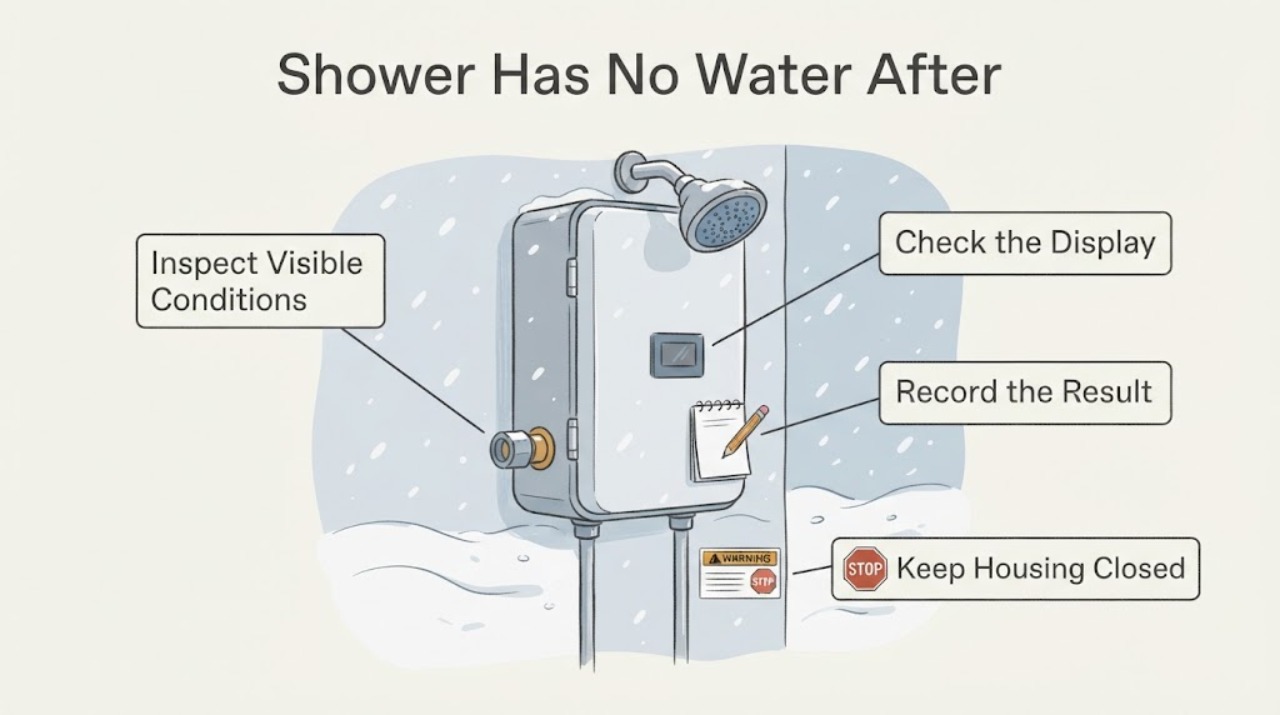
Work through in order
Diagnostic checks
Use only checks that match the exact appliance or system and its official guide.
-
Check 1
Before touching plumbing, check scene safety from a dry, warm position: look for water on floors, ceilings, walls, around the water heater, near outlets or lights, or across an icy route. If water is near electrical equipment, the structure is damaged, or you cannot safely reach a shutoff, keep away and call emergency or professional help.
Expected result: No leak or electrical/structural hazard is visible, or water is escaping, a wall or ceiling is wet or bulging, an electrical area is wet, or access is unsafe.
Next step: Keep people away. From a safe location, contact a licensed plumber; isolate the main water supply only if the valve is dry and safely reachable. Do not enter standing water or operate wet electrical equipment.
Stop if: Stop immediately for uncontrolled flow, wet electrical equipment, a bulging ceiling or wall, structural damage, gas or combustion concerns, or unsafe ice or flood access.
Why this matters
Why: The second result is a water-damage, shock, slip, or structural hazard; finding the frozen shower section is no longer the first priority.
-
Check 2
Open the shower control only gently and compare the result with a nearby sink or tub. Check cold and hot sides separately if the control allows it, without forcing a handle or repeatedly cycling it.
Expected result: The shower has no flow while the sink has normal cold and hot flow, the shower has only a trickle, only hot or only cold is absent, or the whole home has no flow.
Next step: Keep the control in a safe neutral/open position only if it is not leaking, document the comparison, and continue with non-invasive checks. Do not force a frozen handle, remove trim, or open the wall.
Stop if: Stop for a leaking valve, sudden pressure change, cracking noise, uncontrolled flow, or water appearing outside the shower enclosure or behind a wall.
Why this matters
Why: Normal water elsewhere points toward the shower branch, valve, cartridge, or local frozen section. A trickle is consistent with a restriction or frozen pipe. One temperature absent can indicate a hot/cold branch or valve issue. No flow throughout the home points toward a main supply, shutoff, utility, or wider frozen-pipe condition.
-
Check 3
Check only safely visible, labeled controls: the home's main water shutoff, any labeled branch shutoff serving the bathroom, a building or utility outage notice, and the water-heater status if it can be observed without touching wet equipment. Do not turn an unknown valve forcefully or enter a snowed-in service area.
Expected result: A shutoff is visibly closed, the utility or building reports an outage, the water heater is isolated, or no safe external explanation is visible.
Next step: Follow the utility or building restoration guidance. If a labeled shutoff is closed and dry, restore it only according to the property's instructions and watch for leaks; otherwise leave it alone and call a plumber. Never force a frozen valve.
Stop if: Stop for a frozen, corroded, leaking, inaccessible, or unlabeled valve, water near electrical equipment, or any need to enter an unsafe exterior area.
Why this matters
Why: A closed shutoff or known outage can explain no water without a shower fault. An isolated water heater explains absent hot water but not absent cold water. No external explanation leaves a frozen or failed branch possible.
-
Check 4
Map the shower's likely supply route using only visible, non-invasive information: exterior-wall location, bathroom cabinet or crawl-space access, unheated basement or attic below or above, recent loss of heat, and whether other fixtures on that side of the home are affected. Do not drill, remove wall coverings, or dismantle the shower valve.
Expected result: The bathroom is on an exterior wall, the route crosses an unheated space, several fixtures on the same side are weak, or the route is hidden or inaccessible.
Next step: Keep a safe fixture open only as a monitoring point if it is not leaking, maintain safe indoor heat, and ask a licensed plumber to locate and assess the frozen section. Do not use open flame or improvised heating.
Stop if: Stop for a hidden pipe with a wet wall or ceiling, ice or flood exposure, a burst sound, or any need to open the structure or use flame.
Why this matters
Why: Exposure to severe cold or an unheated area raises the likelihood of a frozen supply section; several affected fixtures suggest a shared branch or main. A hidden route cannot be safely cleared by guessing.
-
Check 5
If the affected section is exposed, dry, intact, and safely reachable, use only the manufacturer's or plumber's approved gentle warming method while monitoring the open fixture and nearby surfaces. Keep heat away from combustible materials and water, and never use a torch, kerosene or propane heater, charcoal stove, boiling water, or open flame.
Expected result: A slow return of flow occurs without a leak, no change occurs, or water begins to escape from a pipe, wall, ceiling, fitting, or fixture.
Next step: For any leak or uncertain access, stop warming, isolate the supply only if safely reachable, and call a licensed plumber. If flow returns without leakage, inspect visible areas again and do not assume concealed pipes are sound.
Stop if: Stop for any leak, pressure surge, wet electrical equipment, smoke, scorching, combustion, inaccessible pipe, or need for open flame or high heat.
Why this matters
Why: Gradual flow can indicate thawing, but it does not prove the pipe is intact. No change suggests the frozen area is elsewhere or the problem is not freezing. New water as ice releases indicates a possible burst and requires isolation and service.
-
Check 6
After the storm, compare the shower, nearby fixtures, and visible plumbing again without running a long flow or leaving water unattended. Note whether pressure returns fully, only a trickle remains, hot and cold behave differently, or flow fails again as temperatures fall.
Expected result: Full flow returns and stays dry, flow remains weak, the shower alone fails again, or multiple fixtures lose flow again.
Next step: Keep monitoring visible areas, maintain safe heat, and schedule plumbing inspection for any recurring or incomplete recovery. Do not cycle the shower repeatedly to prove the repair.
Stop if: Stop for renewed leakage, wet walls or ceilings, pressure surges, contamination, unsafe temperature, or any repeat loss of water.
Why this matters
Why: Stable full flow lowers concern for an active restriction but does not clear a concealed leak. Persistent or recurring weakness suggests a remaining frozen/restricted section, valve problem, or damaged line. Multiple fixtures point toward a shared supply or building issue.
-
Check 7
Prepare a plumber's record without dismantling anything: blizzard timing, indoor temperature or heat loss, shower control type, hot/cold pattern, nearby-fixture results, shutoff and outage observations, exterior-wall or unheated-space exposure, visible water path, sounds, and when flow changed.
Expected result: The shower-only fault persists, the whole home has no water, a frozen section is suspected, or a burst or concealed leak is suspected.
Next step: Request a licensed plumber or the building/utility emergency service as appropriate. Have any burst, inaccessible, or concealed line isolated and repaired before normal shower use.
Stop if: Stop for another leak, uncontrolled water, unsafe access, standing water near electricity, structural damage, or any request to open walls or force valves.
Why this matters
Why: The record helps distinguish a local shower valve or branch issue from a frozen main, utility interruption, shared supply problem, or pipe failure while avoiding repeated pressure changes.
Use your observations
Decision map
Find the observation that best matches what you see, then follow the next safe action.
-
PATH 01Next step
What you see
Water is escaping, a wall or ceiling is wet or bulging, standing water is near electrical equipment, or the main shutoff cannot be safely reached.
Do this next
Keep clear; isolate the supply only from a dry, safe location if possible, and call a licensed plumber or emergency service. Do not enter standing water or operate wet electrical equipment.
Why this path and its safety boundary
Why it matters: Treat this as a possible burst or water/electrical/structural hazard rather than a routine no-flow symptom.
-
PATH 02Next step
What you see
The shower has no flow but nearby cold and hot fixtures work normally.
Do this next
Do not force the handle or remove the valve. Document temperature-side behavior and ask a plumber to assess the local supply and valve.
Why this path and its safety boundary
Why it matters: The restriction is likely local to the shower branch, valve, cartridge, screen, or a frozen section serving that fixture; the blizzard timing does not identify which part.
-
PATH 03Next step
What you see
The shower and several fixtures on one exterior wall or unheated side have weak or absent flow.
Do this next
Keep safe fixtures available as observation points, maintain safe heat, and call a licensed plumber if the route is inaccessible or flow does not recover. Do not use flame to thaw it.
Why this path and its safety boundary
Why it matters: A shared branch or frozen supply route is more likely than a shower-only valve fault.
-
PATH 04Next step
What you see
No fixtures in the home have water after the blizzard.
Do this next
Check safe, labeled information and contact the utility, building manager, or licensed plumber. Do not force a frozen main valve or enter an unsafe exterior service area.
Why this path and its safety boundary
Why it matters: A closed main, utility/building outage, frozen service line, or wider supply failure is possible; the shower itself is not yet the useful boundary.
-
PATH 05Next step
What you see
Only hot water is absent but cold water flows, or only cold water is absent but hot water flows.
Do this next
Stop using the affected side if it leaks or behaves unpredictably, record the pattern, and call plumbing service. Do not remove trim or service a water heater without model-specific qualified guidance.
Why this path and its safety boundary
Why it matters: A temperature-specific branch, valve, water-heater, or frozen line may be involved; this is different from total shower no-flow.
-
PATH 06Next step
What you see
A safely exposed section warms and flow slowly returns without visible leakage.
Do this next
Keep watching visible areas, stop if any water appears, and arrange inspection if flow remains weak or the route is not fully visible. Never switch to an open flame or high heat.
Why this path and its safety boundary
Why it matters: The pipe may be thawing, but pressure can reveal a concealed split after ice releases.
-
PATH 07Next step
What you see
The shower remains without water after the home supply is restored and no freezing or leak pattern is visible.
Do this next
Leave the fixture out of service and request a plumber. Do not force the control, drill into the wall, or dismantle the valve as a first response.
Why this path and its safety boundary
Why it matters: A local shower valve, cartridge, screen, branch restriction, or installation fault may be involved, but it cannot be identified safely from the symptom alone.
Helpful context
Understand the symptom
Use the pattern, not the weather alone
A blizzard can leave a home without utility water or power, freeze a pipe at an exterior wall or unheated space, or expose a leak when ice begins to melt. Compare the shower with a nearby faucet and distinguish hot from cold. A dry shower with normal water elsewhere points toward the shower branch or valve; no water anywhere points toward a shutoff, frozen main, utility outage, or wider building problem.
Thawing is also a leak check
Ice can temporarily hold a damaged pipe closed. As it warms, a crack may release water behind a wall, below a floor, or into a ceiling. Keep access areas visible, avoid hidden-pipe experiments, and be ready to isolate the supply safely. Never use a torch or open flame; inaccessible, burst, or uncertain pipes belong with a licensed plumber.
Safety boundary
Stop conditions
- Stop immediately for uncontrolled water, a burst or split pipe, wet walls or ceilings, standing water near outlets or electrical equipment, a bulging structure, unsafe ice or flood access, or a shutoff that cannot be safely reached.
- Do not use a torch, open flame, propane or kerosene heater, charcoal stove, boiling water, improvised heat source, or any heat method near combustible materials, water, or hidden plumbing.
- Do not force a frozen shutoff or shower handle, remove valve trim, open a wall or ceiling, drill for the frozen section, enter a crawl space or snowed-in service area, or dismantle a water heater or shower valve.
- Do not enter standing water, touch wet electrical equipment, run an appliance or heater in a wet area, or use electrical thawing equipment where water, damaged wiring, or unsafe access is present.
- Keep the shower and affected supply out of service when flow is absent throughout the home, repeatedly returns and fails, remains a trickle, or is accompanied by pressure surges, contamination, noises, leakage, or structural or electrical concerns until qualified personnel clear it.
When checks do not resolve it
Need a professional?
Call a licensed plumber for a shower with no water after a blizzard when other fixtures show a shared loss, a frozen or inaccessible supply is suspected, flow is only a trickle, the valve or pipe is frozen, water returns with a leak, or the condition recurs. Contact the utility or building manager for a confirmed outage or closed building supply. Use emergency help for uncontrolled flooding, wet electrical equipment, structural damage, unsafe access, or any immediate danger.
Safety scope: User checks are limited to dry, non-invasive comparison of fixtures, safely visible labels and shutoffs, and visible leak observation. Do not force valves, open walls, dismantle the shower valve or water heater, enter unsafe spaces, touch wet electrical equipment, or use flame, boiling water, or improvised heat.
Common questions
FAQ
Why did my shower stop flowing after a blizzard?
The shower branch or valve may be frozen, the home supply may be shut off or interrupted, or a pipe may have burst and lost pressure. Compare the shower with nearby hot and cold fixtures, but do not force the control or thaw hidden plumbing with flame.
How can I tell whether the shower pipe is frozen?
A shower-only loss with normal water at nearby fixtures points toward a local branch, valve, or frozen section. A trickle after severe cold is a clue, while no water anywhere points toward a main, shutoff, utility, or wider frozen-pipe issue. The pattern is not proof, so do not open walls to search.
Can I use a torch to thaw the shower pipe?
No. Official winter guidance prohibits torch and open-flame thawing because it can start a fire and damage the pipe. Use only a safe, approved gentle-warming method on an exposed, accessible section with no water or electrical hazard, or call a licensed plumber.
What should I do if water returns and a wall starts leaking?
Treat it as a possible burst pipe. Keep clear, isolate the water only from a dry and safely reachable valve, avoid wet electrical equipment and standing water, and call a licensed plumber or emergency service. Do not reopen the wall or keep running the shower.
Read the exact guide
Official sources
- Emergencies and Indoor Air Quality (IAQ)U.S. Environmental Protection Agency · General emergency indoor-environment guidance; professional structural, plumbing, and electrical assessment may be required.
- Preventing & Thawing Frozen PipesAmerican Red Cross · General residential winter-storm plumbing guidance; local systems and the actual installation may differ.
- Winter Weather and Indoor Air QualityU.S. Environmental Protection Agency · General winter-weather household safety; actual plumbing, electrical, and building requirements vary.
Community feedback
Share a repair observation
Share a plain-text repair observation. Accepted observations are published automatically; this page may take a moment to update.