
On this page
Start here
Quick answer
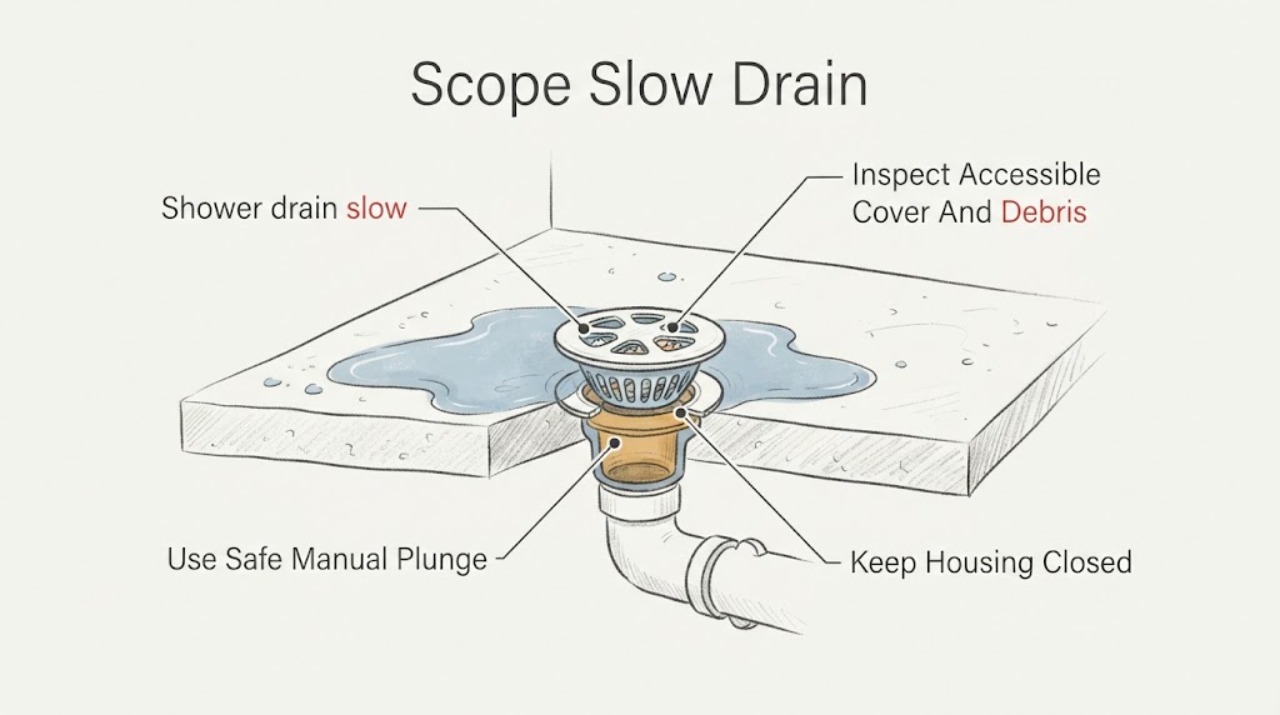
Start by determining whether only this shower drains slowly or several fixtures do, and whether water merely pools briefly or rises, backs up, smells like sewage, or returns after another fixture runs. Remove only an accessible drain cover or strainer and lift out visible hair or debris with gloves; do not pry a fixed cover, reach into an unknown opening, or disturb a sealed drain. A plunger or a simple manual plumber's snake may help a local hair or soap blockage, but do not use either if caustic drain cleaner is present in the line. EPA guidance recommends a plunger or plumber's snake instead of chemical drain openers for a clogged drain, and Poison Control warns that many drain cleaners are corrosive and can splash back. American Standard shower-base drain covers and drain arrangements are model-specific, so do not assume the cover or replacement drain fits every base. Stop and call a licensed plumber for standing water, sewage odor or backup, multiple slow fixtures, a deep or recurring blockage, a damaged drain, a leak below the shower, or any chemical exposure.
Before you begin
Safety first
- Owner checks are limited to comparing fixtures, lifting visible debris from an accessible cover, a controlled plunger or simple manual snake only when no chemical is present and the drain design supports it, and recording behavior. A licensed plumber must handle deep or shared drain lines, traps, vents, concealed leaks, damaged or fixed drain assemblies, waterproofing, powered equipment, chemical-contaminated lines, and utility or septic-side service.
Work through in order
Diagnostic checks
Use only checks that match the exact appliance or system and its official guide.
-
Check 1
Run the shower briefly, then compare one nearby sink or tub without adding cleaners. Note whether only this shower is slow, whether water rises or merely drains slowly, and whether a sink, toilet, or laundry fixture changes the shower level.
Expected result: Only this shower is slow, several fixtures are slow, water rises during the shower, water backs up when another fixture runs, or sewage odor or gurgling is present.
Next step: Use only the accessible near-drain checks for an isolated slow drain. Stop water use and call a licensed plumber for shared backup, sewage odor, rising water, or multiple slow fixtures.
Stop if: Stop for sewage backup, rapidly rising water, flooding outside the shower, contaminated standing water, or any need to enter a wet or unsafe area.
Why this matters
Why: A local strainer or near-drain blockage is more likely when only this shower is affected. Shared backup, odor, gurgling, or another fixture changing the level points toward a deeper branch, vent, or building-drain issue.
-
Check 2
With the shower unused, inspect the drain cover or strainer. Remove only an accessible cover that the exact shower-base or drain instructions identify as removable, then use gloves to lift visible hair and soap debris; do not pry a fixed cover or push debris down the pipe.
Expected result: Hair or soap is visible, the opening is clear, the cover is fixed or damaged, or debris is below reach.
Next step: Remove only loose visible debris and replace the cover correctly. If the cover is damaged, stuck, or model identity is unclear, stop and call a plumber rather than prying or cutting the shower surface.
Stop if: Stop for a sharp or cracked cover, loose waterproofing, standing contaminated water, a fixed grate, or any need to pry, drill, cut, or reach into concealed plumbing.
Why this matters
Why: Visible near-surface debris can restrict a local drain. A clear opening, fixed cover, or debris beyond reach makes a deeper restriction or model-specific service more likely.
-
Check 3
If no drain cleaner has been used and the drain opening is intact, place a correctly sized cup plunger over the opening with enough clean water to seal around it. Use controlled, gentle plunges and stop if water splashes, the cover shifts, or the shower base flexes.
Expected result: Water begins draining, the level does not change, water splashes or rises elsewhere, or the plunger will not seal.
Next step: Run a small clean-water test only after the level falls. If the drain remains slow, backs up elsewhere, or the method is not safe for the drain design, stop and call a plumber; do not add chemicals to improve the result.
Stop if: Stop if drain cleaner may be present, water splashes onto skin or eyes, the shower base moves, the cover loosens, or another fixture backs up.
Why this matters
Why: Improvement supports a movable near-drain blockage. No response, movement elsewhere, or an unsafe seal suggests a deeper or shared restriction and makes repeated force unhelpful.
-
Check 4
If the opening is accessible, no chemical cleaner is present, and you are comfortable following the drain and shower-base instructions, use only a simple manual plumber's snake with controlled insertion. Do not force it, use a powered auger, or push through a sealed trap or waterproofed assembly.
Expected result: The snake meets light resistance and withdraws debris, it stops immediately, it passes without changing drainage, or water appears below the shower.
Next step: Withdraw the tool gently and test with clean water once. Stop and call a licensed plumber for resistance, no improvement, concealed plumbing, or any leak below the shower; do not escalate to a powered tool.
Stop if: Stop if chemical cleaner may be present, the tool catches, the drain cover or trap is not designed for access, water leaks below, or force would be needed.
Why this matters
Why: A shallow movable obstruction may respond to a manual snake. Hard resistance, no improvement, or a below-shower leak can indicate a deeper blockage, pipe damage, trap issue, or waterproofing problem.
-
Check 5
After accessible debris removal and a safe non-chemical test, run a small amount of clean water while watching the shower floor and nearby ceiling or wall if visible. Later, note whether normal use or another fixture causes the slow drain to return; do not flood-test the shower.
Expected result: Drainage is normal, the same shower slows again, another fixture changes the shower level, gurgling or odor returns, or water appears below the shower.
Next step: Limit shower and fixture water use for backup or leakage and call a licensed plumber. Do not keep adding water to prove the drain or remove concealed components.
Stop if: Stop for rising or contaminated water, sewage odor, a wet ceiling or wall, visible leakage below the base, or any sign of structural or electrical water damage.
Why this matters
Why: A one-time improvement supports a local obstruction. Recurrence, cross-fixture response, gurgling, odor, or a concealed leak points toward a deeper line, vent, trap, or waterproofing issue.
-
Check 6
Record whether a commercial drain product, bleach, vinegar, or another cleaner was used; keep its container or label available. Also record the American Standard shower-base or drain model if already visible without removing trim, and whether the drain cover is a standard grate or a model-specific trench cover.
Expected result: No chemical was used, a cleaner was used, the model and cover identity are known, or the drain arrangement is unknown.
Next step: Use only a safe mechanical method when no chemical is present and access is supported. For any chemical history, unknown model, damaged cover, or nonstandard drain, stop and get qualified guidance.
Stop if: Stop for fumes, skin or eye exposure, a chemical splash, an unknown product in standing water, or any need to disturb a model-specific or sealed drain assembly.
Why this matters
Why: Chemical history changes the safety of plunging or snaking and must be disclosed to a plumber. American Standard lists model-specific drain arrangements, so an unknown cover should not be forced or replaced by appearance.
-
Check 7
Document the slow-drain timing, water level, first fixture affected, visible debris, method attempted, chemical history, model and drain-cover identity, recurrence, odor or gurgling, and any leak below the shower. Keep water use limited when backup or leakage is present.
Expected result: The issue resolved once, remains slow, recurs quickly, affects other fixtures, or is accompanied by leakage, odor, or standing water.
Next step: Call a licensed plumber and provide the record, safe photos, and any cleaner label. Do not continue owner troubleshooting after the accessible cover, visible-debris, and one safe mechanical check.
Stop if: Stop after the safe surface and non-chemical checks, or sooner for chemical exposure, backup, flooding, concealed leakage, or structural damage.
Why this matters
Why: A documented isolated improvement may support routine maintenance. Persistence, recurrence, shared symptoms, and leakage require a deeper plumbing diagnosis rather than more drain chemicals or force.
Use your observations
Decision map
Find the observation that best matches what you see, then follow the next safe action.
-
PATH 01Next step
What you see
Only the American Standard shower is slow, visible hair or soap is under an accessible cover, and no other fixture changes the water level.
Do this next
Lift out visible debris, replace the cover, and make one clean-water test. If flow does not improve or quickly slows again, call a plumber instead of adding chemicals.
-
PATH 02Next step
What you see
No drain cleaner was used, a safe plunger seal is possible, and the shower drains better after controlled plunging.
Do this next
Test once with a small amount of clean water and monitor recurrence. Stop and call a plumber if the drain slows again, another fixture backs up, or water leaks below.
-
PATH 03Next step
What you see
The cover and visible debris are clear, plunging or a safe manual snake does not restore drainage, or the shower slows again soon afterward.
Do this next
Limit water use and arrange licensed plumbing service. Do not use a powered auger, cut the base, or remove concealed plumbing as a guess.
-
PATH 04Next step
What you see
A sink, toilet, tub, or laundry fixture changes the shower water level, or several fixtures drain slowly together.
Do this next
Stop adding water and call a licensed plumber or septic professional as appropriate. Keep contaminated water away from skin and do not pour chemicals into the system.
-
PATH 05Next step
What you see
A commercial drain opener or another cleaner was poured into the shower, especially while water remains standing.
Do this next
Do not mix products, plunge, snake, or add water as an improvised flush. Follow the product label, ventilate without entering fumes, seek poison-control guidance for exposure, and tell the plumber exactly what was used.
-
PATH 06Next step
What you see
The shower drains slowly with wetness below the base, a wet ceiling or wall, damaged waterproofing, a cracked cover, or a drain assembly that moves.
Do this next
Stop shower use, close a safe local water supply only if relevant and without force, protect the area, and call a licensed plumber or qualified water-damage professional. Do not pry or seal over the symptom.
Helpful context
Understand the symptom
A slow shower drain is usually a path problem, not a shower-brand problem
Hair, soap residue, and debris near the strainer can restrict a shower drain, but a blockage farther down, an incorrectly supported or sloped drain line, a venting issue, or a shared branch restriction can produce similar symptoms. American Standard notes that drain-line slope, extended piping, and inadequate flow can affect plumbing performance. Compare fixtures and the timing of the backup before pulling a drain part or treating the shower as an isolated clog.
Start with accessible debris and a non-chemical method
An accessible cover or strainer can often reveal hair and soap buildup. Remove only what the shower's model-specific instructions allow, lift visible debris rather than pushing it deeper, and keep small parts together. EPA lists a plunger or plumber's snake as alternatives to chemical drain openers. A manual, controlled method also avoids leaving corrosive liquid in a line that may later splash onto skin or into eyes.
Do not mix drain chemicals or plunge over an unknown chemical
If anyone has already poured a commercial drain cleaner into the shower, stop. Do not add another product, vinegar, bleach, or water at a temperature or volume not specified by the label, and do not plunge over liquid that could splash. Poison Control describes acidic and alkaline cleaners as potentially corrosive and warns about splash-back; follow the product label and seek poison-control or professional guidance for an exposure. Tell the plumber exactly what product was used.
A recurring or shared backup needs a different diagnosis
If the drain slows again soon after surface debris is removed, water rises when a sink or toilet runs, several fixtures back up, or gurgling and sewage odor appear, the restriction may be in a trap, branch line, vent, or building drain. Do not remove a trap through a shower floor, cut the base, or use a powered auger as a guess. A licensed plumber can locate a deeper restriction without damaging the shower waterproofing or concealed piping.
Safety boundary
Stop conditions
- Stop immediately for sewage backup, rapidly rising or contaminated water, flooding, a wet ceiling or wall, water near electrical equipment, chemical fumes or splash, or a drain leak below the shower; limit water use and obtain urgent qualified help.
- Do not mix drain chemicals, bleach, vinegar, or cleaners; do not plunge or snake over an unknown chemical; do not use a powered auger, boiling water, heat, or improvised pressure against a fixed or model-specific drain assembly.
- Do not pry a fixed drain cover, cut the shower base, disturb waterproofing, remove a concealed trap, adjust building piping, or force a stuck drain component. American Standard drain covers and arrangements can be model-specific.
- Stop owner troubleshooting after the scope comparison, accessible debris check, and one safe non-chemical mechanical method. Persistent, recurring, deep, shared, chemical, or concealed-leak symptoms need licensed plumbing diagnosis.
Only after diagnosis
Potential parts
- shower drain cover or strainer
Relevant only when the existing cover or strainer is cracked, missing, corroded, or confirmed as a model-specific restriction after the drain path is inspected.
Confirm the exact shower-base or drain model, dimensions, drain style, finish, and waterproofing interface; do not pry or substitute a cover by appearance alone. - shower drain assembly
Relevant only when a plumber confirms a damaged, leaking, or restricted drain body or connection rather than a removable surface blockage.
Match the exact base, outlet location, drain body, seal, pipe connection, and installation requirements; drain-body replacement can disturb waterproofing and is not inferred from slow flow alone. - drain seal or gasket
Relevant only when a qualified inspection finds a failed seal causing leakage below the shower or around the drain assembly.
Confirm the drain model, seal material, dimensions, compression arrangement, and waterproofing details; do not smear an unapproved sealant over an active leak. - manual drain snake
Relevant only when the accessible drain design supports a simple manual tool, no chemical cleaner is present, and a shallow blockage is suspected.
Confirm safe access and tool type; do not use a powered auger, force resistance, or use any tool over chemical-contaminated standing water. - drain trap or branch-line service
Relevant only when surface debris and one safe mechanical method do not restore flow, symptoms recur, or other fixtures affect the shower.
The appropriate repair depends on drain layout, venting, pipe condition, and access; professional location and testing are needed before selecting components.
When checks do not resolve it
Need a professional?
Call a licensed plumber when water backs up or rises rapidly, more than one fixture is slow, gurgling or sewage odor appears, the drain remains slow after visible debris removal and one safe non-chemical method, the blockage recurs, chemical cleaner was used, the drain cover or base is damaged, or water leaks below the shower.
Safety scope: Owner checks are limited to comparing fixtures, lifting visible debris from an accessible cover, a controlled plunger or simple manual snake only when no chemical is present and the drain design supports it, and recording behavior. A licensed plumber must handle deep or shared drain lines, traps, vents, concealed leaks, damaged or fixed drain assemblies, waterproofing, powered equipment, chemical-contaminated lines, and utility or septic-side service.
Have this ready
- Provide the American Standard shower-base or drain model if already visible, cover type, slow-drain timing, water level, first wet point, visible debris, other-fixture behavior, gurgling or odor, methods attempted, any chemical product and label, recurrence, and safe photos of visible conditions. Do not remove trim or cut the base to collect information.
Common questions
FAQ
Why is my American Standard shower drain slow?
Hair and soap near the strainer are common local possibilities, but a deeper branch blockage, vent issue, slope or extended piping, or shared drain problem can look the same. Compare another fixture, inspect only an accessible cover, and stop for backup, odor, recurrence, or leakage.
Can I remove the American Standard shower drain cover?
Only if the exact shower-base or drain instructions identify it as removable. American Standard lists model-specific drain arrangements and covers. Lift visible debris without prying a fixed grate, cutting the base, or disturbing waterproofing.
Should I use chemical drain cleaner in a slow shower drain?
Do not improvise with chemical products. EPA recommends a plunger or plumber's snake instead of chemical drain openers for a clogged drain, and Poison Control warns that many drain cleaners are corrosive and can splash back. Never mix cleaners or plunge over an unknown chemical.
Can I plunge an American Standard shower drain?
If no chemical cleaner is present, the drain opening is intact, and a cup plunger can seal without moving the base or cover, controlled gentle plunging may help a movable blockage. Stop for splashing, rising water elsewhere, a shifting cover, or no improvement.
When should I use a drain snake?
A simple manual snake is conditional on safe access, no chemical in the line, and comfort with the drain design. Do not force it, use a powered auger, or push through a sealed or model-specific assembly. Resistance, no improvement, or a leak below the shower needs a plumber.
Why does another fixture make the shower drain rise?
That pattern suggests a shared branch, vent, main drain, or septic-side restriction rather than only hair under the shower cover. Limit water use and call a licensed plumber or septic professional. Do not keep flushing water or pour chemicals into the system.
What if drain cleaner was already poured into the shower?
Stop and do not add another product, plunge, or snake over the liquid. Follow the product label, avoid fumes and splash, seek poison-control guidance for any exposure, and tell the plumber the exact product used. Keep children and pets away.
Why is the shower still slow after I remove hair?
The blockage may be farther down the trap or branch, or the drain may have a vent, slope, or concealed pipe issue. If one safe non-chemical method does not restore flow or the problem returns, stop repeated treatments and arrange licensed diagnosis.
What if water leaks below my American Standard shower?
Stop shower use and protect the area. A drain body, seal, connection, waterproofing, or concealed pipe may be leaking; do not pry the cover or seal over it. Call a licensed plumber, urgently if water reaches electrical equipment or a ceiling or wall.
What information should I give the plumber?
Share the shower-base or drain model if safely visible, cover type, when the drain slows, water level, other-fixture response, visible debris, methods attempted, chemical history, odor or gurgling, recurrence, and safe photos. Do not remove concealed parts to collect details.
Read the exact guide
Official sources
- How To Ensure A High-Quality User Experience From High-Efficiency PlumbingAmerican Standard · Manufacturer discussion of shower performance and external plumbing factors including drain-line slope, extended piping, and inadequate flow
- Household Hazardous Waste (HHW)U.S. Environmental Protection Agency · EPA household hazardous-waste guidance listing a plunger or plumber's snake as a drain-cleaner alternative and advising careful handling of hazardous products
- What's in drain cleaner and what happens if you drink it?Poison Control · Poison Control explanation of acidic and alkaline drain cleaners, corrosive injury, splash-back, heat from mixtures, and exposure response
- Townsend 60 x 32-Inch Single Threshold Shower Base With Left-Hand OutletAmerican Standard · Manufacturer product page showing that a shower-base model has a specified drain location, a drain not included, and a removable model-associated trench cover
- How to Care for Your Septic SystemU.S. Environmental Protection Agency · EPA guidance to avoid chemical drain openers for clogged drains and use a plunger or plumber's snake, with cautions about toxins and shared wastewater systems
Community feedback
Share a repair observation
Share a plain-text repair observation. Accepted observations are published automatically; this page may take a moment to update.