
On this page
Start here
Quick answer
A slow American Standard shower drain is often caused by hair or soap buildup at the strainer or in the nearby drain path, but the P-trap, vent, branch line, or main drain can also be involved. Start by observing whether only this shower is slow, whether water rises or gurgles, and whether other fixtures are affected. From ordinary access, remove visible hair and debris only if the drain cover or strainer is designed for user removal; do not reach blindly into the trap or pour caustic chemicals into a drain. American Standard describes a P-trap product with a removable trap eye for cleaning, but a shower trap may be concealed and model or installation dependent. If the obstruction is not accessible, the drain backs up, several fixtures are slow, sewage appears, or the trap or drain connection leaks, stop and arrange qualified plumbing service.
Before you begin
Safety first
- This article supports symptom mapping and ordinary-access strainer inspection or approved surface cleaning only. A qualified plumber must handle concealed P-trap, branch, vent, main-line, contaminated-water, powered-equipment, and leak repairs.
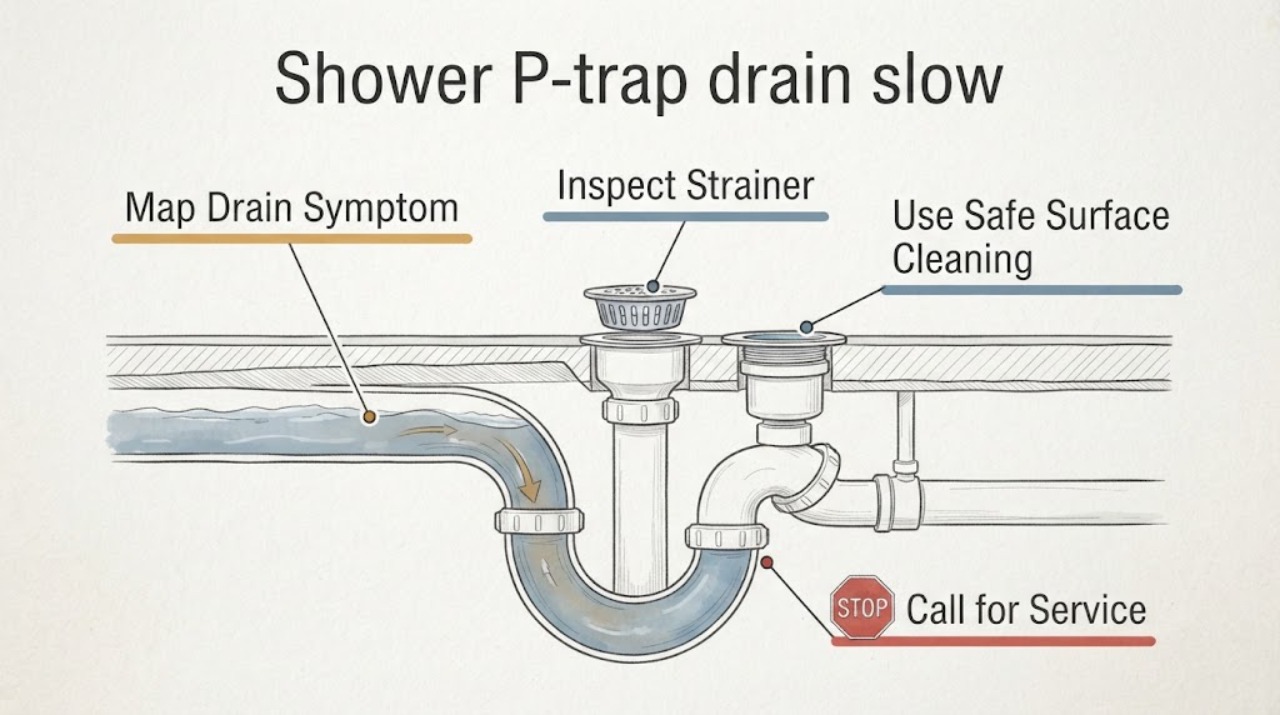
Work through in order
Diagnostic checks
Use only checks that match the exact appliance or system and its official guide.
-
Check 1
Run a small amount of water in the American Standard shower and observe from a stable, dry position; compare a nearby sink, tub, or floor drain without adding enough water to risk an overflow.
Expected result: Only the shower is slow, several fixtures are slow, water rises in another fixture, the shower gurgles, or sewage or foul drain water appears.
Next step: Continue with visible shower-drain checks only for an isolated, non-backup symptom. Stop water use and arrange prompt plumbing service for cross-fixture backup, sewage, or worsening multi-fixture drainage.
Stop if: Stop if water approaches the threshold, contaminated water appears, the floor becomes slippery, or another fixture begins to back up.
Why this matters
Why: An isolated shower pattern supports a strainer, trap, or local branch restriction. Multiple slow fixtures, gurgling, cross-fixture rise, or sewage indicates a downstream, vent, or main-line problem that a surface cleaning may not solve.
-
Check 2
With the shower unused and the area dry, inspect the visible American Standard shower strainer and drain opening; remove only a cover or hair catcher that the installation is designed to release without force.
Expected result: Hair, soap film, or debris is visible at the strainer, the opening is clear, the cover is damaged or stuck, or the obstruction is below ordinary reach.
Next step: Lift visible debris with gloves or a suitable non-sharp method and rinse the removable cover separately, then retest with a small amount of water. Leave a stuck, damaged, or concealed assembly for a plumber.
Stop if: Do not pry the drain body, drill the cover, push wire or a sharp tool into the trap, or step into standing or contaminated water.
Why this matters
Why: Visible material at the strainer can create a localized restriction. A clear opening or inaccessible obstruction shifts concern toward the concealed P-trap, branch, vent, or deeper blockage; a damaged cover can also allow debris into the trap.
-
Check 3
After visible debris is removed, rinse the strainer and surrounding drain surface with clean water and use only a manufacturer-approved, non-abrasive cleaning method; do not pour mixed or caustic drain chemicals into the shower.
Expected result: Water drains freely, remains slow but does not back up, or the drain develops an odor, leak, or visible damage after cleaning.
Next step: Monitor an improved isolated drain and use a hair catcher. For persistent slow flow, gurgling, backup, odor, or leakage, stop further cleaning and arrange qualified plumbing inspection.
Stop if: Do not mix products, use boiling or scalding water on an unknown shower assembly, or continue if chemical residue, contaminated water, or a leak is present.
Why this matters
Why: Improvement supports a near-surface hair or soap restriction. Persistent slow flow suggests material beyond the accessible strainer, a trap or branch restriction, venting, or a deeper line problem; odor or leakage needs a separate assessment.
-
Check 4
From a dry, ordinary-access location, determine whether the shower P-trap has an installed cleanout or removable access that the exact American Standard installation instructions permit; do not open flooring, a ceiling, a wall, or a sealed trap.
Expected result: A cleanout or removable trap eye is clearly documented and accessible, the trap is concealed with no approved access, or an access point is cracked, wet, corroded, or uncertain.
Next step: Use a documented access procedure only when the exact installation allows it and water can be contained. Otherwise, provide the access location and photos to a plumber for safe trap or branch cleaning.
Stop if: Do not remove a trap, cut the shower floor or ceiling, loosen a cleanout under pressure, or open a sealed connection as a user test.
Why this matters
Why: American Standard lists a removable trap eye on a specific decorative P-trap product, but a concealed shower trap cannot be assumed to share that feature. Damaged or uncertain access can turn a clog check into a leak or water-damage event.
-
Check 5
Record whether the slow drain recurs after visible cleaning, whether the shower gurgles, whether other fixtures share the symptom, and whether there is a sewer odor, water damage, or recent plumbing work; keep shower use minimal if the level is rising.
Expected result: The drain remains slow, the symptom returns quickly, gurgling continues, multiple drains are affected, water backs up, or the problem appears after municipal sewer work or heavy rain.
Next step: Stop experimenting and arrange qualified plumbing inspection of the shower trap, branch, vent, and downstream line; provide the timing, fixture map, photos, and any recent work or sewer activity.
Stop if: Do not inspect a roof vent, enter a crawlspace, use powered drain equipment, or continue using fixtures during a developing backup.
Why this matters
Why: Recurrence or cross-fixture symptoms make a deeper branch, vent, main line, or site condition more likely than hair at the strainer. Snoqualmie notes that inadequate venting can cause persistent slow drains and gurgling, while a P-trap's water seal protects against sewer gas.
Use your observations
Decision map
Find the observation that best matches what you see, then follow the next safe action.
-
PATH 01Safety boundary
What you see
Only the shower is slow, water does not back up elsewhere, and hair or soap is visible at the removable strainer or drain opening.
Do this next
Remove visible material from safe access, rinse the permitted cover, retest with a small amount of water, and add a hair catcher after flow is restored.
Why this path and its safety boundary
Why it matters: A near-surface localized restriction is plausible and is more likely than a main-line or vent problem.
Safety stop: Stop if the cover is stuck, the drain body moves, the water is contaminated, or flow remains slow after visible cleaning.
-
PATH 02Safety boundary
What you see
The strainer is clear or approved surface cleaning does not restore flow, while the symptom remains isolated to the American Standard shower.
Do this next
Arrange a plumber to inspect or clear the trap and branch using an appropriate access point; do not cut into the shower or push a tool blindly.
Why this path and its safety boundary
Why it matters: A concealed P-trap, shower branch, or deeper local blockage is more likely; the trap may not be accessible from the shower opening.
Safety stop: Do not open sealed flooring, walls, ceilings, or an uncertain cleanout as a user test.
-
PATH 03Safety boundary
What you see
The shower gurgles, several fixtures drain slowly, another fixture rises when the shower runs, or the slow flow returns soon after cleaning.
Do this next
Reduce water use and request qualified plumbing inspection of venting and the shared drain path; keep people away from any backup water.
Why this path and its safety boundary
Why it matters: A vent, shared branch, or downstream line restriction is more likely than a small amount of hair at the strainer.
Safety stop: Do not climb onto a roof to inspect a vent, use powered equipment, or continue running fixtures into a developing backup.
-
PATH 04Safety boundary
What you see
Water backs up through the shower or another drain, sewage or contaminated water appears, a strong sewer odor enters the room, or the floor is becoming wet.
Do this next
Stop using connected fixtures, keep people and pets away, contain only what can be done without contact, and arrange prompt plumbing service.
Why this path and its safety boundary
Why it matters: The condition has exceeded a routine surface clog check and may involve a shared drain, vent, main line, damaged trap, or failed water seal.
Safety stop: Do not plunge aggressively, add chemicals, enter contaminated water, or open a trap containing unknown chemical residue.
-
PATH 05Safety boundary
What you see
An exact installation guide identifies a removable trap eye or cleanout, it is dry and undamaged, and the obstruction can be contained without opening concealed construction.
Do this next
Follow only the exact installation instructions or have a plumber open and clean the trap; restore the water seal and check for leaks before use.
Why this path and its safety boundary
Why it matters: A model-approved access point may allow targeted cleaning, but the American Standard P-trap listing is product-specific and does not establish access for every shower.
Safety stop: Stop for resistance, damaged threads, a missing seal, leaking joints, chemical residue, or any uncertainty about the installation.
-
PATH 06Safety boundary
What you see
Water appears around the drain, trap, ceiling below, or wall after cleaning, or the strainer, trap, or access point is cracked or displaced.
Do this next
Stop using the shower, photograph the affected area, and arrange qualified plumbing repair with access to the area below if safely available.
Why this path and its safety boundary
Why it matters: The problem may include a failed seal, damaged drain body, trap, or concealed connection; continued shower use can spread water damage.
Safety stop: Do not tighten hidden fittings, caulk over an active leak, remove the drain body, or conceal water damage.
Helpful context
Understand the symptom
The P-trap is only one part of a shower drain
Water first passes through the shower strainer and drain body, then through the concealed trap and branch piping. Hair and soap are commonly caught near the strainer, while a vent or downstream restriction can produce slow drainage even when the visible opening looks clear. American Standard's decorative P-trap listing includes a removable trap eye, but that does not mean every shower installation exposes the trap or can be opened from above.
Use the pattern of the backup to choose the next step
A shower that is slow by itself points toward its strainer, trap, or branch. Gurgling, slow drains in several rooms, water rising at another fixture, or a sewer odor points farther downstream or toward venting. Keep water use low when drainage is worsening so a partial blockage does not become a backup.
Keep chemical and concealed-trap work out of a casual test
Do not mix drain chemicals, pour caustic cleaner into a drain you may later open, or push a sharp tool into an unknown trap. If visible cleaning does not restore flow, a plumber can select a compatible mechanical method and inspect the P-trap, branch, vent, or main line without leaving chemical residue or causing a leak.
Safety boundary
Stop conditions
- Do not push a sharp tool, wire, or powered drain equipment blindly through the shower drain or into a concealed P-trap.
- Do not mix or pour caustic drain chemicals into the shower, especially if the trap may later be opened.
- Do not cut flooring, walls, ceilings, or a sealed shower connection as a clog test; use only exact documented access or qualified service.
- Stop for sewage, contaminated water, a developing backup, water damage, a cracked trap or drain, or a P-trap that cannot hold its water seal.
- Do not climb onto a roof, enter a crawlspace, or use powered drain tools to inspect a vent or main line as an ordinary user check.
Only after diagnosis
Potential parts
- shower drain strainer or hair catcher
Consider only if the existing strainer or catcher is damaged, missing, or unable to retain hair after the drain is clear.
Confirm the exact drain assembly, opening, finish, and approved fit; do not force a generic cover into the drain body. - P-trap assembly or trap seal
Consider only when a plumber confirms the trap is cracked, incorrectly installed, inaccessible for cleaning, or unable to maintain a water seal.
Confirm the actual shower drain layout, trap type, access, pipe dimensions, seals, and local code before replacement. - shower drain gasket or connection seal
Consider only if inspection confirms a seal or connection leak rather than a simple surface blockage.
Match the exact drain and shower-base assembly; do not cover an active leak with caulk or substitute an unverified seal.
When checks do not resolve it
Need a professional?
Arrange qualified plumbing service when visible strainer cleaning does not restore an isolated slow American Standard shower drain, the P-trap is concealed or inaccessible, flow quickly recurs, the drain gurgles, several fixtures are slow, another fixture rises, or the drain or trap leaks. Seek prompt service for any backup, sewage, water damage, strong sewer odor, damaged access point, or inability to safely isolate and contain the trap.
Safety scope: This article supports symptom mapping and ordinary-access strainer inspection or approved surface cleaning only. A qualified plumber must handle concealed P-trap, branch, vent, main-line, contaminated-water, powered-equipment, and leak repairs.
Common questions
FAQ
Is the P-trap always where a slow American Standard shower drain is clogged?
No. Hair and soap are often caught at the strainer or nearby drain path, while a concealed trap, branch, vent, or shared line can also slow drainage. Use the symptom pattern and ordinary-access inspection before assuming the P-trap is reachable or blocked.
Can I remove the shower P-trap to clean it?
Only if the exact installation provides a documented, accessible cleanout or trap opening that can be safely contained. Many shower traps are concealed. Do not cut flooring or open a sealed connection; request a plumber when access or shutoff is uncertain.
Should I pour drain cleaner into a slow shower drain?
Avoid mixed or caustic chemicals, especially when the trap may later need to be opened. Start with visible hair removal and an approved surface-cleaning method; persistent slow flow, gurgling, backup, odor, or leakage needs qualified plumbing assessment.
Read the exact guide
Official sources
- Safer Alternatives for the BathroomCobb County Government · County water-education guidance used for hair-catcher and non-caustic bathroom drain boundaries.
- How to fix a faucet leakPortland Water Bureau · Municipal plumbing guidance used for safe water isolation and leak escalation; it does not prescribe a particular American Standard shower repair.
- Sewer System CleaningCity of Snoqualmie · Municipal wastewater guidance used to distinguish local shower restrictions from vent or downstream sewer issues.
- Decorative P-TrapAmerican Standard · Opened American Standard product page for a decorative P-trap; its removable trap eye must not be assumed for every shower installation.
- Troubleshooting water pressure and flowPortland Water Bureau · Municipal household plumbing guidance used for comparison and escalation; it does not identify a particular shower trap.
- Safety and maintenance tipsCity of Minneapolis · Municipal sewer-maintenance guidance used for P-trap and vent safety boundaries; it does not prescribe a particular American Standard shower repair.
Community feedback
Share a repair observation
Share a plain-text repair observation. Accepted observations are published automatically; this page may take a moment to update.