
On this page
Start here
Quick answer
A slow Kohler shower drain is usually a restriction at the accessible cover or grate, hair and soap in the drain path, a deeper trap or branch-line blockage, or a shared wastewater problem. First confirm that the shower is draining slowly rather than delivering low water flow, then identify whether the Kohler drain is round, linear, tile-in, or part of a shower base. Clean only the accessible cover and reachable debris as the exact model instructions permit; do not force the strainer, disturb the drain body, or pour chemical opener into the drain. If several fixtures are slow, the drain backs up or gurgles, water seeps at the drain or base, or safe access cannot clear it, stop using the shower as needed and arrange qualified plumbing service.
Before you begin
Safety first
- This article supports ordinary-access observation, model identification, accessible-cover cleaning, and removal of reachable surface debris only when the exact Kohler instructions permit it. It does not authorize drain-body disassembly, trap or branch-line work, chemical treatment, waterproofing work, or wall or ceiling access.
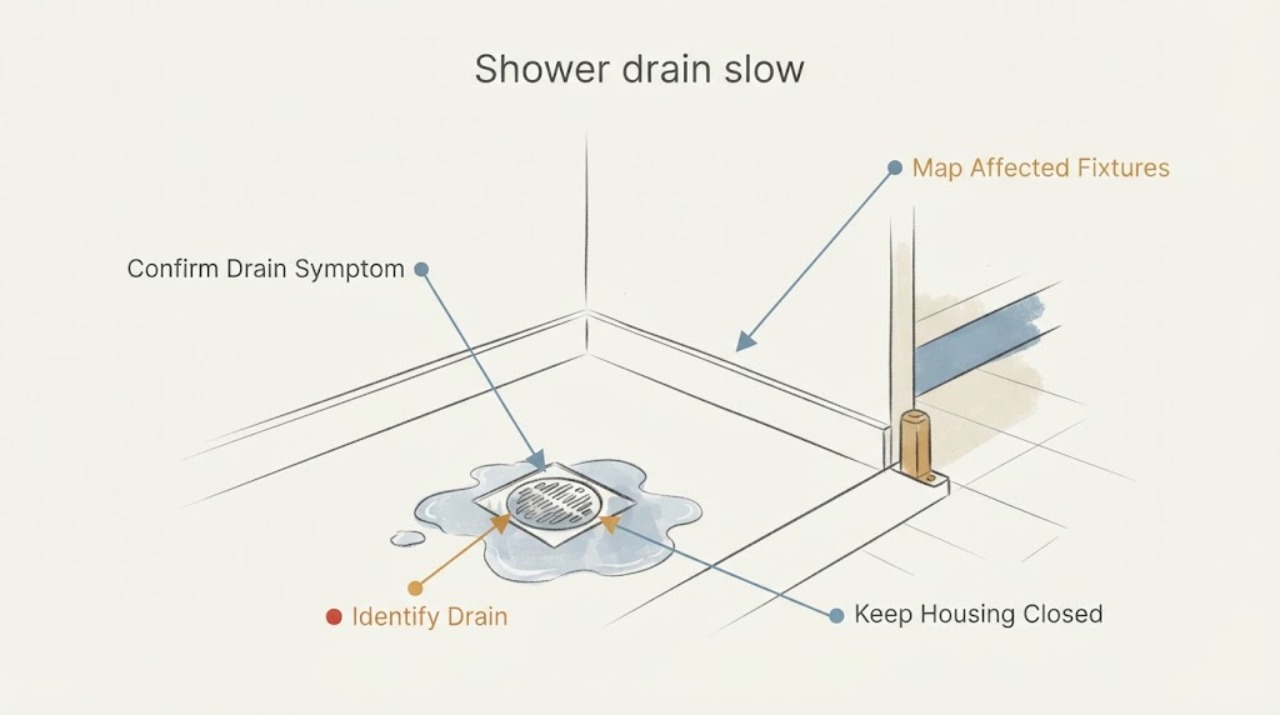
Work through in order
Diagnostic checks
Use only checks that match the exact appliance or system and its official guide.
-
Check 1
With the shower controls in their normal position, observe one ordinary shower cycle from a stable, dry position; do not remove trim or open a wall.
Expected result: Record whether the shower spray is normal but water pools or rises at the floor drain, whether spray itself is weak, and whether water clears after the shower stops.
Next step: Continue with drain checks only when the water supply is normal and the floor drain is the limiting point; use the low-flow or professional-service path when the spray is the actual symptom.
Stop if: Stop if water reaches electrical equipment, the floor is slippery or unsafe, or water is entering a wall, ceiling, or adjacent room.
Why this matters
Why: Normal spray with standing water supports a drain restriction. Weak spray with a clear floor is not evidence of a slow drain and should be assessed as a shower-flow issue instead.
-
Check 2
Without adding drain chemicals or opening plumbing, note the drainage behavior of the shower and nearby fixtures during their normal use; do not deliberately flood the area.
Expected result: Classify the problem as shower-only, several fixtures in the same bathroom, or a broader house issue; note gurgling, wastewater backup, odor, or slow recovery.
Next step: Use the local-cleanup branch only for a shower-only symptom. Arrange plumbing or septic assessment for shared symptoms and avoid sending more water into a backed-up system.
Stop if: Stop and keep people away from wastewater for backup, pooling contaminated water, a strong sewage odor, or an unsafe floor.
Why this matters
Why: A shower-only symptom favors a local cover, hair, trap, or branch restriction. Multiple slow fixtures, gurgling, or backup makes a shared drain, vent, septic, or main-line problem more likely than a Kohler grate alone.
-
Check 3
From ordinary safe access, photograph the Kohler drain and record the model or shower-base identity; identify whether the visible drain is round, linear, tile-in, or another grate or strainer design.
Expected result: The grate or cover is clearly accessible and intact, the design is identified but access is model-specific, or the cover is loose, damaged, seized, or unknown.
Next step: Use the exact Kohler instructions for an accessible, intact cover; stop at the identification step and provide the photographs to a plumber when access or assembly identity is uncertain.
Stop if: Do not pry a tile-in or linear grate, loosen a drain body, disturb sealant or waterproofing, or force a seized component.
Why this matters
Why: Kohler drain configurations differ, so an identified model can guide a compatible cover-cleaning procedure. A damaged, seized, or unknown assembly can involve the strainer, seal, drain body, or waterproofing rather than a simple surface clog.
-
Check 4
Only when the exact Kohler instructions allow cover access, remove the accessible grate or strainer without force, clean hair and soap from the cover, and place it where it cannot fall into the opening.
Expected result: The cover is packed with hair or soap, lightly soiled, clean but the drain remains slow, or it cannot be removed and reseated without force.
Next step: Reinstall an intact cover exactly as directed and run a brief water test; if the cover will not reseat or the symptom remains, stop surface cleaning and use the deeper-blockage service branch.
Stop if: Do not use a screwdriver, knife, drill, abrasive, or force to pry a cover that is not designed for ordinary access.
Why this matters
Why: A packed cover can be the local restriction. A clean cover with continued slow drainage points below the cover, while resistance or poor seating indicates a model, damage, or assembly issue.
-
Check 5
With the cover safely out of the way and only if the model instructions permit it, pull out hair or soap that is visibly reachable at the opening using a suitable non-damaging retrieval method; do not push debris downward.
Expected result: Reachable debris comes out and the opening clears, hard resistance is encountered, the opening looks clear but water still pools, or the drain assembly shifts or leaks.
Next step: Dispose of removed debris, reinstall the cover, and make a small, controlled flow check. Call a plumber for deeper resistance, persistent pooling, movement, or seepage rather than reaching farther or dismantling the drain.
Stop if: Do not push tools into the trap, disassemble the drain body, loosen the seal or nut, or pour chemical opener into the drain.
Why this matters
Why: A visible mat of hair or soap supports a local restriction. Hard resistance or continued pooling indicates a deeper trap or branch restriction; movement or leakage points to an assembly or sealing problem.
-
Check 6
After the cover is correctly reseated and no leak is visible, use a brief normal-flow check and inspect the drain area, shower base, and adjacent ceiling or room for seepage; do not keep adding water to a backed-up drain.
Expected result: Water clears normally with no seepage, drainage improves but remains slow, the drain backs up or gurgles, or moisture appears at the drain, base, wall, ceiling, or adjacent room.
Next step: If the result is not fully normal, stop using the shower as needed and arrange qualified plumbing service; provide the Kohler identity, drain style, fixture map, photos, and what was removed or left untouched.
Stop if: Stop immediately for wastewater backup, sewage odor, visible water damage, a loose or leaking drain assembly, or a condition that cannot be inspected from a stable dry position.
Why this matters
Why: A clean, stable result supports a local cover or reachable-debris restriction. Persistent slow flow suggests a deeper restriction, while backup, gurgling, or seepage needs plumbing or septic diagnosis and may cause property damage.
Use your observations
Decision map
Find the observation that best matches what you see, then follow the next safe action.
-
PATH 01Safety boundary
What you see
The shower alone drains slowly and the accessible Kohler cover or grate is visibly packed with hair or soap.
Do this next
Clean the accessible cover and reachable debris only as the exact Kohler instructions permit, then reseat the cover and make a brief flow check.
Why this path and its safety boundary
Why it matters: A local surface restriction is more likely than a shared building drain problem.
Safety stop: Stop if the cover is seized, damaged, cannot reseat, or the drain remains slow after the accessible material is removed.
-
PATH 02Next step
What you see
The cover is clean and correctly seated, but the shower still pools while nearby fixtures drain normally.
Do this next
Stop reaching farther into the opening and have a plumber inspect the trap or branch using the exact drain and shower-base details.
Why this path and its safety boundary
Why it matters: A deeper trap or shower branch restriction is more likely than a cover obstruction; the restriction is not proven to be a Kohler part.
-
PATH 03Safety boundary
What you see
More than one fixture is slow, drains gurgle, wastewater backs up, or the problem occurs across the home.
Do this next
Limit additional water use, keep people away from wastewater, and arrange plumbing or septic-professional assessment.
Why this path and its safety boundary
Why it matters: A shared drain, vent, main line, or septic system issue is more likely than a Kohler shower grate restriction.
Safety stop: Do not use chemical opener or continue shower tests while wastewater is backing up or a sewage odor is present.
-
PATH 04Safety boundary
What you see
The Kohler drain body, strainer, shower base, or surrounding floor moves, leaks, or shows moisture below or beside the shower.
Do this next
Stop using the shower if water can reach the structure, document the location, and request qualified plumbing service for the drain assembly and surrounding waterproofing.
Why this path and its safety boundary
Why it matters: A drain-body, seal, installation, or waterproofing issue is possible; it is not a clog-clearing task.
Safety stop: Do not tighten hidden parts, add sealant over a leak, lift the base, or disturb the waterproof layer.
-
PATH 05Next step
What you see
The shower spray is weak but the floor drain clears normally and does not pool water.
Do this next
Do not keep cleaning the drain. Record whether other outlets have normal flow and follow the exact Kohler valve or showerhead guidance, escalating for persistent or whole-system low flow.
Why this path and its safety boundary
Why it matters: The observed problem is low shower flow, not slow drainage; a showerhead, valve, or supply path needs a separate assessment.
Helpful context
Understand the symptom
Confirm the symptom before touching the drain
A shower that receives a normal spray but leaves water around your feet has a drainage problem. A weak spray with an otherwise clear floor is a showerhead, valve, or supply-flow question instead. Also note whether only this shower is slow or whether a sink, tub, toilet, or other drain is slow or gurgling. That distinction separates a local cover or hair restriction from a shared branch, vent, septic, or building-plumbing issue.
Kohler drain designs change what is safe to inspect
Kohler offers round, linear, and tile-in drain designs, and a shower base can use a drain body, seal, nut, and strainer assembly. Use the exact Kohler model and its care or installation instructions to decide whether a grate or strainer is user-accessible. An accessible cover can be cleaned; the drain body, seal, waterproofing, and pipe connection are not interchangeable with a generic cover-removal procedure.
Use a mechanical, limited check rather than chemical opener
Remove only surface hair and soap that you can reach without force, and keep debris from being pushed farther down the drain. EPA septic guidance says to avoid chemical drain openers and to use drain covers or hair catchers to limit hair entering the system. If the obstruction is below safe reach, the cover will not reseat, or drainage remains slow, preserve the parts and call a qualified plumber.
Safety boundary
Stop conditions
- Do not pour chemical drain opener into the shower drain, especially when the property uses a septic system.
- Do not pry, drill, cut, scrape, or force a Kohler grate, strainer, tile-in drain, linear drain, seal, or drain body.
- Do not push hair or tools farther into the trap, dismantle the drain body, disturb waterproofing, or add unapproved sealant.
- Stop using the shower and arrange qualified service for wastewater backup, gurgling across fixtures, sewage odor, visible seepage, water damage, or a loose or leaking assembly.
- Do not confuse weak shower spray with slow drainage; use a separate shower-flow diagnosis when the floor drain clears normally.
Only after diagnosis
Potential parts
- Kohler shower drain cover or grate
Consider this category only if the exact Kohler drain identity confirms that the existing cover or grate is missing, damaged, or cannot be restored after inspection.
Confirm the exact Kohler drain style, dimensions, finish, and model fit before ordering; do not substitute a generic cover to hide a drainage or sealing problem. - Kohler drain strainer seal or gasket
Consider this category only when a qualified inspection finds a damaged or missing seal or strainer that explains seepage or failed reseating.
Confirm the exact drain and shower-base assembly with Kohler documentation or a qualified plumber; do not loosen the drain body as a user test. - compatible hair catcher
Consider this category only after the drain opening and cover geometry are identified and the device will not interfere with the Kohler strainer or reduce safe drainage.
Confirm fit and clearance for the exact round, linear, tile-in, or shower-base drain; a catcher is maintenance support, not a remedy for a deeper blockage.
When checks do not resolve it
Need a professional?
Arrange qualified plumbing service when accessible cover and reachable-debris cleaning does not restore drainage, the cover or drain assembly is seized or damaged, water seeps at the drain or shower base, the drain backs up or gurgles, more than one fixture is slow, a septic or main-line issue is possible, or the exact Kohler configuration is unknown. Stop use promptly when wastewater or water damage is present.
Safety scope: This article supports ordinary-access observation, model identification, accessible-cover cleaning, and removal of reachable surface debris only when the exact Kohler instructions permit it. It does not authorize drain-body disassembly, trap or branch-line work, chemical treatment, waterproofing work, or wall or ceiling access.
Common questions
FAQ
Why is my Kohler shower draining slowly but not completely blocked?
A partially restricted cover, hair or soap at the opening, a deeper trap or branch restriction, or a shared wastewater problem can all slow drainage. Identify the Kohler drain style, clean only safe-access areas allowed by the exact model instructions, and escalate for persistent slow flow, gurgling, backup, or seepage.
Can I remove the grate on a Kohler shower drain?
Only when the exact Kohler model instructions show that the grate or strainer is intended for ordinary access and it releases without force. Kohler uses different round, linear, tile-in, and shower-base configurations; do not pry a seized grate or disturb the drain body, seal, threaded assembly, or waterproofing.
Should I use chemical drain opener in a slow Kohler shower drain?
Do not use chemical drain opener as a first-line test. EPA advises avoiding chemical openers for clogged drains, particularly where septic organisms can be harmed. Remove reachable hair or soap only under the model's safe-access instructions, then call a plumber for a deeper restriction.
Does weak water from the Kohler showerhead mean the drain is slow?
No. If the shower spray is weak but the floor drain clears normally, the symptom is low shower flow and may involve the showerhead, valve, or supply. Kohler's low-flow guidance describes a valve-diverter debris path for a specific valve, so confirm the installed model before using any valve procedure.
Read the exact guide
Official sources
- Clog, Be Gone!Delta Faucet Company · General shower-drain guidance used for the limited distinction between an accessible cover or reachable debris and a deeper restriction; Kohler's exact model instructions control the installed drain.
- A Homeowner’s Guide to Septic Systems for Tribal CommunitiesU.S. Environmental Protection Agency · Apply when the property has a septic system or when backup, slow drains, odor, pooling, or gurgling suggests a wastewater-system issue; it does not diagnose a Kohler drain.
- Bathtub & Shower Drains | Drain Parts | KOHLERKOHLER · Use to identify the Kohler drain style before applying model-specific cover or grate instructions; it is not a universal unclogging procedure.
- Low flow from the shower (K-305 Rite-Temp Diverter Valve)Kohler Assist · Used only to distinguish weak shower spray from a drain that leaves water standing; the K-305-specific valve procedure does not establish the installed model.
- Linear DrainKohler Co. · Model-specific installation evidence used to keep ordinary troubleshooting away from the drain body, threaded assembly, sealant, and waterproofing.
Community feedback
Share a repair observation
Share a plain-text repair observation. Accepted observations are published automatically; this page may take a moment to update.