
On this page
Start here
Quick answer
A shower does not flush like a toilet, so “shower won't flush” usually means the shower drain is slow, holding water, or backing up. Stop adding water and look for standing water, a sewage smell, gurgling, or water rising at another fixture. If only this shower is slow and there is no chemical in the drain, you may remove only loose debris that is visible at the strainer and try a correctly sized drain plunger with controlled strokes. If several fixtures are slow, wastewater returns, the blockage keeps recurring, a leak is visible, or a chemical cleaner has already been used, stop DIY work and arrange plumbing service.
Before you begin
Safety first
- The reader-level scope is observation, reachable loose-debris removal, and a controlled plunger check only when no chemical has been added and no backup is present. Drain disassembly, branch or main-line clearing, chemical-residue handling, leak investigation behind finishes, and septic-system inspection require qualified professionals.
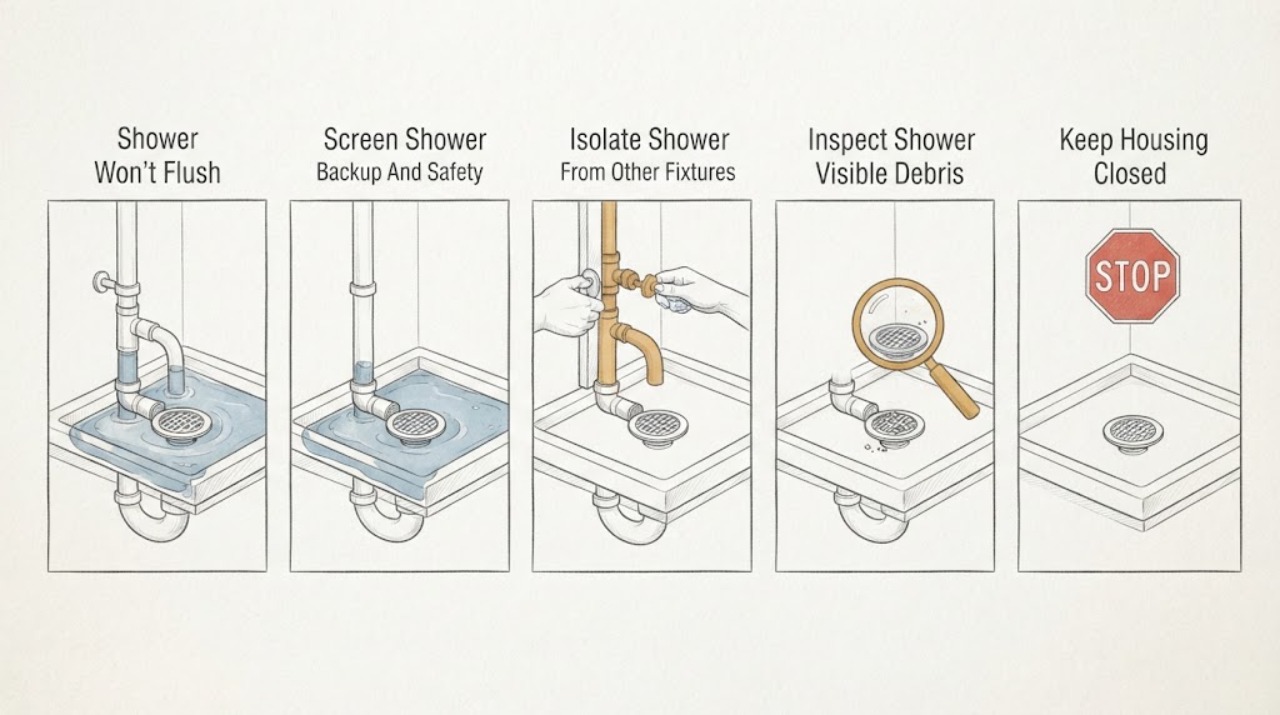
Work through in order
Diagnostic checks
Use only checks that match the exact appliance or system and its official guide.
-
Check 1
Stop the shower and observe the drain from a dry, stable position; note the water level, whether it is rising, any sewage odor, gurgling, or water appearing outside the shower area.
Expected result: Classify the symptom as a small amount of slow drainage, standing water that remains, water rising or returning, sewage odor, or a visible leak or overflow.
Next step: For rising water, wastewater, sewage odor, or overflow, stop using nearby fixtures and arrange urgent plumbing or wastewater-system help. For contained slow drainage with no chemical history, continue to the isolated-drain checks.
Stop if: Do not touch wastewater, stand in contaminated water, keep adding water to test the drain, or use electrical equipment near a wet overflow.
Why this matters
Why: Slow drainage may be a local clog. Rising or returning wastewater, a sewage odor, or an overflow raises a contamination and downstream-backup concern rather than a simple surface obstruction.
-
Check 2
Without running extra water when backup is suspected, observe whether the toilet, sink, tub, laundry drain, or another shower also shows slow drainage, gurgling, odor, or return flow.
Expected result: Record shower-only symptoms, two or more affected fixtures, or another fixture that receives water when the shower is not running.
Next step: Keep water use low and call a plumber for multiple-fixture symptoms, cross-fixture flow, or recurring whole-home slow drainage; otherwise continue with a visual shower-drain inspection.
Stop if: If any fixture backs up with sewage or water rises, stop the comparison immediately and do not flush, wash, or run appliances.
Why this matters
Why: A shower-only pattern is more consistent with a local shower drain path. Multiple affected fixtures or cross-fixture movement points toward a branch or main wastewater path and needs professional diagnosis.
-
Check 3
With the water off, inspect the shower strainer from above and remove only loose hair or soap debris that is plainly visible and reachable without dismantling the drain or inserting a rigid tool.
Expected result: After the accessible debris is removed, note whether the opening is clear, the water level falls normally, the water remains slow, or the strainer or surrounding seal is damaged.
Next step: Rinse the removed debris into a waste container rather than forcing it farther into the drain. If flow does not improve or the drain assembly is damaged or inaccessible, stop and arrange plumbing service.
Stop if: Do not pry up a fixed strainer, dismantle the trap, drill, use a wire, or remove floor or wall finishes to reach a suspected blockage.
Why this matters
Why: Improved flow after visible debris is removed supports a near-opening obstruction. No change, a deep obstruction, damage, or a hidden leak means the blockage is not established as a simple surface problem.
-
Check 4
Confirm whether any drain opener, acid, bleach, disinfectant, or other cleaner was poured into the shower since the symptom began; do not add a second product to counteract the first.
Expected result: If no chemical was used, the accessible shower-only drain can be assessed with a correctly sized drain plunger using short, controlled strokes and splash protection. If a chemical was used or the product is unknown, stop all manual clearing.
Next step: For a no-chemical, shower-only symptom, stop if controlled plunging does not restore flow. For any chemical history, keep the product container or label, ventilate without putting yourself over the drain, and tell the plumber the exact product and timing.
Stop if: Never mix cleaners, lean over a treated drain, use heat, or plunge a drain that may contain corrosive residue; do not proceed if splashing could contact skin or eyes.
Why this matters
Why: A chemical history creates a splash and reaction hazard and changes what a professional needs to know. No chemical history does not prove that plunging will clear a deep or shared-line blockage.
-
Check 5
After the drain has been left unused, inspect the shower floor, adjacent wall, ceiling below if accessible without opening anything, and nearby trim for dampness, staining, odor, or a recurring slow-down.
Expected result: Record a dry area with one isolated episode, persistent standing water, dampness or staining, a damaged drain surround, or a blockage that returns after briefly improving.
Next step: Keep the shower out of service if water is entering the structure or the drain is unusable, document the locations and timing, and arrange qualified plumbing service for a leak, damage, persistence, or recurrence.
Stop if: Do not open the ceiling or floor, remove a trap, cut pipe, or continue water testing when dampness or sewage is present.
Why this matters
Why: A leak, damaged drain surround, persistent standing water, or recurrence can indicate a failed seal, pipe issue, or deeper obstruction that surface cleaning cannot confirm or repair.
Use your observations
Decision map
Find the observation that best matches what you see, then follow the next safe action.
-
PATH 01Safety boundary
What you see
Only the shower is slow, there is no sewage odor or rising water, and loose debris is visible at the strainer.
Do this next
Remove only the reachable loose debris and reassess the water level; arrange service if the flow is unchanged or the problem returns.
Why this path and its safety boundary
Why it matters: A local obstruction near the drain opening is plausible, but visible debris does not prove the trap or branch line is clear.
Safety stop: Do not insert tools deeply, dismantle hidden plumbing, or use chemical drain products.
-
PATH 02Safety boundary
What you see
Water remains standing, rises while the shower is off, returns through the drain, or is accompanied by sewage odor or gurgling.
Do this next
Stop water use in the affected area, keep people and pets away from contaminated water, and arrange urgent plumbing or wastewater-system help.
Why this path and its safety boundary
Why it matters: The drain is not usable and the symptom may be a downstream wastewater backup or a septic malfunction, not just hair at the opening.
Safety stop: Do not flush toilets, run appliances, handle sewage, or attempt chemical or forceful clearing.
-
PATH 03Safety boundary
What you see
A sink, toilet, tub, laundry drain, or another shower is also slow, gurgling, odorous, or receiving return flow.
Do this next
Limit water use and call a qualified plumber; provide the list of affected fixtures, onset, and whether the home uses a septic system.
Why this path and its safety boundary
Why it matters: The shared branch, building drain, or septic system is more suspect than the shower strainer alone.
Safety stop: Do not keep running fixtures to map the blockage once cross-fixture movement or backup appears.
-
PATH 04Safety boundary
What you see
A drain opener, bleach, acid, or unknown cleaner was added to the shower drain.
Do this next
Stop manual work, retain the label or container, keep others away from splashes, and disclose the product and timing when arranging service.
Why this path and its safety boundary
Why it matters: Residue may be corrosive or reactive, so normal plunging, disassembly, or mixing can expose the user or a technician to a chemical hazard.
Safety stop: Do not mix products, neutralize them with another household substance, add hot water, or lean over the drain.
-
PATH 05Safety boundary
What you see
The drain stays unusable, flow returns to slow after a brief improvement, the strainer or drain surround is damaged, or dampness appears outside the shower.
Do this next
Keep the shower unused where water may be entering the structure and arrange a plumbing inspection; do not open floors or ceilings to chase the line.
Why this path and its safety boundary
Why it matters: A deeper obstruction, failed seal, or damaged drain assembly is possible and cannot be reliably confirmed from the room side.
Safety stop: Stop any DIY clearing at the first sign of structural dampness, sewage, damaged plumbing, or inaccessible components.
Helpful context
Understand the symptom
Translate “won't flush” into the drain symptom you can observe
A shower sends water to a drain rather than through a flush valve. The useful distinction is whether water is merely slow to leave the shower, remains standing, or returns from a downstream line. HUD treats inadequate drainage in a shower or tub as a clogged-drain condition. Start with the water level and the number of affected fixtures, not with a chemical or a tool pushed into an unknown pipe.
One slow shower and a whole-home backup are different jobs
A shower-only symptom can be close to the strainer or trap. Slow drainage at more than one fixture, gurgling, or wastewater returning to the shower points farther downstream, such as a branch, building drain, or septic system. EPA identifies slow showers, gurgling, standing water, odors, and wastewater backing up as possible septic-malfunction signs. Do not keep running water to test a system that is already backing up.
Keep chemicals and contaminated water out of a DIY experiment
Do not add drain chemicals, bleach, acids, or another cleaner to a blocked shower. EPA says household hazardous products poured down drains can injure people and contaminate septic tanks or wastewater systems, and incompatible products must not be mixed. If a chemical was already added, keep people and pets away from splashes, retain the container or label, and tell the plumber what was used and when.
Safety boundary
Stop conditions
- Stop water use immediately for rising water, wastewater return, sewage odor, overflow, or cross-fixture backup.
- Do not touch sewage or contaminated standing water; keep people and pets away and arrange appropriate professional cleanup or plumbing help.
- Never mix drain chemicals or pour bleach, acid, or another cleaner into a blocked shower; do not add heat to a drain with unknown contents.
- Do not remove fixed strainers, dismantle traps, cut pipe, open floors or ceilings, or insert rigid tools into hidden plumbing.
- Stop and call a plumber for a chemical history, multiple slow fixtures, a persistent or recurring blockage, a leak, structural dampness, or a drain that is unusable.
Only after diagnosis
Potential parts
- shower drain strainer
Consider this only if the existing strainer is visibly broken, missing, or unable to stay seated after the obstruction question has been resolved.
Confirm the drain opening dimensions and drain assembly type before selecting a replacement; a strainer will not correct a deeper blockage or leak.
When checks do not resolve it
Need a professional?
Arrange urgent plumbing or wastewater-system help for wastewater rising or returning, sewage odor, overflow, or several fixtures affected at once. Arrange prompt plumbing service for a chemical history, a shower drain that stays unusable, a recurring blockage, a damaged drain surround, or any dampness outside the shower. A one-time shower-only slowdown with no chemical history may justify only visible-debris removal and a controlled plunger check; stop if that does not restore normal drainage.
Safety scope: The reader-level scope is observation, reachable loose-debris removal, and a controlled plunger check only when no chemical has been added and no backup is present. Drain disassembly, branch or main-line clearing, chemical-residue handling, leak investigation behind finishes, and septic-system inspection require qualified professionals.
Common questions
FAQ
What does it mean when a shower won't flush?
A shower does not flush like a toilet. The phrase usually means the shower drain is slow, holding water, or backing up. Check whether the water is merely slow, remains standing, rises while the shower is off, or returns at another fixture.
How do I tell whether the shower clog is local or a larger backup?
Observe other fixtures without running more water if backup is suspected. A shower-only slowdown with no odor is more consistent with a local drain path; slow drains in several fixtures, gurgling, sewage odor, standing water, or return flow should be treated as a downstream or wastewater-system concern.
Can I use drain cleaner in a shower that will not drain?
Do not add drain chemicals to a blocked shower, especially if another cleaner may already be present. EPA warns that hazardous household products poured down drains can injure people and contaminate wastewater systems, and incompatible products must not be mixed. If a chemical was used, stop manual clearing and tell the plumber what it was.
Is it safe to remove hair from the shower drain?
Only remove loose debris that is plainly visible and reachable from above, without prying a fixed strainer, dismantling hidden plumbing, or pushing a rigid tool into the drain. If flow does not improve or the blockage returns, arrange plumbing service.
When is a shower drain problem urgent?
Treat rising or returning wastewater, sewage odor, overflow, or several affected fixtures as urgent. Stop water use and avoid contact with contaminated water. A persistent, recurring, leaking, damaged, or chemically treated drain also needs professional assessment even when the water is not currently rising.
Read the exact guide
Official sources
- Household Hazardous Waste (HHW)U.S. Environmental Protection Agency · EPA household-hazardous-waste guidance used to set a no-mixing and no-chemical-history boundary for a blocked shower drain; local disposal instructions control.
- UPCS DictionaryU.S. Department of Housing and Urban Development · HUD inspection terminology used to define the observable shower-drain symptom; it does not identify the cause in an individual home.
- Resolving Septic System MalfunctionsU.S. Environmental Protection Agency · EPA septic guidance used for escalation when a shower symptom includes multiple slow fixtures, gurgling, sewage odor, standing water, or wastewater backup; municipal sewer homes still need a local plumber or utility contact.
Community feedback
Share a repair observation
Share a plain-text repair observation. Accepted observations are published automatically; this page may take a moment to update.