
On this page
Start here
Quick answer
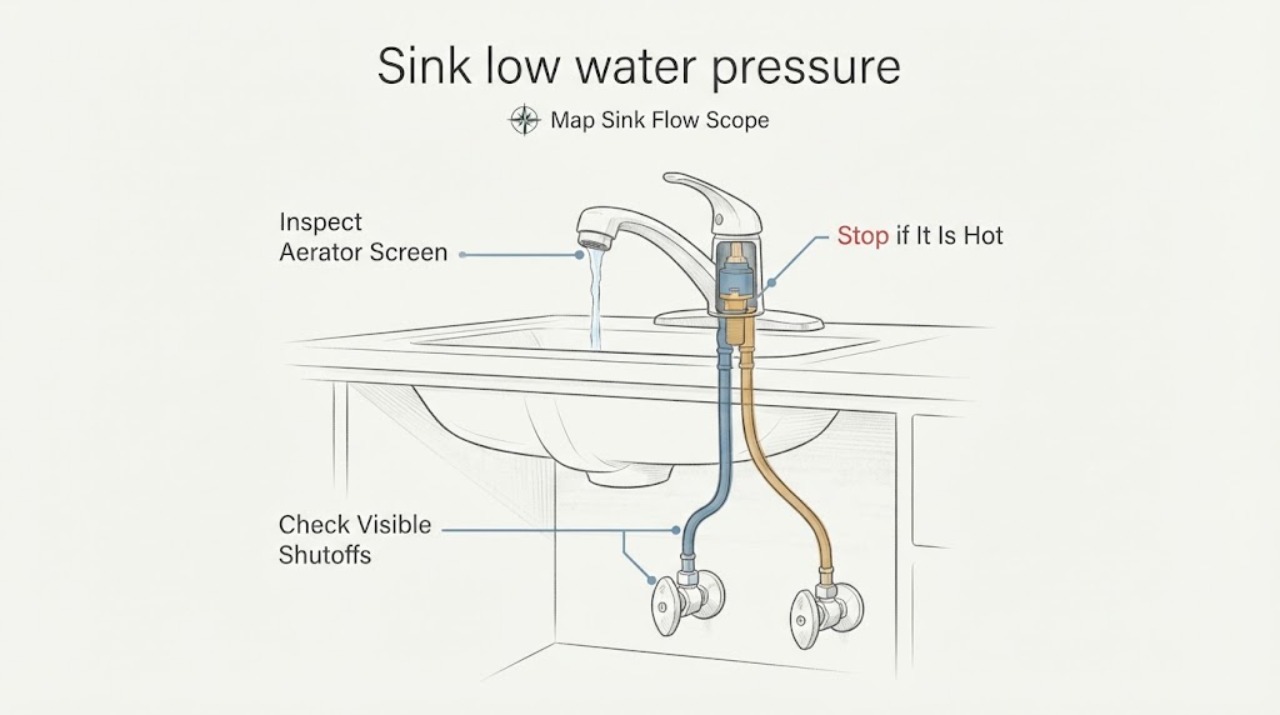
First decide whether the sink alone is weak or whether every faucet is affected, and compare hot and cold flow. A sink-only problem is often a blocked aerator or screen, a partly closed accessible shutoff, a wand or hose screen, or another faucet-specific restriction; remove and rinse only an accessible aerator or screen and do not force a seized fitting. If flow is still low with the aerator removed, or both hot and cold remain weak with the visible valves open, stop before opening the cartridge or valve body and arrange plumbing service. If only hot flow is low, several fixtures are weak, you hear running water, see a leak, or the issue began with a water-service interruption, treat it as a wider plumbing, water-heater, leak, building, or utility problem rather than repeatedly replacing faucet parts.
Before you begin
Safety first
- User checks are limited to comparing fixtures and hot/cold flow, observing dry accessible valves, and rinsing a normally removable aerator or wand screen. Supply-line disconnection, cartridge or valve-body work, water-heater or regulator adjustment, leak repair, and internal or wall plumbing require qualified service.
Work through in order
Diagnostic checks
Use only checks that match the exact appliance or system and its official guide.
-
Check 1
Run the affected sink briefly, then check another cold faucet and another hot faucet without changing any valves. Compare the sink with nearby fixtures, note whether hot and cold are equally weak, and listen for a continuous running-water sound or look for a visible leak under the sink.
Expected result: Only this sink is weak; only hot or only cold is weak; several fixtures are weak; all faucets including an outside outlet are weak; or a leak or running-water sound is present.
Next step: For a sink-only, dry, clear-water symptom, continue with the faucet outlet and visible valve checks. For wider loss, a suspected leak, or a hot-water-system issue, reduce water use and arrange qualified plumbing, property-manager, or utility assessment.
Stop if: Stop for active leakage, water near electrical equipment, unsafe access, or a rapidly worsening loss of flow.
Why this matters
Why: A single-sink pattern points toward its faucet, screens, shutoffs, or supply lines. Hot-only loss points toward the hot side, while multi-fixture or whole-home loss points toward household plumbing, a leak, building supply, or utility event.
-
Check 2
Look under the sink with the cabinet dry and confirm that both visible hot and cold supply shutoff valves are in their normal fully open position, without turning a valve whose function or condition is uncertain. Check for a kinked flexible supply line or a package pressing against it, but do not disconnect the line.
Expected result: One valve is visibly closed or partly closed; a supply line is kinked or crushed; both valves and lines look normal; or a valve is stuck, corroded, or leaking.
Next step: Correct only an obvious normal valve position if it moves freely and does not leak, then retest briefly. If a valve is uncertain, stuck, corroded, or leaking, leave it alone and arrange qualified plumbing service.
Stop if: Do not force a shutoff, disconnect a supply line, or continue around a wet or corroded valve.
Why this matters
Why: A partly closed valve or restricted visible line can reduce flow to one faucet. Normal valves with weak hot and cold flow shift attention to the outlet screen, hose, cartridge, or upstream plumbing. A stuck or leaking valve is not a part-replacement guess.
-
Check 3
Place a towel in the sink and close or cover the drain. If the faucet aerator or outlet screen unscrews by hand or with a protected, light grip, remove it and rinse away visible sediment; keep the gasket and screen in order. Do not force a seized aerator, probe the faucet with a sharp object, or lose the small parts down the drain.
Expected result: The screen contains grit or scale; the screen is clear; the gasket or screen is damaged; or the aerator will not move without force.
Next step: Rinse and refit an intact screen gently, then make a brief flow test. If the screen is damaged, cannot be removed safely, or flow remains low, stop at the outlet and arrange model-matched plumbing or faucet service.
Stop if: Do not use force, sharp tools, or improvised parts on a corroded or leaking aerator connection.
Why this matters
Why: Debris in the aerator is a common faucet-specific restriction and can make a normal-pressure supply look like low pressure. Damage or a seized fitting can cause a leak if forced, while a clear screen makes an upstream restriction more relevant.
-
Check 4
With the aerator safely removed and the sink clear, turn the faucet on briefly at a controlled flow and direct the stream into the basin. Keep hands and small parts clear of the opening, then turn the faucet off before refitting the screen.
Expected result: Flow is strong without the aerator; flow remains weak without it; flow is uneven or sprays from the outlet; or the faucet leaks at the outlet or handle.
Next step: Clean or replace only the accessible aerator after confirming the faucet model and gasket orientation. For weak flow without the aerator, persistent spray, or any leak, stop testing and arrange qualified service.
Stop if: Do not continue if water sprays into the cabinet, the faucet body moves, or the outlet cannot be refitted without force.
Why this matters
Why: Normal flow without the aerator strongly implicates the screen, flow restrictor, or aerator assembly. Weak flow even before the outlet points toward a supply valve, hose, cartridge, or upstream plumbing restriction. A spray or leak means the connection or seal needs attention.
-
Check 5
If this is a pullout or pulldown kitchen faucet, inspect only the accessible wand connection and screen as the faucet manual permits. Check the hose for a kink and, if the wand can be removed normally, compare the flow from the hose into the sink without disconnecting the under-sink supply; do not dismantle a diverter or cartridge.
Expected result: Flow is normal from the hose but low through the wand; the screen has debris; the hose is kinked or damaged; flow is low from the hose too; or the connection leaks.
Next step: Rinse and refit only a user-removable screen or wand component identified by the manual. For low hose flow, a damaged hose, a leak, or a diverter/cartridge concern, stop at the accessible check and arrange qualified service.
Stop if: Do not pull on the hose, disconnect the under-sink line, or open a diverter, cartridge, or valve body.
Why this matters
Why: Normal hose flow with weak wand flow points to the wand screen or outlet. Low hose flow shifts attention to the supply, cartridge, or valve body. A damaged hose or leaking connection can cause property damage and needs service rather than a pressure guess.
-
Check 6
If more than one faucet is weak, compare inside and outside outlets while no other water is running. Note whether the change was sudden or gradual, whether the building or utility recently interrupted water, and whether a meter leak indicator or a safe visible area shows continuous water use; do not adjust a pressure-reducing valve or open a wall.
Expected result: All outlets are weak; only some are weak; a water-service event is suspected; the meter indicates ongoing use with fixtures off; or the issue is gradual in older visible piping.
Next step: Reduce water use, report a building or utility interruption to the responsible party, and arrange a plumber for suspected leaks, corroded piping, or regulator/filter concerns. Do not adjust a regulator or continue replacing sink parts.
Stop if: Stop for visible concealed leakage, rapidly falling pressure, flooding, or any need to alter a regulator, filter housing, or wall piping.
Why this matters
Why: Whole-home loss may involve supply, pressure, a leak, a filter or regulator, or a utility event rather than the sink faucet. Some-faucet loss supports a local plumbing issue, while ongoing use with fixtures off can indicate a leak that needs assessment.
-
Check 7
Record the faucet type and model if visible, sink-only versus wider pattern, hot/cold comparison, valve positions, aerator and hose-screen condition, flow with the aerator removed, leak sounds, recent plumbing work, and whether the symptom returns after cleaning. Do not order a cartridge, hose, diverter, or valve from the symptom alone.
Expected result: Flow stays normal after screen cleaning; flow returns only briefly; flow remains low at the outlet and hose; or several fixtures remain weak.
Next step: Monitor a stable, leak-free result and keep screens clear. For persistent or recurring low flow, hot-only loss, suspected leak, or any internal faucet work, give the record to a qualified plumber or property manager.
Stop if: Stop testing and arrange service for persistent low flow, recurrence, leaks, or any need to open the faucet body or household plumbing.
Why this matters
Why: Stable recovery after an accessible screen obstruction supports a local outlet restriction. Recurrence or weak flow before the outlet leaves a cartridge, supply, piping, leak, or wider-pressure condition that requires diagnosis.
Use your observations
Decision map
Find the observation that best matches what you see, then follow the next safe action.
-
PATH 01Next step
What you see
Only the sink is weak and flow becomes normal when the aerator or outlet screen is removed.
Do this next
Rinse and refit the intact screen, or consider a model-matched replacement only after confirming fit. Arrange service if flow falls again or the connection leaks.
Why this path and its safety boundary
Why it matters: The aerator, flow restrictor, gasket, or outlet screen is the leading accessible restriction.
-
PATH 02Next step
What you see
Only the sink is weak, the aerator is clear or removed, and both hot and cold remain weak.
Do this next
Confirm only the visible, normal valve position and then stop. Arrange qualified faucet or plumbing service; do not disassemble the cartridge or valve body.
Why this path and its safety boundary
Why it matters: The supply valves, flexible lines, cartridge, faucet body, or local piping may be restricting flow.
-
PATH 03Next step
What you see
A pullout or pulldown faucet has good flow from the hose but weak flow through the wand or outlet.
Do this next
Clean and refit only the user-removable screen or wand component named in the manual. Arrange service for a damaged connection, diverter concern, or recurrence.
Why this path and its safety boundary
Why it matters: The wand screen, outlet, or connection is more relevant than household pressure.
-
PATH 04Next step
What you see
Cold flow is normal at the sink but hot flow is weak, or hot flow is reduced at several fixtures.
Do this next
Do not open or adjust the water heater or hidden valve. Arrange qualified plumbing or property-management assessment and report the hot/cold comparison.
Why this path and its safety boundary
Why it matters: The hot supply, hot shutoff, water-heater side, or hot-side faucet path is more relevant than the aerator alone.
-
PATH 05Next step
What you see
Several faucets or outside outlets are weak, or the pressure changed throughout the home.
Do this next
Reduce water use, check only for a confirmed building or utility notice, and arrange plumbing or utility assessment. Do not keep replacing faucet screens to solve a whole-home symptom.
Why this path and its safety boundary
Why it matters: A supply event, leak, filter or regulator issue, corroded piping, building condition, or utility problem may be involved.
-
PATH 06Next step
What you see
A running-water sound, visible leak, wet cabinet, meter leak indication, or rapidly worsening loss accompanies the low flow.
Do this next
Stop using the fixture, close a clearly identified accessible valve only if it moves normally and safely, and arrange qualified plumbing service. Do not disconnect a line or open a wall.
Why this path and its safety boundary
Why it matters: Water may be escaping from the sink supply or household plumbing, making property damage more important than flow adjustment.
-
PATH 07Next step
What you see
Flow returns after an accessible screen is rinsed or a normal valve position is corrected and remains stable without leaks.
Do this next
Monitor the sink, keep the aerator or screen clean, and arrange service if low flow returns, becomes hot-only, or spreads to other fixtures.
Why this path and its safety boundary
Why it matters: A local outlet or operating restriction is plausible, but the result does not certify the hidden faucet or supply condition.
Helpful context
Understand the symptom
Low pressure may actually be low flow at the sink
A weak stream can result from a clogged faucet screen even when household pressure is normal. If only this sink is affected, the restriction is more likely at its aerator, wand, hose, shutoff, cartridge, or supply line. If all faucets are weak, or a leak or water-service event is present, the faucet may not be the cause. Compare hot and cold before choosing a part.
Stay at visible, normal-access checks
Put a towel in the sink and keep small parts out of the drain. Do not force a corroded aerator or shutoff, open a cartridge or valve body, adjust a pressure regulator, disconnect a supply line, or work around a leak that could reach electrical equipment. If a valve will not close or water sprays unexpectedly, stop and arrange qualified plumbing service.
Use the result to choose the next boundary
If flow becomes normal with an aerator or hose screen removed, clean or replace only that accessible component after confirming the faucet model. If flow remains weak before the water reaches the outlet, the cartridge, supply line, shutoff, or household plumbing may be involved. Do not infer a cartridge failure from the symptom alone; persistent or multi-fixture loss needs diagnosis.
Safety boundary
Stop conditions
- Stop immediately for active leakage, water in the cabinet near electrical equipment, a valve or supply line that is wet or corroded, flooding, or a rapidly worsening loss of flow.
- Do not force or drill an aerator, disconnect supply lines, open a cartridge or valve body, adjust a pressure regulator, open a filter housing, or open a wall to chase low pressure.
- Do not continue testing if water sprays unexpectedly, the faucet body or supply connection moves, the outlet cannot be refitted without force, or hot water could scald.
- Arrange qualified plumbing, water-heater, property-management, or utility service for persistent or recurring low flow, hot-only or whole-home loss, suspected leaks, corroded piping, or any internal faucet work.
Only after diagnosis
Potential parts
- faucet aerator or outlet screen
Consider this only if the screen is visibly damaged or flow returns when it is removed after safe cleaning.
Confirm the faucet model, thread, gasket, and flow specification before ordering; a screen will not repair an upstream valve, cartridge, leak, or whole-home pressure condition. - sink faucet cartridge
Consider this only after the aerator, wand or hose screen, visible shutoffs, and hot/cold pattern point to an internal faucet restriction and a qualified diagnosis identifies the cartridge.
Confirm the exact faucet model and manufacturer fit information; do not infer compatibility or replace the cartridge solely from low flow.
When checks do not resolve it
Need a professional?
Call promptly for active or concealed leaks, wet electrical areas, stuck or corroded shutoffs, hot-only or whole-home low flow, ongoing meter use with fixtures off, recurring symptoms, or any need to open the faucet body, water heater, regulator, filter, wall, or supply lines.
Safety scope: User checks are limited to comparing fixtures and hot/cold flow, observing dry accessible valves, and rinsing a normally removable aerator or wand screen. Supply-line disconnection, cartridge or valve-body work, water-heater or regulator adjustment, leak repair, and internal or wall plumbing require qualified service.
Have this ready
- Provide the faucet type and model if visible, sink-only versus whole-home pattern, hot/cold comparison, valve and line observations, aerator and hose-screen condition, flow with the aerator removed, leak sounds, recent plumbing work, and safe dry-position photos.
Common questions
FAQ
Why is my sink faucet pressure low but the other faucets are normal?
That pattern points first to the sink faucet's aerator or screen, wand or hose screen, visible shutoffs, supply line, or internal faucet path rather than whole-home pressure. Compare hot and cold, rinse a normally removable screen, and arrange service if flow remains weak with the outlet screen removed.
Can a clogged aerator cause low water pressure at a sink?
Yes. A clogged aerator or flow restrictor can reduce flow at the outlet even when household pressure is normal. Remove it only with safe, light access, rinse visible debris, preserve the gasket, and stop if it is seized or leaking.
What if both hot and cold water are weak at the sink?
Check the faucet aerator or screen and the normal positions of both visible shutoffs. If flow remains low before the outlet, a supply line, cartridge, faucet body, or local plumbing restriction may be involved. Do not open the faucet body; arrange qualified service.
Why is only the hot water pressure low at my sink?
Hot-only loss makes the hot supply, hot shutoff, water-heater side, or hot-side faucet path more relevant than the aerator alone. Compare another hot fixture, do not open or adjust the water heater, and arrange plumbing or property-management assessment if the pattern persists.
When is low sink pressure a plumbing emergency?
Treat active leakage, water near electrical equipment, a wet or corroded shutoff, flooding, rapidly worsening flow loss, or ongoing water use with fixtures off as a stop condition. Stop using the fixture, avoid disconnecting lines, and arrange qualified plumbing help.
Read the exact guide
Official sources
- Why does my faucet have low water pressure?Delta Faucet · Manufacturer guidance that clogged aerators or flow restrictors reduce faucet flow and that a kitchen or lavatory faucet can be flushed with its aerator removed under controlled conditions.
- Troubleshooting water pressure and flowCity of Portland · Government guidance distinguishing low flow from low pressure and comparing all faucets, hot/cold flow, visible valves, leaks, building events, and utility conditions.
- Low water flow from spout- BOTH hot and cold water on sink faucetsMoen Solutions · Manufacturer guidance for both-hot-and-cold low flow, faucet model identification, supply shutoff checks, aerator cleaning, and pullout or pulldown wand and hose-screen observations.
Community feedback
Share a repair observation
Share a plain-text repair observation. Accepted observations are published automatically; this page may take a moment to update.