
On this page
Start here
Quick answer
First compare hot and cold flow at this sink with another faucet. If only this sink is weak, check the faucet aerator, any under-sink drinking-water filter, and both accessible shutoff valves for blockage, a partly closed position, or a leak. If both temperatures are weak at several fixtures, the fault is more likely in the home's supply, whole-house filter, pressure-reducing equipment, a leak, or the utility supply. Keep the water off when there is an active leak or water near electrical equipment, do not force old valves or open a pressurized filter housing, and arrange qualified plumbing help for a whole-home loss, contaminated-looking water, an inaccessible valve, or any leak that does not stop.
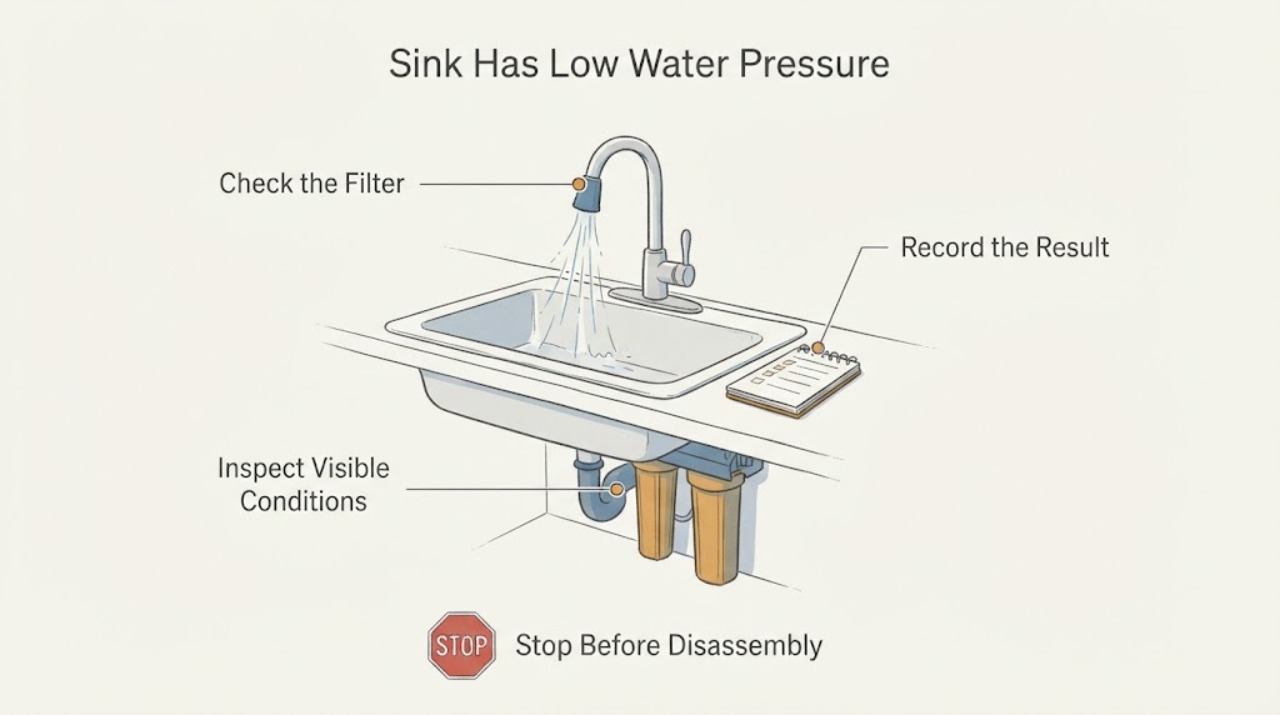
Work through in order
Diagnostic checks
Use only checks that match the exact appliance or system and its official guide.
-
Check 1
Open the affected sink with no other water running and compare cold and hot flow with a nearby faucet and, if practical, an outside hose connection. Note whether the stream is weak only at this sink, only on one temperature, only at a filtered dispenser, or everywhere.
Expected result: A weak stream at one sink suggests a local aerator, filter, shutoff, hose, or faucet restriction. Cold normal with hot weak points toward the hot-side path. Weak flow at several indoor and outdoor outlets points toward a whole-home supply, valve, filter, pressure-control, leak, or utility condition.
Next step: Follow the matching local or whole-home branch. Do not treat a normal stream at another fixture as proof that the sink's drinking-water filter is sound, or a weak sink stream as proof that the utility pressure is low.
Why this matters
Why: This separates a local sink-flow problem from a broader pressure problem before parts are removed.
-
Check 2
With the cabinet dry, look at the faucet outlet and aerator. If it is loose and designed for ordinary hand removal, remove it carefully, keep its small screen and washers together, rinse visible sediment away, and briefly compare flow with the aerator removed while directing the stream into the sink bowl. Do not force a seized or tamper-resistant fitting.
Expected result: A stronger stream with the aerator removed indicates a blocked screen or outlet device. Sediment, scale, damaged threads, a missing washer, or water escaping around the reinstalled device indicates cleaning or model-matched replacement is needed; no change points upstream toward the filter, valve, hose, or faucet body.
Next step: Clean or replace only with a correctly matched aerator, reinstall it without cross-threading or over-tightening, and run water briefly to check the joint for leakage. If the screen quickly clogs again or flow remains weak, stop repeating the cleaning and arrange plumbing diagnosis.
Why this matters
Why: The aerator can restrict flow without representing a whole-home pressure loss, and removing it changes splash and hygiene conditions.
-
Check 3
If the sink has an under-sink drinking-water filter, identify whether low flow affects the filtered outlet only or the main faucet too. Check the filter's clearly marked service or shutoff position, visible tubing kinks, cartridge date or usage indicator, and any leak at the housing without opening a pressurized housing.
Expected result: Only the filtered outlet being weak points toward a restricted, exhausted, incorrectly seated, or closed filter path. Both outlets being weak points away from that filter and toward the faucet supply, sink valves, or upstream plumbing. A wet housing, distorted cartridge, or water that bypasses the seal is a leak condition, not a flow test.
Next step: If the instructions call for a cartridge change, use only a model- and application-matched potable-water cartridge and follow the required flush procedure. If the housing will not depressurize safely, the cartridge is stuck, or the leak returns, leave the supply closed if safe and call a plumber or the filter manufacturer.
Why this matters
Why: The filtered outlet and the ordinary faucet may have separate paths, so a filter conclusion must follow the symptom location and the filter's own instructions.
-
Check 4
Inspect both accessible shutoff valves under the sink and the visible supply hoses. Confirm a valve is not partly closed from earlier work, a hose is not sharply kinked, and no connection is dripping; operate a sound valve only gently and only when it is clearly intended for user operation.
Expected result: A partly closed valve can restrict one sink, while a kink can restrict one temperature or supply side. A valve that is stiff, corroded, leaking at the stem, or will not stay open can worsen the leak when forced. No local change after a fully open, dry supply path points back to the faucet, filter, or upstream pipe.
Next step: Leave a damaged or seized valve alone and arrange plumbing service. If a valve was safely returned to its normal open position, retest once and inspect the cabinet for drips; do not leave the cabinet unattended after a valve operation.
Why this matters
Why: A local restriction can be corrected at the accessible control, but an old valve can fail internally and needs replacement rather than force.
-
Check 5
For weak flow at several fixtures, compare indoor and outside outlets and look for visible dampness, running-water sounds, meter movement when all water is off, a recently changed whole-house filter, or a pressure-reducing device. Do not remove a meter cover, adjust a pressure regulator, or open a whole-house filter housing.
Expected result: Weak flow everywhere with a recent valve or filter change can follow a partly closed control or restricted whole-house filter. A meter that continues to indicate use, damp ground or walls, or unexplained running water raises a leak concern. Normal outdoor flow with weak indoor flow suggests the restriction is in the building plumbing.
Next step: Stop using water and arrange a plumber or water utility investigation for a suspected leak or persistent whole-home reduction. If the home is in a managed building, report the pattern to the property manager; keep any suspected whole-house filter or regulator untouched until identified.
Why this matters
Why: A whole-home pattern is outside the sink aerator's decision boundary and may involve the service line, main valve, filter, pressure-control equipment, corrosion, leak, or utility event.
-
Check 6
After a low-risk cleaning or valve check, run cold water briefly and inspect the aerator, faucet base, hose connections, filter housing, cabinet floor, and nearby wall for new moisture. Observe the water for unusual color, particles, odor, or a damaged filter seal.
Expected result: A dry joint and clear water with restored flow supports a local resolved restriction. Any drip, spray, cabinet wetness, persistent sediment, unusual odor, or flow that falls again means the problem is not safely closed out. Water near an outlet or appliance makes the cabinet an electrical hazard.
Next step: Close the local valve, or the main water valve if needed and safely accessible, for an active leak. Do not drink water with uncertain filter status or abnormal appearance; arrange plumbing or water-quality guidance and keep electrical equipment away from wet areas.
Why this matters
Why: A flow improvement is acceptable only when the potable-water path and surrounding cabinet remain dry and visually normal.
Use your observations
Decision map
Find the observation that best matches what you see, then follow the next safe action.
-
PATH 01Next step
What you see
Only the hot side is weak and cold flow is normal.
Do this next
Arrange qualified service and follow the exact model guidance.
Why this path and its safety boundary
Why it matters: Treat the hot-side aerator, shutoff, hose, heater-side supply, or local mixing path as the next boundary. Do not change a water-heater setting to correct one sink; arrange plumbing service if the hot-side restriction persists or there is a heater leak.
-
PATH 02Next step
What you see
Only the cold side is weak and hot flow is normal.
Do this next
Arrange qualified service and follow the exact model guidance.
Why this path and its safety boundary
Why it matters: Check the cold-side aerator, filter path, shutoff, and hose for a local restriction. If the filtered outlet alone is weak, follow its model instructions; if the visible path is dry and open but the stream remains weak, arrange plumbing service.
-
PATH 03Next step
What you see
Both temperatures are weak at this sink but nearby fixtures have normal flow.
Do this next
Arrange qualified service and follow the exact model guidance.
Why this path and its safety boundary
Why it matters: Prioritize the sink aerator, under-sink filter, two shutoffs, supply hoses, and faucet body. A blocked aerator or local valve is more likely than a utility-wide pressure event; stop if a valve is seized or a connection leaks.
-
PATH 04Next step
What you see
Only the filtered dispenser or filtered faucet outlet is weak.
Do this next
Arrange qualified service and follow the exact model guidance.
Why this path and its safety boundary
Why it matters: Check the filter's own shutoff, cartridge status, seating, tubing, and housing seal without opening a pressurized housing. Use a matched potable-water cartridge only when the instructions call for it; persistent low flow or leakage needs plumbing or filter service.
-
PATH 05Next step
What you see
Flow is weak at several indoor and outdoor outlets.
Do this next
Arrange qualified service and follow the exact model guidance.
Why this path and its safety boundary
Why it matters: Investigate the main valve, whole-house filter, pressure-reducing equipment, visible leak, service line, corrosion, or utility event through safe external observations. Do not adjust pressure equipment or dismantle the supply; arrange a plumber or contact the water utility.
-
PATH 06Next step
What you see
There is active leakage, water near electrical equipment, abnormal water appearance, or a valve or filter housing cannot be controlled safely.
Do this next
Arrange qualified service and follow the exact model guidance.
Why this path and its safety boundary
Why it matters: Stop the flow only from a dry, clearly accessible shutoff, keep people away from wet electrical areas, stop using the water for drinking if its safety is uncertain, and escalate to plumbing or water-quality help. Do not continue flow testing.
Helpful context
Understand the symptom
A sink that seems to have low pressure often has low flow at the outlet. The pattern matters: one temperature, one faucet, or one filtered outlet points toward a local restriction, while weak flow throughout the property points toward a supply, valve, leak, whole-house filter, or pressure-control issue. Start with comparisons before removing anything.
Use only dry, accessible controls and keep this diagnosis external. A filter housing under pressure, a seized valve, a wet cabinet, or a damaged supply connection is not a force-it-yourself repair. If the water looks cloudy or contains unusual particles, stop using it for drinking until the source and filter condition are checked.
Do not assume a replacement filter or aerator fits every sink. Match the faucet or filter model and the water-use application, and follow the component instructions for installation, flushing, and replacement. A temporary improvement after cleaning does not prove that an upstream restriction or leak is resolved.
Safety boundary
Stop conditions
- Stop immediately for an active or uncontrolled leak, water pooling inside the cabinet or reaching an outlet or appliance, a burst hose, a valve that starts leaking when touched, or damage to the sink, wall, or cabinetry.
- Do not force a seized shutoff, open a pressurized filter housing, dismantle a pressure-reducing device or meter, use a filter cartridge with uncertain fit, or mix cleaning chemicals in the drinking-water path.
- Stop drinking the water and arrange water-quality or plumbing guidance for persistent sediment, unusual color, odor, taste, a damaged filter seal, or any suspected contamination.
Only after diagnosis
Potential parts
- faucet aerator screen
Consider this only when removing the existing outlet device produces a stronger stream or its screen is blocked or damaged.
Confirm the faucet's thread type, size, washer arrangement, and any flow requirement before selecting a replacement. - under-sink drinking-water filter cartridge
Consider this only when the filtered outlet is weak and the filter instructions identify a due, blocked, or damaged cartridge as the cause.
Match the exact filter housing or faucet system and use a cartridge rated for the intended potable-water application; do not assume a universal fit.
Common questions
FAQ
Why is the water pressure low at only one sink?
A local restriction is more likely than a utility-wide pressure issue. Compare hot and cold flow, then check the faucet aerator, any under-sink filter, accessible shutoff valves, and supply hoses for blockage, a partly closed position, or a leak.
Why is only the filtered faucet outlet slow?
The filtered and ordinary faucet paths may be separate. Check the filter's shutoff, cartridge status, seating, tubing, and housing seal according to its instructions without opening a pressurized housing.
What if every faucet in the home has low flow?
Compare indoor and outdoor outlets and check for a recent main-valve or whole-house-filter change, visible leaks, or a utility event. Leave pressure-control equipment and meter components alone and arrange plumbing or utility help if the pattern persists.
Is it safe to drink water after cleaning a faucet aerator or changing a filter?
Use only the cleaning and flushing procedure allowed by the component instructions. If water remains cloudy, has particles, an unusual odor or taste, or the filter seal is damaged, stop drinking it until plumbing or water-quality guidance confirms the path is safe.
Read the exact guide
Official sources
- Install a Low-Flow Faucet AeratorU.S. Department of Energy / National Renewable Energy Laboratory · External faucet aerator removal, matching, gentle installation, leak check, and functional verification
- Troubleshooting water pressure and flowCity of Portland · Residential water-pressure and flow comparisons, hot/cold differentiation, local versus whole-home restrictions, leaks, whole-house filters, and utility escalation
- Home MaintenanceU.S. Environmental Protection Agency · Visible faucet, pipe-connection, and under-sink leak inspection
- Bathroom FaucetsU.S. Environmental Protection Agency · Bathroom sink faucet and aerator flow, low-pressure performance, and lead-free potable-water fixture considerations
- Property Owners and ContractorsCity of Fresno Water Division · Low-pressure causes at aerators, under-sink valves, main valves, and household water systems; safe valve and leak escalation guidance
Community feedback
Share a repair observation
Share a plain-text repair observation. Accepted observations are published automatically; this page may take a moment to update.