
On this page
Start here
Quick answer
Low pressure at one sink is usually localized to the faucet aerator, shutoff valve, supply hose, or a filter or under-sink device. If the tank component is part of the installation, it may be an under-sink water tank, filter, reverse-osmosis system, or hot-water unit, but do not assume the tank is the cause. Compare hot and cold water, compare this sink with another fixture, and observe whether flow is low all the time or falls after the tank or filter is used. Check only accessible handles, the faucet aerator, a user-serviceable filter or tank indicator, and visible leaks as the instructions permit. Stop for a burst hose, uncontrolled leak, hot water or steam, contaminated water, electrical moisture, or a gas or combustion warning and arrange qualified plumbing service.
Before you begin
Safety first
- Keep the sink and tank path unused for leaks, hot or contaminated water, water near electricity, smoke, fuel odor, electrical odor, arcing, shock, or severe damage. Do not open tanks or housings, disconnect tubing, adjust pressure, or perform energized work.
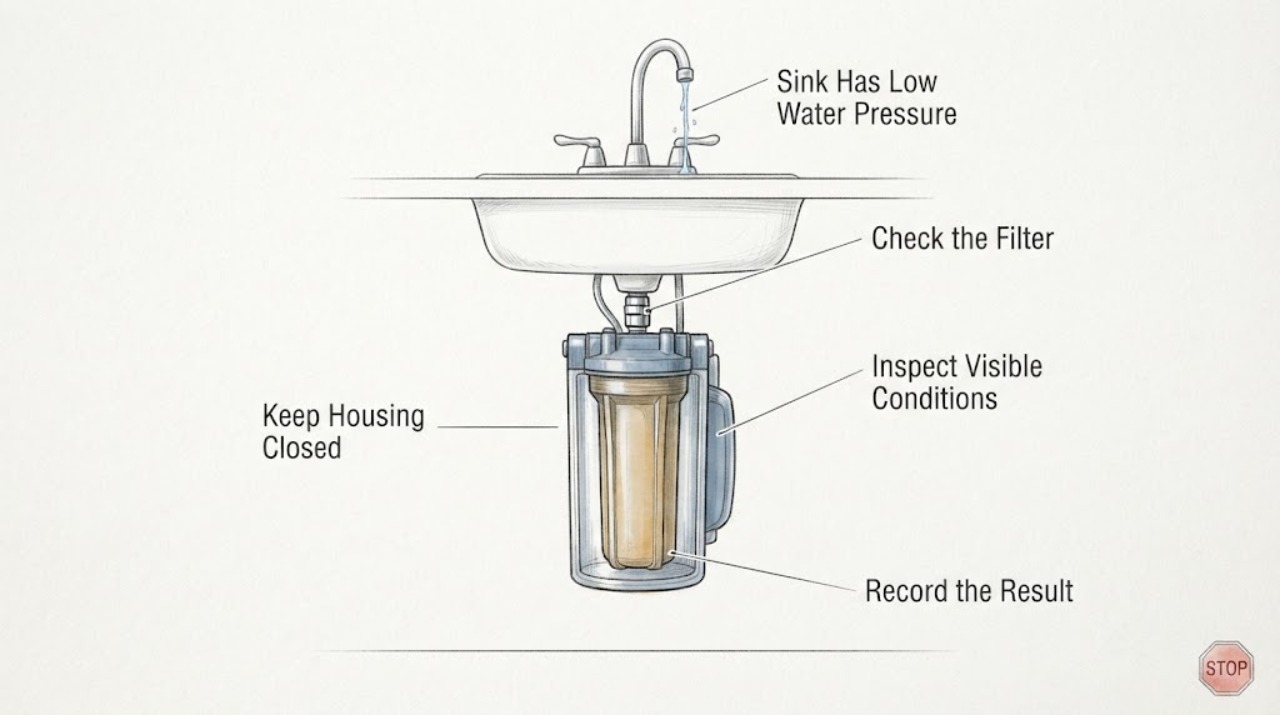
Work through in order
Diagnostic checks
Use only checks that match the exact appliance or system and its official guide.
-
Check 1
At the affected sink, test cold and hot water separately for a few seconds with the handles opened normally. Note whether both sides are weak, only hot is weak, only cold is weak, flow starts normally then fades, or the flow is normal when the tank or filter outlet is bypassed according to the model's normal user controls.
Expected result: Both sides are weak, one temperature is weak, flow fades, or a tank/filter outlet behaves differently from the main faucet.
Next step: Record the pattern and continue with the single-fixture comparison. Do not disassemble the faucet, tank, filter housing, or hot-water device to compare paths.
Why this matters
Why: Both sides weak points toward the faucet outlet, shared valve, supply hose, local piping, or a whole-supply issue. One temperature weak points toward that branch or its hot-water/tank path. Fading flow or a separate tank outlet keeps a filter, storage tank, pressure device, or restricted connection in scope.
-
Check 2
Run the same cold-water test at another nearby fixture, then at one more fixture if needed. Observe whether those outlets have normal flow, the same low flow, or a recent whole-home change. Do not alter the main valve or pressure-control equipment during this comparison.
Expected result: Only the sink is weak, several fixtures are weak, or the entire property changed at once.
Next step: For a local issue, continue with the visible sink checks. For multi-fixture or whole-property low flow, stop changing under-sink parts and request plumbing or building-supply assessment.
Why this matters
Why: One weak sink favors a local aerator, shutoff, hose, filter, tank, or branch-pipe restriction. Several fixtures or a sudden property-wide change shifts attention toward the supply, main valve, pressure-control equipment, building work, or utility condition rather than the sink tank alone.
-
Check 3
Look underneath the sink with the water off and the cabinet dry. Confirm that the accessible hot and cold shutoff handles appear fully open, the supply hoses are not visibly kinked or crushed, and no fitting, tank, filter housing, or drain area is wet. Do not force a stuck valve or tighten a connection by guesswork.
Expected result: A handle is partly closed, a hose is kinked, a tank or fitting is wet, or the visible supply path looks normal.
Next step: If a handle is clearly in the closed position and moves normally, return it gently to the documented open position once. If anything leaks, is stuck, or is damaged, stop using that supply and call a plumber; do not open the tank or filter housing.
Why this matters
Why: A partly closed valve or crushed hose can reduce local flow. Moisture points to a leak that may involve the supply connection, tank, filter, or faucet and takes priority over pressure troubleshooting. A normal visible path does not clear hidden restrictions.
-
Check 4
Inspect the faucet aerator or end screen from the outside. If the faucet manual identifies it as a user-removable part and the water is off, remove and rinse only that small outlet piece as directed, keeping all under-sink tank and hose connections closed. Refit it once and observe the flow.
Expected result: The outlet screen is visibly clogged, the flow improves after the documented cleaning, or the screen is clear and flow remains low.
Next step: If flow does not improve, do not remove deeper faucet parts or open a tank. Continue with the tank/filter identification and request plumbing service if the restriction persists.
Why this matters
Why: A clogged outlet can make the sink look low-pressure even when the supply is normal. Improvement isolates the restriction to the outlet. No improvement shifts attention to the shutoff, hose, faucet body, tank/filter branch, or supply.
-
Check 5
Identify any under-sink tank, filter, reverse-osmosis unit, or instant hot-water device from an exterior label or manual. Record whether its user indicator says replace, service, low pressure, empty, or normal and whether the low flow is limited to its dedicated outlet. Do not adjust tank pressure, open a cartridge housing, or disconnect tubing.
Expected result: There is no tank device, a filter indicator requests service, a tank or hot-water device is involved, or the device appears normal.
Next step: Follow only the exact model's user-level filter or indicator procedure once. If the device leaks, loses pressure repeatedly, has no safe user procedure, or the faucet remains weak, leave it unused and call a plumber or qualified water-system technician.
Why this matters
Why: If the weak outlet is a filtered or tank-fed branch, a restricted cartridge, shutoff, storage tank, feed path, or model-specific pressure condition may be involved. A normal indicator does not rule out a kink, leak, valve, or hidden restriction. A plain faucet with no tank device needs a different local diagnosis.
-
Check 6
Observe the timing of the low flow: present immediately, worse after the tank or filter has been used, worse only after hot water is requested, or intermittent after nearby plumbing work. Note any banging, sputtering, discoloration, unusual taste or odor, and whether the tank or filter outlet recovers after sitting. Do not flush an unknown system or continue using visibly contaminated water.
Expected result: Flow is always low, declines during use, is hot-side only, follows plumbing work, or is paired with air, color, odor, or taste changes.
Next step: Stop drinking or cooking with water that is discolored, odorous, or of uncertain quality until the cause is established. Give the timing and water observations to a plumber or qualified water-system technician.
Why this matters
Why: Always-low flow is consistent with a restriction or valve issue. Declining flow can involve a tank or filter path. Hot-side-only flow points to the hot-water branch. A post-work change raises connection, debris, valve, or hidden-leak questions. Water-quality changes are a water-safety branch, not a pressure adjustment.
-
Check 7
From a safe dry position, inspect for a spray, active drip, cabinet swelling, water near an outlet or powered device, hot steam, a fuel or combustion warning, smoke, or an electrical odor. Do not touch wet electrical equipment, hot tubing, a fuel-fired tank, or a suspect valve.
Expected result: No hazard is visible, or there is an active leak, hot water or steam, contaminated water, moisture near electricity, smoke, odor, or another danger sign.
Next step: Stop using the sink and close the local water valve only if it is safe and moves normally. Isolate power only from a safe dry location if possible. Obtain emergency help for smoke, fire, or gas danger and qualified plumbing/electrical service for other hazards.
Why this matters
Why: A visible hazard overrides low-pressure troubleshooting. Water can damage the cabinet and electrical equipment; hot water can scald; combustion or electrical warning signs can create an immediate safety event.
-
Check 8
Prepare a service note with hot-versus-cold results, comparison-fixture results, aerator condition, shutoff and hose appearance, tank/filter/RO or hot-water model, indicator state, timing, recent plumbing work, water quality, leaks, and safety signs. Photograph only closed equipment from a dry position.
Expected result: Low flow remains after the permitted external checks, or the tank path cannot be separated without opening a device.
Next step: Request qualified plumbing or water-system service and supply the full pattern. Ask for a system diagnosis before approving a tank, filter, valve, faucet, or pressure-device replacement.
Why this matters
Why: The remaining diagnosis may require controlled flow and pressure checks, inspection of the faucet body and branch piping, and model-specific evaluation of the tank, filter, feed valve, pressure device, or hot-water equipment.
Use your observations
Decision map
Find the observation that best matches what you see, then follow the next safe action.
-
PATH 01Next step
What you see
Only this sink is weak and one or both temperatures are affected.
Do this next
Check only the visible valve, hose, aerator, and model-approved tank or filter indicator. Call a plumber if the restriction remains or any connection leaks.
Why this path and its safety boundary
Why it matters: A local aerator, shutoff, supply hose, faucet body, tank/filter branch, or branch pipe is more likely than a whole-property pressure issue.
-
PATH 02Next step
What you see
Several fixtures or the whole property have low flow.
Do this next
Stop changing under-sink parts and request plumbing or building-supply assessment. Do not adjust a pressure-control device without professional guidance.
Why this path and its safety boundary
Why it matters: The issue may involve the main supply, main valve, pressure-control equipment, building plumbing, utility work, or a shared restriction rather than this sink's tank.
-
PATH 03Next step
What you see
The weak outlet is supplied by a filter, reverse-osmosis unit, storage tank, or instant hot-water device.
Do this next
Use only the exact manual's user-level indicator or filter procedure once. Do not change tank pressure, open a pressure vessel, or disconnect tubing; request qualified service if flow remains low.
Why this path and its safety boundary
Why it matters: The tank or treatment branch is relevant, but the cartridge, feed valve, hose, faucet, shutoff, and device-specific control can cause the same result.
-
PATH 04Next step
What you see
Low flow fades during use, returns after sitting, or began after plumbing work.
Do this next
Record the exact timing and stop using the device if water quality or leakage is abnormal. Ask a plumber or water-system technician to inspect the complete branch.
Why this path and its safety boundary
Why it matters: A restricted tank/filter path, trapped air, debris, valve, connection, or hidden leak is possible; the timing changes the service diagnosis.
-
PATH 05Next step
What you see
A tank, hose, valve, or filter housing leaks, the cabinet is swelling, or water is near electricity.
Do this next
Stop using the sink and close the local valve only if safe. Keep clear of wet electrical equipment and request urgent plumbing or electrical service.
Why this path and its safety boundary
Why it matters: This is a water-damage and possible electrical hazard, not an ordinary pressure adjustment.
-
PATH 06Next step
What you see
Water is hot or steaming unexpectedly, contaminated, discolored, odorous, or associated with smoke, fuel odor, or an electrical smell.
Do this next
Stop using the sink and keep clear. Isolate water or power only from a safe position if possible; use emergency help for smoke, fire, or gas danger and qualified service for the water or equipment fault.
Why this path and its safety boundary
Why it matters: Scald, water-quality, combustion, fire, or electrical safety overrides the low-pressure diagnosis.
Helpful context
Understand the symptom
Use the pattern of low flow to find the decision point
First determine whether only this sink is affected, whether both hot and cold are affected, and whether another fixture has normal flow. A restriction at the aerator, valve, hose, filter, or tank path is more plausible when one sink is weak. A whole-home change suggests the supply, main valve, pressure control, or building plumbing. A tank is not a universal explanation for a low-pressure complaint.
Keep tank and filter assumptions conditional
An under-sink tank may belong to a filtered-water or reverse-osmosis system, or the sink may be supplied by a separate hot-water tank. Some systems have a user-replaceable filter or an indicator; others require a trained installer. Confirm the exact model and follow its maintenance instructions. Do not adjust a tank precharge, remove a pressure vessel, open a hot-water tank, or disconnect a tube to test pressure.
Control water, heat, and electricity before service
A small seep under a sink can become cabinet or floor damage, and water near an outlet or powered filtration unit creates an electrical risk. Hot-water tanks and dispensers can scald, while a fuel-fired water heater adds combustion and gas-safety concerns. If a hose is spraying, a tank is leaking continuously, water is hot or contaminated, or electrical equipment is wet, stop using the sink and obtain qualified help.
Safety boundary
Stop conditions
- Stop immediately for an uncontrolled leak, spraying hose, cabinet or floor damage, water near an outlet or powered device, hot water or steam, contaminated water, smoke, fuel odor, electrical odor, visible arcing, shock, or repeated protective-device operation. Keep clear and obtain emergency or qualified service help as appropriate.
- Stop using the tank, filter, reverse-osmosis unit, or hot-water device if it leaks, loses pressure repeatedly, has an unknown service procedure, or produces abnormal color, odor, taste, heat, or noise. Do not continue consuming uncertain water.
- Do not open a tank, pressure vessel, filter housing, hot-water device, or faucet body; adjust tank precharge or pressure controls; disconnect tubing; force a shutoff valve; touch wet electrical equipment; or use chemical treatments to chase low flow.
- Do not infer a failed tank from one weak faucet. Compare temperatures and fixtures and document the visible pattern before selecting a part or service path.
Only after diagnosis
Potential parts
- faucet aerator or outlet screen
Consider this only if the accessible outlet screen is clogged or damaged and the faucet manual supports user-level removal; low flow may originate farther upstream.
Thread, size, flow design, and faucet model must be confirmed; do not force a screen or alter the faucet body. - under-sink filter cartridge
Consider this only when the exact system's indicator or manual identifies a user-serviceable cartridge as due and the tank/filter branch is confirmed to affect the weak outlet.
Use the exact model and water-treatment instructions; do not open a pressurized housing or substitute a cartridge based on appearance. - under-sink storage or pressure tank
Consider this only after qualified testing confirms a tank fault and separates it from the feed valve, filter, tubing, faucet, and supply pressure.
Tank volume, connections, pressure limits, treatment system, and sanitation requirements are model-specific; installation belongs to a qualified technician. - sink shutoff valve or supply hose
Consider this only when professional inspection confirms a restricted, damaged, or leaking local supply component after the low-flow pattern is established.
Connection type, size, temperature rating, and local plumbing requirements must be confirmed; do not force a stuck valve or work on a wet connection.
When checks do not resolve it
Need a professional?
Call after recording hot-versus-cold flow, comparison-fixture results, visible valve and hose condition, tank or filter identity, and timing, or immediately for leaks, water-quality changes, heat, steam, electrical moisture, smoke, fuel odor, or shock.
Safety scope: Keep the sink and tank path unused for leaks, hot or contaminated water, water near electricity, smoke, fuel odor, electrical odor, arcing, shock, or severe damage. Do not open tanks or housings, disconnect tubing, adjust pressure, or perform energized work.
Common questions
FAQ
Can an under-sink tank cause low water pressure at the sink?
It can affect a tank-fed or filtered outlet, but a faucet aerator, shutoff, supply hose, filter, feed path, faucet body, or whole-property supply can produce the same symptom. Compare hot and cold water and another fixture before blaming the tank.
Why is only the hot or cold side of my sink weak?
One weak temperature points toward that branch's shutoff, hose, faucet path, filter or tank connection, or hot-water equipment. Both sides weak favors the shared outlet, local supply, or broader supply problem. Do not open a hot-water device or tank to compare pressure.
Should I change the under-sink filter immediately?
Only if the exact system manual or indicator identifies a user-serviceable filter as due and the filter branch affects the weak outlet. Follow the model procedure once; do not open a pressurized housing or substitute a cartridge by appearance.
How can I tell whether the problem is the sink or the whole house?
Run the same cold-water observation at another fixture. If only this sink is weak, inspect only its visible outlet, valve, hose, and any documented tank or filter path. If several fixtures changed together, request plumbing or supply assessment rather than replacing an under-sink part.
When should I stop using the sink?
Stop for an active or uncontrolled leak, water near electricity, hot water or steam, unusual color, odor or taste, smoke, fuel odor, electrical odor, visible arcing, shock, or severe cabinet or floor damage. Keep clear and obtain qualified service or emergency help as appropriate.
Read the exact guide
Official sources
- Water TreatmentA. O. Smith · Manufacturer product and support information used for conditional under-sink treatment and tank branches; exact system instructions take precedence.
- Home Electrical SafetyElectrical Safety Foundation International · General residential electrical-safety guidance; local emergency and code requirements also apply.
- Troubleshooting water pressure and flowPortland Water Bureau · Municipal troubleshooting guidance; local rules and site conditions vary.
- Publication 5098 - Tap Water ScaldsU.S. Consumer Product Safety Commission · General residential scald-safety guidance; it is not a tank or faucet repair manual.
- Home MaintenanceU.S. Environmental Protection Agency · EPA WaterSense consumer guidance; exact plumbing configuration and equipment instructions vary.
- Water Pressure HelpEast Valley Water District · Municipal water-district guidance; local conditions and fixture manuals vary.
- Water Heater Operating and Safety GuidanceU.S. Department of Energy · Official water-heater manual guidance; equipment models and service procedures vary.
- WaterSense Labeled Homes—Hot WaterU.S. Environmental Protection Agency · EPA WaterSense hot-water system guidance; exact equipment and user procedures vary.
Community feedback
Share a repair observation
Share a plain-text repair observation. Accepted observations are published automatically; this page may take a moment to update.