
On this page
Start here
Quick answer
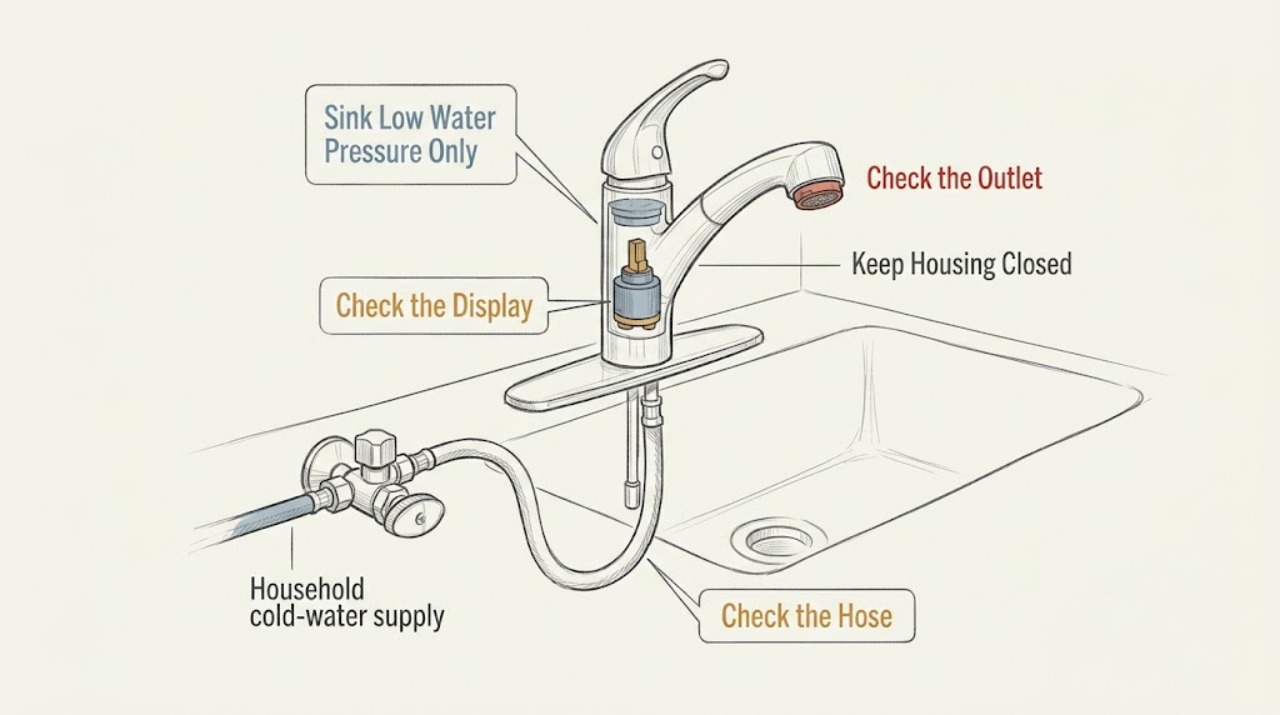
If a sink has low water pressure only on cold water, first compare the cold stream at this sink with another cold fixture and compare it with the hot stream at the same sink. If only this cold side is weak, keep the area dry and inspect the cold shutoff valve, supply hose, faucet screen or aerator, and—only when the faucet design allows it—the cartridge path. If cold flow is weak throughout the home, check for a partly closed main valve, a water-service event, or a pressure-control problem and call the water utility or a plumber. Do not disconnect a pressurized hose, force a stuck valve, open a faucet body, or use the water for drinking if it is discolored or has an unusual odor until the source is clarified.
Work through in order
Diagnostic checks
Use only checks that match the exact appliance or system and its official guide.
-
Check 1
Turn the same sink's cold control fully on for a short observation, then turn it off and compare the cold stream with the hot stream at that sink and with a second cold fixture. Keep the cabinet and floor dry while doing this.
Expected result: Only this sink's cold stream is weak, both hot and cold are weak at this sink, or cold flow is weak at several fixtures.
Next step: For a single-sink result continue with the visible valve, hose, and screen checks. For several fixtures, record the pattern and move to the whole-home branch without disconnecting anything.
Why this matters
Why: A cold-only, single-sink result points toward the cold shutoff, supply hose, faucet screen, or cold passage. A wider result points toward the home's supply, main valve, pressure control, leak, or a utility event rather than one faucet part.
-
Check 2
With the cold control off, look under the sink at the cold shutoff and its hose. Check for a kink, crushed hose, visible corrosion, or a valve handle that is not in its normal fully open position; turn a reachable valve only gently and only if the area is dry.
Expected result: The valve was partly closed, the hose is visibly pinched, or the valve and hose look dry and open.
Next step: Restore only a normally operating valve to its open position and recheck briefly. If it resists, leaks, or does not change flow, stop and have a plumber inspect the valve or supply path.
Why this matters
Why: A partly closed valve or pinched hose can limit cold delivery to this faucet. A dry, open-looking path means the restriction may be in the hose, valve, screen, or faucet rather than being solved by more force on the handle.
-
Check 3
If the faucet has a removable aerator or outlet screen, follow the faucet instructions to remove it with the faucet off, rinse visible sediment, check the washer, and reinstall it gently. Do not pry a fixed spray head or use a sharp tool inside the outlet.
Expected result: Cold flow returns with the screen removed or after it is rinsed, or the cold stream remains weak.
Next step: Verify the stream is stable and there is no seep around the reinstalled screen. If it remains weak, continue to the pull-out or professional-service branch instead of opening the faucet body.
Why this matters
Why: Improvement at the outlet identifies debris or a screen restriction. No improvement means the cold restriction is likely farther upstream, in a pull-out wand screen, or inside the faucet, so changing the aerator alone is unlikely to help.
-
Check 4
For a pull-out or pull-down faucet only, inspect the accessible screen where the wand meets its hose, following the faucet manual. If the design allows the hose end to discharge into the sink without disconnecting a pressurized fitting, compare that flow with the assembled wand.
Expected result: Flow is strong before the wand but weak through the wand, or flow is weak at the hose as well.
Next step: Rinse only the accessible screen permitted by the manual. If the hose connection, valve body, or cartridge would need to be opened, stop and provide the model and observations to a plumber or the faucet maker.
Why this matters
Why: Strong hose flow with weak wand flow indicates a wand screen or outlet restriction. Weak hose flow leaves the cold supply, shutoff, hose, or faucet cartridge path as the likely area; the model-specific manual determines what can be serviced.
-
Check 5
After the visible checks, note whether the cold stream changes when another fixture is used, whether there was recent plumbing work, and whether the cold supply has unusual color, odor, sediment, or a new leak. Do not disconnect the cold hose to test pressure.
Expected result: The issue follows other cold-water use, began after plumbing work, or is accompanied by discoloration, odor, sediment, or moisture.
Next step: Use another known-safe water source if needed, document the timing and first wet point, and contact the utility, property manager, or plumber as appropriate. Keep the local or main shutoff available from a dry position.
Why this matters
Why: A use-dependent or post-work change can indicate a wider supply or valve condition. Unusual water quality or moisture makes continued drinking use, repeated testing, or DIY line opening inappropriate until the source is known.
-
Check 6
If cold flow is weak at multiple fixtures, stop all water use briefly and observe the accessible meter leak indicator only from a safe, dry location; also check the utility's outage or maintenance notices if available.
Expected result: The meter indicates flow with fixtures off, or several cold outlets remain weak while the sink's local parts look normal.
Next step: Close the main valve only if it operates normally and can be reached without entering water. Otherwise leave it alone and call the water utility or a licensed plumber with the fixture pattern and any visible moisture details.
Why this matters
Why: Unexpected meter movement can indicate a leak or open fixture. A multi-fixture cold-only change can involve the main valve, pressure regulator, service line, or a utility event, which is not a faucet-screen repair.
Use your observations
Decision map
Find the observation that best matches what you see, then follow the next safe action.
-
PATH 01Next step
What you see
Only this sink's cold side is weak, while another cold fixture and the same sink's hot side are normal.
Do this next
Inspect the visible valve and hose, then the removable screen; do not open a pressurized connection.
Why this path and its safety boundary
Why it matters: The fault is localized to the cold valve, supply hose, faucet screen, or cold passage.
-
PATH 02Next step
What you see
Cold flow improves when the aerator or outlet screen is removed and the water remains clean.
Do this next
Rinse and reinstall the correct screen gently, then check for leaks around it.
Why this path and its safety boundary
Why it matters: The outlet screen or aerator is restricting flow.
-
PATH 03Next step
What you see
Cold flow stays weak with the screen removed, or the cold supply hose is weak as well.
Do this next
Stop at visible observations and arrange model-specific faucet or plumbing service.
Why this path and its safety boundary
Why it matters: The restriction may be in the cold shutoff, hose, cartridge, valve body, or branch plumbing.
-
PATH 04Next step
What you see
Several cold fixtures are weak, including an outside fixture, while hot and cold comparisons show a wider cold-side change.
Do this next
Check the main valve visually and review utility notices; call the utility or a plumber if the change persists.
Why this path and its safety boundary
Why it matters: This is more consistent with a main valve, pressure-control, service-line, leak, or utility issue than with one sink aerator.
-
PATH 05Next step
What you see
The cold stream changes when another fixture runs or only fails after recent plumbing work.
Do this next
Record when it happens and have the recent work or shared supply checked rather than opening fittings yourself.
Why this path and its safety boundary
Why it matters: Demand, a partly reopened valve, disturbed sediment, or a shared supply restriction may be involved.
-
PATH 06Next step
What you see
A meter leak indicator moves with every fixture off, or water is heard or seen in a cabinet, wall, floor, or ceiling.
Do this next
Use the local or main shutoff only if safe and easy to operate, keep clear of wet electrical equipment, and call a plumber or utility.
Why this path and its safety boundary
Why it matters: Treat the pressure symptom as a possible leak until it is ruled out.
-
PATH 07Next step
What you see
Water is discolored, has an unusual odor, contains visible sediment, or the fixture was opened and its potable-water status is uncertain.
Do this next
Do not use it for drinking or cooking until the utility, property manager, faucet maker, or plumber gives model- and situation-specific guidance.
Why this path and its safety boundary
Why it matters: The water-quality question is separate from the low-flow diagnosis.
Helpful context
Understand the symptom
Cold water only changes the path to inspect
A weak cold stream with normal hot flow usually points to the cold supply path or the cold side of the faucet, not to the water heater. A normal-looking stream can also be low flow rather than low static pressure: a screen, aerator, valve, hose, or internal passage can restrict the amount delivered. Compare the same fixture and a second cold fixture before opening anything.
Start with dry, visible observations
Put a towel below the sink, remove stored items, and keep electrical equipment away from any water. Look for a wet hose, cabinet floor, wall, or valve before testing flow. If a leak is present, the pressure symptom is secondary: close the accessible supply only if it turns normally, and stop if the valve, connection, or cabinet is wet.
The faucet tip is a low-risk isolation point
If the cold supply appears normal and the faucet has a removable screen or aerator, remove it only according to the faucet instructions, rinse visible sediment, and reinstall it without cross-threading or over-tightening. If flow is still weak with the screen removed, do not proceed to a pressurized hose or valve-body disassembly; that result moves the likely restriction upstream or into the faucet internals.
When the whole home is affected
Test another cold tap and, where safe and accessible, an outside cold fixture. If several cold fixtures are weak, check whether work was recently performed, whether the main valve is visibly in its normal fully open position, and whether the utility reports an interruption. A continuous meter indication with all fixtures off can also point to a leak; do not investigate a concealed or wet area by opening walls or floors.
Safety boundary
Stop conditions
- Stop immediately if water is reaching an outlet, appliance, wiring, or other electrical equipment; keep away from the wet area and use a shutoff only from a safe dry position.
- Stop if a shutoff valve, hose, threaded connection, or faucet part resists, starts leaking, sprays, or cannot be identified; do not force it or disconnect a pressurized line.
- Stop using the water for drinking or cooking if it is discolored, has an unusual odor, or carries sediment until the responsible utility or plumbing professional clarifies it.
- Stop troubleshooting and arrange urgent plumbing help for a growing leak, hidden moisture, no usable shutoff, loss of cold water throughout the home, or a meter that indicates flow with all fixtures off.
Only after diagnosis
Potential parts
- faucet aerator or outlet screen
Consider this only if flow improves when the existing removable screen is removed or its mesh is visibly obstructed.
Match the faucet model, outlet thread, screen style, and washer; do not assume a generic screen fits. - cold faucet cartridge
Consider this only after the cold valve, supply hose, and removable screen are normal and the faucet design and model documentation identify the cartridge as serviceable.
Confirm the exact faucet model and manufacturer fit information before selecting any cartridge; a two-handle faucet may use separate cartridges. - cold shutoff valve or supply hose
Consider this only when the visible valve or hose is damaged, restricted, leaking, or unable to deliver normal cold flow after professional isolation.
Connection size, valve style, hose length, local code, and existing pipe condition must be confirmed by the model or plumbing professional.
When checks do not resolve it
Need a professional?
Call a licensed plumber when the cold supply remains weak after the visible valve, hose, and removable screen checks, or when a cartridge, valve body, branch pipe, or pressurized connection would need to be opened., Contact the water utility or property manager when several cold fixtures changed at once, the main supply appears affected, or an outage, maintenance event, or shared-building issue is possible., Request service promptly for any leak, hidden moisture, unsafe water quality, valve that will not operate normally, or electrical equipment exposed to water.
Have this ready
- Give the faucet brand and model if known, whether hot flow is normal, which other cold fixtures were compared, whether the removable screen changed flow, the valve and hose observations, the onset, recent plumbing work, and any moisture or water-quality change.
Common questions
FAQ
Why is only the cold water at my sink weak when hot water is normal?
That pattern usually moves the first checks to the cold shutoff, cold supply hose, faucet screen or aerator, and the cold side of the faucet. Confirm the pattern at another cold fixture before treating it as a whole-home pressure problem.
Could a dirty aerator cause low cold flow?
Yes. If the stream improves when a removable screen is removed or rinsed, sediment at the outlet is a strong explanation. Reinstall the correct screen gently and check for seepage; persistent weakness with the screen removed needs a different branch.
Should I remove the cold supply hose to test pressure?
Not as a routine homeowner check. A supply hose is part of a pressurized connection. Keep the comparison and inspection visible and dry, and let a plumber isolate the line if hose, valve, cartridge, or branch-pipe testing is required.
What if every cold faucet in the home has low flow?
Check the pattern, the normally open position of the main valve, recent work, utility notices, visible leaks, and the meter indicator only from a safe dry location. A utility or plumber should assess a persistent whole-home condition, pressure-control issue, or suspected concealed leak.
Can I keep drinking the water while I troubleshoot?
Do not use it for drinking or cooking if it is discolored, smells unusual, contains sediment, or its potable-water path may have been disturbed. Use a known-safe alternative and ask the responsible utility, property manager, faucet maker, or plumber when it is safe to resume use.
Read the exact guide
Official sources
- Report Low Water PressureSuffolk County Water Authority · Customer triage for one-faucet versus whole-property pressure, aerator, valve, main-valve, and utility-event checks
- Install a Low-Flow Faucet AeratorU.S. Department of Energy · Safe low-flow faucet aerator removal, cleaning, selection, and reinstallation
- Troubleshooting HelpEast Valley Water District · Household water-pressure isolation between one fixture, the main supply, and a possible leak
- Low water flow from spout- ONLY hot or cold water on sink faucetsMoen Solutions · Moen faucet troubleshooting for low flow from only one hot or cold side
- Troubleshooting water pressure and flowPortland Water Bureau · Residential water-pressure and flow comparison, low-flow, leak-indicator, and utility troubleshooting
- Low water flow from spout- BOTH hot and cold water on sink faucetsMoen Solutions · Moen faucet troubleshooting for aerator, wand screen, cartridge, and valve-body flow restrictions
Community feedback
Share a repair observation
Share a plain-text repair observation. Accepted observations are published automatically; this page may take a moment to update.