
On this page
Start here
Quick answer
When a sink loses pressure only while two water sources are in use, first compare one source at a time with both sources open and note whether the drop is limited to this sink or affects other fixtures. A blocked aerator or screen, partly closed shutoff, kinked supply hose, or faucet cartridge can restrict one sink; a pressure drop throughout the home under simultaneous demand points instead to incoming supply, a leak, a pressure-regulating valve, a well system, or shared piping. Inspect only visible, dry, accessible items, do not force valves or adjust the main pressure regulator, and arrange a plumber when the pressure loss is whole-home, persistent, accompanied by a leak, or beyond the faucet's accessible parts.
Work through in order
Diagnostic checks
Use only checks that match the exact appliance or system and its official guide.
-
Check 1
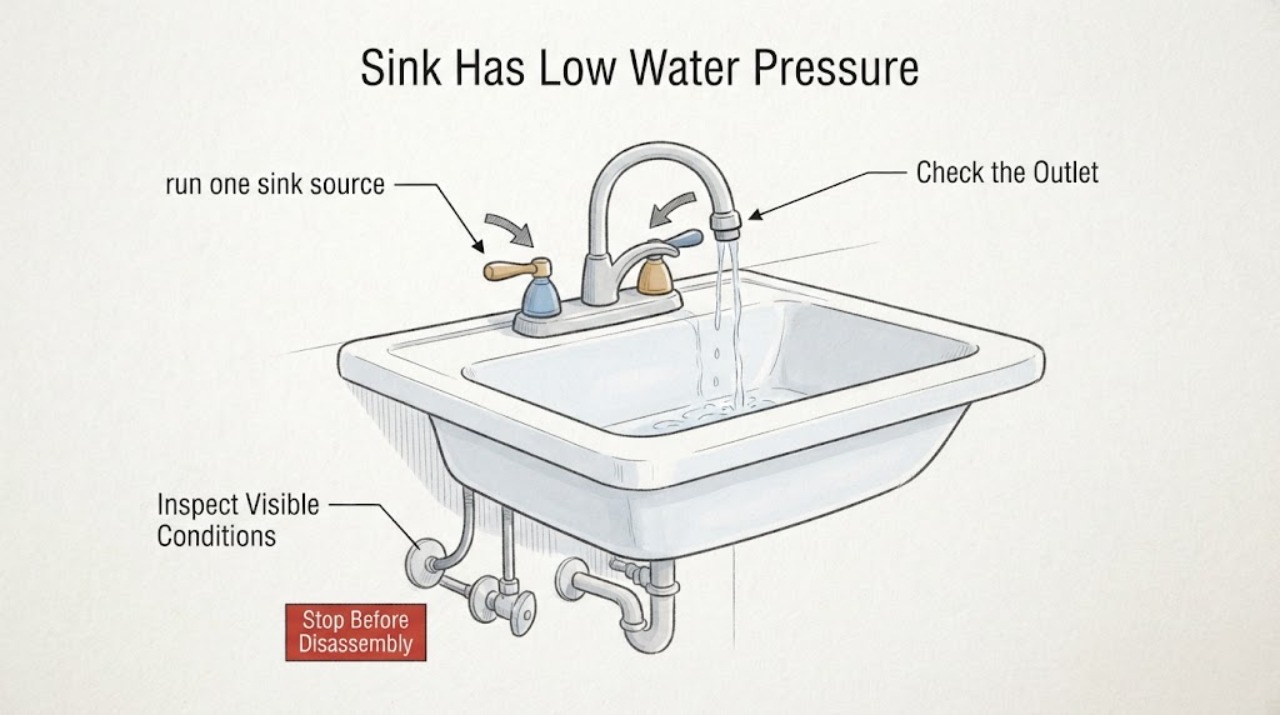
With the sink area dry and no visible leak, run one sink source at its usual setting, then open the second source at the same sink briefly. Compare the flow with only one source open and note which side changes.
Expected result: Each source is strong alone but both weaken together, only hot or only cold weakens, or the flow is weak even with one source.
Next step: Continue by comparing another fixture and inspecting only visible faucet-side restrictions. Stop using the sink if the test produces leaking, spraying, or water near electrical equipment.
Stop if: Stop immediately for a leaking connection, burst hose, uncontrolled flow, water near electrical equipment, or a valve that needs force to move.
Why this matters
Why: A drop only under simultaneous use suggests a shared flow or supply limit; one-temperature weakness points to that supply path or faucet side; weakness with one source already points to a local restriction or supply problem that is not created by the second source.
-
Check 2
Repeat the one-source versus two-source comparison while a nearby fixture is opened briefly, then check one other fixture separately. Keep the test short and observe from a dry position without changing the main shutoff or pressure regulator.
Expected result: Only this sink loses flow, the sink and nearby fixture weaken together, or several fixtures throughout the home weaken when two sources are used.
Next step: Use the pattern to choose faucet-side inspection versus plumber or water-utility contact. Do not compensate by adjusting the main pressure device or repeatedly opening fixtures.
Stop if: Stop if flow becomes uncontrolled, a pipe vibrates or bangs, water appears at a wall or ceiling, or any fixture leaks during the comparison.
Why this matters
Why: A sink-only result favors the aerator, screen, cartridge, shutoff, or supply hose; a shared or whole-home result favors service pressure, a leak, a shared branch, regulator, well equipment, or utility-side limitation.
-
Check 3
From a dry position, inspect the sink's visible aerator or outlet screen, if the faucet design exposes one, for scale or debris. If the manufacturer's instructions identify a user-cleanable aerator, clean it only as directed; do not force it or remove internal faucet parts.
Expected result: The aerator or screen is visibly clogged, damaged, or clean while the sink still loses pressure with two sources in use.
Next step: Reinstall the model-correct screen before one brief comparison. If the restriction returns, the faucet leaks, or the flow remains weak, arrange plumbing service rather than improvising a cartridge or valve repair.
Stop if: Stop for a seized fitting, damaged threads, a spray from the connection, wet cabinetry, or any need to work below the sink while water is leaking.
Why this matters
Why: Debris at the outlet can restrict a single sink, but a clean outlet with a pressure drop only under shared demand shifts attention to the supply hoses, shutoffs, faucet cartridge, branch, or home service pressure.
-
Check 4
Visually check both sink shutoff valves and the visible hot and cold supply hoses for an obviously closed handle, kink, crushing, corrosion, or moisture. Do not force a handle, disconnect a hose, or open a corroded valve.
Expected result: A shutoff appears not fully open, a hose is kinked or damaged, moisture is present, or the visible supply path looks intact.
Next step: If a handle is plainly in the normal open position and dry, leave it alone and continue to a plumber. If the installation instructions clearly permit a gentle adjustment of a healthy accessible valve, change it only as directed and recheck once; do not force it.
Stop if: Stop for any active leak, corrosion that could break, a loose connection, a seized valve, or water pooling in the cabinet.
Why this matters
Why: A partly closed valve or crushed hose can reduce flow to one sink; moisture or corrosion can precede a leak; an intact visible path makes the shared-demand pattern more useful evidence.
-
Check 5
If the home has a safe, accessible hose bib and no leak or freezing concern, document service pressure with a suitable gauge only according to the gauge and plumbing instructions, with other water-using fixtures off. Do not alter a pressure-regulating valve, well setting, or main shutoff.
Expected result: The documented pressure is stable with no use, falls substantially when two sources run, or the gauge cannot be installed safely or the pressure is outside the home's expected range.
Next step: Give the readings and the one-versus-two-source pattern to a plumber or, when the pattern is shared by neighbors, the water utility. If a gauge cannot be used safely, skip it and use the fixture comparison instead.
Stop if: Stop for a leaking hose bib, damaged fitting, water spray, an unstable gauge connection, or any need to adjust the main pressure equipment.
Why this matters
Why: A pressure change under demand can indicate a supply, leak, regulator, pump, or shared-pipe limitation; an unsafe or abnormal reading needs professional interpretation rather than an adjustment by guesswork.
-
Check 6
Prepare a plumber handoff listing the sink type, hot/cold result, flow with one and two sources, other fixtures tested, aerator and hose condition, shutoff appearance, any pressure reading, and all leaks or noises observed. Do not continue reproducing a severe pressure drop.
Expected result: The problem is repeatable only with two sources, has become constant, affects multiple fixtures, or is accompanied by a leak, water discoloration, pipe noise, or loss of service.
Next step: Arrange plumbing service and provide the record. Contact the water utility as well when the pressure change affects the property broadly or coincides with neighborhood service work.
Stop if: Stop and close only the local fixture's normal controls if safe when water is escaping; do not reach through water, expose hidden piping, or open walls or ceilings.
Why this matters
Why: A repeatable shared-demand symptom needs diagnosis of supply capacity, leaks, regulators, pumps, or piping; a constant or leaking condition may worsen even when the sink is not running.
Use your observations
Decision map
Find the observation that best matches what you see, then follow the next safe action.
-
PATH 01Next step
What you see
The sink is strong with one source but both sources weaken together, while other fixtures remain normal.
Do this next
Inspect only the sink's accessible aerator, screen, visible supply hoses, and shutoff appearance. If those are clear and dry, arrange a plumber to assess the faucet or its shared branch; do not force valves or dismantle the cartridge.
-
PATH 02Next step
What you see
The sink and other fixtures weaken when two sources are used.
Do this next
Treat the pattern as a possible service-pressure, leak, regulator, pump, utility, or shared-piping issue. Document the comparison and arrange plumbing service; do not adjust the main pressure equipment.
-
PATH 03Next step
What you see
Only hot or only cold is weak, including when the other side is closed.
Do this next
Focus the handoff on that side's shutoff, visible hose, faucet inlet, cartridge, or hot-water system. Keep the check external and model-specific; service is needed if the path is not plainly accessible and dry.
-
PATH 04Next step
What you see
The aerator or screen is visibly restricted and the flow improves after a permitted, gentle cleaning.
Do this next
Reinstall the correct screen and reassess once. If the two-source drop remains, the restriction is not explained by the outlet alone and a plumber should assess the faucet or supply.
-
PATH 05Next step
What you see
A leak, burst-hose sign, water in the cabinet, wall or ceiling moisture, severe pipe noise, or rapidly worsening pressure is present.
Do this next
Stop testing, keep clear of the affected area, and arrange prompt plumbing service. Do not disconnect lines, open walls, or continue running fixtures to reproduce the symptom.
Helpful context
Understand the symptom
The important clue is the condition: does this sink flow normally by itself and become weak only when a second source is opened? Test the pattern briefly and consistently, using the same handle positions, while watching for leaks. A sink-only restriction and a whole-home pressure drop need different next steps.
Begin with the faucet and its visible supply path. Scale or debris at an aerator or screen, a kinked hose, or a shutoff that is not fully open can limit flow before the home's supply pressure is involved. Follow the faucet manufacturer's model instructions for cleaning or removal; do not dismantle a cartridge or force a seized valve.
If several fixtures lose flow together, treat it as a supply, leak, shared-pipe, regulator, pump, or utility issue rather than a sink part. A pressure gauge can document service pressure when installed at a safe, accessible hose bib, but do not adjust a pressure-regulating valve yourself. Active leaks, water near electricity, burst-pipe signs, or loss of water service are stop points for prompt plumbing help.
Safety boundary
Stop conditions
- Stop immediately for an active leak, burst hose, water pooling, moisture in a wall or ceiling, or water near electrical equipment; keep clear and arrange prompt plumbing help.
- Stop for a seized or corroded shutoff, unstable gauge connection, pipe banging or vibration, rapidly worsening pressure, or any need to dismantle the faucet or hidden piping.
- Do not adjust the main pressure regulator, well equipment, or main shutoff to chase a reading; do not continue running fixtures to reproduce a severe pressure loss.
Only after diagnosis
Potential parts
- sink faucet aerator or outlet screen
Consider an aerator or screen only when the accessible outlet is visibly scaled or blocked and cleaning does not restore flow.
Confirm the faucet model, thread, flow specification, and potable-water suitability before selecting a replacement; do not assume universal fit.
When checks do not resolve it
Need a professional?
Arrange plumbing service when low flow affects multiple fixtures, persists after an accessible aerator and visible supply-path check, or occurs with a leak, pipe noise, corrosion, or a pressure drop under shared demand., Contact the water utility when the pressure change is broad across the property or neighbors, or coincides with known utility work; a plumber is needed for private piping, regulators, pumps, and leaks., Do not adjust a main pressure-regulating valve, well pressure setting, or hidden piping based on a guessed reading. Do not force shutoffs, disconnect hoses, open walls, or continue tests around active water.
Common questions
FAQ
Why does my sink lose pressure only when two sources are in use?
If the sink is strong alone but weak with a second source, compare other fixtures. A sink-only result favors an aerator, hose, shutoff, faucet, or shared branch; a whole-home drop points toward service pressure, a leak, regulator, pump, utility, or shared piping.
Should I adjust the home's pressure regulator?
No. Document the pressure if it can be measured safely at an accessible hose bib, but have a plumber evaluate or adjust the regulator, well equipment, and main supply. A guessed adjustment can create leaks or damage.
Can a clogged aerator cause low sink flow?
Yes. Scale or debris at an aerator or flow restrictor can limit a faucet. Clean or replace it only when the faucet instructions allow and the model and fit are confirmed; if the pressure still falls with two sources, continue with supply-side diagnosis.
When does low sink pressure need a plumber?
Call when the pattern affects several fixtures, persists after one safe accessible check, or comes with a leak, pipe noise, corrosion, abnormal pressure, or water damage. Keep testing external and do not disconnect hidden or pressurized piping.
Read the exact guide
Official sources
- Why does my faucet have low water pressure?Delta Faucet · Delta faucet low-flow and clogged aerator guidance
- Appliance and Electrical Fire SafetyU.S. Fire Administration · U.S. Fire Administration guidance on household electrical equipment near water and outlet safety
- WaterSense Labeled Homes Technical Sheet: Service Water PressureU.S. Environmental Protection Agency WaterSense · EPA WaterSense service-pressure measurement and pressure-regulating-valve guidance
- Home MaintenanceU.S. Environmental Protection Agency WaterSense · EPA WaterSense home leak, service-pressure, faucet, and maintenance guidance
- Low water flow from spout- BOTH hot and cold water on sink faucetsMoen Solutions · Moen faucet troubleshooting for low flow at sink spouts, aerators, supply lines, and model-specific parts
Community feedback
Share a repair observation
Share a plain-text repair observation. Accepted observations are published automatically; this page may take a moment to update.