
On this page
Start here
Quick answer
Treat a blocked flat-roof downspout as a drainage and water-intrusion concern, not a DIY roof-access job. From a dry, protected position, look for water failing to leave the visible outlet, overflow around the wall or downspout, and new interior stains. Do not climb, reach onto the roof, enter ponded water, or try to clear a concealed drain. Keep people and property away from overflow and arrange a qualified roofing or drainage professional promptly; escalate immediately for active leakage, ceiling movement, structural signs, or water near electrical equipment.
Before you begin
Safety first
- User observation only: remain on stable dry ground or inside, do not climb or reach onto the roof, enter ponded water, move a ladder, disturb a membrane or drain, probe a concealed pipe, or use tools and chemicals to clear the system. Keep people away from active overflow, falling material, unstable surfaces, and wet electrical equipment.
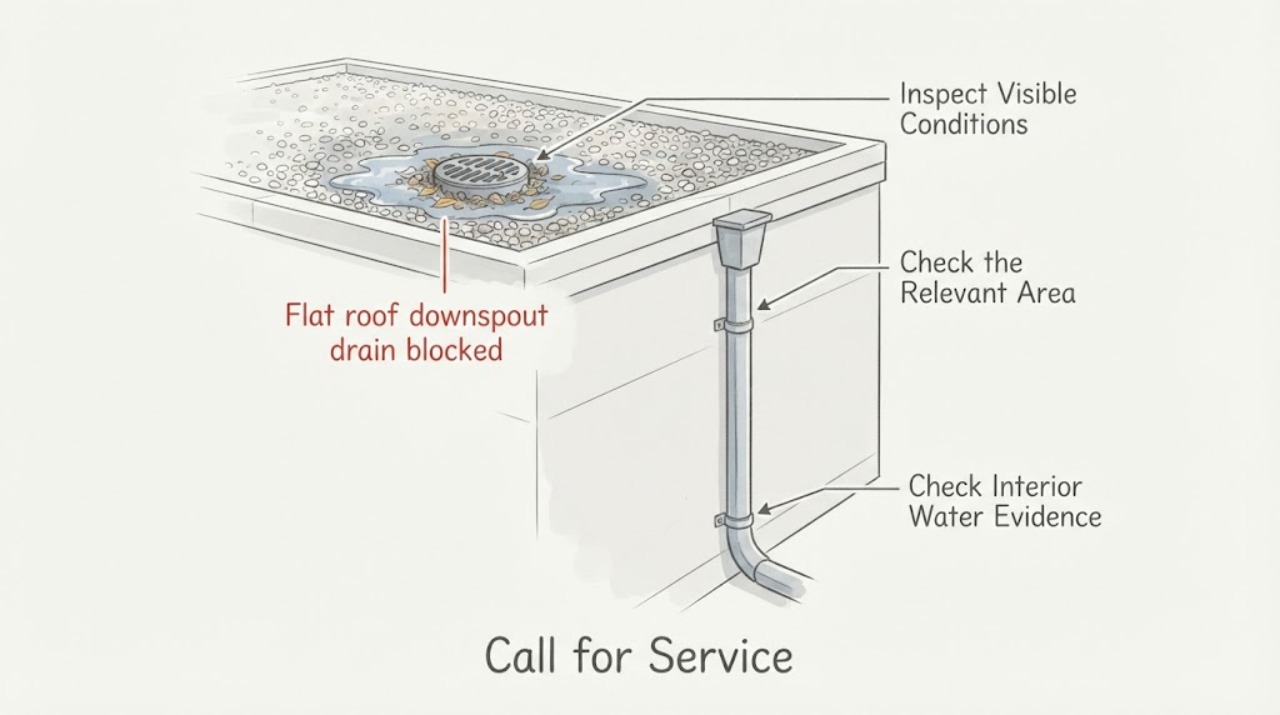
Work through in order
Diagnostic checks
Use only checks that match the exact appliance or system and its official guide.
-
Check 1
From the ground or another dry protected position, look at the visible end of the downspout without touching it or reaching above shoulder height.
Expected result: Record whether the outlet is visibly open, buried or pressed into soil, disconnected, crushed, or surrounded by fresh overflow marks. Do not infer that an open-looking outlet proves the roof drain is clear.
Next step: Photograph the condition from a safe distance, keep people and valuables away from the discharge area, and give the observation to a roofing or drainage professional.
Stop if: Stop immediately if the outlet is loose overhead, material is falling, water is moving toward an entrance or electrical equipment, or the ground is slippery or unstable.
Why this matters
Why: A blocked, displaced, or overflow-stained outlet supports a drainage-path problem, but the restriction may still be higher up or concealed.
-
Check 2
During ordinary rain only when you can remain under shelter, observe the downspout outlet and the wall or ground below it; do not make a hose test or approach the roof edge.
Expected result: Note whether water exits normally, trickles while water spills elsewhere, stops entirely, backs up at a visible connection, or cannot be seen because the outlet is concealed.
Next step: End the observation when conditions become unsafe and send the timing, weather, and visible flow pattern to the professional who will inspect the system.
Stop if: Stop and move to safety for heavy rain, lightning, wind, ice, floodwater, falling debris, or water entering the building.
Why this matters
Why: Little or no discharge with overflow suggests a restricted route or inadequate drainage capacity; an apparently normal outlet does not rule out a roof-level drain obstruction or intermittent restriction.
-
Check 3
From the floor in a dry interior area, inspect ceilings and upper walls below or near the suspected drain route without opening finishes or entering an attic.
Expected result: Look for a new or enlarging stain, bubbling paint, damp odor, dripping, sagging, or a change that follows rain. Note the room, approximate location, and whether the mark is near a light, outlet, or other electrical equipment.
Next step: Photograph the area, keep clear of any weakened ceiling, and request prompt professional inspection. If water is near electrical equipment, use only a safe remote shutoff if one is already accessible without approaching wet areas; otherwise leave it to an electrician or emergency professional.
Stop if: Stop observation and isolate the room if the ceiling bulges or sags, water is actively entering, a burning smell or electrical arcing is present, or you cannot stay dry and stable.
Why this matters
Why: A rain-linked interior change raises concern that retained or diverted roof water is reaching the building; a dry ceiling does not prove the exterior system is safe.
-
Check 4
From ground level, scan the wall, trim, foundation-visible area, and walkways below the drainage route for water tracks or repeated overflow without probing, digging, or moving the downspout.
Expected result: Record darkened masonry or trim, washed soil, pooling at the building edge, staining that extends down the wall, or apparent separation or deflection. Distinguish a one-time wet surface from a recurring path by noting the date and weather.
Next step: Keep the area clear, preserve photos and dates, and ask the professional to assess the complete drainage route and any affected roof or wall assembly.
Stop if: Stop and keep away if the ground is flooded, the wall or roof edge appears unstable, debris is overhead, or water is approaching electrical service or equipment.
Why this matters
Why: A repeated path or pooling beside the building can indicate that water is not being carried away as designed and may be affecting other building components; visible deflection or separation requires urgent assessment.
-
Check 5
Review safe-to-access records, prior service notes, and photographs, then compare them with the visible downspout route and the current interior or exterior symptoms.
Expected result: Note whether the same outlet, roof section, wall, or room has recurred after rain; whether a recent roof, gutter, or wall project changed the route; and whether an overflow or stain is new.
Next step: Share the timeline and records, request a qualified inspection of the downspout and roof drainage design, and follow the professional's written assessment for clearing or repair.
Stop if: Stop any further checking when active leakage, ponding-related structural change, unsafe weather, or electrical exposure is present.
Why this matters
Why: A recurring location points to a persistent drainage, slope, membrane, or concealed-pipe issue rather than a single visible piece of debris. The history helps the professional plan an inspection without a hazardous exploratory visit by the homeowner.
Use your observations
Decision map
Find the observation that best matches what you see, then follow the next safe action.
-
PATH 01Safety boundary
What you see
Water is actively entering, a ceiling is bulging or sagging, the wall or roof edge appears deflected, or water is near electrical equipment.
Do this next
Keep people out of the affected area, avoid wet electrical equipment, and contact appropriate emergency or qualified roofing/electrical help immediately.
Why this path and its safety boundary
Safety stop: Do not continue observing, climb, reach, or attempt to divert or clear the drainage path.
-
PATH 02Safety boundary
What you see
The visible downspout outlet has no normal discharge or shows overflow, displacement, or a crushed/opening problem.
Do this next
Treat it as a likely drainage-path restriction or failure and arrange a professional inspection rather than reaching into it.
Why this path and its safety boundary
Safety stop: Do not use a ladder, hose, rod, pressure tool, or chemical cleaner on the roof drainage system.
-
PATH 03Safety boundary
What you see
The outlet cannot be seen, appears normal, or the symptom occurs only intermittently.
Do this next
Do not dismiss the concern; an obstruction may be at the roof drain, scupper, concealed leader, or downstream connection.
Why this path and its safety boundary
Safety stop: Do not create a flow test or access the roof to search for a blockage.
-
PATH 04Safety boundary
What you see
Wind, lightning, ice, heavy rain, falling material, unstable ground, or a need to climb or reach is present.
Do this next
Postpone exterior observation and remain in a dry protected location.
Why this path and its safety boundary
Safety stop: Do not approach the roof edge, downspout, ponded water, or fallen debris.
-
PATH 05Safety boundary
What you see
There is no active leak or obvious structural warning, but overflow, staining, or ponding signs recur after weather.
Do this next
Schedule a prompt qualified drainage and roofing assessment before the next severe weather event.
Why this path and its safety boundary
Safety stop: Do not treat a temporary lack of visible water as proof that the blockage has cleared.
Helpful context
Understand the symptom
Why a blocked downspout matters on a flat roof
A flat roof is usually low-slope rather than perfectly level. Its drainage design guides runoff toward drains, scuppers, or a downspout. When the outlet or connected path is blocked, water can remain at a low point or spill against the building. That can look like a simple clog from the ground while the actual restriction is at roof level, inside a concealed leader, or in a below-grade connection. The safe homeowner task is to document visible evidence and protect the area; diagnosis and clearing belong to a qualified professional.
Use a safe observation window
Observe only from a stable, dry location during normal conditions or after weather has passed. If rain, wind, ice, lightning, falling debris, or slippery surfaces make the area unsafe, stay inside and record what is visible through a window instead. Do not create a test flow, move a ladder, walk on the roof, reach over an edge, or disturb the membrane, drain, scupper, or downspout.
What to give the professional
A short timeline is more useful than a guessed cause: note when the problem first appeared, recent rain or snow, whether water came from the outlet, where any interior stain appeared, and whether the same area has recurred. Photos or video taken from a safe position can show the outlet, overflow path, interior ceiling or wall staining, and nearby electrical equipment without requiring roof access.
Only after diagnosis
Potential parts
- drain screen or debris guard
Consider only if a qualified inspection identifies a suitable exposed drain opening and the roof system design allows a guard; a screen cannot correct a concealed blockage, poor slope, or damaged membrane.
Confirm the drain, scupper, downspout, membrane, and manufacturer requirements with the professional before selecting any component. - gutter and downspout cleaning tool
This category is relevant only to a qualified service provider after the route and access conditions are assessed; the homeowner should not use a tool from a roof, ladder, or unstable ground.
The tool must match the drainage configuration and must not puncture or stress the roof membrane, drain, leader, or concealed connection. - moisture meter
A professional may use this to map suspected interior moisture after visible leakage or staining is documented; it does not locate or clear a blocked downspout by itself.
Use readings only with the meter's instructions and the building material context; do not treat a reading as a structural or mold diagnosis.
When checks do not resolve it
Need a professional?
Arrange qualified roofing or drainage service for any suspected blockage, absent or irregular discharge, recurring overflow, ponding, or rain-linked staining. Escalate immediately for active leakage, structural signs, or electrical exposure.
Have this ready
- Provide the downspout location, safe photos, weather and symptom timeline, visible discharge pattern, interior or exterior water marks, and any prior service or roof work history.
Common questions
FAQ
Can I clear a blocked flat-roof downspout from the ground?
Do not assume the visible outlet is the blockage and do not push a rod, hose, pressure tool, or chemical into the system. Photograph what is visible and have a qualified professional assess the full route, including any concealed connection.
Does an open downspout outlet mean the roof drain is clear?
No. The restriction can be at the roof drain, scupper, conductor path, concealed leader, or downstream connection. Normal-looking discharge on one occasion also does not rule out an intermittent restriction.
How urgent is a blocked downspout on a flat roof?
Prompt professional assessment is appropriate because low-slope drainage depends on designed flow to drains or scuppers. Active interior leakage, ceiling movement, visible deflection, substantial ponding, or water near electrical equipment requires immediate safety isolation and escalation.
What information should I collect before calling a roofing professional?
Record the outlet location, whether discharge was absent or overflowing, the date and weather, any recurring exterior track or interior stain, and safe photos. Do not climb or create a test flow to collect more evidence.
Read the exact guide
Official sources
- NRCA Roofing GlossaryNational Roofing Contractors Association · Industry definitions for downspout, drain, gutter, and sump in roofing systems
- Ponding Water on TPO and PVC MembranesGAF Technical Services · Technical guidance on ponding, positive drainage, and risks for TPO and PVC membrane roofs
- The Importance of Commercial Drain MaintenanceGAF · Commercial low-slope roof drainage, roof drains, scuppers, downspouts, and maintenance context
Community feedback
Share a repair observation
Share a plain-text repair observation. Accepted observations are published automatically; this page may take a moment to update.