
On this page
Start here
Quick answer
A flat or low-slope roof that appears to need replacement should be evaluated by a qualified roofing professional rather than patched from the surface by a homeowner. From inside and from the ground, document active leaks, ceiling or wall damage, ponding, blocked drainage, exposed membrane, and repeated repair areas. Gather the roof's history and request a written scope that explains whether repair, restoration, or replacement is appropriate, how drainage and penetrations will be handled, what happens to wet or damaged deck materials, and what warranties are included. Do not climb onto the roof or begin tear-off yourself; roofing work has serious fall and structural hazards.
Work through in order
Diagnostic checks
Use only checks that match the exact appliance or system and its official guide.
-
Document the symptoms without getting on the roof
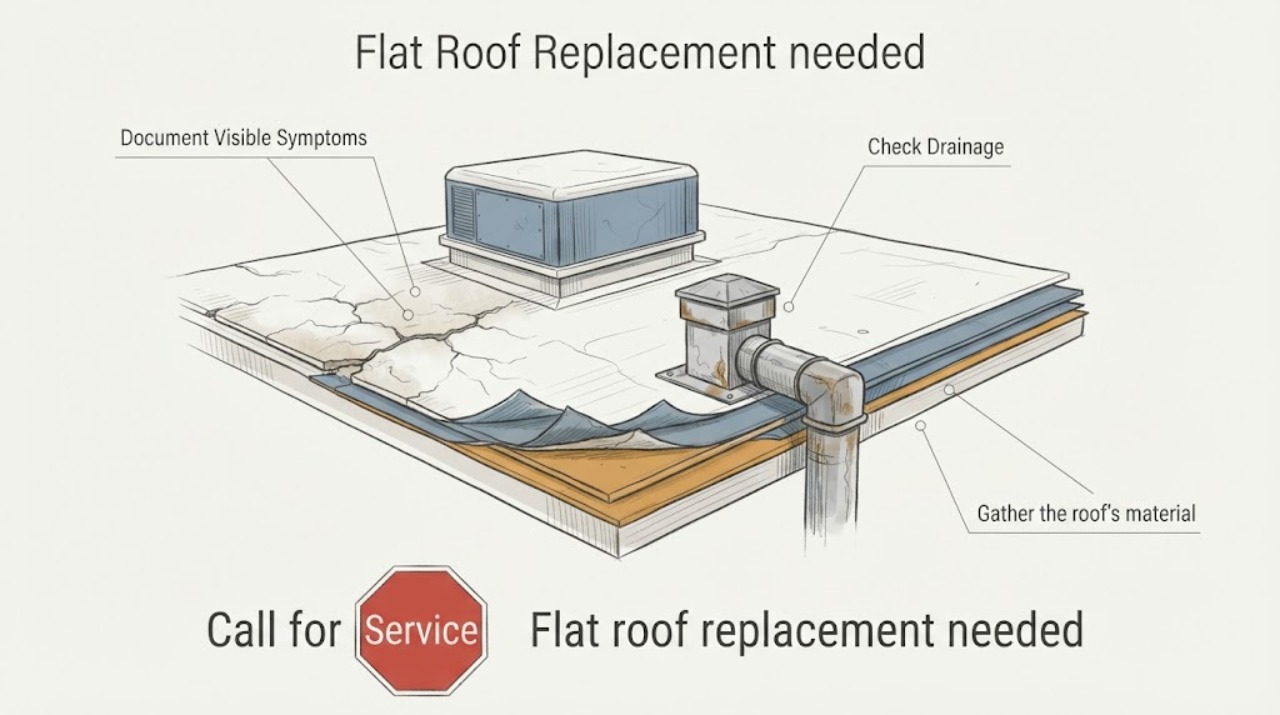
From inside the building and from a stable ground-level viewpoint, photograph water stains, damp areas, bubbling paint, ceiling movement, exterior drips, exposed membrane, deteriorated flashing, or visible debris near drains. Record when each symptom appeared and whether it follows rain, snow, or a plumbing or HVAC event.
Expected result: The damage is inactive and localized, or there is active water entry, a growing stain, a sagging ceiling, a strong musty odor, or damage near electrical equipment.
Next step: Preserve the photos and notes for the contractor. If the ceiling is sagging, water is near electrical equipment, or the area is unsafe, stop investigating and arrange urgent professional help.
Why this matters
Why: A localized, inactive symptom may allow time for a planned inspection. Active entry, structural-looking movement, or water near electrical equipment needs prompt professional attention and may require keeping people out of the affected area.
-
Check drainage from a safe location
After wet weather, observe the roof only from the ground, an existing safe window, or another location that does not require ladder or roof access. Note visible standing water, overflow at edges, blocked-looking drains or scuppers, water around skylights or rooftop equipment, and staining below parapets or roof edges.
Expected result: Water appears to flow toward drains or edges, or it remains in low areas, overflows, or collects around a penetration.
Next step: Give the contractor the location and timing of the water pattern. Do not walk onto the roof to clear a drain or test a low spot; have the professional assess drainage, structure, and access conditions.
Why this matters
Why: Drainage and properly flashed penetrations are central to a durable low-slope roof. Persistent ponding or overflow can change the replacement scope beyond a new membrane, while a localized penetration symptom may need focused investigation.
-
Gather the roof's material and repair history
Collect permits, invoices, warranty documents, inspection reports, maintenance notes, and photos from previous work. Record any known membrane or coating type, approximate installation period if documented, locations of past patches, and whether leaks returned after those repairs.
Expected result: The roof system and prior work are documented, or the material, age, and repair history are uncertain.
Next step: Send the records and symptom photos with the service request. Ask each bidder to identify the existing roof system and separate observed conditions from allowances or items that require opening the assembly.
Why this matters
Why: A known system and repair history help a contractor assess compatibility and remaining serviceability. Missing records are not a reason to guess; they are a reason to ask the contractor to identify the existing assembly and state what was verified versus assumed.
-
Compare written scopes, not just totals
Ask qualified flat-roof contractors for a written inspection result and scope. Confirm that each proposal states the proposed repair, restoration, or replacement system; removal and disposal; treatment of wet insulation or damaged deck; drains, scuppers, edges, curbs, and other penetrations; site protection; schedule; and workmanship and product warranty terms.
Expected result: The proposals describe the same underlying conditions and scope, or they use different assumptions, omit drainage or penetrations, or provide only a lump-sum price.
Next step: Ask for written clarification before choosing. If the contractors disagree about repair versus replacement, request the evidence and assumptions behind each recommendation and consider an independent roof assessment.
Why this matters
Why: Comparable scopes make price differences meaningful. An unexplained low total or an omitted drainage, flashing, deck, or warranty item may simply be an incomplete scope rather than a better repair.
Use your observations
Decision map
Find the observation that best matches what you see, then follow the next safe action.
-
PATH 01Next step
What you see
There is active water entry, a sagging ceiling, or water near electrical equipment
Do this next
Stop the inspection, keep people clear of the affected area, and arrange prompt professional help. Do not climb onto the roof to investigate the source.
-
PATH 02Next step
What you see
The leak appears localized and the roof otherwise has a documented, serviceable history
Do this next
Ask for a repair or restoration option and the conditions that would make replacement preferable; do not assume a patch is durable without an inspection.
-
PATH 03Next step
What you see
Ponding, overflow, repeated patches, widespread membrane damage, or wet deck concerns are reported
Do this next
Request a replacement assessment that addresses drainage, penetrations, substrate or deck condition, and the complete assembly rather than pricing only a new surface.
-
PATH 04Next step
What you see
A quote omits drainage, edge details, penetrations, deck treatment, or warranty terms
Do this next
Ask for a clarified written scope before comparing prices or authorizing work.
Helpful context
Understand the symptom
What replacement planning should answer
A leak is evidence of a water-management problem, but it does not by itself prove that the entire roof needs replacement. A flat roof is an assembly: the membrane, seams, flashing, insulation or deck, drains or scuppers, and penetrations all affect whether a repair can last. The useful decision is to have a professional connect the symptoms to the assembly's condition and give you a clear repair-versus-replacement scope.
Safety and stop point
Do not climb onto a flat roof, cross a parapet, remove the membrane, open a skylight, probe a soft area, or attempt a tear-off or patch as a homeowner. A roof can have hidden openings, slick surfaces, weak deck areas, and fall hazards even when it looks flat. Keep occupants away from unsafe interior areas, protect belongings from interior drips without creating an electrical or fall hazard, and let a qualified roofing professional determine the safe inspection and replacement method.
When checks do not resolve it
Need a professional?
Call a qualified roofing professional when the membrane is failing, leaks recur, drainage overflows or ponds, flashing or penetrations are damaged, the roof's structure or deck is in question, or you need a repair-versus-replacement quote. Seek prompt help for active interior water, a sagging ceiling, or water near electrical equipment.
Have this ready
- Interior and ground-level photos with the locations and dates of symptoms
- What weather or event preceded the leak and whether it returned after prior repairs
- Known membrane, coating, insulation, or deck information and all available repair or warranty records
- Any observed ponding, overflow, blocked-looking drain, parapet, skylight, curb, or equipment-penetration concern
Common questions
FAQ
Does one flat-roof leak mean the whole roof must be replaced?
Not necessarily. A leak can come from a localized membrane seam, flashing, drain, or penetration, but recurring leaks, ponding, widespread membrane damage, or wet deck concerns can change the recommendation. A professional inspection should explain the evidence for repair, restoration, or replacement.
What should a flat-roof replacement quote include?
Ask for a written scope covering the proposed system, removal and disposal, wet insulation or deck treatment, drains and scuppers, edges, penetrations, site protection, schedule, and product and workmanship warranty terms.
Can I inspect or patch a flat roof myself?
Do not climb onto or tear off a roof as a homeowner. Hidden openings, slick surfaces, weak deck areas, and fall hazards can be present even when the roof looks flat. Use ground-level observations and have a qualified professional perform the inspection.
What information should I send a roofer before an estimate?
Send symptom photos, leak timing, the locations of interior damage, any ground-level observations of ponding or overflow, the known roof system and age if documented, and records of previous repairs or warranties.
Read the exact guide
Official sources
- Measure Guideline: Deep Energy Enclosure Retrofit for Zero Energy Ready House Flat RoofsU.S. Department of Energy, Building America · Supports the diagnostic emphasis on drainage, roof slope toward drains, membrane water control, and properly flashed penetrations; it is design guidance, not a homeowner replacement procedure.
- Using Cool Roofs to Reduce Heat IslandsU.S. Environmental Protection Agency · Supports identifying low-slope roof systems and distinguishing membrane, coating, and aggregate options without prescribing a particular product for an unknown building.
- Fall Protection in Residential Construction - OSHA Guidance DocumentOccupational Safety and Health Administration · Supports the instruction to keep homeowners off the roof and leave inspection and replacement access planning to qualified professionals; the guidance is for employers and workers, not a DIY method.
Community feedback
Share a repair observation
Share a plain-text repair observation. Accepted observations are published automatically; this page may take a moment to update.