
On this page
Start here
Quick answer
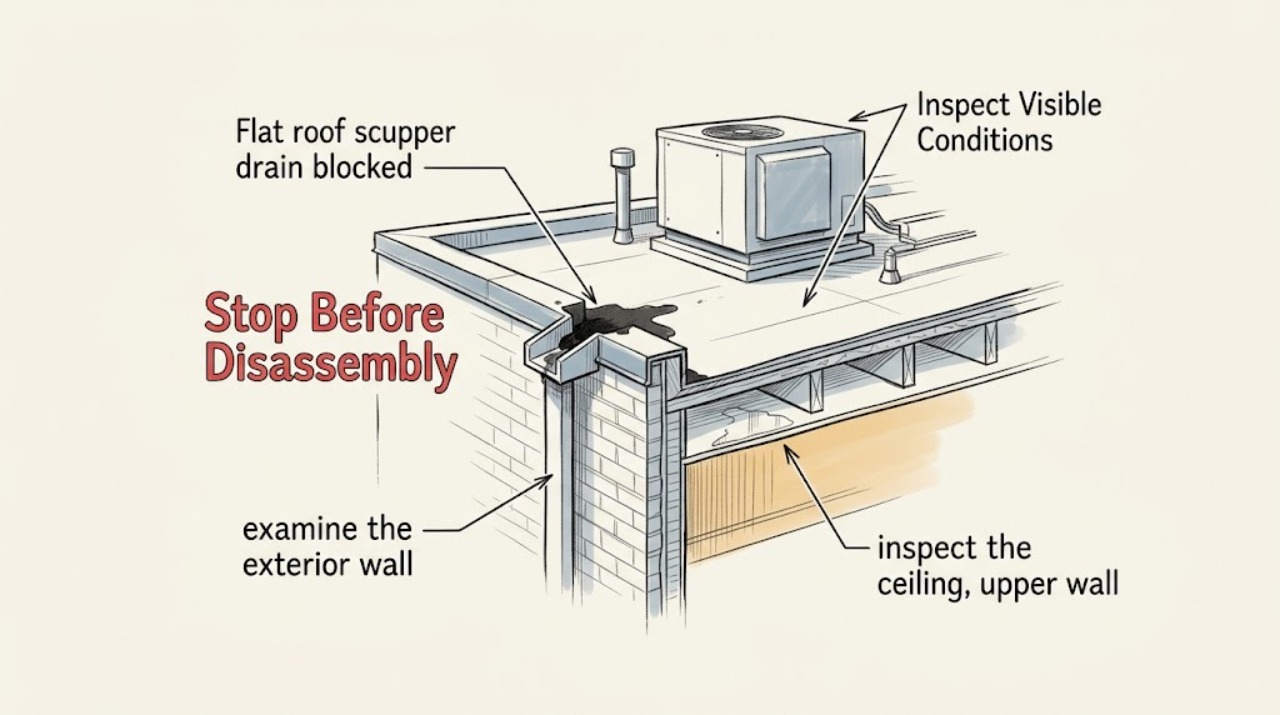
Do not climb onto a flat roof to clear a blocked scupper. From a safe ground-level or interior position, record whether water exits the scupper, whether the wall below it shows overflow staining, whether ponding is visible without approaching the roof edge, and whether ceilings or walls inside are damp or bulging. A restricted outlet can leave water on the roof and a failed scupper lining can let concentrated water enter the building, so arrange qualified roofing service promptly; treat active interior leakage, ceiling movement, structural damage, or water near electrical equipment as urgent.
Work through in order
Diagnostic checks
Use only checks that match the exact appliance or system and its official guide.
-
Check 1
From a safe ground-level location, observe the scupper opening and its discharge path during or shortly after rain without approaching the roof edge, using a ladder, or reaching toward the opening.
Expected result: Record whether water flows, dribbles, backs up, spills over the wall, or is not visible; note the time, rainfall conditions, and any debris that is visible from a distance.
Next step: Photograph the view from the safe location and give the timing and observed flow to a qualified roofer for an elevated inspection and controlled clearing or repair.
Stop if: Stop observing and keep away during lightning, high wind, driving rain, flooding, or any situation that makes the ground or access area unstable.
Why this matters
Why: Restricted flow or overflow is consistent with a possible scupper blockage, but a ground view cannot distinguish debris from a damaged outlet, downspout, membrane, or drainage layout.
-
Check 2
From the ground or a safe interior view, examine the exterior wall and parapet area below and beside the scupper without touching the wall or removing any finish.
Expected result: Look for fresh water trails, dark staining, peeling paint, efflorescence, bulging finish, cracking, or repeated marks below the outlet; note whether the pattern appeared after the same rain event as the restricted flow.
Next step: Map the affected area in photographs with a date and weather note, and ask the roofer to assess the scupper lining, flashing, discharge path, and adjacent roof system.
Stop if: Do not continue near loose masonry, falling finish, exposed material, active runoff, or visible structural movement; keep people below the area clear and request professional service.
Why this matters
Why: A concentrated stain or overflow trail supports a water-path concern, while a clean wall does not rule out a blocked outlet or concealed membrane problem.
-
Check 3
From accessible rooms, inspect the ceiling, upper wall, and corners that are below or near the scupper without poking, cutting, opening, or pressing on the surfaces.
Expected result: Record dry staining, fresh dampness, dripping, bubbling paint, sagging, softness seen without contact, or no interior sign; note when the sign occurs relative to rain.
Next step: Keep the area clear, protect belongings only without contacting wet electrical equipment, and provide photographs and timing to a qualified roofer or water-damage professional.
Stop if: Stop immediately for an active leak, sagging ceiling, falling material, suspected structural instability, or water near electrical equipment; use emergency help when there is immediate danger.
Why this matters
Why: Interior moisture or movement indicates that water may already be entering the building, but the interior location may not be directly below the exterior source.
-
Check 4
From a safe ground-level or window view, look for visible roof-surface ponding only where it can be seen without climbing, leaning over an edge, or measuring from an unsafe position.
Expected result: Record whether water appears to remain after rain, whether it is near the scupper, and whether its visible extent changes between weather events; do not infer the roof condition from one unclear view.
Next step: Save dated photographs and rain-event notes for the roofer, who can inspect the roof and drainage system using appropriate access and fall protection.
Stop if: Do not seek a better view by climbing or using a ladder. Stop if water is approaching an edge, the roof structure appears distressed, or severe weather is present.
Why this matters
Why: Persistent or recurring visible ponding suggests that drainage, outlet capacity, blockage, or roof slope needs professional assessment; no visible ponding may simply mean the surface is out of view.
-
Check 5
Review safe records and observations for recurrence: recent roof work, prior scupper overflow, downspout discharge changes, storms, leaves or debris seen from the ground, and the timing of interior stains.
Expected result: Separate confirmed observations from unknown conditions such as the outlet interior, membrane seams, roof slope, and concealed wall construction.
Next step: Prepare one service record with the scupper location, dates, weather, flow behavior, wall and interior findings, photographs, and safe-access limitations.
Stop if: Stop all further checks if the record would require roof access, membrane contact, probing, temporary sealing, or work near unstable or wet electrical areas.
Why this matters
Why: A repeated pattern after rain raises the priority of a drainage or water-entry assessment, while a single event still cannot establish the blockage location or cause.
Use your observations
Decision map
Find the observation that best matches what you see, then follow the next safe action.
-
PATH 01Next step
What you see
Water exits normally and there is no visible wall or interior moisture sign.
Do this next
Treat the result as reassuring but not conclusive. Keep the dated record and ask for routine professional inspection if the concern recurs or the outlet cannot be safely viewed.
-
PATH 02Next step
What you see
Flow is restricted, water spills over the wall, or visible ponding recurs after rain.
Do this next
Arrange qualified roofing service promptly and provide the flow timing and ground-level photographs. Do not climb or attempt to clear the scupper from above.
-
PATH 03Next step
What you see
The wall has overflow staining or the interior shows dampness, bubbling, or a fresh ceiling/wall mark.
Do this next
Request a roof and water-entry assessment even if the scupper now appears clear; the lining, flashing, membrane, or discharge path may still need attention.
-
PATH 04Next step
What you see
There is active interior water, a sagging or moving ceiling, loose exterior material, or water near electrical equipment.
Do this next
Keep people out of the area and seek urgent qualified roofing or restoration help. Avoid wet electrical equipment and use emergency services for immediate danger.
-
PATH 05Next step
What you see
A storm, high wind, lightning, or flooding makes observation or access unsafe.
Do this next
Stay at ground level and wait for safe conditions; do not use the event as a reason to climb, reach, or perform a temporary roof repair.
Helpful context
Understand the symptom
Why a scupper needs prompt attention
A scupper is an opening through a parapet or roof edge that carries roof water outward, sometimes into a downspout. GAF explains that drains and scuppers cannot function when they are not maintained, and that blocked drainage can allow pools of water to form. Building Performance notes that water concentrates at a scupper and that failed joints can have serious water-ingress consequences. Those facts make safe observation and timely professional inspection more useful than trying to reach the outlet yourself.
Keep the inspection observational
Use photographs, timestamps, normal windows or doors, and safe standing areas. Do not use a ladder, step onto the roof, reach into the scupper, probe the membrane or wall, or attempt a temporary membrane repair. A clear outlet viewed from the ground does not prove that the roof drainage path or lining is sound.
Only after diagnosis
Potential parts
- drain-screen
Consider this only if a qualified roofer confirms that a compatible scupper screen is missing or damaged after inspecting the actual drainage assembly.
Confirm the scupper opening, roof membrane system, parapet detail, and installer-approved fit before selecting any screen. - gutter-cleaning-tool
This is relevant only to a professional's planned, controlled maintenance method after the blockage location and safe access have been established; it is not a recommendation for roof access by a homeowner.
The tool and method must suit the roof, scupper, downspout, and membrane without scraping or puncturing the waterproofing system. - moisture-meter
Consider this only when a qualified roofer or restoration professional needs non-destructive confirmation of suspected wall or ceiling moisture after visible signs are documented.
Readings depend on the material and instrument; the professional must choose an appropriate meter and interpret it with the building assembly.
When checks do not resolve it
Need a professional?
Request qualified roofing service for restricted scupper flow, overflow staining, recurring visible ponding, or any interior moisture sign. Treat active leakage, ceiling movement, loose exterior material, structural concern, or water near electrical equipment as urgent.
Have this ready
- Provide the scupper location, dated ground-level photographs, rain and overflow timing, visible discharge behavior, wall and interior observations, recurrence history, recent roof work, and the fact that the roof was not accessed.
Common questions
FAQ
Can I clear a blocked flat-roof scupper from the ground?
Do not reach toward the scupper or use a ladder to access it. Record the outlet behavior and any overflow from a safe position, then have a qualified roofer inspect and clear or repair the drainage system with appropriate access.
Does a scupper that looks clear mean the roof is safe?
No. A clear ground-level view does not show the full drainage path, roof slope, membrane, lining, or concealed water entry. Recurring ponding, stains, or interior moisture still warrants professional assessment.
What should I photograph for the roofer?
Photograph the scupper and discharge path from a safe ground-level viewpoint, any wall staining below it, visible ponding that can be seen without climbing, and interior ceiling or wall signs. Add dates, weather, and whether the condition recurs.
When is a blocked scupper an urgent problem?
Active interior leakage, a sagging or moving ceiling, loose exterior material, structural concern, or water near electrical equipment calls for urgent professional help. Keep people away and do not approach the roof or wet electrical equipment.
Read the exact guide
Official sources
- Scupper linings in E2/AS1 – preformed or formed on-site?Building Performance, New Zealand Ministry of Business, Innovation and Employment · New Zealand E2/AS1 guidance used here for the general principle that scupper joints need monitoring and compatible system design; local requirements and the installed roof system may differ.
- The Importance of Commercial Drain MaintenanceGAF · General commercial low-slope roof guidance; do not infer a specific installed assembly or repair method.
- Mitigating Water on RoofsGAF · General low-slope and commercial roof guidance; the installed roof system and access plan remain site-specific.
Community feedback
Share a repair observation
Share a plain-text repair observation. Accepted observations are published automatically; this page may take a moment to update.