
On this page
Start here
Quick answer
A blocked flat-roof drain with overflow is a water-routing and leak-escalation problem, not a routine rooftop cleaning task. From the ground or a dry interior location, record where water emerges, whether an overflow scupper or outlet is carrying it, which ceiling or wall area shows water, and how long the condition lasts after rain stops. Keep off the roof and out of standing water. Active interior leakage, water near electricity, a blocked or absent emergency outlet, or ponding that persists after rain needs prompt roofing service because the drain, piping, flashing, membrane, or roof structure may all be involved.
Before you begin
Safety first
- This page is limited to safe ground-level and dry-interior observation. A qualified roofer determines drain, emergency overflow, piping, flashing, membrane, and structural work. No roof entry, ladder work, ponded-water contact, drain removal, hose flushing, chemical clearing, or concealed repair is provided.
Work through in order
Diagnostic checks
Use only checks that match the exact appliance or system and its official guide.
-
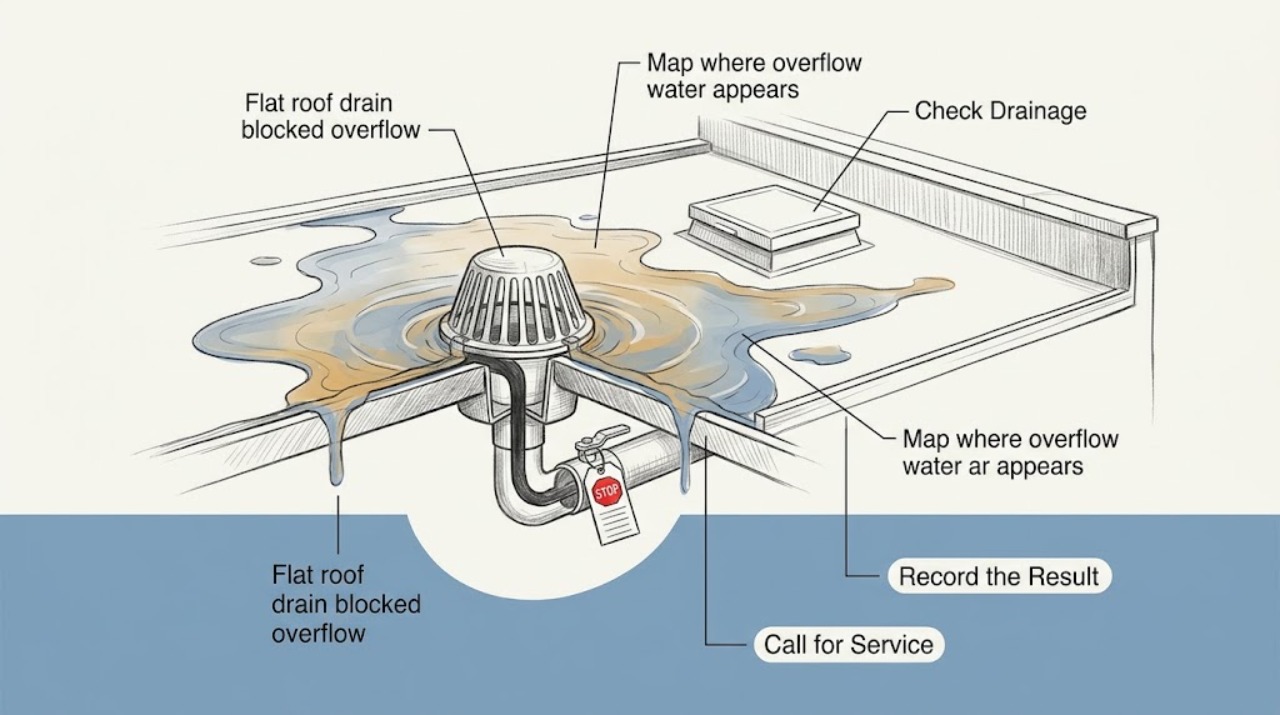
Map where overflow water appears
From the ground or another dry, stable location, photograph the building edge, visible downspout or scupper discharge, wall below the drain area, and any splash or runoff path. Do not climb, use a ladder, or approach ponded roof water.
Expected result: Water exits through a visible emergency outlet or edge, spills over a wall or parapet, backs up at a downspout, or has no visible exterior route.
Next step: Mark the location on a simple building sketch and give the photos to a roofing professional; do not try to redirect or clear the route yourself.
Stop if: Stop for falling water or debris, unstable masonry, power lines, electrical equipment, or any need to gain height.
Why this matters
Why: An emergency outlet or edge discharge shows that water is reaching a secondary route while the primary drain may be restricted. Wall overflow or no visible route raises concern for concealed drainage, membrane, or structural conditions that cannot be safely checked from the ground.
-
Check the interior below the drain path
From the floor, inspect the ceiling, wall, and visible drain-pipe area beneath or near the reported drain for fresh stains, dampness, bubbling paint, sagging, or water near lights and outlets. Do not touch wet surfaces or electrical equipment and do not open the ceiling.
Expected result: There is active dripping, a new stain, a bulging or sagging finish, water near electricity, or no visible interior change.
Next step: Keep people clear of the affected area, notify the building owner or manager if applicable, and request prompt roofing and water-damage assessment.
Stop if: Stop and isolate the area for electrical exposure, falling material, ceiling movement, or contaminated water.
Why this matters
Why: Active water, a sagging finish, or water near electricity makes the overflow an immediate building-damage and safety concern. No interior mark does not clear the roof because water can travel inside a wall or drain chase before appearing.
-
Record the rainfall and drainage timeline
Write down when rain or snowmelt begins, when overflow starts, whether it changes with rainfall intensity, and whether dripping continues after precipitation ends. Use dated photos from safe locations rather than testing the drain with a hose.
Expected result: Overflow appears only during heavy rain, begins during ordinary rain, continues after the weather clears, or occurs in dry weather.
Next step: Send the timeline with the route map and interior photos so the roofer can plan a drain, scupper, piping, and waterproofing inspection.
Stop if: Stop observing during lightning, high wind, flooding, or any condition that makes the exterior or interior unsafe.
Why this matters
Why: Heavy-rain-only overflow may indicate restricted capacity or a partially blocked route. Overflow during ordinary rain or continued dripping after rain suggests a more persistent blockage, retained water, failed connection, membrane, or interior leak and needs faster assessment.
-
Compare nearby drainage outlets from the ground
From a safe exterior position, compare the reported discharge with other visible downspouts, scuppers, or ground outlets on the same building and note leaves, dirty water trails, detached extensions, or a missing visible outlet. Do not insert a tool or hose into any outlet.
Expected result: Only one outlet shows overflow, several outlets show the same condition, a discharge path is detached or damaged, or the route cannot be seen.
Next step: Record each affected outlet and request a coordinated drainage inspection rather than replacing a visible screen or extension based on appearance alone.
Stop if: Do not enter a drainage trench, touch contaminated runoff, move heavy covers, or reach above safe ground level.
Why this matters
Why: One affected outlet supports a localized drain, connection, or flashing assessment. Several affected outlets or an unseen route suggests a shared downstream or building drainage problem; a detached outlet can move water against the wall without proving the roof drain itself is clear.
-
Decide whether the overflow needs prompt roofing service
Ask whether water is entering the building, the overflow continues after rain, the primary route cannot be seen, the roof edge or wall is being wetted, the roof is ponded, or anyone would need a ladder or roof access to inspect it. Base the decision on the observed route and timing, not on an assumption that debris is the only cause.
Expected result: Yes: one or more escalation signs is present. No: the event was brief, exterior-only, and fully documented without unsafe access.
Next step: Request roofing service and provide the route map, interior findings, rainfall duration, outlet comparison, and access limits; keep people away from affected areas until assessed.
Stop if: Do not climb, walk on the roof, work in ponded water, remove a drain assembly, or attempt a chemical or mechanical clearing.
Why this matters
Why: Any escalation sign needs prompt roofing assessment because the condition may involve a concealed drain, emergency overflow, flashing, membrane, or structure. A brief exterior-only event still needs follow-up if it repeats during the next rain or the source remains uncertain.
Use your observations
Decision map
Find the observation that best matches what you see, then follow the next safe action.
-
PATH 01Safety boundary
What you see
Is water actively entering the building, near electricity, or accompanied by a bulging or sagging ceiling?
Do this next
Keep people clear, isolate the affected room if safe, and request prompt roofing and water-damage response; do not touch wet electrical equipment.
Why this path and its safety boundary
Safety stop: Do not open the ceiling, climb above the ceiling, or wait through an active leak to see whether it worsens.
-
PATH 02Safety boundary
What you see
Is water discharging through an emergency scupper or visible overflow route rather than the expected primary outlet?
Do this next
Treat the secondary discharge as evidence that the primary drainage path needs professional inspection; record its location and do not block or alter it.
Why this path and its safety boundary
Safety stop: Do not test an emergency outlet with a hose or place anything into it.
-
PATH 03Safety boundary
What you see
Does dripping or wetting continue after rain or snowmelt has stopped?
Do this next
Request prompt assessment for retained water, a persistent blockage, failed drain connection, flashing, membrane, or interior leak.
Why this path and its safety boundary
Safety stop: Do not infer that a dry interval repaired the blockage or waterproofing.
-
PATH 04Safety boundary
What you see
Would confirming the blockage require a ladder, roof entry, ponded-water contact, drain-cover removal, or concealed-pipe work?
Do this next
Stop at the safe observation boundary and arrange a qualified roofer with the photos, route map, and timing.
Why this path and its safety boundary
Safety stop: No roof, ladder, ponded-water, drain-removal, hose-flushing, or chemical work is included.
Helpful context
Understand the symptom
Overflow reveals the drainage route
When a primary drain is blocked, water can stop following the intended route and appear at an overflow scupper, roof edge, wall, ceiling, or interior drain line. The location and timing of that water are more useful than trying to identify a blockage from below. An overflow that discharges outside is not proof that the roof is safe; it is evidence that the primary path may not be carrying water as intended.
Use rain timing to separate a short event from a continuing leak
Record when rain begins, when overflow or dripping starts, whether the discharge is clear or dirty, and whether dripping continues after the weather is dry. A brief event at the edge may indicate a drainage-capacity or obstruction issue, while water that continues indoors after rain or appears during dry weather raises concern for retained water, a failed drain connection, flashing, membrane, or plumbing path. Only a roofer can determine which layer is responsible.
Interior water marks change the urgency
Look from the floor for fresh ceiling or wall staining, bulging paint, damp insulation that is already visible, soft finishes, or water near lights and other electrical equipment. Do not touch wet electrical equipment or open the ceiling. Water entering the building, a ceiling that is sagging, or an active leak should be isolated from people and handled as a prompt professional assessment rather than waiting for the next storm.
Do not turn a safe observation into rooftop work
The checks on this page are limited to ground-level exterior views, safe interior views, photos, and records. Do not use a ladder, step onto the roof, walk through ponded water, remove a drain cover, push debris into a drain, flush an interior drain, or apply chemicals. A blocked drain may be connected to a concealed pipe or damaged waterproofing, and a temporary flow change can hide the source while water damage continues.
Safety boundary
Stop conditions
- Stop and keep people clear for active interior leakage, ceiling movement, water near electricity, contaminated water, falling debris, lightning, or high wind.
- Do not climb, use a ladder, walk on the roof, enter ponded water, remove drain covers, or reach into an outlet.
- Do not flush an interior drain, push debris into a drain, apply chemicals, or redirect water in a way that hides the source.
- Use qualified roofing service for concealed drains, emergency outlets, persistent overflow, membrane or flashing concerns, and any work above safe ground level.
Only after diagnosis
Potential parts
- drain-screen
Consider only after a roofer identifies a damaged or incompatible screen and confirms that the drain assembly, membrane, outlet, and local requirements are otherwise sound.
Match the drain opening, strainer style, roof system, fastening method, and manufacturer requirements; do not access the roof or remove a screen for this article's checks. - gutter-cleaning-tool
Consider only for a professional-approved ground-level route that is actually a reachable gutter or downspout; it is not a tool for a flat-roof drain or interior leader.
Confirm the drainage layout, reach, material, and safe operating boundary with the property professional; never push debris into a roof drain or use it from a ladder. - moisture-meter
Consider only as a supplemental documentation aid when a water-damage professional requests comparison readings around a visible interior mark; it cannot locate a blocked drain or clear a roof assembly.
Follow the instrument instructions and avoid wet electrical areas, damaged finishes, and any probing; a dry reading does not rule out concealed moisture.
When checks do not resolve it
Need a professional?
Request prompt qualified roofing service when a flat-roof drain overflows, especially if water reaches an emergency outlet, wall, ceiling, or interior drain line; continues after rain; recurs during ordinary rain; has no visible safe route; or would require roof or ladder access. Arrange urgent water-damage or electrical help for active interior leakage, contaminated water, ceiling movement, or water near electricity.
Safety scope: This page is limited to safe ground-level and dry-interior observation. A qualified roofer determines drain, emergency overflow, piping, flashing, membrane, and structural work. No roof entry, ladder work, ponded-water contact, drain removal, hose flushing, chemical clearing, or concealed repair is provided.
Have this ready
- Ground-level photos of the building edge, visible outlets, runoff path, and nearby wall
- Interior photos of stains, dripping, bulging, sagging, or water near electrical equipment from a safe distance
- Rain or snowmelt start time, overflow start time, and how long dripping continued
- Whether one outlet or several outlets are affected and which routes are not visible
- Roof access limits and what was not climbed, removed, flushed, touched, or tested
Common questions
FAQ
Does an overflow scupper mean the flat roof drain is working?
No. It can mean water is using a secondary route because the primary drain or its downstream path is restricted. Record where the water exits and arrange roofing assessment rather than blocking or testing the outlet.
What should I look for inside when a roof drain overflows?
From the floor, look for fresh ceiling or wall stains, active dripping, bulging or sagging finishes, and water near electrical equipment. Do not touch wet electrical equipment or open the ceiling; isolate the area and request prompt help for active leakage.
How does rain duration help diagnose a blocked roof drain?
Record when rain and overflow begin and whether dripping continues after precipitation stops. A brief heavy-rain event may differ from overflow during ordinary rain or continued dripping, which can point to a persistent blockage, retained water, failed connection, or waterproofing problem.
Can I climb up and clear a flat-roof drain myself?
Not as part of these checks. Do not use a ladder, walk on the roof, enter ponded water, remove a drain cover, flush an interior drain, or apply chemicals. Give a roofer ground-level photos, interior observations, and the rain timeline.
When is a blocked flat-roof drain an emergency?
Treat it as urgent when water enters the building, reaches electricity, continues after rain, causes ceiling movement, spills over a wall, involves contaminated water, or has no safe visible route. Keep people clear and request qualified roofing or water-damage response.
Read the exact guide
Official sources
- Flashing of Penetrations in Existing RoofsPacific Northwest National Laboratory Building America Solution Center · Supports the distinction between roof drainage and waterproofing details around a drain or penetration, and the need for qualified assessment of water-control layers rather than a guessed surface fix.
- Facility Tip of the Week: Let’s Take it from the TopNew York City Administration for Children's Services · Supports the connection between a blocked roof drain, overflow, water traveling over drain flashings, and interior wall or ceiling leakage; the article deliberately limits the reader to safe observation.
Community feedback
Share a repair observation
Share a plain-text repair observation. Accepted observations are published automatically; this page may take a moment to update.