
On this page
Start here
Quick answer
A blocked drain on a flat or low-slope roof can leave water or snow melt ponded against a membrane, parapet, or roof structure. Do not climb onto the roof, use a ladder, clear a drain, probe a membrane, or alter a roof detail. From inside and at ground level, document ceiling or wall moisture, active drips, exterior overflow, outlet conditions, and whether the problem follows rainfall or snow melt. Keep people away from any bulging ceiling or unsafe area and arrange urgent service from a qualified roofing or drainage professional; escalate immediately if water is near electrical equipment or the building shows structural distress.
Before you begin
Safety first
- Do not climb onto the roof, use a ladder, clear or snake a drain, flush it with water, chip ice, probe or cut a membrane, open roof access, or perform roofing or structural work yourself.
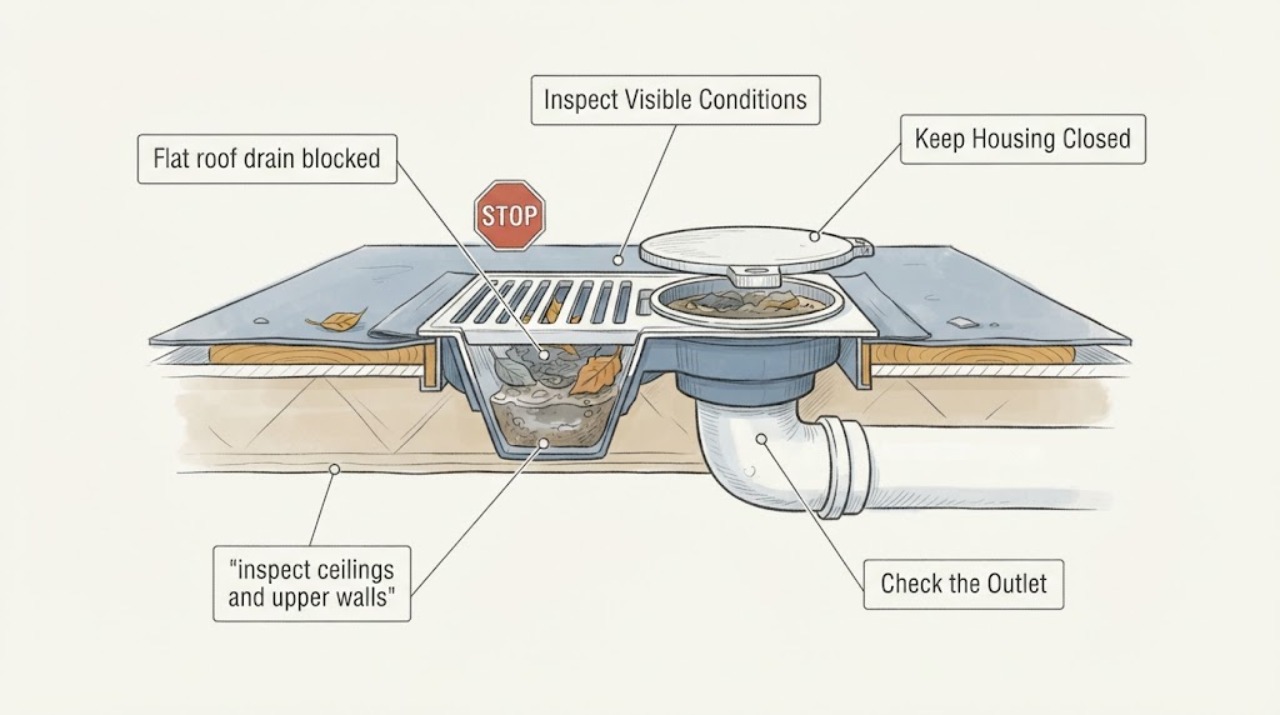
Work through in order
Diagnostic checks
Use only checks that match the exact appliance or system and its official guide.
-
Check 1
From inside the building and from floor level, inspect ceilings and upper walls below or near the low-slope roof for fresh drips, water stains, peeling or discolored finishes, damp insulation that is already visible without opening anything, bulging surfaces, or cracks. Do not touch a bulge, open the ceiling, move electrical equipment, or stand beneath an unstable area.
Expected result: Active dripping, a growing stain, a bulging ceiling, or visible structural distress indicates that water is entering or accumulating and the area may be unsafe. A dry ceiling does not rule out ponding or hidden roof moisture.
Next step: Photograph the damage from a safe floor position, note when it appeared, and move people away. If water is near lights, wiring, panels, or other electrical equipment, use only a safe, accessible shutoff route and obtain appropriate emergency help.
Stop if: Leave the room and keep others out if the ceiling is sagging or bulging, material is falling, water is near electrical equipment, or the floor becomes wet and unsafe.
Why this matters
Why: Interior evidence sets the urgency and tells the roofing professional which roof zone or drain path to trace; it does not identify whether the drain, membrane, flashing, or structure is at fault.
-
Check 2
At ground level and without climbing, look toward the roof edge, parapet, scupper, downspout, or visible outlet from a safe position. Observe whether water is overflowing, backing up, cascading from an unusual seam, or absent where a normal outlet would discharge during or soon after rain.
Expected result: Overflow at an edge or scupper, water staining below an outlet, or no discharge during a period of runoff supports a drainage-path concern. A clear ground-level outlet does not prove the roof drain or internal leader is open.
Next step: Record the outlet location, weather timing, direction of overflow, and any visible debris without reaching toward it. Keep the area below the outlet clear of people and property until inspected.
Stop if: Do not approach an outlet under active flow, falling debris, ice, snow, or unstable roof-edge conditions; move farther away and wait for professional assessment.
Why this matters
Why: The outlet observation helps the professional distinguish an exterior overflow or scupper issue from an internal drain, leader, membrane, or flashing problem.
-
Check 3
Compare the timing of interior and ground-level evidence with recent rain, snow melt, or freeze-thaw conditions. Note whether water appears only during intense rainfall, continues after precipitation stops, or returns at the same ceiling, wall, or outlet location.
Expected result: Water that follows heavy rain or snow melt and returns at one zone supports a drainage-capacity, blockage, ponding, or roof-envelope investigation. Water that appears without precipitation may indicate a plumbing, HVAC, condensation, or unrelated building source.
Next step: Keep a simple timeline with rainfall or snow melt, first drip, duration, and location, then send it with photos to the roofing or building professional.
Stop if: Stop investigating from outside during lightning, high wind, heavy rain, active snow or ice movement, or any condition that makes the ground-level area unsafe.
Why this matters
Why: The weather correlation changes which professional should be contacted first and prevents assuming that every ceiling stain is a blocked roof drain.
-
Check 4
From inside or another already accessible ground-level location, look for non-invasive signs around visible interior drain chases, ceiling access panels, walls, and equipment rooms: damp staining, dripping at a joint, unusual overflow noise, or water tracking along a wall. Do not open an access panel, insert anything into a drain, flush with water, or disturb insulation or membrane materials.
Expected result: A recurring damp mark or sound along the drain route can help locate the affected zone, while an isolated stain near a roof penetration may point toward flashing or membrane work rather than a blocked drain.
Next step: Photograph from the floor, identify the room or chase, and ask the professional to inspect the drain, overflow, membrane, flashing, and interior route using a safe access plan.
Stop if: Do not open, probe, snake, flush, chip, or dismantle any drain or roof component. Stop if water contacts equipment, insulation, or a damaged ceiling.
Why this matters
Why: Location clues narrow the service request but cannot confirm blockage, structural capacity, or the condition of concealed waterproofing.
-
Check 5
From the ground and a safe interior viewpoint, document building context that can increase urgency: visible ponding reported by a building manager, snow or ice accumulation, a sagging roof edge seen from below, newly displaced trim, a crack that is changing, or water entering near a skylight, curb, parapet, or HVAC enclosure.
Expected result: Ponding combined with snow, a sagging edge, changing cracks, or water near a roof penetration or equipment enclosure may involve structural load or a failed roof detail, not just loose debris at a drain.
Next step: Keep occupants and equipment away from the affected area, retain photos and timeline notes, and request urgent professional evaluation with any building or utility coordination needed.
Stop if: Treat visible structural distress, active roof-edge movement, or a rapidly worsening leak as an emergency. Do not wait on the roof or attempt a temporary membrane repair.
Why this matters
Why: These observations call for a broader roofing and structural assessment and may require the building to be restricted until the hazard is controlled.
Use your observations
Decision map
Find the observation that best matches what you see, then follow the next safe action.
-
PATH 01Next step
What you see
Water is actively entering, the ceiling is bulging, electrical equipment is wet, or the building shows structural distress.
Do this next
Clear the affected area, use only a safe accessible utility shutoff when appropriate, and contact emergency building, electrical, structural, and roofing help as needed. Do not enter the roof area or touch wet electrical equipment.
-
PATH 02Next step
What you see
Overflow or backing up appears at a scupper, roof edge, or visible outlet during or after rain.
Do this next
Keep people and property out of the discharge area and arrange urgent qualified roofing or drainage service. Do not reach into, flush, snake, or clear the outlet yourself.
-
PATH 03Next step
What you see
Interior staining or dripping repeats after rainfall, but no ground-level outlet can be safely observed.
Do this next
Provide the rainfall timeline, interior location, and photos to a qualified roofing professional and request a safe roof-drain, overflow, membrane, and flashing assessment.
-
PATH 04Next step
What you see
Water appears without rain or snow melt and follows a plumbing, HVAC, or interior route.
Do this next
Do not assume a roof-drain blockage. Ask the appropriate building, plumbing, or HVAC professional to trace the source while keeping the affected area dry and safe.
-
PATH 05Next step
What you see
Ponding or blocked drainage is reported on the roof, but the interior is currently dry.
Do this next
Treat the report as an urgent preventive inspection, keep the roof closed to unqualified access, and ask a roofing professional to assess drainage capacity, overflow paths, membrane condition, and structural implications.
Helpful context
Understand the symptom
Why a blocked low-slope roof drain matters
Low-slope roofs are designed to direct water to drains, scuppers, or edge outlets rather than leave it on the roof. When a drain is blocked, ponding can add load and prolong water exposure; water can also reach interior finishes through penetrations, roof edges, or membrane defects. A ground-level report can establish urgency, but it cannot identify the obstruction or approve a membrane repair.
Keep the roof and interior safe while waiting
Stay off the roof and keep ladders, tools, and people away from the suspected drainage path. Place containers only where they can be reached without entering an unsafe area, and protect belongings from a safe location. Do not flush, snake, chip, scrape, seal, or puncture a drain or roof assembly; give the professional photos and the timing of the water instead.
Only after diagnosis
Potential parts
- drain-screen
Only consider a drain screen after a qualified roofer identifies a missing or damaged screen and confirms the exact drain assembly; it is not a reason to access the roof or disturb a membrane during an active blockage.
Match the drain body, overflow arrangement, membrane system, and local roof design. Confirm the professional installation scope before ordering. - gutter-cleaning-tool
Only consider a tool when a professional confirms that an accessible exterior gutter or downspout, rather than a roof drain or internal leader, is the issue; this article does not instruct the reader to clear a roof drain.
Confirm the drainage layout, safe reach, building height, and material compatibility. Do not use a tool from a ladder, roof, near electrical lines, or around an inaccessible internal drain. - moisture-meter
Only consider a moisture meter as a supplementary professional assessment tool when interior staining is present but the wet boundary is unclear; a reading cannot locate a blocked drain or prove that a roof assembly is dry.
Interpret readings against the wall, ceiling, and finish materials and a dry comparison area. Follow the inspecting professional's method and do not open or probe the assembly.
When checks do not resolve it
Need a professional?
Arrange urgent roofing or drainage service for any ponding or blocked drain report on a low-slope roof, recurring rain-linked interior water, visible overflow, or water near roof penetrations. Escalate immediately for bulging ceilings, structural distress, electrical contact, heavy rain or snow load, or active roof-edge movement.
Safety scope: Do not climb onto the roof, use a ladder, clear or snake a drain, flush it with water, chip ice, probe or cut a membrane, open roof access, or perform roofing or structural work yourself.
Have this ready
- Provide the building address and safe access point, roof type if known, interior rooms and stains, outlet or scupper location, rainfall or snow-melt timeline, photos from ground and interior viewpoints, visible ponding or overflow reports, and any utility or structural concern.
Common questions
FAQ
How can I tell if a flat-roof drain is blocked without going on the roof?
Look from inside and at ground level for rain-linked ceiling or wall moisture, outlet overflow, missing discharge, water trails, and repeated timing after rain or snow melt. These clues support a professional drainage inspection but cannot confirm the obstruction.
Can I climb up and clear leaves from the drain?
No. Do not climb, use a ladder, enter the roof, probe a membrane, flush or snake a drain, or chip ice. Low-slope roofs can have hidden structural and fall hazards; arrange qualified roofing or drainage service.
What if water is coming through the ceiling near a roof drain?
Keep people away from bulging or damaged ceilings, protect belongings from a safe location, and escalate urgently if water is near electrical equipment. Give the roofing professional the room, timing, and photos; the cause could be a drain, overflow, membrane, flashing, or another source.
Does a dry interior mean the blocked drain is safe to wait on?
No. Ponding can still load a low-slope roof or damage the membrane before water reaches the interior. Keep the roof closed to unqualified access and arrange a prompt professional assessment, especially after snow melt or heavy rain.
Should I seal the roof or replace the membrane around the drain?
Not as a diagnostic shortcut. A roof professional must identify whether the problem is blockage, drainage capacity, ponding, flashing, membrane damage, or structural movement before selecting a repair.
Read the exact guide
Official sources
- Moisture Control Guidance for Building Design, Construction and MaintenanceU.S. Environmental Protection Agency · Used for the interior and ground-level observation boundaries and for drainage and ponding mechanisms; the source contains professional inspection and repair guidance that is intentionally not presented as homeowner roof work.
- Flashing of Penetrations in Existing RoofsU.S. Department of Energy Building America Solution Center, Pacific Northwest National Laboratory · Used to distinguish a drain-path concern from penetration or flashing concerns and to explain why roof membrane work requires a qualified assessment; no roof access or membrane work is instructed.
- Snow Load Safety GuideU.S. Department of Homeland Security, Federal Emergency Management Agency · Used only for the urgent branch involving snow melt or blocked drainage and possible structural load; it does not provide a residential roof-inspection or clearing procedure.
Community feedback
Share a repair observation
Share a plain-text repair observation. Accepted observations are published automatically; this page may take a moment to update.