
On this page
Start here
Quick answer
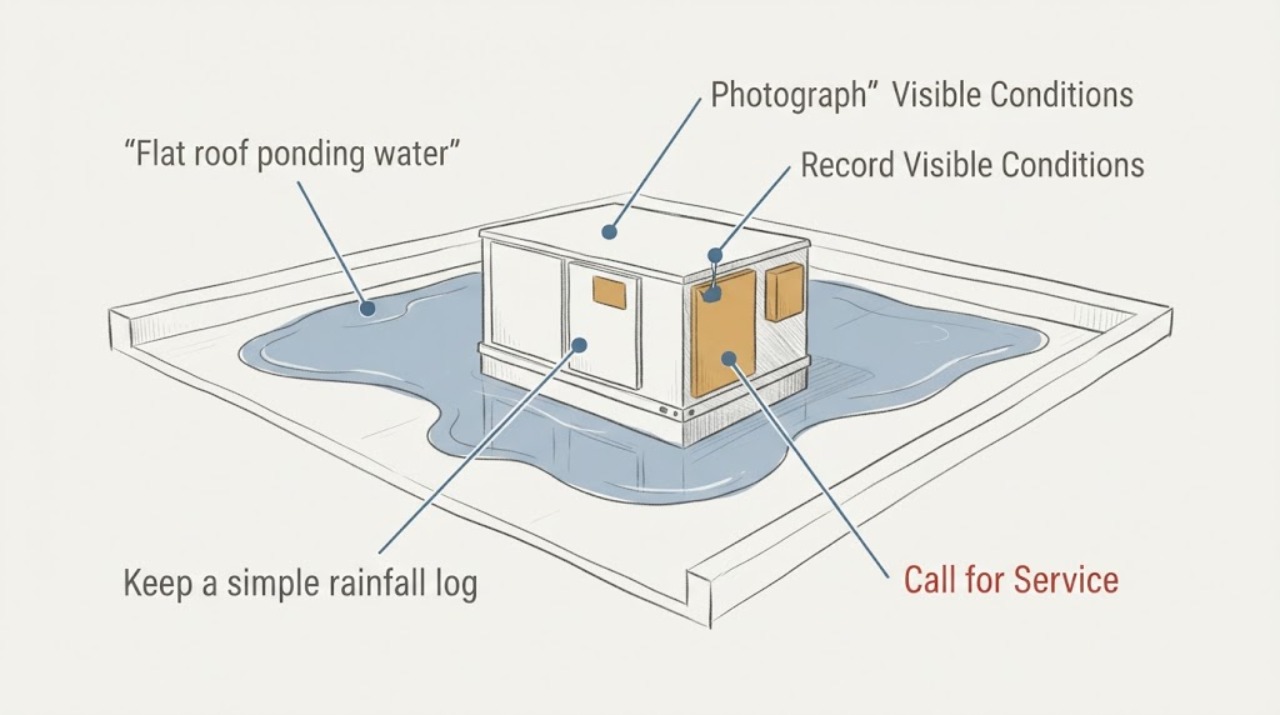
Do not go onto a flat roof to inspect standing water, clear a roof drain, probe the membrane, or apply a patch. From inside and at ground level, document where and when water appears: look for ceiling stains, active drips, bulging drywall, wet insulation or finishes, exterior overflow, and drainage changes during or after rain. Keep clear of a bulging ceiling and any electrical fixture affected by water. Arrange a qualified low-slope-roof professional promptly when ponding repeats, drainage overflows, the ceiling shows damage, or water enters the building; urgent service is warranted for active interior flow or structural warning signs.
Work through in order
Diagnostic checks
Use only checks that match the exact appliance or system and its official guide.
-
Check 1
From the floor, view each affected ceiling and wall area without probing or puncturing it, and photograph the area with a date and room reference.
Expected result: Record a dry stain, a fresh or spreading stain, active dripping, bubbling paint, damp finishes, a sagging or bulging section, or water near a light or other electrical fitting.
Next step: Keep people out from under damaged material, protect belongings only from a safe position, and contact a qualified roofing professional; use an electrician or emergency service when water affects electrical equipment.
Stop if: Stop observing and leave the area if the ceiling sags, cracks, drops material, or water reaches an electrical fitting.
Why this matters
Why: A spreading stain or active drip shows that water is entering now; a bulge or water near electrical equipment creates an immediate interior safety concern rather than a roof-repair experiment.
-
Check 2
From a safe ground-level position, view the building perimeter during or after rainfall and record visible water paths without climbing, reaching onto the roof, or moving a drain cover.
Expected result: Look for overflow at a visible scupper, gutter, downspout, wall edge, or roof-to-wall transition; note whether discharge is continuous, intermittent, or absent and whether water collects against the building.
Next step: Photograph the flow and its location, keep clear of slippery runoff, and give the pattern to the roofing professional for a controlled inspection.
Stop if: Stop if you would need a ladder, roof access, contact with a drain, or movement across wet or unstable ground to see more.
Why this matters
Why: Overflow or discharge in an unexpected location suggests a drainage, outlet, or detailing issue, but a ground view cannot confirm the condition of a concealed roof drain or membrane.
-
Check 3
Keep a simple rainfall log from inside or at ground level for each recurrence, including weather conditions and the room or exterior location where evidence appears.
Expected result: Compare whether the problem follows heavy rain, wind-driven rain, rainfall from one direction, repeated storms, or a dry period after rain; record when the interior evidence first becomes visible without claiming a universal time threshold.
Next step: Send the log with photos and the roof type or age if known, and arrange service when ponding recurs or any interior damage is present.
Stop if: Stop tracking and escalate promptly if interior water is active, the ceiling changes shape, or the weather is creating unsafe conditions.
Why this matters
Why: A pattern tied to rainfall direction or intensity helps the professional distinguish drainage capacity, edge or penetration details, and a possible membrane leak; absence of an immediate drip does not clear the roof.
-
Check 4
From inside, compare affected rooms with adjacent rooms and inspect only accessible finished surfaces for moisture signs; do not probe, open the membrane, or remove ceiling material.
Expected result: Note whether one room, a wall edge, a roof penetration area, or several rooms show stains, odor, dampness, or finish damage, and whether the evidence aligns with a visible exterior drainage path.
Next step: Mark the room locations on a simple sketch and provide it to the professional; do not infer the roof defect from the spot directly above the stain.
Stop if: Stop if inspection requires entering a crawlspace or attic with unsafe footing, touching wet insulation, moving fixtures, or disturbing the ceiling.
Why this matters
Why: A single localized pattern can help the roofer trace a penetration or drainage detail, while several rooms or spreading damage may indicate a broader roof or drainage problem.
-
Check 5
From ground level, photograph the roof edge, visible vents, skylights, parapet areas, and drainage outlets with zoom rather than approaching or stepping onto the roof.
Expected result: Record visible debris at the edge, damaged trim, a displaced cap, overflowing outlet, or a change after a storm; do not treat an apparently intact edge as proof that the membrane or low spot is sound.
Next step: Keep the photographs and storm details for the roofing professional and request a safe, controlled roof and drainage assessment.
Stop if: Stop if the only way to see the feature is roof access, ladder work, reaching over an edge, or walking on a wet surface.
Why this matters
Why: A visible edge or outlet defect can prioritize the service call, while a clear ground view still cannot authorize drain clearing, membrane repair, or rooftop measurement.
Use your observations
Decision map
Find the observation that best matches what you see, then follow the next safe action.
-
PATH 01Next step
What you see
Water is actively entering, the ceiling is bulging or sagging, material is falling, or water is near an electrical fixture.
Do this next
Leave the affected area, do not puncture or touch the ceiling or electrical fitting, and use qualified roofing, electrical, or emergency service as the hazard requires.
-
PATH 02Next step
What you see
Interior staining or dripping follows rainfall and there is no immediate structural or electrical warning.
Do this next
Document the room, timing, rainfall and wind pattern, and arrange prompt qualified low-slope-roof service; do not assume the leak is directly above the stain.
-
PATH 03Next step
What you see
Ground-level observation shows an overflow, unexpected discharge, or water collecting against the building during rain.
Do this next
Photograph the flow from a safe position, keep clear of slippery runoff, and ask a roofing professional to assess the drainage path without clearing a roof drain yourself.
-
PATH 04Next step
What you see
Ponding is reported or visible but there is no current interior leak.
Do this next
Schedule a professional roof and drainage inspection because repeated ponding can indicate inadequate drainage or a low spot; do not use an unsourced time threshold to declare it harmless.
-
PATH 05Next step
What you see
A storm has just passed or wind and rain remain severe.
Do this next
Stay off the roof and wait for safe conditions while recording only interior and ground-level evidence; escalate any active interior flow or structural warning.
Helpful context
Understand the symptom
Why standing water matters
Ponding on a low-slope roof can reflect a blocked or undersized drainage path, a low spot or movement in the roof assembly, or a membrane and flashing problem. Water that reaches the interior may not appear directly below the roof defect because it can travel through the assembly before showing at a ceiling or wall. The safe first step is a time-stamped interior and ground-level record, not a rooftop investigation.
Use rainfall and drainage patterns
Record whether water appears during a light rain, after heavy rain, with wind-driven rain, or only after the rain has ended. From the ground, note overflow at visible scuppers, gutters, downspouts, or wall edges and whether discharge reaches the intended ground drainage. A clear-looking outlet does not prove the roof drain or membrane is sound, and a roof drain must not be cleared from the roof by an unprotected homeowner.
Protect the interior while help is arranged
Move belongings away from a drip only if the floor is safe and no electrical hazard is present. Do not puncture a water-filled ceiling bulge, probe wet drywall, touch a wet light fitting, or stand beneath visibly sagging material. If water is near electrical equipment or the ceiling changes shape, leave the affected area and use a qualified roofer and electrician or emergency service as appropriate.
Only after diagnosis
Potential parts
- roof-sealant
Only consider a sealant after a qualified roofer identifies a compatible membrane, a specific repair location, and a repair method that will not hide a drainage or structural problem.
Roof membranes, primers, weather conditions, and warranties vary; confirm compatibility with the membrane manufacturer and roofing professional before use. - drain-screen
Only consider this category when a professional confirms the roof drain and screen design and determines that a replacement is appropriate and safely accessible.
Confirm drain dimensions, overflow design, membrane detailing, and system requirements; a screen cannot correct a low spot, blocked concealed line, or membrane failure. - moisture-meter
Only consider a meter for a qualified or appropriately trained person documenting accessible interior finishes after a leak; it is not a substitute for roof or membrane diagnosis.
Readings depend on the material and instrument and are comparative rather than a universal pass/fail result; follow the instrument and building professional's guidance.
When checks do not resolve it
Need a professional?
Arrange prompt qualified roofing service for recurring ponding, any interior staining or dripping, visible overflow, storm-related roof evidence, or suspected drainage or membrane failure. Escalate active flow, ceiling deformation, or electrical exposure immediately.
Have this ready
- Provide the address, roof type or age if known, affected room locations, dated photos, rainfall and wind pattern, visible ground-level drainage observations, storm timing, prior repairs, and whether water reached electrical equipment.
Common questions
FAQ
Is ponding water safe if it disappears after rain?
Do not use a universal time threshold to decide. Repeated or visible ponding can indicate inadequate drainage or a low spot even when no interior leak is present, so document it from the ground and arrange a professional assessment.
Can I clear the flat-roof drain myself?
Not from the roof. Do not climb, reach over an edge, remove a drain cover, or walk on a wet membrane. Photograph visible ground-level overflow and have a qualified roofer inspect and clear the drainage system safely.
Why is the ceiling stain not directly below the pond?
Water can travel through roof layers, insulation, framing, and wall or penetration details before it appears indoors. Record the full interior pattern and let the roofing professional trace the source rather than opening the ceiling.
Read the exact guide
Official sources
- Polyiso Roof InsulationGAF · The roofing manufacturer describes positive drainage and tapered systems as design solutions that direct water toward drains; it does not authorize homeowner roof access or repair.
- Green Job Hazards: Green Roofs: Fall ProtectionOccupational Safety and Health Administration · OSHA identifies falls, trips, uneven surfaces, openings, and edge exposure as serious roof-maintenance hazards and requires appropriate fall protection for workers.
- Design Guidelines and Maintenance Manual for Green Roofs in the Semi-Arid and Arid WestU.S. Environmental Protection Agency, Region 8 · Although written for green roofs, the document explains general roof drainage and membrane behavior: drains, slope, overflow components, and ponded water must be evaluated as a system, and membrane work requires experienced professionals.
Community feedback
Share a repair observation
Share a plain-text repair observation. Accepted observations are published automatically; this page may take a moment to update.