
On this page
Start here
Quick answer
Flat-roof insulation replacement is a roof-assembly project, not a safe cosmetic patch. From the ground and finished interior only, document uneven room temperatures, ceiling or wall staining, condensation, damp or musty areas, visible roof-edge changes, and energy or moisture patterns. Do not climb onto the roof, enter a low-clearance roof cavity, pull down ceiling material, disturb insulation, or attempt replacement. Wet insulation, mold-like growth, active leaks, sagging ceilings, suspected hazardous material, or electrical/ventilation conflicts require professional assessment before any insulation decision. A roofing or building-envelope professional should determine whether the cause is the roof membrane, drainage, air leakage, condensation, insulation condition, or the whole assembly.
Before you begin
Safety first
- This is a ground-level and finished-interior observation guide. Do not climb, enter the roof cavity, remove roof or ceiling materials, disturb insulation, cut, drill, seal, or attempt DIY insulation or roof replacement.
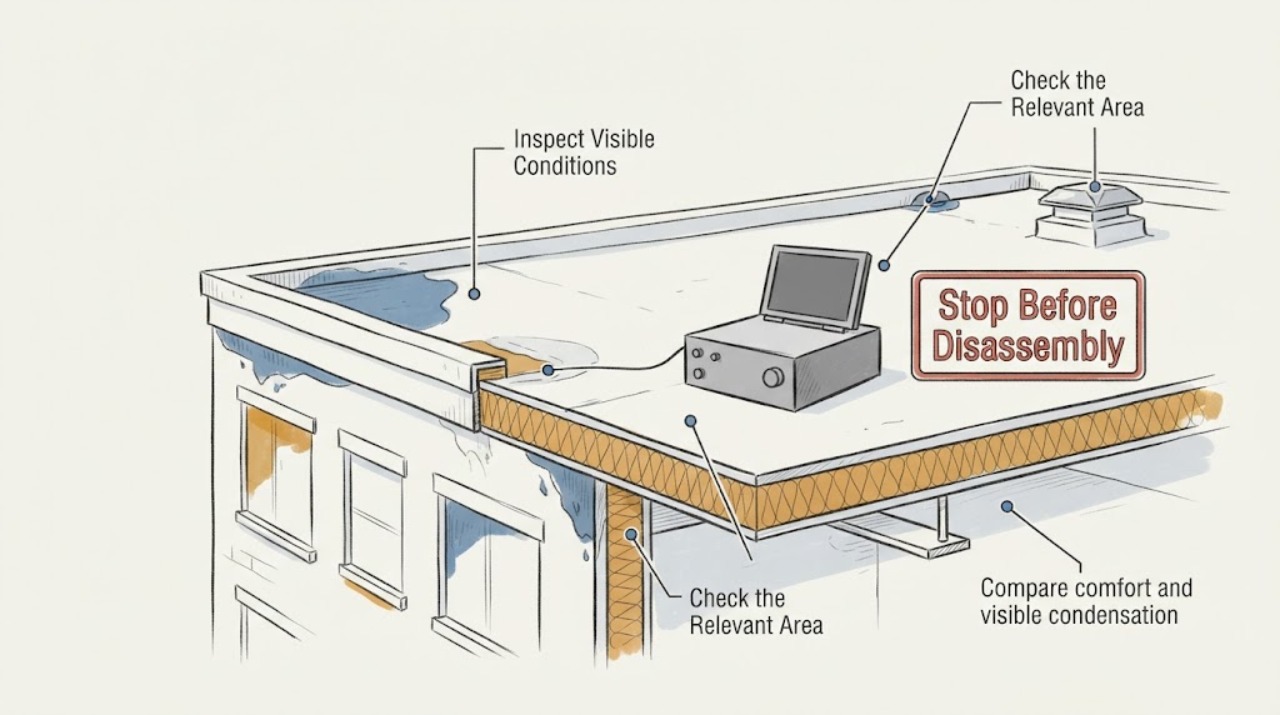
Work through in order
Diagnostic checks
Use only checks that match the exact appliance or system and its official guide.
-
Check 1
From the ground or a normal window view, observe the visible roof edge, parapet, membrane edge, drains, and nearby exterior wall without climbing, reaching, or touching roof materials.
Expected result: Note ponding that is visible from a safe viewpoint, damaged or displaced edge material, staining below the roof line, blocked-looking drainage, or changes that appeared after weather.
Next step: Photograph the exterior from a safe distance and ask a roofing/building-envelope professional to evaluate the roof and insulation relationship.
Stop if: Stop if inspection would require a ladder, roof access, approaching a roof edge, entering a storm area, or working near overhead lines.
Why this matters
Why: Exterior moisture or drainage clues can point to a roof-envelope cause rather than insulation alone, but a ground view cannot confirm the assembly condition.
-
Check 2
From finished interior rooms, look at ceilings, upper walls, corners, and roof-adjacent areas for stains, peeling paint, bubbling finish, dampness, mold-like growth, or sagging without touching, puncturing, or opening surfaces.
Expected result: Record the room, position, size trend by comparison with older photographs, odor, and whether the sign follows rain, snow, thaw, heating, cooling, or high indoor humidity.
Next step: Keep furnishings and occupants clear of unstable areas and provide the photos and timing to a roofing or building professional before any interior opening.
Stop if: Stop and isolate the area if the ceiling sags, material is falling, water is active, mold-like growth is extensive, or moisture is near electrical fixtures.
Why this matters
Why: A stain or condensation pattern can indicate active or past moisture, but it cannot identify whether the roof, insulation, air barrier, or another source is responsible.
-
Check 3
Compare comfort and visible condensation across rooms below the flat roof during ordinary heating or cooling, without changing system settings to create a stress test.
Expected result: Note rooms that remain unusually hot or cold, surfaces that collect condensation, drafts at ceiling or wall junctions, and whether the pattern is seasonal or localized.
Next step: Share the room pattern and seasonal timing with a home-energy or building-envelope professional who can separate insulation performance from other causes.
Stop if: Stop if condensation is accompanied by active water, visible mold-like growth, a musty odor with symptoms, or signs of ceiling or wall instability.
Why this matters
Why: Uneven comfort can be consistent with insulation or air-control differences, but it can also result from HVAC distribution, solar exposure, humidity, or roof leakage.
-
Check 4
Review existing records from the safe living space, such as prior roof repairs, leak dates, renovation history, utility changes, and any visible maintenance notes, without opening the roof or ceiling assembly.
Expected result: Note whether symptoms began after a roof repair, insulation work, HVAC change, interior renovation, severe weather, or a recurring seasonal condition.
Next step: Give the history and photographs to the professional and request an assembly-level assessment before selecting insulation or a replacement scope.
Stop if: Stop if records indicate hazardous material, an unresolved active leak, prior structural damage, or work around wiring, flues, or other building services.
Why this matters
Why: Timing can reveal whether the replacement question is connected to a roof event, an air/moisture-control change, or a longer-standing thermal problem, but it does not establish causation.
-
Check 5
From accessible finished areas, observe ventilation outlets, bathroom or kitchen moisture patterns, and any recurring musty odor near the flat-roof ceiling without disconnecting ducts, opening cavities, or disturbing insulation.
Expected result: Note whether moisture follows showers, cooking, exhaust operation, weather, or occupancy, and whether odor is localized or widespread.
Next step: Report the pattern to the roofing/building-envelope professional and the relevant HVAC or ventilation professional; do not cover or seal symptoms before the source is evaluated.
Stop if: Stop if occupants have breathing or other health symptoms, the odor is strong and persistent, mold-like growth is visible, or the area has active water or electrical risk.
Why this matters
Why: Indoor moisture or ventilation may contribute to roof-assembly condensation, while a localized odor or staining may indicate concealed wet material that needs professional investigation.
Use your observations
Decision map
Find the observation that best matches what you see, then follow the next safe action.
-
PATH 01Next step
What you see
The roof edge and interior are dry, but rooms are persistently uneven in temperature or show a long-standing thermal pattern.
Do this next
Request a professional energy/building-envelope assessment to determine whether insulation, air control, HVAC distribution, or solar exposure is responsible before planning replacement.
-
PATH 02Next step
What you see
There are stains, dampness, condensation, active leaks, musty odor, or mold-like growth.
Do this next
Stop any insulation replacement planning until the moisture source and affected assembly are professionally evaluated and corrected.
-
PATH 03Next step
What you see
The ceiling sags, materials are falling, or water is near electrical fixtures or other building services.
Do this next
Keep occupants clear, avoid the area, and obtain urgent roofing/building and electrical assistance as applicable; do not access the roof or ceiling cavity.
-
PATH 04Next step
What you see
Prior work involved unknown insulation, suspected hazardous material, structural damage, or an inaccessible low-clearance roof cavity.
Do this next
Use a qualified professional with appropriate inspection and material-handling capability; do not disturb or sample the assembly yourself.
Helpful context
Understand the symptom
A flat roof has limited assembly depth, so insulation, air control, vapor movement, drainage, and the roof membrane interact. A cold room or stained ceiling does not by itself prove the insulation needs replacement. The safe first step is to record observable symptoms and the history of leaks, repairs, and seasonal changes for a qualified professional.
Moisture is an important branch. Wet or damp insulation can reflect a roof leak, condensation, plumbing or ventilation issue, or another building-envelope path. Replacing insulation before the moisture source is corrected can leave the new assembly at risk, and opening a concealed cavity can spread contamination or expose hazards.
Flat-roof work often requires coordinated roofing, insulation, ventilation, and interior repair decisions. Keep observations non-destructive and let the professional determine access, assembly design, materials, code applicability, and whether a roof replacement or interior opening is necessary.
When checks do not resolve it
Need a professional?
Arrange a roofing or building-envelope professional assessment when flat-roof insulation appears inadequate, thermal comfort remains uneven, or replacement is being considered. Escalate promptly for active leaks, wet insulation, mold-like growth, ceiling sag, structural concern, hazardous-material suspicion, or electrical/ventilation conflicts.
Safety scope: This is a ground-level and finished-interior observation guide. Do not climb, enter the roof cavity, remove roof or ceiling materials, disturb insulation, cut, drill, seal, or attempt DIY insulation or roof replacement.
Common questions
FAQ
Does a cold room prove the flat-roof insulation needs replacement?
No. Uneven comfort can also come from air leakage, HVAC distribution, solar exposure, humidity, or roof moisture. Record the pattern and obtain an assembly-level professional assessment.
Can I replace the insulation from inside the room?
Do not open the ceiling or disturb a concealed roof cavity as a home test. Flat-roof access can expose moisture, structural, electrical, ventilation, or hazardous-material issues that require professional planning.
What if the insulation is wet?
Treat wet or damp insulation as a moisture-source problem first. Keep clear of unsafe areas and have a roofing or building-envelope professional identify and correct the leak or condensation path before replacement.
What information should I collect for a quote?
Provide room locations, comfort and condensation patterns, photos of interior stains or roof-edge clues from safe viewpoints, leak timing, previous roof or insulation work, and any access or hazardous-material concerns.
Read the exact guide
Official sources
- A Brief Guide to Mold, Moisture and Your HomeU.S. Environmental Protection Agency · EPA identifies roof materials above ceilings as possible hidden-mold locations after leaks or insufficient insulation and advises caution and experienced professionals when investigation would disturb concealed growth.
- About Attic VentilationENERGY STAR · ENERGY STAR explains that insulation and air sealing interact with ventilation and moisture control; this supports evaluating the whole flat-roof assembly rather than choosing replacement material from appearance alone.
- Attic Air Sealing ProjectENERGY STAR · ENERGY STAR lists uneven room temperatures and drafts as symptoms to investigate, and recommends professional correction before insulation work where insulation is wet, moisture damage or mold is present, access is difficult, or ventilation is inadequate.
Community feedback
Share a repair observation
Share a plain-text repair observation. Accepted observations are published automatically; this page may take a moment to update.