
On this page
Start here
Quick answer
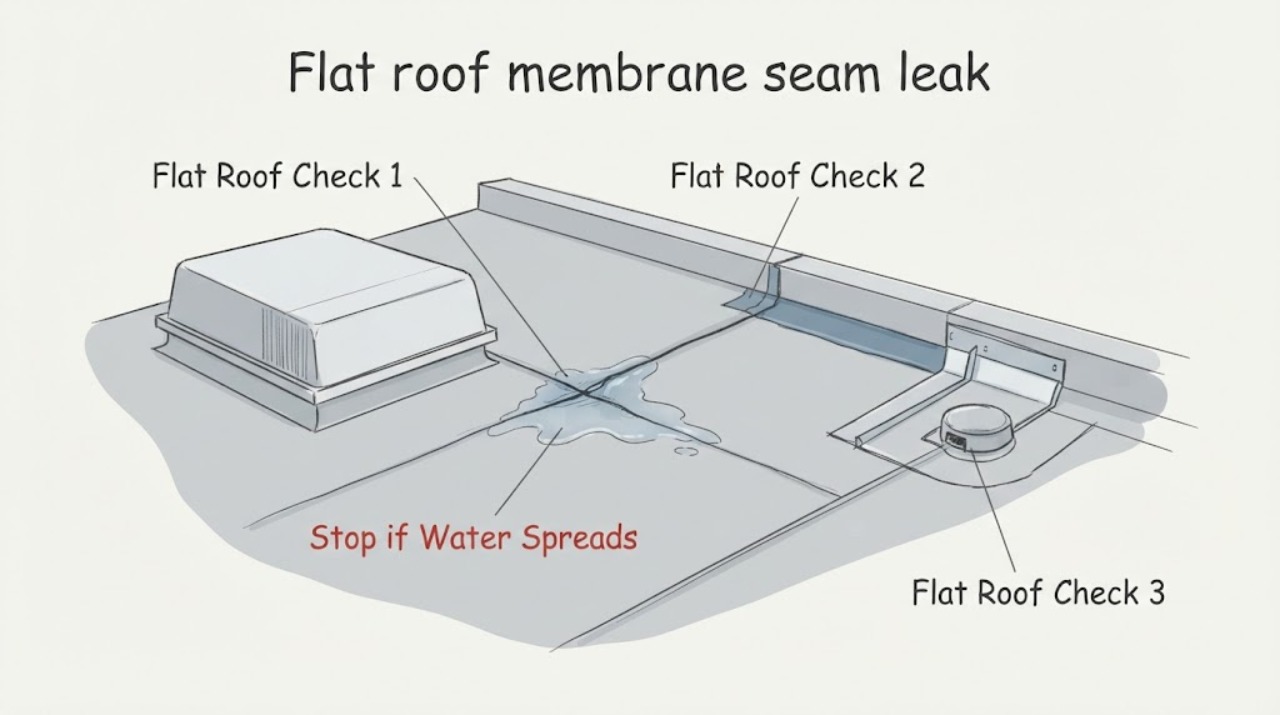
Treat a suspected flat-roof membrane seam leak as a professional roofing inspection, not a DIY roof walk or patch. From inside and from stable ground, document when water appears, where the ceiling or wall is wet, and whether visible roof edges, drains, scuppers, or flashing show ponding or damage. Water can travel sideways before it appears indoors, and a seam-looking stain may actually come from a penetration, edge, drain, or another part of the membrane. Contain interior drips safely, keep people away from unsafe areas, and give the observations to a qualified roofer who can identify the membrane system and use a compatible repair method.
Work through in order
Diagnostic checks
Use only checks that match the exact appliance or system and its official guide.
-
Check 1
From inside the building during or after rain, photograph each drip, stain, blistered finish, or damp area from a dry standing position. Record the room, ceiling or wall location, weather, and whether the water is active, intermittent, or only a past stain.
Expected result: A new drip or expanding damp area indicates current water entry. A dry stain that returns only after rain still indicates a moisture path, while a stain near a wall, vent, light, or other opening may not be directly below the membrane seam.
Next step: Contain drips with a stable container if needed and contact a roofing professional with the photos and timing. Do not open the ceiling or remove finishes to chase the leak.
Stop if: Stop if water is near electrical equipment, the ceiling is sagging, or the floor is slippery or structurally unsafe.
Why this matters
Why: The indoor appearance maps where water emerges, not necessarily where it enters. This record helps a roofer trace the likely path without guessing from one stain.
-
Check 2
From stable ground or another normal-access viewpoint, inspect only the visible roof perimeter, gutters, downspouts, scuppers, drain outlets, and flashing edges. Use photographs or binoculars if helpful; do not climb, lean a ladder against the roof edge, or step onto the membrane.
Expected result: Visible ponding, blocked drainage, debris at an outlet, displaced edge metal, open-looking flashing, or membrane movement after wind gives the roofer a likely area to prioritize. If none of these features can be seen, the seam or penetration may simply be out of view.
Next step: Send the exterior photographs and the interior map to a qualified roofer and request a roof-system inspection. Do not attempt to reach an unseen seam.
Stop if: Stop immediately if the only way to see the suspected seam is to climb, access a fragile roof surface, or work near an unprotected edge.
Why this matters
Why: A ground-level view can identify a drainage or edge clue but cannot clear or certify a membrane seam. Absence of a visible defect does not rule out a roof leak.
-
Check 3
If the interior surface is safely reachable, compare the damp area with a nearby dry-looking area using a moisture meter according to its instructions, and mark the locations on the same room sketch; do not drill, probe, or remove the ceiling.
Expected result: A consistent damp pattern extending beyond the visible stain suggests moisture has traveled or remains in the assembly. A dry reading at the finish does not prove the roof is dry if the membrane, insulation, or deck is hidden from view.
Next step: Give the roofer the sketch, readings, and dates. Ask whether the inspection should include the roof membrane, seams, edge details, drains, penetrations, and the interior moisture path.
Stop if: Stop the meter check if the surface is wet near electrical equipment, the instrument instructions do not cover the material, or the reading requires disturbing a finish.
Why this matters
Why: A meter can add a non-destructive comparison to the report, but it cannot identify the membrane seam or replace a professional roof investigation.
-
Check 4
Compare the leak record with recent wind, heavy rain, snow, roof-drain overflow, or nearby construction and note whether the problem repeats under one condition; do not test the roof by spraying water or applying a temporary membrane patch.
Expected result: A leak that follows heavy rain or wind may point the professional toward drainage, edge, seam, or flashing conditions. A leak that continues in dry weather may involve stored moisture, plumbing, HVAC, condensation, or a different building-enclosure path.
Next step: Update the professional when the leak recurs and keep the interior protected. If the roofer identifies a membrane system, ask for a compatible repair plan and warranty implications before any work begins.
Stop if: Stop all testing if weather is severe, the interior becomes unsafe, or anyone proposes a roof repair without identifying the membrane system and safe access plan.
Why this matters
Why: Timing narrows the investigation but cannot prove a seam is the source. A roof-system professional should determine whether the membrane, drainage, or another component needs repair.
Use your observations
Decision map
Find the observation that best matches what you see, then follow the next safe action.
-
PATH 01Next step
What you see
Water is actively entering, the ceiling is sagging, or electrical equipment may be wet
Do this next
Protect people and contents from a safe location, avoid the electrical hazard, and arrange urgent professional assessment.
-
PATH 02Next step
What you see
A visible drain, scupper, edge, or flashing clue is present
Do this next
Tell the roofer where the clue is and ask that it be checked alongside the suspected seam.
-
PATH 03Next step
What you see
The roofer cannot identify the membrane type or compatible repair method
Do this next
Pause repair authorization and request system identification, written scope, and any warranty or manufacturer requirements.
Helpful context
Understand the symptom
Why a seam-looking stain is not proof of the leak point
Flat and low-slope roofs use a water-control layer that depends on continuous membrane sheets, sealed joints, edges, and penetrations. A leak can enter at one point and travel within the roof assembly before appearing at a ceiling or wall. A failed seam is possible, but so are a drain or scupper problem, a roof-wall transition, flashing, or damage around equipment. The useful first step is to map observations without disturbing the roof.
Keep the inspection at safe observation level
Do not climb onto the roof, use a ladder to reach the membrane, probe a seam, move rooftop equipment, or apply generic tape or sealant. Wet membranes, edges, skylights, and low-slope surfaces can be difficult to judge from a standing position, and an incorrect repair can hide the leak or damage the roof system.
Safety boundary
Stop conditions
- Do not climb the roof, use a ladder to reach the membrane, probe or peel a seam, move rooftop equipment, or perform roofing work as an ordinary-user check.
- Do not apply generic roof tape, sealant, tar, or a membrane patch before the membrane system, leak path, and compatible repair method are identified by a qualified professional.
- Stop and seek urgent help if water reaches electrical equipment, the ceiling sags, the roof edge or access route is unsafe, or interior damage is expanding.
Only after diagnosis
Potential parts
- Roof membrane repair tape
Only consider this search category after a qualified roofer identifies the membrane system and specifies that a compatible tape repair is appropriate.
Membrane type, surface preparation, weather, and warranty requirements control compatibility; do not assume one tape works on EPDM, TPO, PVC, or modified-bitumen systems. - Roof sealant
Only consider this if the professional identifies a sealant-compatible edge, flashing, or seam detail as the repair target.
Use only the product and application method specified for the roof system; a generic sealant can interfere with a proper membrane repair. - Moisture meter
Only consider this as a non-destructive aid for comparing accessible interior surfaces while documenting a leak.
Follow the instrument instructions for the surface material and treat readings as supporting evidence, not proof of membrane condition.
When checks do not resolve it
Need a professional?
Call a qualified roofing or waterproofing professional for any suspected membrane seam leak, especially when water is active, the leak returns after rain, the visible roof area is inaccessible, drainage or flashing may be involved, or the membrane type is unknown. Provide the interior map, dates and weather conditions, ground-level exterior photos, and any safe moisture comparisons.
Have this ready
- Provide the service address, roof type if known, interior leak locations, weather and recurrence pattern, photos of visible edges or drains, any moisture-meter comparison, and information about prior roof work or warranty documents.
Common questions
FAQ
Can I repair a flat-roof membrane seam with generic tape?
Do not assume so. The roof system and membrane type determine the compatible repair, and a generic patch can hide the leak or interfere with the professional repair. Document the leak and ask a qualified roofer to specify the method.
Does an indoor stain directly identify the leaking seam?
No. Water can travel through the roof assembly before appearing indoors. A seam, drain, edge, flashing, penetration, or another roof detail may be the entry point, so provide the interior map and timing to the professional.
What can I safely inspect myself?
Stay inside or on stable ground. Photograph interior dampness, record weather and recurrence, and observe visible edges, drains, scuppers, and flashing without climbing, probing, moving equipment, or disturbing the membrane.
Read the exact guide
Official sources
- Low-Slope ("Flat") RoofsU.S. Department of Energy Building America Solution Center · Official DOE/Pacific Northwest National Laboratory guidance used for explaining membrane continuity, seam sealing, wind-related membrane movement, and the distinction between roof-system design and a consumer repair.
- Factors Affecting the Service Life of Seams of EPDM Roof MembranesNational Institute of Standards and Technology · Official NIST publication used for the limited claim that EPDM seam performance is a known roof-leak mechanism and depends on membrane and seam construction, not a universal DIY repair method.
- Moisture Control Guidance for Building Design, Construction and MaintenanceU.S. Environmental Protection Agency · Official EPA building guidance used for observing open membrane seams, drainage, flashings, roof-wall intersections, ponding, and moisture infiltration without assuming the visible stain is the entry point.
Community feedback
Share a repair observation
Share a plain-text repair observation. Accepted observations are published automatically; this page may take a moment to update.