
On this page
Start here
Quick answer
Peeling or failed paint at a roof-edge fascia does not by itself prove wood rot. From the ground, first note whether the finish is dry and flaking or whether the board looks swollen, soft, sagging, or repeatedly wet after rain. Trace visible water from the gutter, downspout, roof edge, and drip edge, then check whether the fascia or its attachments are changing. Do not climb, walk the roof, spray a hose, peel material, or probe the wood; arrange a roofing or exterior-building professional when moisture, rot, or structural attachment is suspected.
Before you begin
Safety first
- No ladder, roof access, hose test, scraping, peeling, probing, pulling, or temporary support work is included in this observation-only page.
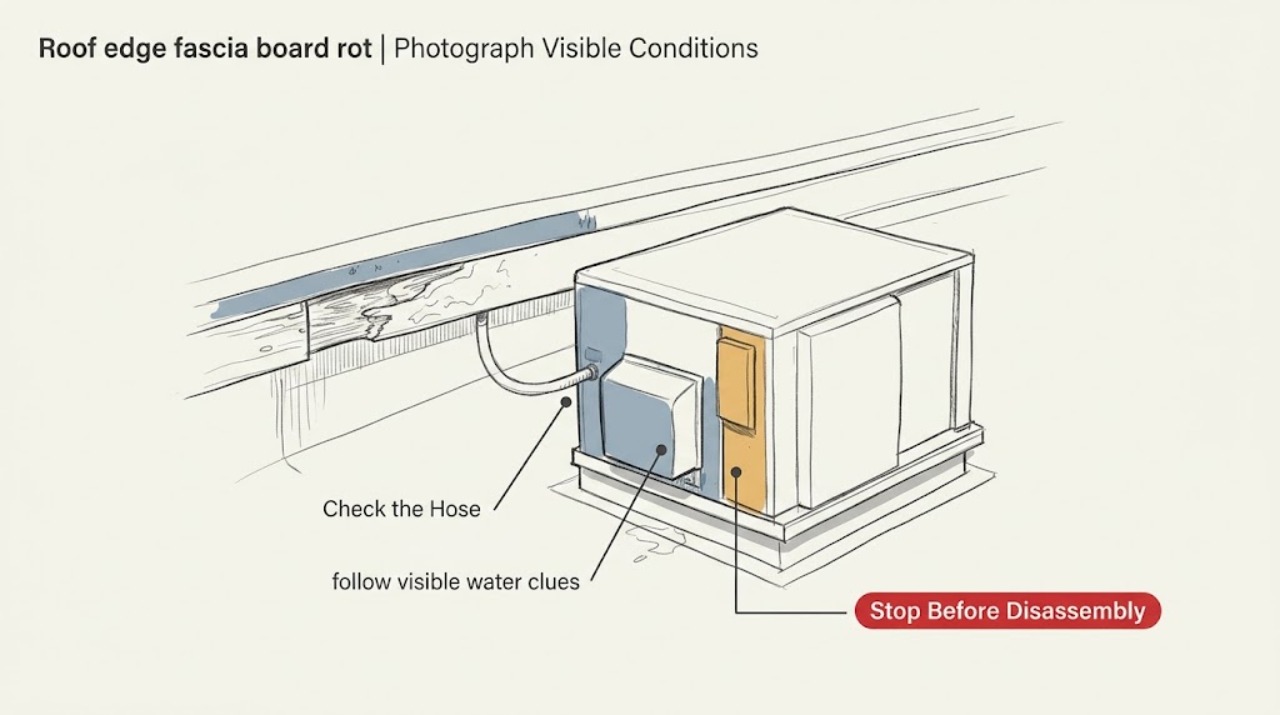
Work through in order
Diagnostic checks
Use only checks that match the exact appliance or system and its official guide.
-
Check 1
From a stable ground-level position, photograph the full roof-edge fascia and close views using a camera zoom or binoculars; do not climb, walk on the roof, or peel the finish.
Expected result: Record whether paint is peeling, chalking, blistering, or faded while the board remains straight and dry-looking, or whether there are dark wet areas, swelling, open joints, sagging, exposed fibers, or visible decay.
Next step: Save the images and mark where the finish failure begins and ends, then compare the pattern with the gutter and rain observations.
Stop if: Stop if material appears loose overhead, debris is falling, the fascia or gutter is moving, or closer inspection would require a ladder or roof access.
Why this matters
Why: Dry, localized flaking or blistering with no visible swelling or moisture supports a paint-failure path, but it does not prove the wood behind the finish is sound. Dark, swollen, sagging, or crumbly-looking material raises a rot or water-damage concern.
-
Check 2
Compare the fascia appearance with the recent weather timeline from the ground, without spraying water or creating a hose test.
Expected result: Note whether the affected area is dry now, becomes visibly wet after rain, remains damp, or shows repeated water streaks and staining at the same location.
Next step: Record the last rain, the delay before wetting appeared, and whether the same area dries between events; provide this timeline to the roofing professional.
Stop if: Stop if rain, wind, lightning, or falling debris makes the area unsafe, or if an observation would require roof or ladder access.
Why this matters
Why: Failure that stays dry and unchanged after ordinary weather can be a finish issue. Wetting, darkening, dripping, or renewed staining after rain points toward a roof-edge or gutter water path that must be corrected before repainting.
-
Check 3
From the ground, follow visible water clues at the gutter, downspout, roof edge, and drip-edge area; do not reach into the gutter, move the downspout, or inspect from above.
Expected result: Record whether water appears to spill over the gutter, bypass the end, run behind the gutter, track along the fascia, or emerge only at a corner after rain.
Next step: Photograph the highest visible stain and the route below it, and ask the professional to inspect the gutter, roof edge, drip edge, and fascia interface as one path.
Stop if: Stop if the gutter is loose, the downspout is unstable, water is near electrical equipment, or any check requires climbing or pulling material.
Why this matters
Why: Overflow marks, a separated downspout, water staining below the gutter, or runoff concentrated at one fascia section supports a drainage or edge-detail inspection. No visible clue does not rule out concealed roof or flashing water entry.
-
Check 4
Use only a ground-level visual comparison to distinguish a dry finish defect from visible board deformation; do not scrape paint, press the wood, or probe with a tool.
Expected result: Compare the affected section with adjacent fascia for straightness, joint width, surface plane, color, and visible wood fibers; note whether damage is isolated or extends along the edge.
Next step: Keep the finish undisturbed and request a professional moisture and substrate assessment before any paint or replacement decision.
Stop if: Stop if inspection would disturb suspect material, release debris, require elevated access, or expose an unstable edge.
Why this matters
Why: Peeling paint without visible board change does not establish rot. Swelling, bowing, open seams, soft-looking exposed fibers, or a persistent dark boundary makes hidden moisture or decay more likely and moves the task beyond cosmetic repainting.
-
Check 5
Inspect the visible attachment line from below, including the fascia-to-gutter, fascia-to-soffit, and roof-edge trim relationships; do not pull, fasten, or adjust any component.
Expected result: Record gaps, sag, bowing, rusted or missing-looking fasteners, detached trim, water staining at joints, or any movement already visible from the ground.
Next step: Photograph the joint and keep people away from the area until a qualified roofer or exterior-building professional confirms the support and water path.
Stop if: Stop immediately for falling material, a visibly detached gutter, structural movement, or any need to stand below a loose section.
Why this matters
Why: A sagging gutter, widening joint, loose-looking trim, displaced soffit, or fascia movement suggests attachment or structural support concerns rather than paint failure alone. A straight, stable assembly narrows but does not eliminate the hidden-moisture question.
-
Check 6
Prepare a service handoff with ground-level photos, paint and board observations, rain timing, gutter or drip-edge clues, attachment changes, and the exact affected elevation.
Expected result: Confirm whether the evidence is dry paint failure, rain-linked wetting, visible swelling or decay, gutter or drip-edge overflow, attachment movement, or an uncertain combination.
Next step: Arrange qualified roofing or exterior-building service before scraping, repainting, or replacing material. Ask the provider to correct the water source before cosmetic restoration.
Stop if: Stop the DIY path if anyone proposes ladder or roof work, hose testing, peeling or probing material, or supporting a loose gutter or fascia.
Why this matters
Why: A location-specific handoff prevents fascia paint failure from being treated as confirmed rot and helps the provider decide whether to address finish, moisture entry, gutter or drip-edge routing, substrate replacement, or structural attachment.
Use your observations
Decision map
Find the observation that best matches what you see, then follow the next safe action.
-
PATH 01Next step
What you see
Paint is dry and peeling or blistered, the fascia remains straight from the ground, and no rain-linked wetting, swelling, or attachment change is visible.
Do this next
Request a professional exterior assessment before repainting; confirm the finish failure and correct any hidden moisture source first rather than assuming rot.
-
PATH 02Next step
What you see
The fascia darkens, stains, or becomes visibly wet after rain, or water tracks behind or over the gutter or at the drip edge.
Do this next
Request a roof-edge, gutter, downspout, and drip-edge water-path inspection. Do not repaint over active wetting or perform a hose test.
-
PATH 03Next step
What you see
The board appears swollen, bowed, sagging, open-jointed, or crumbly, or the condition spreads beyond the painted surface.
Do this next
Treat it as possible rot or substrate damage and arrange qualified roofing or exterior-building service. Do not scrape, probe, or remove the fascia from a ladder.
-
PATH 04Next step
What you see
The gutter, soffit, trim, or fascia attachment looks loose, displaced, or structurally unsupported.
Do this next
Keep people clear and request prompt professional assessment of attachment and falling-material risk, even if no ceiling or roof damage is visible.
-
PATH 05Next step
What you see
The cause cannot be classified from the ground or the next step requires a roof, ladder, hose, or disturbed material.
Do this next
Stop DIY investigation and provide the photos and weather timeline to a qualified professional who can inspect the edge safely.
Helpful context
Understand the symptom
Paint failure and rot are different observations
Dry peeling, blistering, or faded paint can be a finish problem, while swelling, sagging, open joints, darkened wet areas, or crumbly exposed wood can indicate moisture damage. A ground-level view cannot establish the condition behind the finish. Do not scrape, peel, puncture, or press the fascia to decide.
Trace the water path from below
Rain-linked wetting can come from gutter overflow, a separated downspout, roof-edge runoff, drip-edge or flashing details, or an attachment gap. Look for streaks, overflow marks, staining below the gutter, and wet areas visible from the ground. Do not use a hose test or climb to inspect the roof edge.
Attachment movement changes the urgency
Fascia can also support or border gutters and connect to soffit and roof-edge assemblies. A sagging gutter, widening gap, loose-looking trim, bowing board, or visible movement is not a paint-only repair. Keep people clear of falling-material risk and have a qualified professional inspect the water path and structure together.
When checks do not resolve it
Need a professional?
Call a qualified roofing or exterior-building professional when wetting recurs, wood appears swollen or decayed, the gutter or fascia moves, the water path is uncertain, or the repair would require a ladder, roof, or disturbed material.
Safety scope: No ladder, roof access, hose test, scraping, peeling, probing, pulling, or temporary support work is included in this observation-only page.
Have this ready
- Provide ground-level photos, affected elevation, dry versus wet appearance, rain timing, gutter or drip-edge clues, swelling or decay observations, and any loose or sagging attachment.
Common questions
FAQ
Does peeling fascia paint prove the board is rotten?
No. Dry peeling or blistering can be a finish failure. Visible swelling, sagging, open joints, dark wetting, exposed fibers, or recurring rain-linked staining make moisture damage more likely, but the hidden condition cannot be established by scraping or probing from a ladder.
How can rain timing help identify the cause?
If the area stays dry and unchanged, a finish path is more plausible. If it darkens, drips, or stains after rain, trace visible clues at the gutter, downspout, roof edge, and drip edge. Do not use a hose to create a test.
Can I repaint the fascia now?
Do not repaint over active wetting, swelling, rot, or an unresolved gutter or roof-edge water path. Have a professional confirm the substrate and correct the source before cosmetic restoration.
Should I touch or probe the fascia to check for soft wood?
No. Keep the observation visual and ground-level. Pressing, scraping, puncturing, or peeling can release debris, worsen damage, and still fail to show the condition behind the finish.
When should this be treated as structural or urgent?
Escalate promptly for a sagging or detached gutter, bowing or loose fascia, widening joints, falling material, water entering the building, or any need for ladder or roof access. Keep people clear and arrange qualified roofing or exterior-building service.
Read the exact guide
Official sources
- Mold and Your HomeU.S. Environmental Protection Agency · EPA explains that moisture can condense or enter from leaks, that moisture control prevents mold, and that hidden moisture sites require caution and professional assessment.
- Moisture Barrier and Flashing on the Roof: Water-Managed Roof Assembly or Roof Water Barrier SystemU.S. Department of Energy Building Science Education · DOE Building Science Education explains that roof water intrusion can damage insulation, foster mold, and start structural rot, supporting water-path inspection before cosmetic repair.
Community feedback
Share a repair observation
Share a plain-text repair observation. Accepted observations are published automatically; this page may take a moment to update.