
On this page
Start here
Quick answer
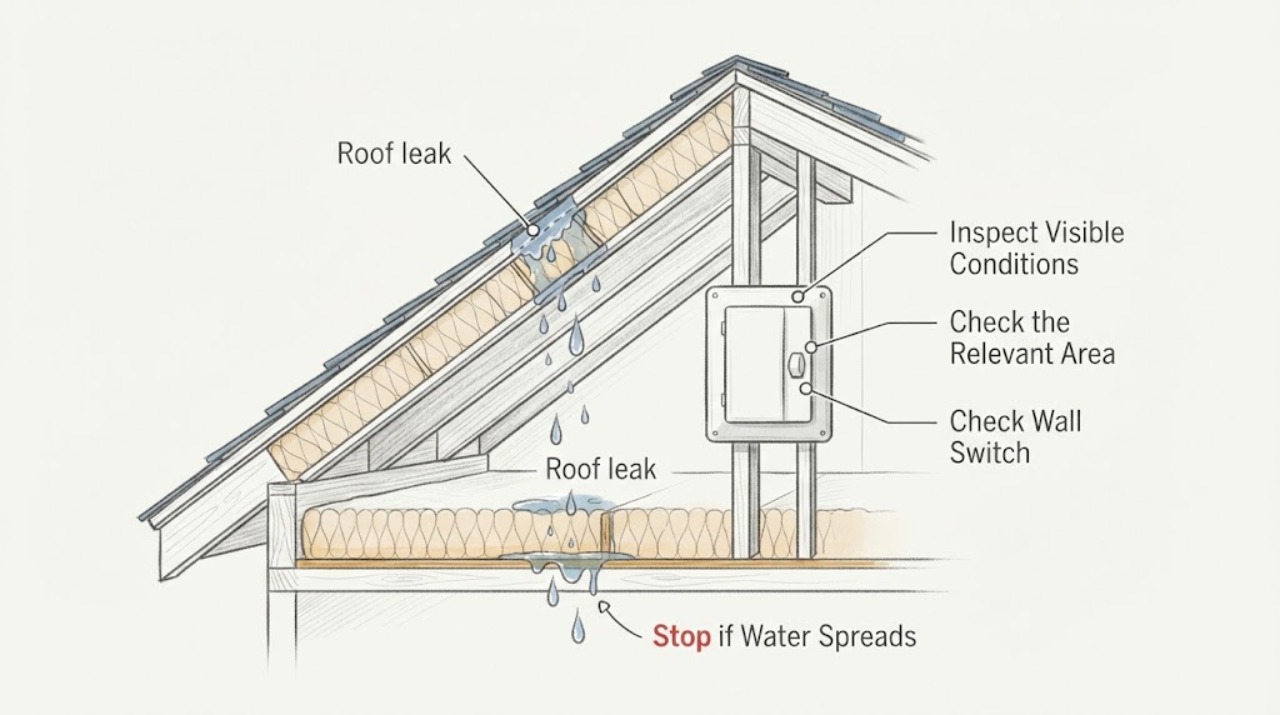
Treat a roof leak as an active water-intrusion and safety problem, not a reason to climb onto the roof. From inside on dry flooring and from ground level outside, record when water appears, where the ceiling or wall is changing, how the pattern relates to rain or wind, and whether electrical equipment or a ceiling surface is involved. Catch water only from a stable, safe position if you can do so without standing under a bulge. Keep people away from sagging or falling material, wet electrical equipment, and roof edges, and arrange urgent professional roof and water-damage assessment.
Work through in order
Diagnostic checks
Use only checks that match the exact appliance or system and its official guide.
-
Check 1
From a dry, stable position indoors, look at the ceiling and upper wall around the visible stain without touching, puncturing, or standing beneath a bulge. Record the shape, spread, color, cracking, sagging, and whether the area changes while it is raining.
Expected result: A dry, stable stain is different from active dripping, a growing ring, bubbling paint, a soft-looking surface, or a sagging section that could release material.
Next step: Photograph the ceiling and wall from a safe location, note the room and approximate boundary, and arrange roof-leak assessment. Keep the area below a bulge clear.
Stop if: Stop and isolate the room if the ceiling bows, cracks, sheds material, drips heavily, or appears likely to fall. Do not touch or puncture it.
Why this matters
Why: The pattern and change over time help the professional judge urgency and possible water travel, but the stain does not identify the roof defect by itself.
-
Check 2
Record the timing of water or staining relative to rain, wind direction, snow or ice conditions, and the end of the weather event. Observe only from indoors or from ground level; do not go onto the roof or use a ladder.
Expected result: A leak that starts during rain, after wind-driven rain, or only after the roof is wet gives different information from a stain that appears during dry weather or continues long after precipitation.
Next step: Write a simple timeline with weather conditions and take ground-level photos of roof edges, gutters, and visible exterior staining only if no approach or height risk is involved.
Stop if: Stop outside observation during lightning, high wind, icy conditions, unstable ground, or any need to climb, reach, or approach the roof edge.
Why this matters
Why: Weather correlation helps the roofer prioritize roof surfaces, flashing, drainage, or another moisture path, but it is not a diagnosis and does not justify a roof inspection by the homeowner.
-
Check 3
From a safe position, identify whether the indoor leak is near a light fixture, outlet, appliance, smoke alarm, HVAC register, or other electrical equipment. Look without touching wet surfaces, switches, cords, or fixtures.
Expected result: A stain away from electrical equipment remains a water-damage concern; water at or inside an electrical fixture, flickering, smoke, sparks, or a burning odor is an immediate electrical-safety escalation.
Next step: Keep people away and contact a qualified electrician or emergency service as appropriate. Tell the roofer and restoration professional that electrical equipment may be affected.
Stop if: Stop immediately for sparks, smoke, burning odor, shock, wet electrical equipment, or a need to touch a switch or fixture in the wet area.
Why this matters
Why: Water and electricity can create shock and fire hazards, so the repair sequence may require qualified electrical isolation before roof or ceiling work.
-
Check 4
From ground level or a window, look for visible exterior clues such as missing-looking roofing, displaced edge material, damaged flashing that can be seen without approaching, blocked-looking drainage, or water marks on walls. Do not climb, reach, probe, or remove anything.
Expected result: A visible exterior change that aligns with the indoor timing is useful for the roofer; no visible change does not rule out concealed flashing, underlayment, or penetration problems.
Next step: Take photos from the ground or window and provide the direction and location to the roofing professional. Leave all roof materials and drainage components untouched.
Stop if: Stop if the view requires a ladder, roof access, standing under an unstable edge, storm inspection, or approaching loose debris.
Why this matters
Why: Exterior observations can connect the indoor symptom to an area for professional inspection while avoiding roof access and concealed-condition claims.
-
Check 5
Note the condition of nearby flooring, furnishings, insulation that is already visible without opening anything, and wall or ceiling materials. Record musty odor, repeated dampness, visible mold-like growth, or whether the area has remained wet since the leak began.
Expected result: A small, promptly contained wet mark differs from widespread wet materials, persistent dampness, musty odor, or suspected contamination that may extend into hidden cavities.
Next step: Keep occupants away from suspect material, provide the timeline and photos to the professionals, and allow them to determine safe drying, removal, or remediation.
Stop if: Stop if material is falling, mold is being disturbed, sewage or contaminated water is present, or observation would require opening a ceiling or wall.
Why this matters
Why: Extent and duration help determine whether roofing alone is sufficient or whether a restoration or mold professional should assess hidden moisture and porous materials.
Use your observations
Decision map
Find the observation that best matches what you see, then follow the next safe action.
-
PATH 01Safety boundary
What you see
There is active dripping, a growing ceiling bulge, sagging material, falling debris, or a ceiling that may collapse.
Do this next
Move people and pets away from the room, keep clear of the area below the damage, and request urgent roof and water-damage help. Use emergency services for an immediate collapse or other emergency.
Why this path and its safety boundary
Safety stop: Do not stand under the bulge, puncture the ceiling, pull down material, or attempt an interior patch.
-
PATH 02Safety boundary
What you see
Water is near a light, outlet, appliance, HVAC equipment, or other electrical component, or there is smoke, spark, burning odor, or shock.
Do this next
Keep everyone away and contact qualified electrical or emergency help before approaching the wet equipment. Tell the roofing and restoration professionals about the electrical involvement.
Why this path and its safety boundary
Safety stop: Do not touch switches, fixtures, cords, wet surfaces, or electrical equipment in the affected area.
-
PATH 03Safety boundary
What you see
The leak appears only during or after rain, with no immediate interior collapse or electrical hazard.
Do this next
Document rain and wind timing, interior spread, and ground-level exterior clues, then arrange urgent professional roof inspection. Keep the area protected from further occupancy damage only using safe, non-contact measures.
Why this path and its safety boundary
Safety stop: Do not climb, walk on the roof, use a ladder, apply sealant, place a tarp, or perform storm-time roof work.
-
PATH 04Safety boundary
What you see
The stain is old or currently dry but there is persistent odor, recurring dampness, visible mold-like growth, or extensive porous-material damage.
Do this next
Arrange roof-source assessment plus a qualified water-damage or mold assessment, and keep occupants away from material that may be disturbed.
Why this path and its safety boundary
Safety stop: Do not scrape, sand, paint, caulk, or disturb suspect mold or hidden wet material.
Helpful context
Understand the symptom
The wet spot on a ceiling is not necessarily directly below the roof entry. Water can travel along framing, insulation, or finish materials before it appears indoors. The useful first record is the timing and location of the interior symptom, its spread, and the weather conditions—not a risky attempt to locate the source from the roof surface.
This is an observation-only assessment. Do not climb a ladder or roof, walk on shingles, puncture the ceiling, pull down wet material, remove roof covering, or apply a temporary roof patch. Keep children and pets away from the affected room and the exterior work area.
Active water, a ceiling bulge, sagging material, a wet light or outlet, smoke, sparks, or falling debris changes the priority. Isolate people from the hazard and use qualified roof, electrical, restoration, or emergency help as appropriate.
EPA guidance emphasizes fixing the moisture source, drying water-damaged areas, and using experienced professionals when damage is extensive, contaminated, or hidden. A roof professional should assess the roof and flashing; a water-damage professional can assess wet interior assemblies after the source is controlled.
Only after diagnosis
Potential parts
- roof-repair sealant
Consider this category only if a qualified roofer identifies a compatible, localized repair and confirms that sealant is an appropriate part of the repair plan.
Roofing material, weather exposure, substrate, and repair method must be verified by the roofer; a generic product is not a diagnosis or a substitute for repair. - temporary roof tarp
Consider this only when a qualified professional determines that temporary weather protection is safe and suitable before permanent repair.
Placement and securement are height and wind hazards; the professional must select the method for the roof condition and weather. - leak-detection moisture meter
A moisture meter may help a qualified assessor map wet interior materials or track drying after the roof source is controlled.
Readings vary by material, instrument, and method; have an experienced professional interpret them without relying on an unsupported threshold.
When checks do not resolve it
Need a professional?
Arrange urgent roofing service for active or recurring water intrusion. Add water-damage or mold assessment for spreading, persistent, hidden, or contaminated moisture. Use qualified electrical or emergency help for wet electrical equipment, smoke, sparks, shock, falling debris, or a collapsing ceiling.
Have this ready
- Provide dated interior photos, room and ceiling-wall locations, leak timing versus rain and wind, ground-level exterior photos, water volume, spread, odor, material condition, and any electrical involvement. Explain that no roof access, ceiling puncture, temporary patch, or material disturbance was attempted.
Common questions
FAQ
Should I climb onto the roof to find the leak?
No. Observe from inside and from ground level only. Roof walking, ladders, storm inspection, and temporary patching can create a fall or structural hazard; arrange a professional roof inspection.
What should I do about a ceiling bulge?
Keep everyone away from the area below it and do not puncture, touch, or pull it down. Request urgent roof and water-damage help, and use emergency services if collapse is imminent.
What if the leak is near a light or outlet?
Keep away from the wet electrical equipment and do not touch the switch, fixture, cord, or wet surface. Contact qualified electrical or emergency help, then tell the roofing and restoration professionals.
Can I put a tarp or sealant on the roof temporarily?
Not as a homeowner roof procedure in this workflow. A qualified roofer must decide whether temporary weather protection is safe and compatible with the roof and conditions.
Read the exact guide
Official sources
- Home Inspections for HomeownersFederal Emergency Management Agency · Provides government context that roof and ceiling damage can threaten electrical components and that inspections consider roof, ceiling, wall, and utility conditions.
- Mold Cleanup in Your HomeU.S. Environmental Protection Agency · Supports fixing water problems, drying affected items, and using experienced professionals for extensive, hidden, or contaminated damage.
- A Brief Guide to Mold, Moisture and Your HomeU.S. Environmental Protection Agency · Identifies roof materials above ceiling tiles as a possible hidden moisture location and supports source control before repair or cleanup.
Community feedback
Share a repair observation
Share a plain-text repair observation. Accepted observations are published automatically; this page may take a moment to update.