
On this page
Start here
Quick answer
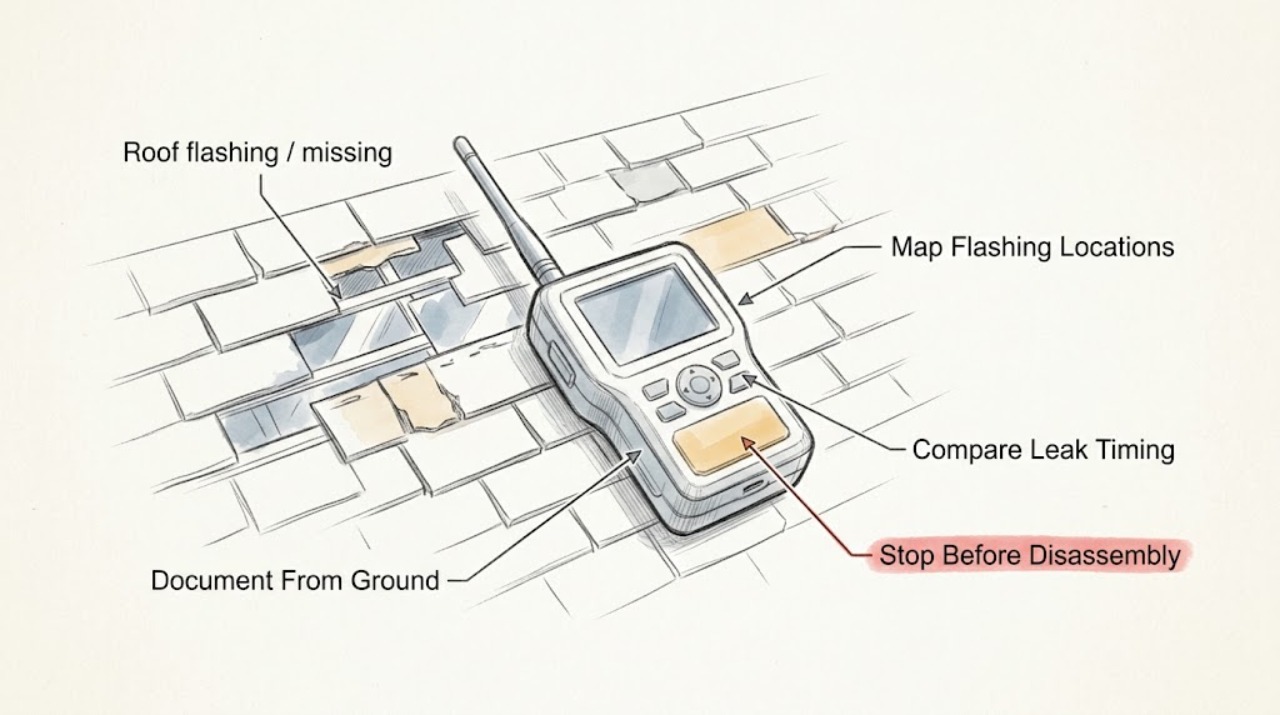
Treat missing or damaged shingles and questionable flashing as a roof-water-entry problem until a qualified roofer confirms otherwise. From the ground and from safe interior locations, document missing or shifted shingles, exposed metal, stains, dampness, and when the symptom appears. Pay particular attention to roof-wall intersections, valleys, eaves, gutters, and penetrations such as vents or chimneys. Do not climb onto a wet, icy, steep, or damaged roof or try to lift shingles or flashing; arrange prompt roofing service when there is active leaking, visible deck or wall damage, unsafe access, or an uncertain water path.
Work through in order
Diagnostic checks
Use only checks that match the exact appliance or system and its official guide.
-
Check 1
From the ground or another stable location, photograph the roof slope, eaves, ridge, wall intersections, and any visible roof penetrations. Do not climb, lift shingles, pull flashing, or use a ladder to extend the inspection.
Expected result: Record missing, lifted, torn, cracked, or wind-shifted shingles; exposed underlayment or metal; loose-looking flashing; displaced ridge material; and debris or impact marks.
Next step: Send the photos and the affected slope or roof feature to a qualified roofer for a safe close inspection.
Stop if: Stop if the only way to see the area is to climb, stand below falling material, or approach during wind, rain, snow, ice, or other slippery conditions.
Why this matters
Why: A visible covering defect can expose the water-shedding layers, but the photo cannot show whether the underlayment, flashing laps, or roof deck below are damaged.
-
Check 2
Use the exterior photo and the building layout to identify nearby roof-wall intersections, valleys, eaves, gutters, chimneys, vents, skylights, and other penetrations without removing any roof or wall material.
Expected result: Note whether the suspected damage is at a wall junction, where runoff enters a gutter, around a penetration, in a valley, or near an eave; also note gutter overflow, a missing diverter, streaks, or water directed toward the wall.
Next step: Tell the roofer the exact feature and direction of water flow so the inspection can follow the drainage path rather than replacing a random visible shingle.
Stop if: Do not pry siding, cut housewrap, remove a vent or chimney cover, or reach behind flashing to confirm the detail.
Why this matters
Why: A roof-wall intersection or penetration is a high-risk water-management detail. Missing or inadequate step or kick-out flashing can let runoff enter the wall cavity or travel behind the roof covering.
-
Check 3
Record when water appears and compare it with rain direction, wind, snow or ice conditions, gutter overflow, and the location of an interior stain. Inspect only already accessible ceiling, attic, or upper-wall surfaces; do not enter a confined or unsafe space.
Expected result: The symptom may occur only during wind-driven rain, after snow or ice buildup, whenever water enters a valley or penetration, or long after the roof surface looks dry. The interior stain may be offset from the exterior feature.
Next step: Photograph the interior evidence, protect belongings from active drips without climbing, and request prompt service when moisture is recurring or spreading.
Stop if: Stop if the area is wet near electricity, the ceiling is sagging, the attic or crawlspace is unsafe, or investigation would disturb insulation, mold, or damaged structure.
Why this matters
Why: Timing and location narrow the likely drainage path, but an intermittent or offset leak still requires a roof-assembly inspection. Water entering the assembly can damage insulation and framing before a large interior drip appears.
-
Check 4
From safe, accessible locations, look for secondary effects: ceiling or wall staining, damp insulation, musty odor, peeling interior finish, swollen sheathing visible at an existing opening, or water collecting near electrical equipment.
Expected result: Note whether the effect is new, enlarging, soft, odorous, moldy, or associated with a sagging ceiling, exposed wiring, or active dripping.
Next step: Keep people and belongings clear, stop using affected electrical equipment if it is safe to do so, and arrange qualified roofing or building-envelope assessment.
Stop if: Stop immediately for a sagging ceiling, exposed or wet electrical parts, structural movement, extensive mold, contaminated water, or any need to open the assembly.
Why this matters
Why: Secondary effects raise the possibility that water has reached the roof deck, insulation, wall cavity, or framing rather than remaining a shingle-only defect. A normal interior view does not rule out concealed water entry.
-
Check 5
Before ordering material or accepting a surface patch, collect the roof covering type, approximate age, prior repair history, affected roof feature, leak timing, photos, and any accessible manufacturer or installation information.
Expected result: The roof may have matching shingles available, a discontinued covering, multiple repair layers, or a flashing detail that must be integrated with underlayment and wall drainage layers.
Next step: Give the record to a qualified roofer and ask for the diagnosed water path, the condition below the covering, and the proposed flashing and shingle scope before work begins.
Stop if: Do not cut, nail, seal, or install roofing materials yourself when the repair requires roof access, removal of integrated layers, or an uncertain compatibility decision.
Why this matters
Why: Material appearance alone does not establish compatibility, and a shingle replacement cannot correct missing step flashing, a failed diverter, damaged underlayment, or a compromised roof deck.
Use your observations
Decision map
Find the observation that best matches what you see, then follow the next safe action.
-
PATH 01Next step
What you see
Missing, lifted, or damaged shingles are visible from the ground, but there is no active leak, unsafe access, or sign of secondary damage.
Do this next
Arrange a roofer to inspect the shingle, underlayment, nearby flashing, and roof deck and to confirm the compatible repair scope.
Why this path and its safety boundary
Why it matters: The covering defect needs a planned roofing assessment, but the safe next step is documentation and material identification rather than an unprotected climb or a guessed patch.
-
PATH 02Next step
What you see
The leak or damage aligns with a dormer, chimney, vent, skylight, valley, roof-wall junction, eave, or gutter transition.
Do this next
Request a focused inspection of the flashing integration and runoff path before accepting shingle-only replacement.
Why this path and its safety boundary
Why it matters: A flashing or drainage-plane failure becomes more likely than an isolated shingle blemish. Water may be entering behind the covering or wall layers.
-
PATH 03Next step
What you see
Water is actively entering, interior staining is enlarging, insulation or framing is damp, or the leak appears intermittently after weather events.
Do this next
Protect the interior and belongings from a safe position and arrange prompt roofing or building-envelope service; do not open the assembly yourself.
Why this path and its safety boundary
Why it matters: The roof assembly may already be taking on water, and concealed damage can extend beyond the visible ceiling or shingle area.
-
PATH 04Next step
What you see
Inspection would require climbing in wet, icy, windy, steep, damaged, or otherwise unprotected conditions, or there is a sagging ceiling, exposed electricity, falling material, or structural movement.
Do this next
Keep people away, stop the inspection, and contact a qualified professional; use emergency assistance when there is immediate danger.
Why this path and its safety boundary
Why it matters: The observation has crossed into a fall, electrical, or structural hazard and further homeowner testing can increase harm.
Helpful context
Understand the symptom
Why shingles and flashing are one water-management system
Shingles shed most rain, while flashing and underlayment help manage water at edges, wall intersections, valleys, and penetrations. A missing shingle can expose the layers below; damaged, absent, or poorly integrated flashing can direct water into the roof or wall assembly instead of away from it. The visible leak or stain may therefore be below or beside the actual entry point.
Read the pattern before choosing a repair
A leak that begins after wind-driven rain near a dormer, chimney, vent, or roof-to-wall junction points toward a detail that needs inspection, not simply a tube of sealant. A ceiling stain can remain after the roof has dried, and no interior stain does not prove that the roof is watertight. Record the pattern and let the roofer inspect the layers that cannot be safely seen from the ground.
Temporary protection and permanent repair are different decisions
Keeping people and belongings away from a leak and arranging prompt service limits exposure, but a temporary cover or surface patch does not establish that the shingle, flashing, underlayment, or roof deck is sound. The replacement material and installation detail must match the existing roof assembly and the cause of the damage.
Safety boundary
Stop conditions
- Do not climb onto a roof or ladder to inspect missing shingles or flashing when access is wet, icy, windy, steep, damaged, or unprotected.
- Do not lift shingles, pull flashing, cut roofing layers, open a wall, or apply a guessed sealant as a routine diagnostic step.
- Stop for active water near electricity, a sagging ceiling, falling material, structural movement, extensive mold, or contaminated water.
- Keep people and belongings clear of the affected area and arrange qualified service; seek emergency assistance for immediate danger.
Only after diagnosis
Potential parts
- matching roofing shingles
Consider this category only after a roofer confirms the visible shingle damage and identifies the existing covering and the condition below it.
Match the existing roof system, exposure, material, and installation requirements; appearance alone does not establish compatibility. - step flashing
This category is relevant only when inspection finds missing, damaged, or poorly integrated flashing where a roof meets a wall.
The flashing must integrate with the roof covering and wall drainage layers; a generic metal shape is not a confirmed repair. - kick-out diverter flashing
Consider this category only when runoff at a roof-wall eave is spilling toward the wall or the existing diverter is missing or inadequate.
Sizing and integration with the water-resistant barrier and gutter are site-specific and should be confirmed by a qualified roofer. - roof underlayment or eave membrane
This category may be needed only if the inspection finds damaged underlayment or an eave water-entry condition such as ice-dam backup.
Climate, roof edge, existing layers, and local installation requirements control; do not choose a membrane from a product photo alone.
When checks do not resolve it
Need a professional?
Arrange prompt roofing service for missing or damaged shingles, exposed flashing, recurring moisture, or a leak near a roof-wall intersection, valley, eave, gutter, chimney, vent, or skylight. Call urgently when water is actively entering, the ceiling is sagging, electricity is affected, material is falling, or the roof cannot be observed safely.
Common questions
FAQ
Can I replace one missing shingle without checking the flashing?
Do not assume the missing shingle is the whole problem. First document the area and identify nearby walls, valleys, eaves, gutters, and penetrations. A roofer should check the underlayment, flashing integration, and roof deck before confirming a shingle-only repair.
Why can a roof leak appear away from the missing shingle or flashing?
Water can travel through roof and wall drainage layers before appearing at an interior ceiling or wall. The stain or drip may be below or beside the entry point, especially around roof-wall intersections and penetrations.
Should I climb up to take a closer photo of damaged roof flashing?
No. Use ground-view or safe interior photos and arrange a qualified roofing inspection. Roofing work has serious fall hazards, and wet, icy, windy, steep, or damaged surfaces increase the risk.
Is a roof sealant enough when flashing is missing?
Not necessarily. Flashing must work with the roof covering and wall drainage layers to direct water away. A surface seal can conceal a missing or poorly integrated detail while water continues behind the assembly.
When is a missing-shingle problem urgent?
Arrange prompt service for active leaking, enlarging interior stains, damp insulation, exposed roof layers, or damage near a wall, valley, eave, gutter, chimney, vent, or skylight. Stop and keep people clear for a sagging ceiling, exposed electricity, falling material, structural movement, or unsafe roof access.
Read the exact guide
Official sources
- Installing Self-Sealing Membrane at EavesU.S. Department of Energy, Building Science Education · General eave and cold-climate guidance; climate zone and existing assembly determine applicability.
- Kick-out Flashing at Roof-Wall IntersectionsU.S. Department of Energy, Building Science Education · General roof-wall runoff guidance; sizing and integration depend on the existing building assembly.
- Step Flashing at Roof-Wall IntersectionsU.S. Department of Energy, Building Science Education · General roof-wall flashing guidance; the existing roof and wall drainage layers require site-specific assessment.
- Water-managed Roof AssemblyU.S. Department of Energy, Building Science Education · General roof-assembly guidance; the installed roof, climate, and local requirements control.
- Fall Protection in Residential Construction - OSHA Guidance DocumentOccupational Safety and Health Administration · OSHA guidance is written for residential construction employers; it supports the article's decision to avoid unprotected roof access, not a homeowner work plan.
Community feedback
Share a repair observation
Share a plain-text repair observation. Accepted observations are published automatically; this page may take a moment to update.