
On this page
Start here
Quick answer
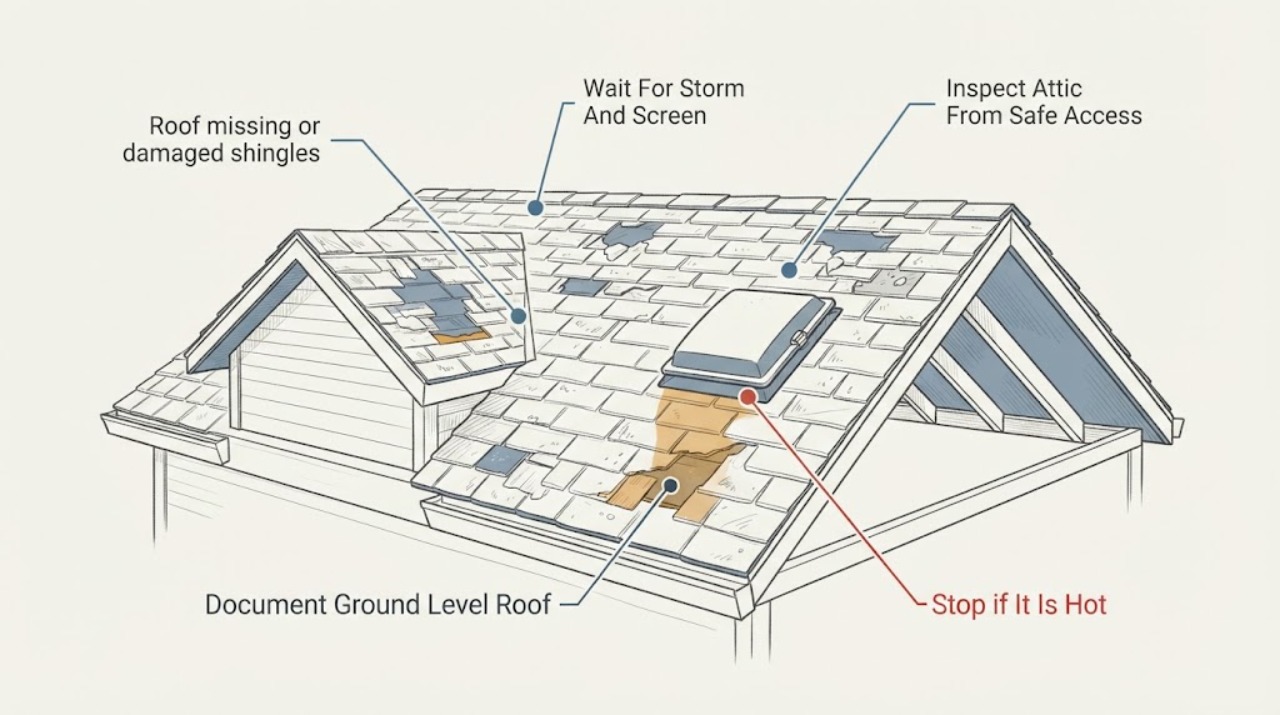
After hail, missing shingles need prompt weather protection, but a dented gutter or a few loose granules do not by themselves prove that every shingle needs replacement. Stay indoors until the storm and lightning have passed. From inside, look only from a safe attic access point for daylight, wet decking, or a sagging area; from the ground, photograph missing, cracked, curled, or displaced shingles, bent flashing, dented gutters or vents, and debris. Do not climb a ladder or roof, walk on a damaged surface, pull at shingles, or nail a patch. Hail impact can leave random dents, fractures, granule loss, or less-visible damage that develops later, so a qualified roofer should inspect the roof system and arrange a professional temporary cover when water can enter. Active leaks, an unstable ceiling, fallen trees, exposed wiring, or an unsafe structure make the call urgent.
Before you begin
Safety first
- This article supports storm-safe containment, ground-level photography, and observation from a safe attic access point only. A qualified roofer must handle ladders, roof access, debris removal, tarping, shingle and flashing work, leak tracing, and deck or structural assessment.
Work through in order
Diagnostic checks
Use only checks that match the exact appliance or system and its official guide.
-
Check 1
Stay indoors until hail, lightning, and damaging wind have passed; then move contents away from a drip and note whether water reaches a light, outlet, wiring, or a ceiling that is sagging or swelling.
Expected result: There is no active water, there is a small drip or stain, water is near electrical equipment, or the ceiling is sagging, bulging, or shedding material.
Next step: Keep clear of electrical and unstable areas and contact appropriate emergency, electrical, structural, or roofing help from a safe location. For a safe small drip, contain it only where stable and continue with non-contact observations.
Stop if: Do not stand beneath a bulging ceiling, touch wet electrical equipment, or go outside during a storm to protect or inspect the roof.
Why this matters
Why: A dry interior allows documentation, while an active leak needs prompt weather protection. Water near electricity or an unstable ceiling is an immediate safety and property concern, not a shingle-identification exercise.
-
Check 2
From a safe attic access opening, use a flashlight to look without stepping onto insulation or unstable framing for daylight, wet insulation, dark water tracks, stained decking, mold, or structural movement; do not remove insulation or approach a damaged area.
Expected result: Daylight or fresh water tracks appear, insulation or decking is wet, the attic is dry with only an old stain, or the access and framing are unsafe.
Next step: Photograph evidence from the access point and arrange a qualified roofing inspection. Request prompt temporary protection if water is entering; do not seal, patch, or walk the roof from above.
Stop if: Stop for unstable framing, a sagging ceiling, exposed wiring, excessive heat, mold, rot, or insulation that hides safe footing.
Why this matters
Why: Daylight and fresh wet evidence support an opening or weathering failure, but the attic view cannot identify whether hail, wind, flashing, or another roof detail caused it. A dry view does not rule out an intermittent leak or water that traveled. Unsafe access ends the inspection.
-
Check 3
From the ground or another secure non-roof position, photograph the roofline and nearby surfaces for missing, cracked, curled, or displaced shingles, bent or detached flashing, granule piles, dents in gutters or vents, stripped vegetation, and fallen branches; do not use a ladder for a closer view.
Expected result: A shingle or flashing is visibly missing or displaced, random dents or granule deposits appear after hail, branches or debris struck the roof, or no visible damage is present.
Next step: Save dated photos and provide the pattern to a qualified roofer. Keep off the roof and do not sweep, pry, nail, or caulk the visible area; have a professional remove heavy debris and assess the covering.
Stop if: Do not approach fallen power lines, climb over debris, touch loose roof materials, or inspect from a wet, icy, steep, or visibly unstable surface.
Why this matters
Why: A missing or displaced shingle is an exposed weathering defect that needs prompt professional attention. Dents and granule deposits support hail exposure but cannot establish the full extent of hidden damage. No ground-level defect does not clear the roof because impact and flashing damage can be subtle.
-
Check 4
Using only safe photos and views, classify the reported defect as a missing shingle, a cracked or fractured surface, a depression with granule loss, a lifted edge or seal, or damage limited to flashing and accessories; do not diagnose the roof by comparing one shingle to a sample from another area.
Expected result: The covering has a clear opening, random impact marks, a lifted edge, widespread granule loss, or damage only on metal accessories while shingles look unchanged.
Next step: Tell the roofer exactly what is visible and ask for an assessment of nearby courses, flashing, underlayment, and deck. Do not order replacement shingles or assume a whole-roof replacement from a single mark.
Stop if: Do not pull off intact shingles, scrape granules, lift sealed edges, or use a tool to test whether a shingle is loose.
Why this matters
Why: A clear opening or lifted edge raises the risk of water entry. Random impact marks and granule loss make hail damage plausible, but widespread wear, manufacturing age, wind, and foot traffic can look different and require professional discrimination. Accessory dents confirm exposure, not the repair scope.
-
Check 5
If a roof opening, active leak, or widespread storm damage is documented, contact a qualified roofer for temporary weather protection and a repair assessment; do not place or fasten a tarp, patch, or sealant yourself.
Expected result: Water is entering, the opening is exposed but dry, only cosmetic-looking marks are visible, or the roof cannot be safely reached by a professional without additional site safety work.
Next step: Provide photos, the storm timing, interior observations, and access limitations to the roofer. Keep the area protected from falling material and do not use an improvised roof covering as a permanent repair.
Stop if: Do not climb, nail, staple, tape, or weigh down a cover on the roof, and do not work during wind, lightning, rain, or unstable conditions.
Why this matters
Why: An active opening has a time-sensitive water risk even when the interior is currently dry. A dry but exposed defect should be assessed before another storm. Cosmetic-looking impact can conceal loss of weathering, while access constraints change the safe work plan.
-
Check 6
Keep dated photos of roof, gutter, siding, attic, and interior evidence and record the storm date, hail or wind observations, leak timing, prior roof repairs, and any professional findings; do not disturb the damage before documentation unless a safety emergency requires it.
Expected result: Damage is confirmed in one area, damage is widespread, no leak is found but hail marks are present, or the inspection is inconclusive because the roof was inaccessible.
Next step: Ask the roofer for the observed damage, recommended repair scope, and any need for reinspection after the next rain. Keep records with the roof documents and contact the insurer only according to the policy and local process if a claim is relevant.
Stop if: Do not delay urgent water, structural, electrical, or falling-object protection while gathering documentation.
Why this matters
Why: A localized defect may need a targeted repair, while widespread or inaccessible damage requires a system-level assessment. Hail marks without a leak can still warrant timely follow-up because some impact damage is latent; an inconclusive inspection is not proof that the roof is sound.
Use your observations
Decision map
Find the observation that best matches what you see, then follow the next safe action.
-
PATH 01Next step
What you see
A shingle or roof section is visibly missing or displaced, and fresh water, wet decking, daylight, or a ceiling stain is present after the hail or wind event.
Do this next
Keep people away from unsafe areas, contain interior water only where stable, and request prompt professional roof inspection and temporary weather protection. Do not climb or patch it yourself.
Why this path and its safety boundary
Why it matters: An open weathering defect with active or recent water entry is more likely than a harmless cosmetic mark and can worsen with the next storm.
-
PATH 02Next step
What you see
Gutters, vents, siding, or vegetation show hail exposure and shingles have random dents, depressions, fractures, or granule loss, but no interior leak or open shingle is visible.
Do this next
Photograph the pattern and arrange a qualified roof inspection before assuming that no repair is needed. Avoid roof access and do not scrape or test the affected shingles.
Why this path and its safety boundary
Why it matters: Hail impact is plausible even without an immediate leak; damage to the shingle surface or seal may be subtle or develop later.
-
PATH 03Next step
What you see
Hail dents are visible on gutters, vents, flashing, or siding, while the shingles look intact and the interior stain is near a penetration, valley, wall transition, or other roof detail.
Do this next
Ask the roofer to trace the leak and inspect accessories, flashing, underlayment, and nearby shingles as a system. Do not order a shingle-only repair from the stain location.
Why this path and its safety boundary
Why it matters: Hail exposure is established, but the leak may involve flashing, a penetration, wind-driven rain, or another weathering path rather than the shingle field alone.
-
PATH 04Next step
What you see
Granule loss or curling is visible, but there is no clear storm timing, random impact pattern, accessory denting, or fresh water evidence.
Do this next
Arrange a routine professional roof assessment and provide roof age and maintenance history. Do not replace a roof or sample shingles based on an uncertain photo diagnosis.
Why this path and its safety boundary
Why it matters: Age, weathering, prior foot traffic, wind, or general deterioration may be as likely as hail; a visual mark alone cannot assign the cause or repair scope.
-
PATH 05Next step
What you see
The storm is ongoing, lightning or damaging wind remains possible, a tree or large debris is on the roof, the ceiling is unstable, power lines are down, or the building structure is unsafe.
Do this next
Shelter or leave the affected area as appropriate, keep others away, and contact emergency services, the utility, structural help, or a qualified roofer from a safe location. Do not approach or enter the hazard to take another photo.
Why this path and its safety boundary
Why it matters: The immediate hazard takes priority over roof diagnosis and may require emergency, utility, structural, or fire response.
Helpful context
Understand the symptom
Separate a missing shingle from less-visible hail impact
A blown-off shingle is an obvious opening, while hail can leave random depressions, fractures, granule loss, exposed mat, or a weakened self-seal bond. The impact may be subtle or become more apparent as the shingle ages. Dents in gutters, vents, flashing, siding, or a chimney cap support the conclusion that hail reached the house, but they do not map every roof defect. A roofer should inspect the covering, underlayment, flashing, and deck as a system.
Use safe vantage points after the storm
During hail, wind, and lightning, remain sheltered. Afterward, document the roof from the ground and inspect the attic only if the access and framing are safe. Ceiling stains, wet insulation, daylight, or sagging can indicate water entry, while missing shingles and bent flashing identify visible storm damage. A ladder or roof walk adds fall risk and can turn a small defect into more damage, so leave close inspection and temporary weather protection to a qualified roofer.
Temporary water protection is not a shingle repair
If a roof opening is allowing water in, a professional can install a temporary cover while planning a permanent repair. Do not throw a loose tarp over a roof, drive nails through the covering, scrape granules, or spread sealant over an unknown leak path. Keep water away from electrical equipment and protect the interior only where doing so does not require standing under an unstable ceiling.
Safety boundary
Stop conditions
- Do not go outside during hail, lightning, damaging wind, or an active storm to inspect or protect the roof.
- Do not climb a ladder, walk on the roof, step near loose shingles or debris, or use an improvised tarp, patch, nail, staple, or sealant.
- Stop attic inspection for a sagging ceiling, unstable framing, exposed wiring, mold, rot, excessive heat, or insulation that hides safe footing.
- Do not touch fallen power lines, wet electrical equipment, large branches, loose roof materials, or structural debris; contact the appropriate professional from a safe location.
- Do not assume that no interior leak means no hail damage, and do not order a shingle or full-roof replacement before a qualified inspection establishes the repair scope.
Only after diagnosis
Potential parts
- matching replacement shingles
Consider this category only after a qualified inspection confirms missing or damaged shingles and identifies the covering, exposure, repair extent, and whether a compatible match is available.
Match the installed roof system, color, profile, weathering details, and local requirements with the roofer; do not select shingles from a photo or assume a generic shingle will seal correctly. - underlayment or leak-barrier repair material
Consider this category only if inspection finds damaged or exposed weather barrier beneath a missing or hail-damaged shingle area.
The material, overlap, exposure, and installation depend on the roof covering and local requirements; have a qualified roofer specify and install it. - flashing or roof-accessory replacement
Consider this category only when dents, displacement, or a leak trace confirms damage to flashing, vents, drip edges, gutters, or another roof accessory.
Confirm dimensions, interfaces, weathering, and attachment method for the installed roof; accessory damage does not automatically mean all shingles need replacement. - professional temporary roof cover
Consider this category only when a qualified roofer finds an open section or active leak that needs short-term weather protection before permanent repair.
The roofer must choose and secure temporary protection for the roof slope, wind, water path, and access conditions; do not install or fasten a cover yourself.
When checks do not resolve it
Need a professional?
Arrange a qualified roofing inspection after hail when shingles are missing, cracked, lifted, depressed, or losing granules; gutters, vents, flashing, or siding are dented; branches or debris struck the roof; or the interior shows a stain, daylight, wet insulation, or water track. Request prompt professional temporary weather protection for an open section or active leak. Treat a sagging ceiling, exposed wiring, fallen power lines, unstable structure, large debris, or an ongoing severe storm as an urgent safety situation.
Safety scope: This article supports storm-safe containment, ground-level photography, and observation from a safe attic access point only. A qualified roofer must handle ladders, roof access, debris removal, tarping, shingle and flashing work, leak tracing, and deck or structural assessment.
Common questions
FAQ
How can I tell if hail damaged my shingles?
From the ground, look for missing or cracked shingles, random depressions, granule piles, and hail dents on gutters, vents, flashing, siding, or vegetation. Hail damage can be subtle or develop later, so a qualified roofer should inspect the roof rather than relying on one photo or a single mark.
What should I do about a shingle that blew off after hail?
Stay off the roof and arrange prompt professional inspection and temporary weather protection if the underlayment or deck is exposed. Contain interior water only where safe, and do not nail, tape, caulk, or throw a tarp over the roof yourself.
Can a roof have hail damage without leaking?
Yes. Hail may leave dents, fractures, granule loss, or a weakened seal without an immediate indoor leak. That still warrants timely professional evaluation because weathering can deteriorate later, especially after more wind or rain.
Do dented gutters prove the shingles are damaged?
They show that hail reached the property, but they do not prove the location or extent of roof damage. The roofer should inspect shingles, flashing, vents, underlayment, and other roof details as a system.
Can I inspect the roof from a ladder after a storm?
This article recommends ground-level observation and a safe attic-access view only. Wet, steep, damaged, or debris-covered roofs create fall and structural hazards; leave ladder and roof access to a qualified professional with the right safety equipment.
When is hail roof damage an emergency?
Get urgent help for active water near electricity, a sagging or unstable ceiling, a tree or large debris on the roof, exposed wiring, fallen power lines, structural instability, or continuing severe weather. Keep people away and do not enter or climb to investigate.
Read the exact guide
Official sources
- Storm Damage Roof Repairs: Resources GuideGAF · General residential roof-storm guidance from a roofing manufacturer; the actual roof assembly and local safety requirements control repairs.
- Damage To Shingles Caused By HailGAF Technical Services · Technical guidance for asphalt shingle hail assessment; it does not replace a site inspection or establish coverage for a particular roof.
- Severe Thunderstorm SafetyNational Weather Service, National Oceanic and Atmospheric Administration · General U.S. severe-weather safety guidance; local warnings and emergency instructions control during an active storm.
Community feedback
Share a repair observation
Share a plain-text repair observation. Accepted observations are published automatically; this page may take a moment to update.