
On this page
Start here
Quick answer
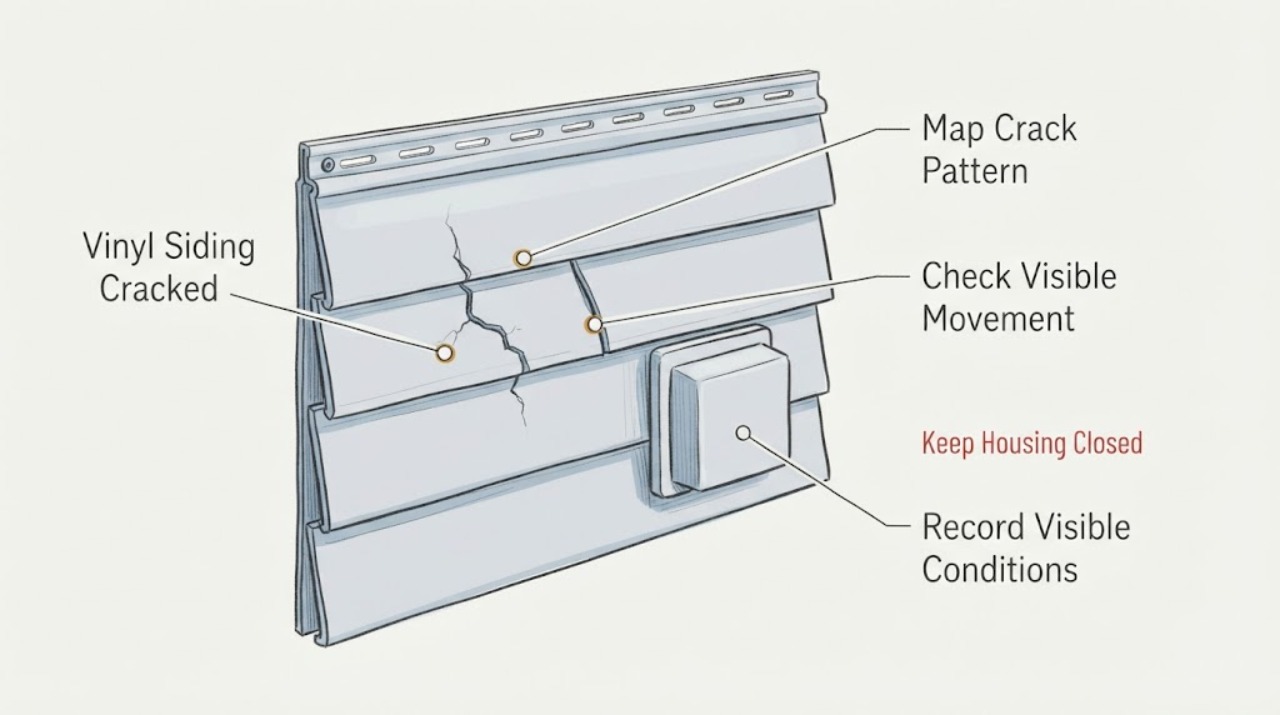
Treat a cracked vinyl siding panel as an exterior-cladding condition to document, not as a reason to climb, pry, cut, or open the wall. From ground level, record the crack's location and pattern, whether one panel or many are affected, visible gaps or movement, moisture or exposed insulation, and any recent storm or impact. A small isolated crack with no visible moisture may be a panel-repair assessment; widespread cracking, loose or displaced panels, open seams, exposed backing, or moisture signs should be referred to a siding professional promptly. Do not claim the wall behind the siding is sound or damaged without an appropriate inspection.
Work through in order
Diagnostic checks
Use only checks that match the exact appliance or system and its official guide.
-
Check 1
From a stable ground-level position, photograph and map each visible crack, split, puncture, or missing section without touching the siding or inserting anything into the seam.
Expected result: Record whether the damage is a single panel or spans multiple courses, and whether the line is horizontal, vertical, diagonal, near a joint, around an opening, or at a corner or edge.
Next step: Send an overview and close photograph with the map to a siding professional and keep the area undisturbed.
Stop if: Stop if viewing the damage requires a ladder, stepping onto an unsafe surface, or approaching loose material that could fall.
Why this matters
Why: A small isolated panel defect supports a focused repair assessment; repeated or aligned damage across panels may indicate movement, impact, installation, or weather exposure that should be evaluated as a system.
-
Check 2
Compare the cracked area with adjacent courses from the ground, looking for visible buckling, waviness, gaps, displaced edges, loose-looking panels, or a change in alignment; do not pull, press, or try to re-lock a panel.
Expected result: Note whether neighboring panels remain visually aligned or whether several panels show the same displacement, separation, or distortion.
Next step: Restrict access below loose or displaced siding and request a siding inspection, particularly after wind, impact, or a major temperature change.
Stop if: Stop and keep clear if any panel, trim piece, or accessory appears detached or could fall.
Why this matters
Why: Alignment changes across multiple panels raise the priority of a professional assessment because a single cosmetic patch may not address the cause. A visually aligned area still needs model- and condition-specific evaluation before repair.
-
Check 3
From outside and at ground level, look for visible dampness, staining, darkened seams, mold-like growth, open joints, exposed insulation, or water tracks around the crack; do not remove siding or probe behind it.
Expected result: Record whether moisture signs are absent, limited to the damaged panel, or spreading along a seam, corner, window, door, or lower wall area.
Next step: Photograph the surrounding trim and ground below, keep rainwater from being directed at the opening, and arrange a professional inspection.
Stop if: Stop if water is entering the interior, insulation is exposed, electrical equipment is wet, or the wall area is unstable.
Why this matters
Why: Visible moisture or exposed backing increases the need for prompt assessment because the cladding is no longer providing its intended exterior barrier at that location. Absence of visible moisture does not prove that concealed layers are dry.
-
Check 4
Review when the crack first appeared and note any recent hail, wind, falling branch, impact, freeze-thaw period, heat event, exterior work, or nearby change that could have affected the siding; do not recreate an impact or apply heat or force.
Expected result: Record whether one face of the building, one height band, or one area near an opening is affected, and whether the crack has changed since it was first noticed.
Next step: Give the event timeline and photographs to the siding provider, and preserve any installation, product, or warranty records if available.
Stop if: Stop if the event also damaged roofing, windows, electrical service, or a structural element; request appropriate professional help before approaching the area.
Why this matters
Why: A localized post-impact defect and broad weather- or temperature-associated cracking may require different inspection scopes. Timing is useful context, not proof of cause.
-
Check 5
From the ground, compare the crack with nearby window and door trim, corners, soffit, foundation line, and visible panel ends for open gaps, separation, or damaged flashing; do not remove trim, caulk, or siding to look behind it.
Expected result: Note whether the defect is isolated in the panel or continues toward an opening, corner, or lower edge, and whether any visible weather barrier or backing is exposed.
Next step: Provide a wide photograph showing the opening or edge and ask the professional to assess the cladding transition before any cosmetic product is chosen.
Stop if: Stop if gaps allow water into the interior, trim is loose, or the area cannot be observed safely from the ground.
Why this matters
Why: A crack that reaches an opening, corner, or edge may need a broader water-management and alignment review. A panel-only appearance is still not proof that the concealed wall condition is unaffected.
Use your observations
Decision map
Find the observation that best matches what you see, then follow the next safe action.
-
PATH 01Next step
What you see
One panel has a small visible crack, neighboring courses remain aligned, and there are no visible moisture or exposed-backing signs.
Do this next
Request a focused panel-repair or replacement assessment and confirm the siding profile and color before selecting any material.
-
PATH 02Next step
What you see
Multiple panels crack, buckle, gap, or appear displaced, or loose material could fall.
Do this next
Keep people clear and arrange a professional siding inspection; do not attempt to re-lock, remove, or replace panels from a ladder.
-
PATH 03Next step
What you see
The crack has open seams, water tracks, dampness, mold-like growth, exposed insulation, or interior water entry.
Do this next
Prioritize a professional moisture and cladding assessment and protect the area from additional water without opening the wall yourself.
-
PATH 04Next step
What you see
The damage followed an impact or is accompanied by window, trim, roof, foundation, or other structural-looking damage.
Do this next
Stop approaching the affected area and request the appropriate siding and building professional to assess the full visible scope.
Helpful context
Understand the symptom
What a crack can and cannot tell you
Vinyl siding can crack or warp after weather, impact, temperature changes, or a problem affecting the cladding system. CertainTeed notes that freeze-thaw cycles can contribute to cracking and that moisture entering compromised siding may lead to further problems. A photograph from the ground can establish the visible condition, but it cannot prove what is behind the panel or identify the correct replacement profile.
Keep the inspection at ground level
Use daylight, a camera zoom, and a stable position. Do not use a ladder, climb, pull on a panel, insert a tool into a seam, cut the siding, remove trim, open the wall, or disturb unknown materials. If a higher panel or concealed condition matters, give the photographs to a siding professional.
Only after diagnosis
Potential parts
- vinyl siding repair kit
Consider this category only if a professional confirms a limited panel defect and the selected method is compatible with the existing vinyl profile and exposure.
Confirm profile, color, finish, age, and manufacturer guidance before ordering; a generic kit may not match the installed cladding. - exterior caulk
Consider this category only for a professional-approved small transition or gap condition, not as a substitute for a cracked or displaced panel assessment.
Verify compatibility with vinyl, adjacent trim, movement, moisture exposure, and the intended location before selection. - siding removal tool
Consider this category only when a qualified siding professional has determined that panel access is required; it is not a reason to climb or pry on an unknown condition.
Confirm the siding system and safe access plan with the professional; do not use a tool from a ladder or around loose, damaged, or concealed materials.
When checks do not resolve it
Need a professional?
Arrange siding service for any crack that spreads across panels, reaches an opening or corner, is accompanied by buckling or loose material, shows moisture or exposed insulation, or follows a storm or impact. Seek prompt help for interior water entry, falling pieces, or damage near electrical service or other unstable building elements.
Have this ready
- Provide ground-level overview and close photographs, crack location and pattern, number of affected panels, visible gaps or moisture, recent weather or impact history, and any product, installation, or warranty records.
Common questions
FAQ
Is a cracked vinyl siding panel an emergency?
A small isolated crack without visible moisture or loose material is usually a normal repair-assessment issue, but widespread cracking, displaced panels, exposed insulation, interior water entry, or falling pieces needs prompt professional attention.
Can I tell whether the wall behind the siding is damaged?
Not reliably from a ground-level exterior view. Photograph visible moisture, open seams, and exposed backing, then have a professional assess the cladding and any concealed condition without opening the wall yourself.
What can cause vinyl siding to crack?
Weather and temperature changes, freeze-thaw exposure, impact, and system or alignment issues can all be relevant. The timing and pattern help a professional choose the inspection scope but do not prove a single cause.
Can I seal a crack with exterior caulk?
Do not use caulk to hide a cracked or displaced panel before the condition is assessed. Caulk may be appropriate for a specific transition only when a professional confirms the location, material compatibility, and water-management requirements.
When should I stop inspecting the siding?
Stop when inspection requires a ladder or wall opening, panels or trim could fall, water is entering the building, insulation is exposed, or nearby electrical or structural elements may be affected. Keep clear and request qualified help.
Read the exact guide
Official sources
- Siding Solutions: When to Call a ContractorCertainTeed · The manufacturer discusses weather-related cracking, moisture concerns, widespread cracking, exposed insulation, and when to call a professional; it does not establish the concealed condition of an individual home.
- MainStreet Vinyl SidingCertainTeed · The product page confirms that vinyl siding is offered in multiple panel styles and uses a product-specific locking system, supporting the need to confirm profile and compatibility rather than assume a universal replacement.
Community feedback
Share a repair observation
Share a plain-text repair observation. Accepted observations are published automatically; this page may take a moment to update.