
On this page
Start here
Quick answer
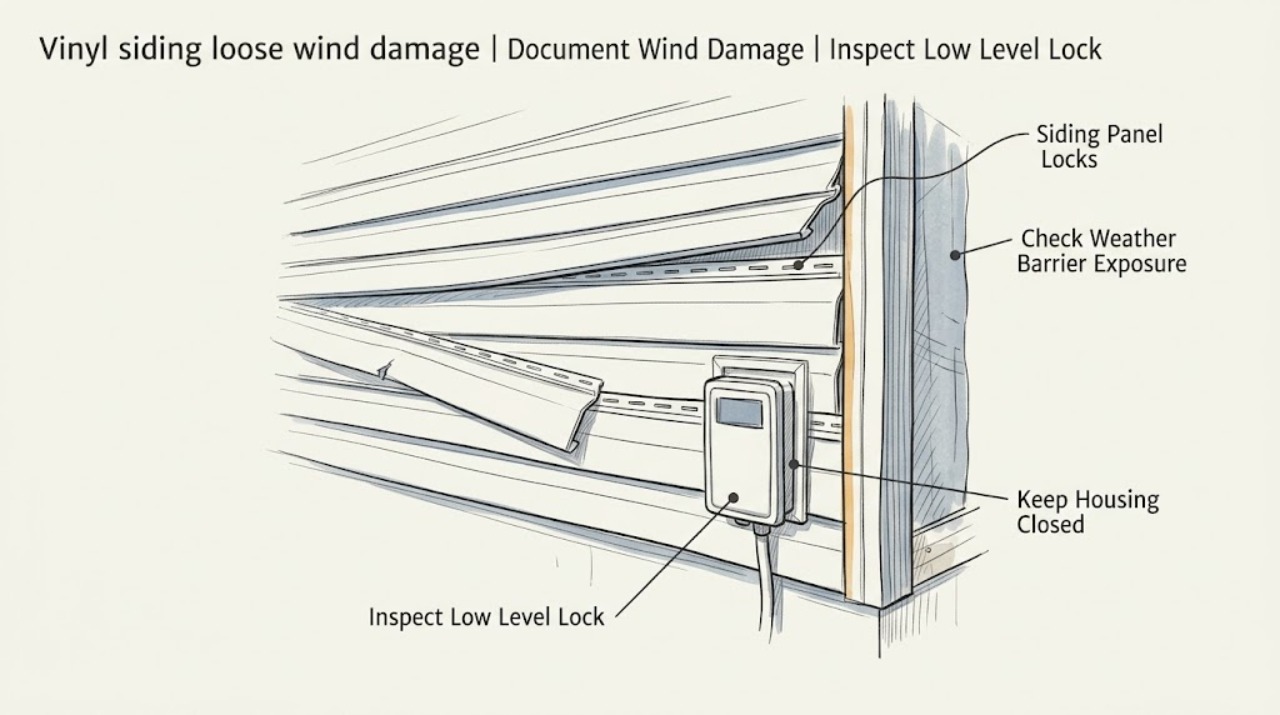
After strong wind, loose vinyl siding can mean that a panel has disengaged from its lock, a trim or corner connection has moved, fasteners no longer hold correctly, or the underlying wall or weather barrier has been damaged. Start from the ground after the wind has subsided and photograph the exact panel, direction of movement, missing or cracked pieces, exposed underlayment, and any water entry. Vinyl siding is an exterior cladding rather than the wall's water-resistive barrier, and the Vinyl Siding Institute says its wind performance depends on correct product selection and installation; its panels also need room to move rather than being forced tight. Do not climb a ladder or roof in wind, pull a loose panel back into place, face-nail it, or seal over an exposed opening as a blind repair. Have a qualified siding or exterior contractor assess the profile, locks, fastening, trim, wall barrier, and wind damage.
Before you begin
Safety first
- This article supports safe ground-level observation and documentation only. Elevated inspection, panel or trim removal, re-locking, fastening, flashing, weather-barrier repair, and work near utilities belong to qualified professionals.
Work through in order
Diagnostic checks
Use only checks that match the exact appliance or system and its official guide.
-
Check 1
After wind has subsided, photograph the loose siding from the ground or another stable ordinary-access position, including the full wall, nearby corners and openings, and the direction in which the panel is lifted or bowed; do not touch it.
Expected result: Record one loose edge, a panel hanging or missing, a cracked or punctured panel, several shifted courses, or no visible damage despite a reported movement.
Next step: Keep the area clear, save the photos and storm timing, and arrange siding inspection; do not create movement by pulling, pressing, or tapping the panel.
Stop if: Stop for ongoing high wind, falling material, a hanging panel over a walkway, unstable ground, damaged utility lines, or any need to climb.
Why this matters
Why: A single loose edge may be a local lock or trim issue, while multiple courses, missing panels, or broad bowing raise concern about fastening, wind-load installation, or the wall assembly. No visible ground-level damage does not rule out a high or concealed failure.
-
Check 2
Only from dry, stable, ground-level access, inspect the visible bottom edge, overlap, corner post, J-channel, starter area, and trim around windows or doors without inserting tools or trying to re-lock the panel.
Expected result: Note a visible open lock, separated overlap, displaced corner or channel, missing trim, buckled panel, or an area that cannot be judged without a ladder or panel removal.
Next step: Photograph the interface and have the installer or siding contractor identify the profile-specific repair; do not face-nail, screw through the panel, or force the lock closed.
Stop if: Do not climb, pry between courses, remove trim, or work near a roof edge, window ledge, electrical service, or unstable material.
Why this matters
Why: An open lock or displaced trim can explain wind movement, but vinyl courses must remain interlocked, aligned, and able to accommodate normal movement. A buckled or constrained panel can indicate fastening or clearance trouble rather than a simple loose edge.
-
Check 3
From safe exterior and interior locations, look for visible housewrap or underlayment, wet sheathing, new staining, damp insulation, or water entering behind the loose section without removing siding or opening the wall.
Expected result: Record intact dry surfaces, an exposed weather barrier, fresh exterior or interior moisture, staining, swelling, or no safe way to see behind the cladding.
Next step: Keep water-sensitive contents away from the area, photograph the path, and request siding and moisture assessment; involve a roofer or remediation professional when the opening reaches roof or wall components.
Stop if: Do not tape, caulk, foam, or cover over wet or exposed wall materials as a permanent repair, and stop for active leakage, electrical contact with water, or a sagging wall or ceiling.
Why this matters
Why: Vinyl siding is cladding and not the water-resistive barrier; exposed or wet material changes the task from cosmetic re-locking to weather protection and wall-moisture assessment. Moisture can persist even after wind stops.
-
Check 4
Compare the damaged area with adjacent courses and the same detail on another wall from a safe position, noting alignment, panel movement, trim separation, fastener visibility, and whether the problem returns in later wind; do not use a ladder to reach a higher course.
Expected result: Classify the condition as isolated to one panel, repeated along one wall, repeated around openings or corners, or widespread across several elevations.
Next step: Give the comparison and storm history to the contractor so the cause is evaluated across the wall rather than patched at one visible panel.
Stop if: Stop if more pieces move, a panel may fall, the wall is unstable, or weather conditions make exterior observation unsafe.
Why this matters
Why: An isolated panel can be a local lock, trim, or impact repair. A repeated pattern suggests installation, movement clearance, fastening, substrate, or wind-exposure issues; widespread damage may include the wall barrier, soffit, fascia, or roof edge.
-
Check 5
Collect the siding profile, color, installation or prior-repair history, storm timing, ground-level photos, and any spare panel or product label without removing installed pieces or walking the roof.
Expected result: Record an identifiable product or only a visual profile, whether the repair followed earlier wind, and whether the contractor can inspect fasteners, locks, trim, substrate, weather barrier, and wind exposure.
Next step: Arrange a qualified siding or exterior inspection and ask for a repair plan that addresses the loose panel, surrounding attachment, water barrier, and any secondary damage.
Stop if: Do not order a generic panel, drive new fasteners, dismantle a course, or approve a repair that ignores exposed or wet wall materials.
Why this matters
Why: Vinyl profiles and accessory details are not interchangeable by appearance, and the wind performance depends on the product and installation. A useful handoff helps avoid forcing a mismatched replacement or hiding a wall problem.
Use your observations
Decision map
Find the observation that best matches what you see, then follow the next safe action.
-
PATH 01Safety boundary
What you see
One low, visible panel edge appears unlocked after wind, with no crack, missing trim, water entry, or movement in adjacent courses.
Do this next
Have the installer or siding professional re-engage or repair the course using the product instructions; keep the area clear until it is secure.
Why this path and its safety boundary
Why it matters: A local lock, trim, or fastening issue is plausible, but the panel still needs profile-specific handling and the surrounding attachment should be checked.
Safety stop: Do not pull the panel, face-nail it, screw through its face, or treat a temporary hold as a wind-rated repair.
-
PATH 02Safety boundary
What you see
Several courses on one wall are loose, bowed, displaced, or repeatedly move in wind.
Do this next
Keep people away from the wall and arrange a siding contractor to inspect the full elevation, trim, fasteners, and wall surface before any patch.
Why this path and its safety boundary
Why it matters: A fastening, lock, movement-clearance, substrate, or wind-load installation issue is more likely than one isolated panel defect.
Safety stop: Do not pull courses into alignment, add random fasteners, or climb to inspect a higher section.
-
PATH 03Safety boundary
What you see
A panel is cracked or missing, or housewrap, sheathing, insulation, or wet wall material is visible behind it.
Do this next
Keep rain and people away from the area as practical without sealing wet materials, document the opening, and request prompt siding and moisture service.
Why this path and its safety boundary
Why it matters: The exterior cladding no longer provides its intended cover and the wall weather-resistive assembly may be exposed; moisture and substrate damage need assessment.
Safety stop: Do not permanently cover, caulk, foam, or tape over wet or damaged wall material, and stop for active leaks or electrical hazards.
-
PATH 04Safety boundary
What you see
The loose siding is at a corner, roofline, soffit, fascia, window, door, utility penetration, or J-channel rather than in the middle of a panel.
Do this next
Arrange a siding or exterior-envelope inspection that includes the trim, flashing, wall barrier, and adjacent roof or opening detail.
Why this path and its safety boundary
Why it matters: Trim and flashing details may be directing water or holding the course, so a panel-only replacement may leave the actual wind and moisture path unresolved.
Safety stop: Do not climb, remove trim, or work around a utility service, roof edge, or unstable opening.
-
PATH 05Safety boundary
What you see
The same panel or wall section loosens again after an earlier repair or after ordinary temperature changes.
Do this next
Stop repeated patching and ask a qualified contractor to review the complete installation and prior repair materials against the manufacturer instructions.
Why this path and its safety boundary
Why it matters: A mismatched profile, incorrect lock or fastening, insufficient movement clearance, unstable substrate, or unaddressed wind exposure may be involved.
Safety stop: Do not add more fasteners or caulk the overlap to suppress movement; those changes can distort the panel or hide water entry.
-
PATH 06Safety boundary
What you see
Wind continues, pieces are hanging or falling, a wall or roof edge is unstable, or the damaged area is above a walkway or near utilities.
Do this next
Keep people away, avoid the elevation, and call emergency or qualified exterior service when safe access is available; report any utility damage to the relevant provider.
Why this path and its safety boundary
Why it matters: The immediate falling, weather, or utility hazard takes priority over siding diagnosis.
Safety stop: Do not approach, climb, hold, or remove a hanging panel during the hazard.
Helpful context
Understand the symptom
A loose panel is not always a loose nail
Vinyl siding is installed as interlocking courses with trim around corners and openings. Wind can disengage one lock, move a J-channel or corner post, crack a panel, or expose a failure in the fastening or wall behind it. Because the cladding is not the wall's water-resistive barrier, a loose or missing section can also allow water to reach the assembly. The safe first step is to document the pattern, not to pull the panel or drive a new fastener through its face.
Wind-only damage versus a recurring installation problem
If one accessible panel moved after an unusual gust while surrounding courses remain aligned, the issue may be localized. Several panels on one wall, recurring movement, buckling, or gaps around trim suggest fastening, expansion movement, substrate, or wind-load concerns. A prior repair can also fail if the replacement profile, lock, fastener position, or clearances do not match the installed system.
Keep height and weather hazards out of the DIY path
OSHA's ladder guidance emphasizes choosing safer equipment when work requires height, sideways reach, heavy materials, or extended time, and maintaining stable footing and contact. A loose panel near a roofline, second story, utility service, or wet surface is a contractor inspection. Keep people away from falling pieces and document the wall from the ground while arranging service.
Safety boundary
Stop conditions
- Do not climb a ladder, roof, window ledge, or unstable ground to inspect or re-lock siding, especially in wind, rain, ice, or poor visibility.
- Do not pull, pry, face-nail, screw through, or force a loose vinyl panel; the lock, fastener, trim, and movement clearance depend on the exact profile and installation.
- Do not permanently caulk, tape, foam, or cover exposed or wet wall materials before the weather barrier, flashing, and substrate are assessed.
- Keep people away from hanging panels, falling debris, damaged utility lines, unstable walls, roof edges, and water near electrical equipment.
- Arrange qualified siding or exterior-envelope service for multiple shifted courses, cracked or missing panels, trim or roofline damage, recurring movement, inaccessible areas, or any water entry.
Only after diagnosis
Potential parts
- matching vinyl siding panel
Consider this category only when inspection confirms that a panel is cracked or missing and the exact installed profile, color, lock, overlap, and weather exposure can be matched.
Confirm the exact product and accessory system with the manufacturer or contractor; a similar-looking panel may not interlock or perform the same in wind. - J-channel, corner post, starter, or utility trim
Consider this category only when the professional finds that displaced or damaged trim is releasing the panel or allowing water at a corner, opening, or roofline.
Match the installed panel profile, opening detail, flashing, movement clearance, and manufacturer instructions; do not use trim to hide damaged sheathing or a wet wall. - corrosion-resistant siding fasteners
Consider this category only when inspection identifies missing, damaged, or incorrectly placed fasteners and the manufacturer's installation method supports replacement.
The contractor must match fastener type, placement, substrate, wind-load requirements, and movement allowance; do not add fasteners through the face as a guess.
When checks do not resolve it
Need a professional?
Call a qualified siding or exterior-envelope professional after wind loosens more than one panel, leaves a crack or opening, exposes the wall barrier, affects a corner, roofline, soffit, fascia, window, door, or utility penetration, recurs after repair, or cannot be inspected from the ground. Request coordinated roofing, moisture, or electrical assessment for roof-edge damage, active water, wet wall materials, or damaged utility service. Seek urgent help for hanging or falling pieces, unstable walls, ongoing high wind, fire, or electrical danger. Provide ground-level photos, storm timing, product or profile information, prior repair history, and any interior staining.
Safety scope: This article supports safe ground-level observation and documentation only. Elevated inspection, panel or trim removal, re-locking, fastening, flashing, weather-barrier repair, and work near utilities belong to qualified professionals.
Common questions
FAQ
Can I push loose vinyl siding back into place after wind?
Do not force it. The panel may have a damaged lock, trim, fastening, or wall detail, and a forced or face-nailed repair can distort the panel and hide water entry. Photograph it from the ground and have a siding professional assess the profile.
Is one loose siding panel an emergency?
It is urgent if it is hanging over a walkway, exposing wet or damaged wall materials, near utilities, or still moving in wind. A stable isolated panel still needs timely inspection because water can reach behind the cladding.
Why did the same vinyl siding come loose again?
The prior repair may not have matched the profile, lock, trim, fastening, movement clearance, substrate, or wind exposure. Ask for a review of the surrounding installation instead of adding more fasteners or caulk.
Does vinyl siding keep rain out by itself?
No. Vinyl siding is exterior cladding, not the wall's water-resistive barrier. A cracked, missing, or displaced section can expose the weather barrier or wall assembly and may need moisture assessment.
Can I use a ladder to inspect or repair high siding?
Avoid ladder or roof work for this problem, especially in wind or wet conditions. High, sideways, prolonged, or roofline work should be handled by a qualified exterior contractor with appropriate equipment and fall protection.
Read the exact guide
Official sources
- Installation ManualVinyl Siding Institute · Official Vinyl Siding Institute industry installation manual; product-specific instructions, current local code, climate, and the existing wall assembly control a particular repair.
- Falling Off Ladders Can Kill: Use Them SafelyOccupational Safety and Health Administration · OSHA ladder-safety booklet used for height and access boundaries; it is advisory and does not replace a contractor's site-specific fall-protection plan.
Community feedback
Share a repair observation
Share a plain-text repair observation. Accepted observations are published automatically; this page may take a moment to update.