
On this page
Start here
Quick answer
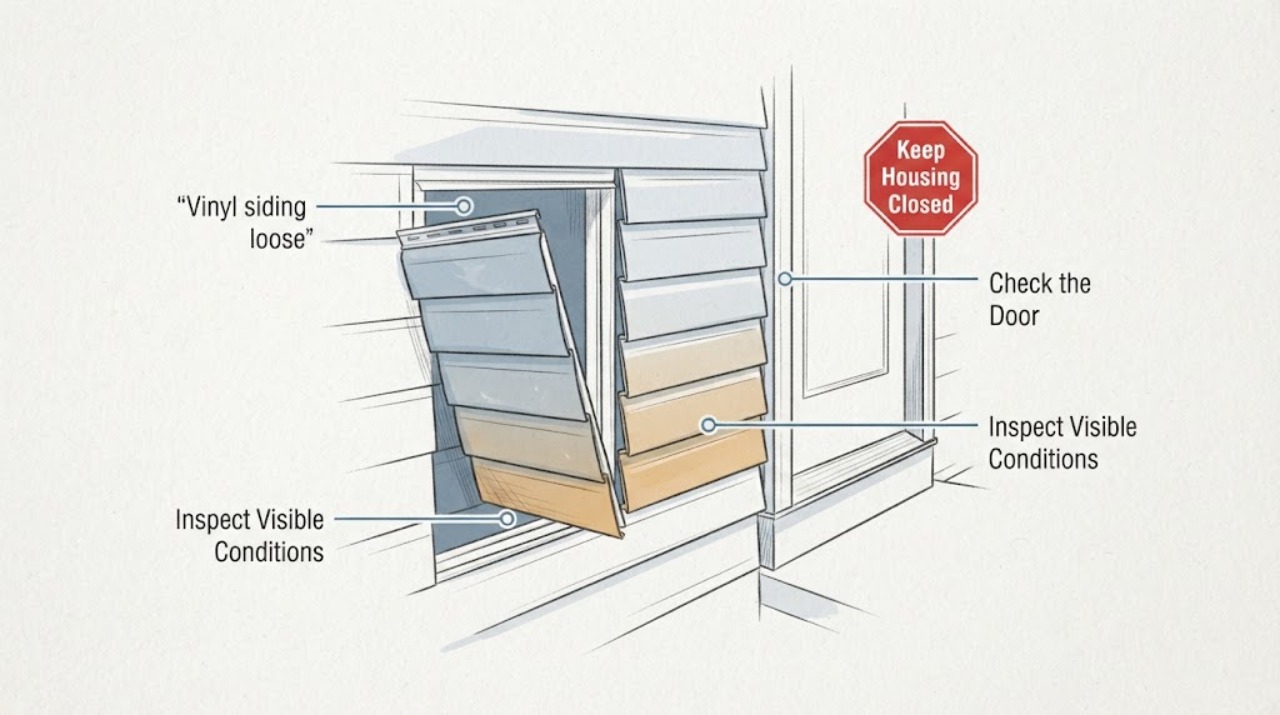
A loose vinyl-siding panel should be assessed from a safe ground-level or window view and then referred to a siding professional, especially if it moves in ordinary wind, has a visible gap near a window or door, has fallen pieces, or is associated with dampness. Record the location and visible pattern without touching the panel. Vinyl siding is designed to accommodate movement, so a loose appearance alone does not prove concealed wall damage, but an open seam, missing trim, or water evidence needs prompt attention.
Work through in order
Diagnostic checks
Use only checks that match the exact appliance or system and its official guide.
-
Check 1
From ground level or a safely accessible window, identify the wall location of the loose appearance and note whether it is at a field seam, corner, eave, window, door, or other transition.
Expected result: Record the approximate course, side of the building, and whether a panel end, trim edge, or separate piece appears displaced or is on the ground.
Next step: Photograph the area from the safe position and give the location to a siding professional.
Stop if: Stop the observation and keep people away if pieces are falling, the wall is unstable, or conditions are windy or stormy.
Why this matters
Why: A location at a window, door, corner, or roofline may involve trim or flashing as well as the siding panel; a fallen or visibly displaced piece raises the urgency.
-
Check 2
During calm, ordinary conditions, observe the panel from a safe distance or through a window for movement, noise, or a changing gap; do not approach to make it move.
Expected result: Note whether the panel stays still, flutters repeatedly, pulls away visibly, or makes contact noise when normal wind passes.
Next step: Use the observation to set the service urgency and include a short video only if it can be captured safely from the same position.
Stop if: Stop and move away if wind increases, debris is moving, or the panel appears likely to detach.
Why this matters
Why: Repeated movement or a growing gap suggests that the lock, fastening area, or trim may need professional assessment; stillness does not rule out a concealed issue.
-
Check 3
Visually compare the seam and nearby trim with adjacent siding from the same ground-level viewpoint, looking for an open buttlock, a channel gap, or an exposed fastening line.
Expected result: Classify the visible result as a clean, unchanged seam; a separated or uneven seam; an open corner or window/door channel; or a missing edge or trim piece.
Next step: Send clear, non-contact photos and note the nearest corner, opening, or transition for the professional visit.
Stop if: Stop if the only way to see the area would require elevated access, moving the siding, or disturbing a fragile piece.
Why this matters
Why: A separated seam or open channel is a visible repair condition, but the correct repair depends on the siding profile and what is behind the trim; appearance alone is not a safe basis for forcing it back.
-
Check 4
Check only readily visible interior surfaces near the corresponding window, door, or wall for signs that coincide with the loose exterior area.
Expected result: Look for a new stain, dampness, peeling finish, musty odor, or no interior sign; do not open the wall or remove finishes.
Next step: Tell the professional the date and location of any moisture evidence and preserve the area for inspection.
Stop if: Stop if water is near electrical equipment, the surface is actively wet, or the condition is spreading.
Why this matters
Why: Dampness or a new stain makes possible water entry more urgent and means the exterior siding condition should be evaluated with the building-envelope path, while no interior sign does not prove that the wall is dry.
-
Check 5
Review the safe visual history: recent wind or impact, a prior repair, new construction, nearby work, or a piece found on the ground.
Expected result: Note which event, if any, preceded the looseness and whether the condition is localized or visible on several walls.
Next step: Share the sequence, photos, and any loose piece only if it is already safely indoors and can be identified without approaching the wall or debris field.
Stop if: Do not approach fallen material or the building during storm conditions; wait for safe conditions and professional assessment.
Why this matters
Why: A recent event can help a professional distinguish localized impact or storm damage from a recurring movement or trim condition; it does not identify the hidden cause by itself.
Use your observations
Decision map
Find the observation that best matches what you see, then follow the next safe action.
-
PATH 01Next step
What you see
One panel appears loose from the ground, with no visible water evidence, falling material, or ongoing movement.
Do this next
Leave it undisturbed, document the location, and schedule a siding professional to identify the profile and repair condition.
-
PATH 02Next step
What you see
The panel flutters repeatedly, pulls away, or nearby pieces have fallen.
Do this next
Keep people and pets clear, avoid the area in wind, and request prompt professional service; do not attempt temporary reattachment.
-
PATH 03Next step
What you see
The gap or missing trim is at a window, door, corner, eave, or other transition.
Do this next
Ask for a siding and flashing/building-envelope assessment, because the visible panel may not be the only affected component.
-
PATH 04Next step
What you see
Interior staining, dampness, peeling finish, or a musty odor corresponds to the exterior looseness.
Do this next
Treat it as possible water entry, stop investigating, protect the area from further exposure when safe, and arrange prompt professional evaluation.
-
PATH 05Next step
What you see
There is no visible movement or interior symptom, but the area is inaccessible from ground level.
Do this next
Do not infer that the condition is resolved; provide the location to a professional who can use appropriate access and inspection methods.
Helpful context
Understand the symptom
Loose vinyl siding can result from a panel that is no longer engaged with the course below, a damaged fastening hem or trim piece, wind or impact, movement at a transition, or a problem around a window or door. The exterior view cannot establish whether the sheathing or wall cavity is damaged. Keep this check observational: do not use a ladder, pry or push the panel, attempt reattachment, cut or remove siding, or approach during a storm or high winds.
The Vinyl Siding Institute and CertainTeed both describe siding panels as needing room for normal movement and a properly engaged lock rather than a forced, tight fit. That guidance helps explain why a visibly open or repeatedly moving panel is a repair signal, while ordinary thermal movement by itself is not proof of a hidden failure.
Only after diagnosis
Potential parts
- vinyl siding repair kit
Consider this category only after a professional identifies a compatible damaged panel, lock, fastening area, or trim condition and confirms that a kit is appropriate.
Confirm the siding profile, color, manufacturer, and the actual repair scope before ordering; a generic kit is not assumed to fit every panel. - exterior caulk
Consider this category only when a professional identifies a compatible joint, flashing, or trim seal issue; caulk is not a substitute for an engaged or damaged siding panel.
Use only a product and application compatible with the siding and adjacent flashing or trim, as confirmed for the specific repair.
When checks do not resolve it
Need a professional?
Call a siding professional for a loose or separated panel, repeated wind movement, missing or fallen pieces, a gap at a window/door/corner, any moisture evidence, or any area that cannot be safely viewed from ground level. Prompt service is warranted after storm or impact damage once conditions are safe.
Have this ready
- Provide the building side and approximate height/course, safe ground-level or window photos, whether movement occurs in ordinary wind, recent wind or impact history, any interior moisture evidence, and the siding brand/profile if known.
Common questions
FAQ
Can I push a loose vinyl-siding panel back into place?
Do not push or force it. A panel can look loose because of a lock, fastening, trim, or transition condition, and the appropriate repair depends on the profile and surrounding water-management details. Document it from a safe position and use a siding professional.
Does loose siding prove that the wall is damaged?
No. Loose siding can be a visible panel or trim problem, and an exterior view cannot confirm the condition behind the wall. Stains, dampness, peeling finish, or a gap near an opening make professional evaluation more urgent.
Should I inspect loose siding while it is windy?
No. Observe only in calm, safe conditions from ground level or a safely accessible window. Keep away from a panel that may detach or from fallen pieces, and wait for professional service after a storm.
When might a repair kit or exterior caulk be relevant?
Only after the siding professional identifies the actual damaged panel, profile, trim, flashing, or compatible joint. Neither category should be used to force a loose panel into place or cover possible water damage.
Read the exact guide
Official sources
- Installing Horizontal SidingCertainTeed · Supports the explanation that a panel should engage its lock and slide freely, and that window, door, corner, and flashing details affect the siding system.
- 2020 Vinyl Siding Installation ManualVinyl Siding Institute · Supports the explanation that panels and accessories need appropriate clearance and movement, and that the siding system includes water-resistive and flashing considerations.
Community feedback
Share a repair observation
Share a plain-text repair observation. Accepted observations are published automatically; this page may take a moment to update.