
On this page
Start here
Quick answer
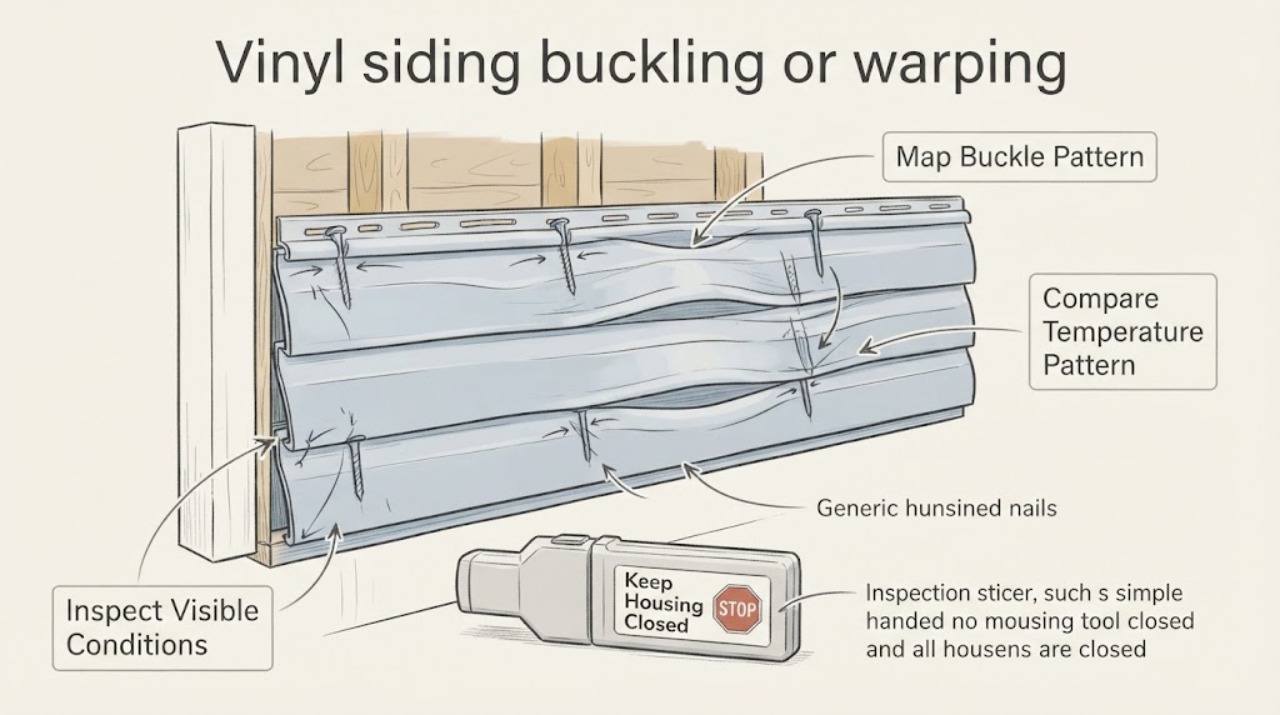
Vinyl siding that buckles or warps is often a movement and installation-detail problem, not a panel that should simply be nailed flatter. From the ground or another stable, non-elevated position, map where the bowing occurs, compare it with seams, corners, windows, doors, and temperature or sun exposure, and look for visible fasteners that are tight against the nail hem, off-center in slots, face-nailed, or pressed into trim. Do not climb, pull nails, pry panels, cut siding, or seal over movement. Request qualified siding or exterior-envelope service when buckling is persistent, panels are loose or cracked, water can enter, the wall substrate may be uneven or damp, or the fastener and trim details cannot be safely observed.
Before you begin
Safety first
- User work is limited to stable ground-level observation and documentation. Do not climb, reach, pull or adjust fasteners, pry or cut panels, remove trim, seal over movement, or disturb the wall assembly.
Work through in order
Diagnostic checks
Use only checks that match the exact appliance or system and its official guide.
-
Check 1
From the ground or another stable, non-elevated position, photograph and map each buckled or warped panel by wall elevation, course, seam, corner, window, door, roofline, and distance from the nearest visible obstruction.
Expected result: The deformation is isolated to one panel or fastener course, repeats at openings or corners, follows several courses, or cannot be viewed safely from the ground.
Next step: Keep the map and dated photos for siding service and do not use a ladder, roof, bucket, or improvised platform to obtain a closer view.
Stop if: Stop for loose or falling panels, high wind, ice, wet surfaces, unstable ground, overhead hazards, or any need to climb or reach beyond stable standing height.
Why this matters
Why: A localized pattern can focus service on a panel, fastener, overlap, or trim detail; a broad pattern raises the possibility of substrate, moisture, or larger installation movement. Inaccessible evidence cannot be safely diagnosed by guessing.
-
Check 2
Record whether the buckling changes after shade, direct sun, a hot day, a cool period, or ordinary seasonal temperature change; make comparisons only from a safe location and without touching or loading the siding.
Expected result: The panel flattens or changes as it cools, remains bowed in all conditions, or the timing has no clear relationship to temperature.
Next step: Add the temperature and sun pattern to the service request and leave the panel undisturbed; do not press, heat, cool, or wet-test it.
Stop if: Do not use a heat source, hose, ladder, roof access, or physical force to reproduce movement.
Why this matters
Why: A repeatable temperature-related change is consistent with restricted thermal movement but does not identify the exact fastener or clearance defect. A persistent bow increases concern for distortion, substrate irregularity, moisture, or damaged material.
-
Check 3
From a stable ground-level view or an existing safe opening, look for visible fastener heads that appear tight against the nail hem, off-center in a slot, driven through the face, crooked, or associated with dimpling; do not loosen, pull, or drive any fastener.
Expected result: Fasteners appear centered with visible movement space, or one or more appear tight, off-center, face-nailed, crooked, or impossible to judge safely.
Next step: Photograph the detail with its panel location and provide the manufacturer's identity if safely visible; have qualified siding service determine whether re-fastening, panel replacement, or another correction is appropriate.
Stop if: Do not unzip, pry, pull nails, drill, cut slots, or access the fastener course from a ladder or roof.
Why this matters
Why: A restricted or distorted fastening detail is a plausible movement constraint and gives the professional a focused inspection area, but appearance does not establish the correct clearance or repair method for this product.
-
Check 4
From the ground, inspect the visible relationship between the siding and window, door, corner, or other trim for panels pressed tightly into the receiver, missing or uneven gaps, displaced J-trim, open seams, or water staining.
Expected result: Trim interfaces look clear and allow a visible joint, or siding is tight against trim, displaced, cracked, open, or accompanied by staining or active water entry.
Next step: Photograph the opening and route any water concern to prompt siding service; do not caulk, force the panel into trim, or remove the trim as a temporary fix.
Stop if: Stop for water entering the wall, loose trim or panels, falling debris, electrical fixtures affected by water, or any need for elevated or invasive access.
Why this matters
Why: A tight or damaged trim interface can restrict thermal movement or admit water. Staining, active entry, or displaced trim expands the work from cosmetic buckling to exterior-envelope and moisture assessment.
-
Check 5
From a safe exterior position, compare the buckled area with nearby wall planes and record visible bulges, depressions, soft-looking or rotten boards, open joints, staining, or a change after recent siding, roofing, window, or wall work.
Expected result: The wall plane appears even and dry, or the area has broad unevenness, damaged substrate, recurring moisture, or a recent alteration that could have changed the backing.
Next step: Keep the elevation undisturbed, record the history and photos, and request qualified siding or exterior-envelope assessment before any panel or fastener work.
Stop if: Do not probe, remove panels, open the wall, climb, work near overhead conductors, or continue where wind, rain, ice, or falling-material risk is present.
Why this matters
Why: Vinyl siding can reflect an uneven or unstable substrate; damaged or damp backing may require wall and water-control assessment before siding is reworked. A flat-looking exterior does not clear concealed conditions.
Use your observations
Decision map
Find the observation that best matches what you see, then follow the next safe action.
-
PATH 01Next step
What you see
Fasteners appear overdriven, off-center, face-nailed, crooked, or the siding cannot move freely in its slots.
Do this next
Request qualified siding service to verify the product instructions and fastening detail. Do not pull nails, widen slots, or re-fasten from a ladder or roof.
-
PATH 02Next step
What you see
Buckling concentrates at a window, door, corner, J-trim, overlap, or other stop where the panel appears pressed tight or the trim is displaced.
Do this next
Have a siding professional inspect the trim receiver, movement clearance, flashing, and panel condition before changing sealant or trim. Keep the elevation intact.
-
PATH 03Next step
What you see
The wall is broadly wavy or uneven, water enters, staining recurs, backing looks damaged, or the condition followed exterior-wall work.
Do this next
Arrange prompt exterior-envelope assessment for siding, water-resistive barrier or flashing, sheathing, framing, and moisture source. Do not cover the area with new siding or caulk as a diagnosis.
-
PATH 04Next step
What you see
Panels are detached, cracked, torn, displaced, or at risk of falling, or debris is reaching people or property below.
Do this next
Keep people and property clear of the elevation, avoid windy conditions, and request urgent siding service for safe stabilization and repair. Do not reach up or climb to secure the panel.
-
PATH 05Next step
What you see
Buckling is stable, dry, visible from the ground, and not associated with loose panels, water entry, broad substrate movement, or a critical access hazard.
Do this next
Keep dated temperature, location, trim, and fastener observations and schedule prompt siding assessment. A stable appearance does not authorize a DIY nail or panel adjustment.
Helpful context
Understand the symptom
Vinyl siding needs room to move
Vinyl siding expands and contracts as its temperature changes. The Vinyl Siding Institute (VSI) says panels should move freely side to side, fasteners should be centered in the slots, and the fastener head should not be driven tightly against the nail hem. It also calls for clearance at openings and stops. HUD's exterior-wall guidance similarly identifies overdriven or improperly placed fasteners as a cause of buckling. These details explain a likely mechanism, but a bowed panel does not by itself prove which fastener or installation detail is at fault.
Use temperature and location to route the inspection
Photograph the same elevation when the panel is cool and when it is visibly heated only if both views can be made safely from the ground. Note whether the buckling is local to one fastener course, overlap, corner, window or door trim, or broad across the wall. A repeatable heat-related pattern supports an exterior siding detail assessment; persistent waves, loose panels, moisture staining, or a wall that appears uneven also require the substrate and water-resistive assembly to be assessed.
The repair boundary is not a nail-pulling test
Correcting overdriven nails, reworking trim clearances, replacing a panel, or repairing sheathing can require elevated access and can expose the wall to water if done incorrectly. Keep the exterior intact while documenting it. A siding professional should identify the panel system, confirm the manufacturer's details, and determine whether the cause is fastening, trim, substrate, moisture, heat, or a combination.
Safety boundary
Stop conditions
- Do not climb a ladder, roof, scaffold, bucket, or improvised platform to inspect or repair the exterior siding.
- Do not pull, loosen, re-drive, or add nails; unzip, pry, cut, drill, heat, wet-test, or force panels or trim.
- Stop for loose or falling panels, cracked siding, active water entry, falling debris, high wind, ice, unstable ground, or overhead electrical hazards.
- Do not cover buckling with new siding or caulk it shut before a professional checks movement, trim, moisture, and substrate.
Only after diagnosis
Potential parts
- vinyl siding replacement panel
Consider only after a qualified inspection confirms that the panel is permanently distorted, cracked, or otherwise not salvageable and identifies the siding system and repair boundary.
Confirm exact profile, exposure, color, locking geometry, trim interface, installation temperature, and manufacturer requirements before ordering; buckling may be caused by fastening, trim, moisture, or substrate rather than a failed panel.
When checks do not resolve it
Need a professional?
Request prompt qualified siding or exterior-envelope service when vinyl siding remains buckled, fasteners appear overdriven or off-center, buckling concentrates at trim or openings, or the wall plane, backing, or moisture condition is unclear. Seek urgent service for loose or falling panels, cracked or torn siding, active water entry, falling debris, high-wind instability, or a hazard below the elevation. Provide dated ground-level photos, the buckling map, temperature and sun pattern, visible fastener and trim observations, recent exterior work, and any water history.
Safety scope: User work is limited to stable ground-level observation and documentation. Do not climb, reach, pull or adjust fasteners, pry or cut panels, remove trim, seal over movement, or disturb the wall assembly.
Common questions
FAQ
Can overdriven nails cause vinyl siding to buckle?
Yes. VSI and HUD guidance explain that tight or improperly placed fasteners can restrict the panel's thermal movement. A professional should confirm the fastener and trim detail; do not pull or re-drive nails from a ladder or roof.
Why does vinyl siding buckle more on hot days?
Temperature changes make vinyl siding expand and contract. If a panel is restricted by tight fasteners, trim, overlaps, or an uneven backing, the movement can show as waves or buckling. A temperature-related pattern supports this inspection path but does not prove the exact defect.
Should I loosen the siding nails myself?
Not as a first check. Loosening or re-driving fasteners can damage the panel, water-resistive layer, or trim and often requires elevated access. Document the visible fastener position from the ground and have qualified siding service determine the correction.
Could buckled siding mean water damage behind the wall?
It could, especially when buckling is broad or accompanied by staining, open seams, recurring moisture, or an uneven substrate. Buckling alone cannot prove concealed damage. Request exterior-envelope assessment before covering or sealing the area.
When should vinyl siding buckling be treated as urgent?
Request urgent service for loose or falling panels, cracked or torn siding, active water entry, exposed wall materials, falling debris, high-wind instability, or any condition near an occupied route or property below. Keep people clear and do not climb to stabilize it.
Read the exact guide
Official sources
- Siding and Cladding ProblemsCanada Mortgage and Housing Corporation · Government housing reference used for thermal-movement observations and the need to follow the product manufacturer's details; local building requirements may differ.
- Installation Manual: Getting StartedVinyl Siding Institute · Industry installation guidance used to explain thermal movement and fastening observations; the product manufacturer's current instructions and local requirements control repair.
- VOL 2: The Rehab Guide - Exterior WallsU.S. Department of Housing and Urban Development · Government rehabilitation reference used for the relationship between fastener placement, movement, substrate, and water-resistive backing; it does not prescribe a repair for a particular elevation.
Community feedback
Share a repair observation
Share a plain-text repair observation. Accepted observations are published automatically; this page may take a moment to update.