
On this page
Start here
Quick answer
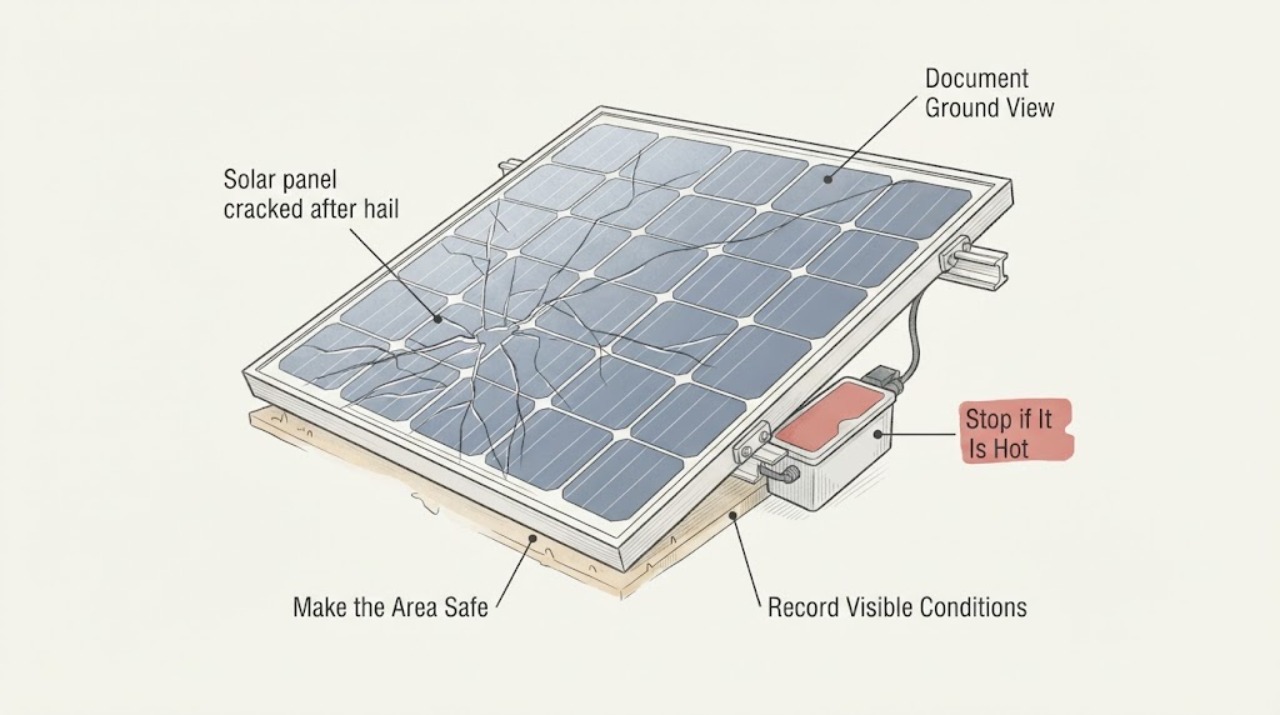
A cracked or shattered solar-module surface after hail is not a cosmetic clearance. From the ground, keep people and pets away, photograph the affected area, and note any loose module, displaced frame, exposed cable, inverter warning, smoke, heat, or water entry. Do not touch the glass, wash or cover the module, climb onto the roof, open the inverter, pull connectors, operate unfamiliar disconnects, or repeatedly reset the system. Visible glass damage can coexist with hidden cell cracks, and a system may still produce normally; the Department of Energy recommends visual and electrical inspection before the system is returned to service. Arrange qualified solar service to assess the modules, wiring, racking, roof, and system status, with emergency help for smoke, fire, arcing, or an actively unsafe structure.
Before you begin
Safety first
- The technician determines safe shutdown, visual and electrical tests, module or cable replacement, racking and roof coordination, insurance documentation, and the conditions for return to service.
Work through in order
Diagnostic checks
Use only checks that match the exact appliance or system and its official guide.
-
Check 1
From a safe location, keep people, pets, and visitors away from the array and any area below loose or broken modules; do not touch fallen glass, cables, racking, or wet electrical equipment.
Expected result: Note smoke, fire, arcing, a burning odor, heat, an exposed conductor, a module hanging or shifting, water near an inverter, a roof or structure that looks unstable, or none of these signs.
Next step: For smoke, fire, or active arcing, move away and contact emergency services from a safe location. For other hazards, maintain the exclusion area and request urgent qualified solar service.
Stop if: Do not pick up glass, brace a module, dry equipment, or enter a wet or unstable area.
Why this matters
Why: Smoke, fire, arcing, exposed conductors, loose overhead equipment, or an unstable structure is an immediate hazard rather than a DIY diagnosis. No visible emergency sign only means that safe documentation may continue; it does not clear the array.
-
Check 2
Photograph the array and roof from the ground or another stable location that does not require a ladder or contact with PV equipment; record the hail date and which module row appears affected.
Expected result: Record visible shattered or spiderwebbed glass, a dark or cloudy area, frame deformation, a displaced module, loose hardware, detached cable, roof-covering damage, broken skylight, gutter debris, or no visible damage.
Next step: Save dated wide and close ground photographs, mark the module location on a simple array sketch, and give them to the solar contractor and insurer if a claim is being considered.
Stop if: Do not climb onto the roof, step on a module, scrape the surface, wash it, or use a drone or ladder in unsafe weather just to obtain a closer image.
Why this matters
Why: Visible glass or structural damage supports keeping the affected system out of service pending professional inspection. No visible damage cannot rule out cell microcracks or cable and racking damage because hail impact can be random and some damage is hidden.
-
Check 3
Without changing settings or opening equipment, save the inverter display or monitoring-app status at the time of the storm and again after it, if the information is visible from a normal user interface.
Expected result: Record normal production, a sudden output change, an inverter or rapid-shutdown warning, unavailable data, repeated trips, or no status information; include the time, daylight, and weather context.
Next step: Provide screenshots and the timeline to the qualified solar technician; let that technician determine safe shutdown, electrical testing, and return-to-service steps.
Stop if: Do not repeatedly reset the system, change protection settings, open the inverter, pull a PV connector, or operate an unfamiliar disconnect as an experiment.
Why this matters
Why: A warning or production loss increases the need for prompt qualified diagnosis. Normal production does not prove that a visibly cracked or internally damaged module is safe, because damaged cells may continue to produce before degradation or a fault becomes obvious.
-
Check 4
From safe ground-level viewpoints and from inside the building, note roof leaks, ceiling staining, broken skylights, damaged roof coverings, gutter debris, and whether water is approaching electrical equipment; do not inspect by walking on the roof.
Expected result: The roof appears dry and intact, a leak or broken opening is visible, water is entering near the array, the mounting appears displaced, or the condition cannot be judged from below.
Next step: Photograph the interior or ground-level signs and ask the solar contractor to coordinate with a qualified roofer when the roof covering, flashing, underlayment, or array attachment may be involved.
Stop if: Do not remove roof material, lift a module, move racking, open a ceiling, or touch a wet electrical enclosure.
Why this matters
Why: A leak or displaced mounting may require coordinated roof and solar assessment, not just module replacement. A dry interior does not rule out damage beneath the array, and an inaccessible condition should remain untested rather than prompting roof access.
-
Check 5
Request an assessment from a qualified solar PV contractor and provide the array location, photos, module label if readable from the ground, storm date, monitoring history, alarms, and any roof or water observations.
Expected result: The contractor confirms visible glass or backsheet damage, suspected cell microcracks, cable or connector damage, displaced racking, roof damage, or no confirmed damage after visual and electrical testing.
Next step: Keep the affected area isolated until the contractor says the system is safe and repaired; ask for the inspection findings, testing performed, replacement scope, and documented return-to-service decision.
Stop if: Do not perform insulation, current, voltage, infrared, or electroluminescence testing yourself and do not reconnect or repower a visibly damaged system.
Why this matters
Why: A damaged module may need replacement, while hidden cell, string, wiring, racking, or roof findings can change the repair scope. The decision belongs to the trained technician using appropriate inspection and electrical tests, not to a normal production reading or a guessed replacement part.
Use your observations
Decision map
Find the observation that best matches what you see, then follow the next safe action.
-
PATH 01Safety boundary
What you see
Cracked or shattered glass, a cracked backsheet, a loose frame, or a displaced module is visible from the ground, with no smoke or active fire.
Do this next
Keep people clear, do not touch or wash the module, and request prompt qualified solar inspection before return to service. Ask the contractor to assess the full array because hail damage can be uneven.
Why this path and its safety boundary
Safety stop: No roof access, glass handling, connector work, or homeowner electrical testing.
-
PATH 02Safety boundary
What you see
The app or inverter shows normal production, but glass, frame, or other impact damage is visible.
Do this next
Treat the normal reading as history only. Keep the system out of service pending qualified visual and electrical inspection, because cell cracks or water intrusion may not immediately reduce output.
Why this path and its safety boundary
Safety stop: Do not use normal production as permission to touch, clean, cover, or repower the affected module.
-
PATH 03Safety boundary
What you see
Production drops, an inverter warning appears, cables are exposed, or there is heat, odor, smoke, or arcing.
Do this next
Move away, keep others away, and request urgent qualified solar or electrical response; contact emergency services for smoke, fire, or active arcing.
Why this path and its safety boundary
Safety stop: Do not reset repeatedly, open equipment, or approach the array to locate the fault.
-
PATH 04Safety boundary
What you see
A roof leak, broken skylight, displaced array, loose mounting, or unsafe roof condition is visible from below.
Do this next
Keep out of the roof area and arrange coordinated solar and roofing assessment. Document the interior and ground-level evidence without disturbing the array.
Why this path and its safety boundary
Safety stop: Do not climb, lift a module, move a rail, or enter a wet or structurally questionable area.
Helpful context
Understand the symptom
A normal production reading does not clear a hail-damaged module
Hail can break the front glass, crack cells without obvious glass breakage, deform a frame, loosen mounting, or damage a cable. Some damaged modules still produce at their expected level for a time, so a normal app graph is useful history but not proof that the module is safe. The Department of Energy describes infrared, ultraviolet, and electroluminescence imaging as ways a trained inspection can find damage that a casual visual check misses.
Keep the roof, glass, and electrical equipment out of the homeowner check
Hail can damage the roof and the array in the same event. Look from the ground or another stable, non-PV location for loose material, displaced modules, broken skylights, leaks, or debris, but do not climb a ladder or walk on the array to confirm a mark. Do not touch cracked glass, exposed conductors, connectors, racking, or inverter internals; the post-damage work requires inspection and electrical testing by trained PV personnel.
Separate urgent hazards from the repair and insurance record
Smoke, burning smell, visible arcing, a hot or damaged enclosure, a loose overhead module, active water near electrical equipment, or a roof that appears structurally unsafe changes this from a documentation task to an urgent safety response. Otherwise, dated ground photos, the hail date, module locations, production history, alarms, and roof observations help a qualified solar contractor and insurer scope module, wiring, racking, and roof work without a risky close inspection.
Safety boundary
Stop conditions
- Do not touch cracked or shattered module glass, fallen glass, exposed PV cables, connectors, racking, or wet electrical equipment.
- Do not climb onto the roof, use a ladder for a close inspection, or step on a module.
- Do not open the inverter, pull PV connectors, operate unfamiliar disconnects, change protection settings, or repeatedly reset the system.
- Do not wash, scrape, cover, brace, lift, or repower a visibly damaged module.
- Treat smoke, fire, arcing, heat, an unstable structure, or an overhead loose module as an urgent safety condition.
Only after diagnosis
Potential parts
- matching photovoltaic module
Consider a replacement only after a qualified technician confirms the exact module model, electrical characteristics, physical fit, and whether the module is actually the failed component.
Do not order from appearance or wattage alone; module, connector, racking, warranty, and rapid-shutdown requirements must be confirmed for the installed system. - photovoltaic cable or connector
Consider this only when a qualified technician identifies storm damage to a cable or connector and specifies the exact listed replacement and installation method.
Do not unplug, splice, or substitute PV connectors yourself; the array and connector circuit require qualified electrical isolation and testing. - solar mounting or roof flashing component
Consider this only if coordinated solar and roofing inspection confirms displaced mounting or storm-damaged flashing, underlayment, or attachment hardware.
The correct part depends on the roof assembly, racking system, attachment layout, and local requirements; a module-only repair may leave a roof leak or structural issue.
When checks do not resolve it
Need a professional?
Call urgently for smoke, fire, arcing, heat, exposed conductors, a loose overhead module, active water near electrical equipment, or an unsafe roof or structure. Otherwise arrange prompt qualified solar inspection for any visible crack, broken glass, damaged backsheet, displaced frame, output change, warning, or unexplained post-hail condition.
Safety scope: The technician determines safe shutdown, visual and electrical tests, module or cable replacement, racking and roof coordination, insurance documentation, and the conditions for return to service.
Common questions
FAQ
Can a cracked solar panel keep working after hail?
Yes, a damaged module may still produce normally for a time, but that does not make it safe or undamaged. Hidden cell cracks and water intrusion can worsen, so visible damage needs qualified visual and electrical inspection before return to service.
Can I climb onto the roof to check the cracked panel?
No. Stay on the ground or another stable location that does not require contact with the array. Roof, ladder, broken-glass, and electrical hazards should be handled by trained professionals.
Should I turn off my solar system after hail?
If visible damage is present, the Department of Energy recommends shutdown and visual and electrical inspection before repowering, but do not operate unfamiliar disconnects or open equipment as a homeowner experiment. Ask a qualified solar professional how the installed system should be safely isolated.
How can I tell whether hail caused hidden cell cracks?
You cannot confirm hidden cell cracks from an app graph or casual ground view. A trained PV technician may use appropriate electrical testing and IR, UV, or electroluminescence imaging, and should assess the full array because hail impact can be uneven.
What should I give the solar contractor or insurer?
Provide dated ground-level photos, the hail date and weather context, affected module locations, monitoring screenshots and alarms, and any roof leak or interior staining. Do not obtain evidence by touching glass, opening equipment, or climbing the roof.
Read the exact guide
Official sources
- Severe Thunderstorm SafetyNational Weather Service · Supports treating hail as a property-damage and ongoing severe-weather hazard and delaying exterior inspection until conditions are safe.
- Hail Damage Mitigation for PV SystemsU.S. Department of Energy · Supports the distinction between visible and hidden hail damage, the need for visual and electrical inspection before repowering, and professional imaging for microcracks.
- Life Cycle of Photovoltaic Systems: Operate and Maintain an Existing Photovoltaic SystemU.S. Department of Energy · Supports securing damaged areas, blocking access, electrical testing, replacement of damaged systems before energizing, and professional post-damage recovery.
- PV System Owner’s Guide to Identifying, Assessing, and Addressing Weather Vulnerabilities, Risks, and ImpactsU.S. Department of Energy · Supports documenting broken glass and cell cracks, water-intrusion and electrical-fault risk, roof and electrical hazards, and trained technician testing or replacement.
Community feedback
Share a repair observation
Share a plain-text repair observation. Accepted observations are published automatically; this page may take a moment to update.