
On this page
Start here
Quick answer
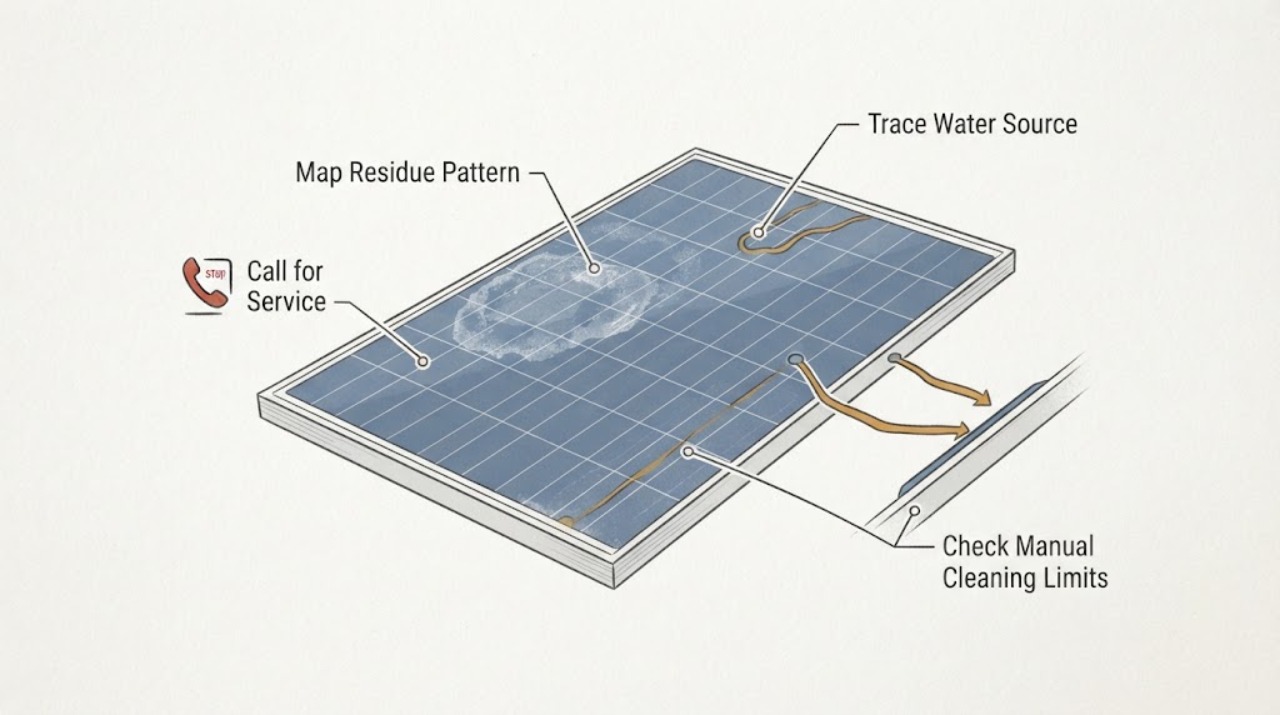
White, chalky marks on solar-panel glass are often dried minerals left by hard water, sprinkler overspray, or runoff, but the appearance alone does not prove that the glass or its coating is sound. From a safe position, photograph the pattern, identify what water reached the panel, and check the exact module manual before any cleaning. If the marks are tied to an external water path and there are no cracks, delamination, exposed connections, or unsafe access, use only the manufacturer-approved low-mineral water and non-abrasive method during an appropriate cool period. Do not dry-scrape, use household window chemicals, apply acid or alkali, or climb onto the array. If residue remains or returns, or power output is also abnormal, stop repeated cleaning and arrange qualified solar service.
Work through in order
Diagnostic checks
Use only checks that match the exact appliance or system and its official guide.
-
Check 1
From ground level or another stable, approved access point, photograph the glass and map where the white or chalky marks start and stop. Do not climb onto modules, step on them, or touch wiring while inspecting.
Expected result: The mark forms a narrow band below a frame, follows a sprinkler arc or runoff path, or appears uniformly across the array; note separately any crack, chip, rainbow-like film, peeling, or mark that looks beneath the glass.
Next step: If damage or unsafe access is visible, stop and call a qualified solar professional. If the glass is intact and access is safe, identify the water source before choosing a cleaning method.
Stop if: Stop immediately for cracked glass, loose hardware, exposed conductors, water inside the module or junction area, or unstable roof or ground access.
Why this matters
Why: A repeatable external water pattern makes surface mineral deposit more likely. A subsurface-looking mark, delamination, crack, or damaged edge is not a cleaning diagnosis and may involve the module or its seal.
-
Check 2
Observe the panel from a safe position after irrigation, rain, washing, or roof runoff and record which panels receive the water. Check whether a sprinkler, gutter, masonry edge, metal surface, or previous cleaning route can explain the same deposit location without moving solar equipment.
Expected result: Only panels in the spray or runoff path develop the marks, or the residue appears on the whole array even though no identifiable water path is present; note whether it returns after the same event.
Next step: If the cause is a ground-accessible sprinkler or other ordinary household adjustment, correct only that source without touching the array and document the change. If the source is on the roof, in the mounting, or otherwise uncertain, ask the installer or a qualified technician to assess it.
Stop if: Do not move modules, alter mounts, redirect roof drainage by working on the array, or enter an unsafe roof area to trace a drip.
Why this matters
Why: A localized, recurring water path supports an external mineral source. Array-wide or source-free residue makes broader soiling, water chemistry, coating damage, or another site condition more plausible and cannot be diagnosed by appearance alone.
-
Check 3
Read the exact module manufacturer's cleaning section and record the permitted water quality, pH guidance, tool material, temperature or timing limits, and any required electrical isolation. Treat a generic cleaning tip as insufficient for an unidentified module.
Expected result: The manual specifies a low-mineral or otherwise treated water, near-neutral conditions, a non-abrasive non-conductive implement, and a safe isolation procedure; or it gives no user-safe procedure for the installed access and equipment.
Next step: If the manual and physical access support a safe, approved cleaning procedure, have the responsible trained person follow that procedure once. If it requires array isolation, roof work, special chemicals, or unknown equipment, stop and arrange qualified service instead of improvising.
Stop if: Never dry-scrape or rub crust from the glass, use acid or alkali, use household window products, use sharp or abrasive tools, or clean a damaged or energized array contrary to the manual.
Why this matters
Why: The manufacturer's limits control. For example, Canadian Solar warns that high-mineral water can deposit on glass and recommends low-mineral, near-neutral water; its cleaning manual also prohibits dry scraping and abrasive, corrosive, or unsuitable chemical methods. Those limits must not be generalized to a different module without checking its documentation.
-
Check 4
After one manufacturer-approved cleaning performed within the safe access and isolation procedure, compare the before-and-after photographs and review the system's monitoring trend under comparable daylight. Do not judge production from a single cloudy or shaded interval.
Expected result: The deposits clear and the production trend is consistent again; the deposits remain or return after the same water event; or the glass looks clear while the system still reports a sustained loss, alert, or abnormal behavior.
Next step: Log the water source and approved method if the result is stable. For recurrence, persistent marks, or an output alert, stop repeated cleaning and give the professional the photos, monitoring context, model information, and the exact procedure used.
Stop if: Stop if cleaning exposes damage, the monitoring system reports a fault, or the result requires opening, rewiring, testing live conductors, or repeated chemical or abrasive treatment.
Why this matters
Why: Clearing with a matching production improvement supports external soiling as a contributor. Persistent or recurring deposits point back to water chemistry, runoff, or a surface/coating issue. Clear glass with continuing performance trouble makes shading, module damage, wiring, inverter, or another system cause more likely than residue alone.
Use your observations
Decision map
Find the observation that best matches what you see, then follow the next safe action.
-
PATH 01Safety boundary
What you see
White or chalky residue is localized to panels below a sprinkler or runoff path, the glass looks intact, and system monitoring is otherwise normal.
Do this next
Remove or prevent the safe, ground-level water source if possible, then use only the exact manual-approved cleaning procedure through the appropriate trained person and record the result.
Why this path and its safety boundary
Why it matters: The pattern makes an external mineral deposit more likely than a failed module, although it does not prove the glass coating is unaffected.
Safety stop: Do not climb, dry-scrape, or use household glass chemicals to speed the job.
-
PATH 02Safety boundary
What you see
Residue is uniform or iridescent, looks beneath the glass, remains after the approved method, or returns even after the identifiable water source is gone.
Do this next
Stop cleaning experiments and contact the module manufacturer, installer, or qualified solar technician with close photos, dates, water source, and the manual section used.
Why this path and its safety boundary
Why it matters: A coating, glass, seal, environmental, or installation issue is more plausible than removable surface dust; repeated cleaning could add scratches or damage.
Safety stop: Do not scrape, polish, sand, apply acid or alkali, or open the module to investigate.
-
PATH 03Safety boundary
What you see
The glass looks clear after an approved cleaning, but output remains abnormal or the monitoring system shows an alert, especially when the problem is not limited to the water-exposed panels.
Do this next
Stop trying additional surface treatments and have a qualified technician evaluate the monitoring data and electrical system; provide the panel pattern and before-and-after record.
Why this path and its safety boundary
Why it matters: The remaining issue is less likely to be hard-water residue alone and may involve shading, a module defect, wiring, inverter, or another system-level cause.
Safety stop: Do not reset protections repeatedly, disconnect conductors, or test live equipment as a do-it-yourself step.
-
PATH 04Safety boundary
What you see
There is cracked or broken glass, water intrusion, loose or unstable mounting, exposed wiring, a ground-fault or other electrical alert, fire damage, or unsafe roof access.
Do this next
Keep people clear, avoid touching the array, and contact the responsible qualified solar professional or emergency service appropriate to the immediate hazard.
Why this path and its safety boundary
Why it matters: The observation has crossed from surface maintenance into an electrical, structural, or access hazard.
Safety stop: Stop all cleaning and do not approach the damaged or energized equipment.
Helpful context
Understand the symptom
What hard-water residue can and cannot tell you
A white ring or crust that follows a sprinkler arc, a lower frame, or a roof runoff line is consistent with dried mineral deposits on the outside of the glass. It is different from a haze, rainbow-like change, peeling, cracking, or a mark that appears beneath the glass. Surface soiling can reduce light reaching the module, but a visual mark does not identify a failed electrical component or justify ordering a replacement. Canadian Solar's published guidance notes that high-mineral wash water can deposit on glass and affect transmittance and an anti-reflective coating; treat that as manufacturer-specific guidance and check the manual for the actual module.
Set the safety boundary before touching the surface
Solar modules can remain electrically active in daylight, and a cracked or wet module increases shock risk. Roof access, array isolation, work near conductors, and any change to mounting or wiring belong to a qualified person unless the exact installation procedure explicitly assigns them to a trained operator. Keep checks observational when access is unstable or the array is damaged. Never use the visible residue as a reason to bypass a shutdown device or open a module.
Use the result to choose the next safe step
The useful distinction is not simply clean versus dirty. A localized deposit that stops after the water source is corrected supports an external maintenance issue. A persistent film, damaged-looking glass, or normal-looking glass with continuing output loss points to a different diagnosis. Record photos, the water source, the cleaning method allowed by the manual, and the production or monitoring context so an installer can separate soiling from module, wiring, inverter, shading, or site problems.
Safety boundary
Stop conditions
- Do not climb onto modules or work from unstable access.
- Do not dry-scrape, polish, sand, or use acid, alkali, household window products, sharp tools, or abrasive brushes on the glass.
- Do not touch conductors, open modules, alter mounting or wiring, bypass shutdown or protection devices, or clean a cracked or wet-damaged array as a DIY step.
- Stop repeated cleaning when the residue remains, returns, or the system output or monitoring stays abnormal.
When checks do not resolve it
Need a professional?
Call a qualified solar professional when residue persists or recurs, the source is on a roof or array, the glass or seal looks damaged, access is unsafe, monitoring remains abnormal, or the job requires isolation, electrical work, structural work, or a model-specific cleaning procedure.
Have this ready
- Module brand and model or a readable nameplate photo
- Before-and-after photos showing the residue pattern
- When the marks first appeared and whether they recur after rain, irrigation, or cleaning
- The suspected water source and any safe ground-level correction
- Monitoring trend or alerts and the exact cleaning method, if any, that was approved and used
Common questions
FAQ
Are white spots on solar panels always hard-water stains?
No. A deposit following a sprinkler or runoff path is consistent with dried minerals, but a uniform haze, iridescent or peeling area, crack, or mark beneath the glass can indicate a surface, seal, or module issue. Photograph the pattern and check the exact module manual before cleaning.
Can I use vinegar, acid, or household glass cleaner on solar-panel glass?
Do not choose a chemical from a generic recipe. Use only the exact manufacturer's approved method. Canadian Solar's opened manual warns against corrosive acid or alkali solutions, acetone, industrial alcohol, dry scraping, and abrasive tools; another module may have different limits.
What if the panel looks clean but power output is still low?
Treat that as a separate system diagnosis rather than continuing to scrub. Compare the monitoring trend under similar daylight and have a qualified technician check for shading, module damage, wiring, inverter, or other system causes.
When is cleaning not a safe do-it-yourself job?
Stop when access requires climbing or roof work, when the array is cracked or wet-damaged, when wiring or shutdown status is uncertain, or when the approved procedure requires isolation, electrical testing, structural changes, or equipment you are not trained to use.
Read the exact guide
Official sources
- Optimizing Solar Photovoltaic Performance for LongevityU.S. Department of Energy, Federal Energy Management Program · General PV operations and maintenance context; the installed system's manuals and qualified service procedures govern the repair.
- EERE Success Story – The Plug-and-Play Device That Streamlines Solar CleaningU.S. Department of Energy · General PV soiling context; it does not identify the cause of an individual panel's residue.
- Installation Manual of Aluminum Frame Dymond ModuleCanadian Solar · The cited cleaning annex applies to the Canadian Solar module family covered by the manual; other modules require their own instructions.
- Solar Photovoltaic Hardening for Resilience – WildfireU.S. Department of Energy, Federal Energy Management Program · The cited cleaning cautions are written for ash removal after wildfire; they support the general warning to avoid damaging glass and using unsuitable household cleaning equipment.
- CUSTOMERSUPPORT – Canadian Solar – GlobalCanadian Solar · Canadian Solar modules; use the installed module's own manual for other manufacturers.
Community feedback
Share a repair observation
Share a plain-text repair observation. Accepted observations are published automatically; this page may take a moment to update.