
On this page
Start here
Quick answer
For a cracked solar panel with suspected water ingress, use only ground-level or indoor observation. Compare a fixed fracture, edge or backsheet damage, frame separation, and post-rain darkening or clouding with ordinary dirt, residue, shadow, or reflection. Existing monitoring alerts can add context, but do not measure, clean, touch, disconnect, reconnect, or climb to the array. Keep people clear and contact the installer or qualified PV technician promptly when water-related change, broken glass, backsheet or frame damage, alerts, or unsafe access is present.
Before you begin
Safety first
- Use ground-level or indoor observation only; do not climb, touch, clean, measure, open equipment, disconnect, reconnect, seal, cover, or remove a module.
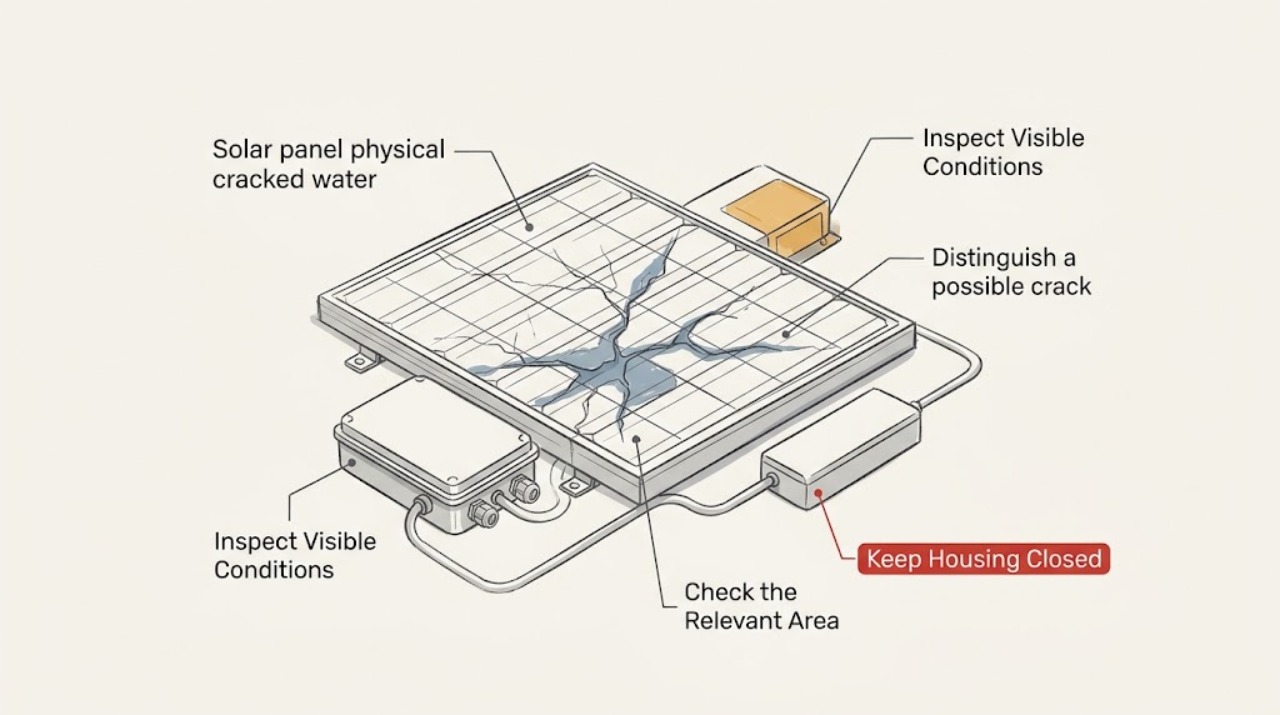
Work through in order
Diagnostic checks
Use only checks that match the exact appliance or system and its official guide.
-
Check 1
From the ground or through an indoor window, observe the panel only from a safe distance. Note whether the reported crack is in the glass surface, near an edge, across a frame, or on a visible backsheet, and whether the panel or frame appears displaced.
Expected result: Choose visible broken glass, edge or backsheet damage, frame separation, an angle-dependent mark, no reliable view, or uncertain.
Next step: Record the panel row or location and take photos from the same safe viewpoint without touching, cleaning, measuring, or approaching the array.
Stop if: Stop for loose panels, falling material, exposed conductors, water near electrical equipment, roof or ladder access, or any need to touch the module.
Why this matters
Why: A broken top sheet, edge separation, cracked backsheet, or detached frame can expose different water and electrical risks. A dark line that changes with viewing angle may be dirt or reflection rather than a crack.
-
Check 2
Compare existing photos or safe observations made after rain with a dry-period view. Look for new edge darkening, droplets, cloudy areas, staining, peeling backsheet, frame moisture, or a change that follows rainfall; do not stand outside in rain or climb to inspect.
Expected result: Record no change after rain, temporary edge or surface moisture, recurring dark or cloudy area, visible water path, or no safe comparison.
Next step: Keep the date and weather context with the photos and tell the installer which panel and edge changed, if any.
Stop if: Do not wipe the panel, apply sealant, spray water, use a hose, or make a roof-level inspection.
Why this matters
Why: A repeatable post-rain change near a crack or edge makes water ingress more plausible than a stable surface mark. Absence of a visible change does not prove that the module is sealed.
-
Check 3
Distinguish a possible crack from dirt, bird residue, shadow, glare, or reflection using only changes in appearance with viewpoint, daylight, and time. Do not scrape, rub, wash, or use a tool to test the surface.
Expected result: Record fixed line or break, angle-dependent mark, residue-like patch, glare only, or uncertain.
Next step: Save the clearest unedited photos and report uncertainty instead of labeling a reflection as a cracked module or applying a cleaner.
Stop if: Stop if resolving the mark would require contact, cleaning, roof access, panel removal, or electrical testing.
Why this matters
Why: A mark that moves or disappears with viewing angle is less specific than a fixed fracture line or edge separation. Surface appearance alone cannot confirm cell damage or water entry.
-
Check 4
Inspect only visible frame and edge conditions from ground level: look for lifted or separated frame corners, peeling backsheet edges, corrosion marks, pooled water beneath a low edge, or loose-looking cables without approaching or reaching under the array.
Expected result: Record frame appears intact, frame separation, backsheet peeling or crack, corrosion or water mark, loose-looking cable, or cannot view safely.
Next step: Map the edge, frame, and backsheet observation to the panel location and request an installer or qualified PV technician inspection.
Stop if: Do not touch the frame, lift a corner, move cables, reach behind a panel, remove hardware, or disconnect anything.
Why this matters
Why: Frame or backsheet damage can create a water path even when the front surface crack is small. A clean frame and no visible water path do not clear a cracked module because concealed damage requires trained inspection.
-
Check 5
Review existing system records without changing controls: note production alerts, inverter or monitoring messages, a sudden output change, and whether the event followed hail, wind, snow, cleaning, or another impact. Do not perform a new electrical measurement.
Expected result: Record no alert, production change, electrical fault message, alert history unavailable, or uncertain.
Next step: Export or photograph the existing alert and timeline and send it with the panel photos to the installer or system owner representative.
Stop if: Do not open an inverter or combiner, test DC voltage, change settings, disconnect, reconnect, or re-energize the system.
Why this matters
Why: A water-related visual change paired with a production or fault alert raises the priority of a trained PV inspection, but normal output does not make a visibly cracked module safe or watertight.
-
Check 6
Set the boundary from the evidence: keep people away from a visibly damaged or water-affected panel and request installer or qualified PV service; do not decide that a surface mark is harmless or that a replacement module is compatible from appearance alone.
Expected result: Answer yes if water-related change, broken glass, backsheet or frame damage, an electrical alert, or unsafe access is present; otherwise arrange non-urgent confirmation of the uncertain mark.
Next step: Provide the panel location, crack or mark photos, rain comparison, frame or backsheet findings, and existing monitoring history for a service decision.
Stop if: Do not climb, touch, clean, measure, disconnect, reconnect, cover, seal, remove, or replace the module yourself.
Why this matters
Why: Water ingress into broken glass or a cracked backsheet can create internal electrical faults even when the array still produces power. The safe response depends on trained inspection and the system's physical and electrical design.
Use your observations
Decision map
Find the observation that best matches what you see, then follow the next safe action.
-
PATH 01Safety boundary
What you see
A fixed crack or broken glass is visible and a new or recurring dark, cloudy, wet, or stained area appears after rain.
Do this next
Keep people clear and contact the installer or qualified PV technician promptly for safe isolation, inspection, and module replacement planning.
Why this path and its safety boundary
Why it matters: The crack and post-rain change make water ingress a credible hazard, not merely a cosmetic defect; the module should not be treated as safe because it still produces power.
Safety stop: Do not touch, clean, seal, cover, climb to, disconnect, reconnect, or electrically test the module.
-
PATH 02Safety boundary
What you see
A crack or edge break is visible, but there is no safe evidence of a post-rain change and the system has no known alert.
Do this next
Arrange installer inspection and preserve the location and photos; do not resume normal assumption of safety based on output alone.
Why this path and its safety boundary
Why it matters: No visible water does not prove the seal or backsheet is intact. The module remains a professional inspection matter, with lower urgency only if no warning sign or access hazard is present.
Safety stop: No roof access, surface cleaning, crack filling, measurement, disconnection, or reconnection.
-
PATH 03Safety boundary
What you see
The mark changes with angle or light and has no fixed fracture, edge separation, or water-related change.
Do this next
Keep the photos and ask the installer to confirm the mark during routine service rather than cleaning or approaching the panel.
Why this path and its safety boundary
Why it matters: Dirt, residue, shadow, and reflection are more plausible than water ingress, but an image cannot rule out a fine crack or cell damage.
Safety stop: Do not rub, wash, scrape, measure, climb, or use a tool to confirm the mark.
-
PATH 04Safety boundary
What you see
A frame corner is lifted, a backsheet is peeling or cracked, corrosion or a water path is visible, or a cable appears loose.
Do this next
Keep the area clear and request prompt installer or specialized PV inspection for safe isolation and repair or replacement scope.
Why this path and its safety boundary
Why it matters: Damage at the module boundary can admit water or compromise physical and electrical protection even if the front glass looks mostly intact.
Safety stop: Do not reach under the array, move cables, lift a frame, apply sealant, or disconnect equipment.
-
PATH 05Safety boundary
What you see
An inverter or monitoring alert, sudden production change, or fault history accompanies visible crack or water evidence.
Do this next
Send the existing alert and timeline to the installer and request prompt qualified PV and electrical assessment.
Why this path and its safety boundary
Why it matters: The combined visual and system evidence raises the likelihood of an electrical or module fault and makes continued operation a poor user decision.
Safety stop: Do not open equipment, change controls, measure DC output, disconnect, reconnect, or re-energize the system.
-
PATH 06Safety boundary
What you see
The panel or its underside cannot be viewed from the ground, access requires a roof or ladder, or glass or material appears loose or falling.
Do this next
Keep people and vehicles clear and request prompt installer or qualified PV service; follow emergency guidance if material is actively falling or a fire hazard is present.
Why this path and its safety boundary
Why it matters: Fall, glass, and electrical hazards outweigh any benefit of a closer user inspection.
Safety stop: No roof access, ladder, touching, cleaning, measuring, panel handling, or electrical isolation by an unqualified user.
Helpful context
Understand the symptom
Water evidence changes the safety boundary
A cracked solar panel with suspected water ingress needs a safe visual distinction between a true fracture, edge or backsheet damage, and a surface mark. Compare fixed cracks and frame changes with existing post-rain photos or monitoring history from the ground or indoors. Water-related darkening, clouding, staining, or recurring edge moisture raises the service priority even if the panel still produces power.
Keep the panel and wiring untouched
Solar modules can remain electrically hazardous in daylight. Do not climb, touch, clean, measure, disconnect, reconnect, seal, cover, or remove a damaged module. Do not open an inverter or combiner. The installer or qualified PV technician should decide safe isolation, inspection, and replacement.
Do not confuse reflection with confirmed damage
A stable angle-dependent mark without a fixed crack or water change can be dirt, residue, shadow, or reflection, but it still should not be rubbed or tested by the homeowner. Provide clear photos, panel location, weather timing, frame or backsheet observations, and any existing monitoring alert for professional confirmation.
Safety boundary
Stop conditions
- Stop for broken or loose glass, peeling backsheet, frame separation, loose material, exposed conductors, water near electrical equipment, a monitoring fault, roof or ladder access, or any need to touch the array.
- Do not climb, clean, rub, measure, open an inverter or combiner, disconnect, reconnect, seal, cover, remove, or replace a solar module yourself.
When checks do not resolve it
Need a professional?
Call the installer or qualified PV technician promptly for water-related visual changes, broken glass, peeling backsheet, frame separation, loose material, electrical alerts, or unsafe access. Arrange routine confirmation only for an uncertain angle-dependent mark with no warning signs.
Safety scope: Use ground-level or indoor observation only; do not climb, touch, clean, measure, open equipment, disconnect, reconnect, seal, cover, or remove a module.
Have this ready
- Provide panel location, fixed crack or mark photos, edge, backsheet and frame observations, post-rain comparison, impact or weather timeline, and existing inverter or monitoring alerts.
Common questions
FAQ
What visible sign makes water ingress more concerning?
A recurring dark, cloudy, wet, or stained area after rain near a fixed crack or edge break makes water ingress more plausible. Do not touch or clean the panel to investigate.
Is a cracked panel safe if it still produces power?
No. A panel may keep producing while broken glass or a cracked backsheet worsens and allows moisture to create an internal fault.
How can I tell a crack from dirt or reflection?
Use viewpoint and daylight changes only. A fixed line, broken glass, edge separation, or recurring post-rain change deserves installer review; do not rub, wash, scrape, or measure.
What should I give the solar installer?
Note panel location, fixed crack or mark, edge or backsheet condition, rain timing, existing photos, and inverter or monitoring alerts without changing system controls.
When should a cracked panel be treated as urgent?
Keep people clear and call promptly for broken glass, peeling backsheet, frame separation, loose material, an electrical alert, water-related change, or any access that requires a roof or ladder.
Read the exact guide
Official sources
- PV System Owner’s Guide to Identifying, Assessing, and Addressing Weather Vulnerabilities, Risks, and ImpactsU.S. Department of Energy · Supports the specific water-ingress risk of broken glass top-sheets and cracked backsheets, the need for trained PV inspection, and the fall and electrical hazards of roof-level work.
- Keeping Solar in the Field by Keeping Water OutU.S. Department of Energy Integrated Energy Systems Office · Supports edge-seal and water-entry reasoning without suggesting that a homeowner test or reseal a module.
- Green Job Hazards - Solar Energy: ElectricalOccupational Safety and Health Administration · Supports the boundary that solar work involves electrocution, arc-flash, overhead-line, and fall hazards and requires trained safe work practices.
Community feedback
Share a repair observation
Share a plain-text repair observation. Accepted observations are published automatically; this page may take a moment to update.