
On this page
Start here
Quick answer
For storm branch debris blocking access, isolate the blocked driveway, walkway, exit, road, or emergency route first from a distant, stable position. Identify whether any branch is hanging, supported, under pressure, moving, touching a structure, or near a power line; assume lines are energized and keep clear. Record a safe detour, wide and zoomed photos, weather changes, and hidden areas without crossing, stepping over, driving over, dragging, lifting, or cutting debris. Call emergency services for an obstructed emergency route or immediate danger, the utility for line contact, and qualified tree-removal service for controlled assessment and removal.
Before you begin
Safety first
- Request a blocked-access storm-debris assessment that preserves emergency routes, evaluates hanging or tensioned wood, standing-tree stability, utility contact, structure impact, public-road exposure, and weather-related changes. Qualified tree, utility, emergency, road, and structural responders coordinate the safe sequence; the reader should not move the debris.
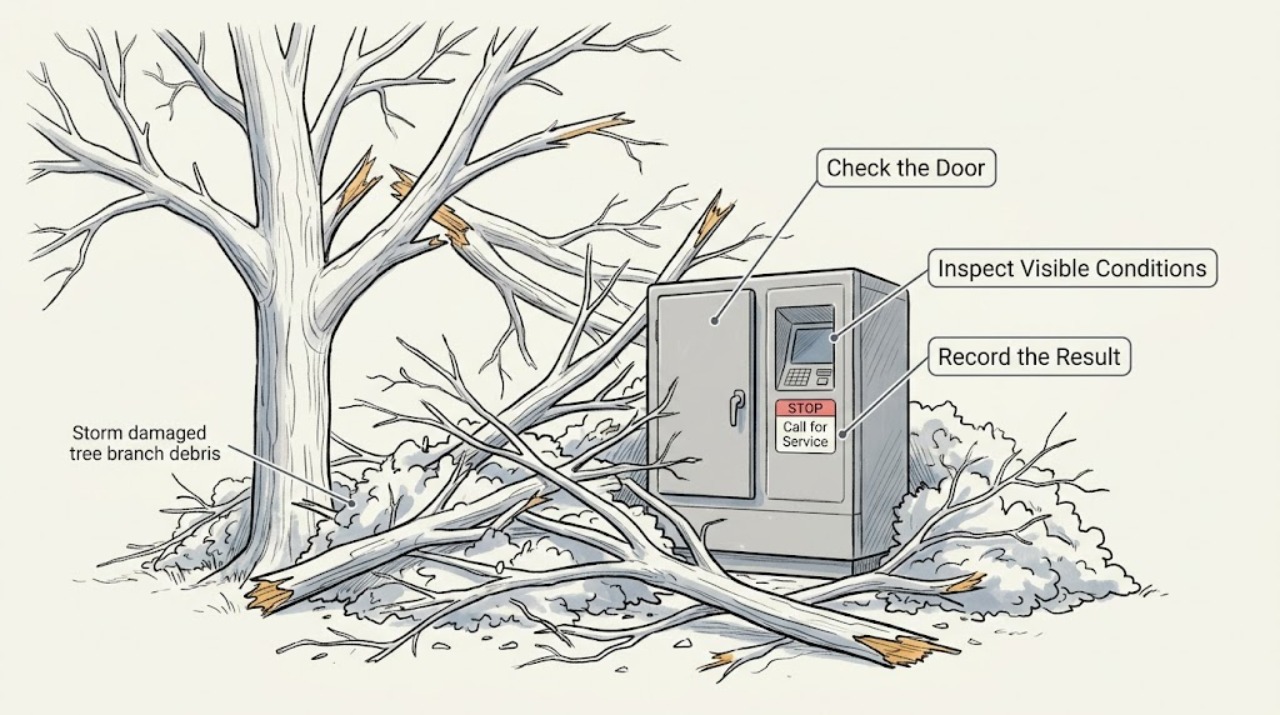
Work through in order
Diagnostic checks
Use only checks that match the exact appliance or system and its official guide.
-
Check 1
From a distant, stable position, identify exactly which driveway, walkway, door, gate, road, fire-access route, or work area is blocked by storm branch debris. Keep people, pets, vehicles, and emergency traffic outside the debris and any nearby tree or limb fall area.
Expected result: Record the blocked route, whether anyone is inside or needs access, the safe detour, and whether debris extends beyond the visible pile or could shift into the route.
Next step: Use a safe alternate route if one exists, notify occupants or site management, and call emergency services when an exit, public road, or emergency access route is obstructed or unsafe.
Stop if: Do not cross, step over, crawl under, drive over, drag, lift, or move any branch, log, or debris to reopen the route.
Why this matters
Why: Blocked access changes the first priority from cleanup to controlled isolation: a route that prevents evacuation or emergency response requires faster escalation than debris lying in an unused area.
-
Check 2
From outside the isolated area, inspect the debris pattern with photos or zoom: look for suspended branches, a broken limb resting on another tree, a trunk under pressure, rolling or hanging pieces, fresh movement, or debris touching a roof, wall, fence, vehicle, or other support.
Expected result: Record whether material is loose on the ground, tangled overhead, leaning, wedged, hanging, or resting on a structure, and whether wind or rain changes its position.
Next step: Record each visible piece and its relationship to the standing tree and structures and request qualified tree-risk or removal service without entering the pile.
Stop if: Stop observing and move farther away if wood shifts, a crack opens, debris falls, wind rises, or the safe viewpoint becomes unstable.
Why this matters
Why: Suspended, supported, or tensioned wood can move when a pile is disturbed, so a blocked route beside it needs professional tree-removal planning even when the visible branch appears small.
-
Check 3
From a safe distance, look for overhead or downed electrical lines, service drops, poles, gas or water utilities, and branches or fences that may be touching them. Do not approach to determine whether a line is live or to separate a branch from it.
Expected result: Record visible contact, sagging, sparks, outage, arcing, or uncertainty about separation, plus whether the line crosses the blocked route or building access.
Next step: Stay well clear, notify the utility or emergency services from a safe location, and tell the tree-removal provider about the utility exposure. Wait for utility clearance before any tree work.
Stop if: Do not touch, drive beneath, throw anything toward, pull, cut, or inspect with a ladder or tool near a downed or potentially energized line.
Why this matters
Why: A line-contact or possible line-contact pile is an electrical emergency boundary, not ordinary yard debris; lines can re-energize and can energize trees, fences, water, or other objects.
-
Check 4
From outside the blocked area, compare the debris with nearby structures and access points: roof or wall impact, broken windows, damaged fences or gates, leaning trunks, lifted roots, and whether a door, stair, driveway, or public route cannot be safely used.
Expected result: Record structural cracks, displaced gutters or roofing, broken glazing, gate or door obstruction, route width, and any alternate safe entrance visible without entering the hazard.
Next step: Photograph the exposed structure and maintain the exclusion boundary. Request emergency or qualified inspection for any damaged building, utility, road, or entry point before reentry or debris removal.
Stop if: Do not enter a damaged building, open a blocked door by force, climb over debris, inspect a roof, or stand beneath an impacted limb or structure.
Why this matters
Why: Structure contact or a blocked emergency route increases the urgency and may require coordinated fire, utility, structural, and tree response; it is not a reason to pull the branch away.
-
Check 5
Observe the site only from safe ground as weather changes and note whether wind, rain, darkness, ice, or saturated soil could alter the pile, standing tree, access road, or utility condition. Compare dated photos rather than testing the debris.
Expected result: Record new movement, falling fragments, water flow, soil failure, changing line position, or loss of the previously safe viewing point.
Next step: Update occupants, site management, the utility, or emergency responders if the route or debris changes and provide the time-stamped photos to the professional.
Stop if: Stop and retreat if visibility drops, lightning or high wind arrives, soil or structures move, or the only view requires crossing, climbing, or approaching the debris.
Why this matters
Why: A pile that appears stable in calm weather may slide, roll, or release a suspended limb after another gust or when wet ground shifts; blocked access should remain isolated until conditions and hazards are assessed.
-
Check 6
Prepare a remote service handoff with the blocked route, safe detour, wide and zoomed photos, suspended or ground debris, tension or support clues, line and structure exposure, weather changes, access limits, and any emergency response already notified.
Expected result: Confirm what was seen from the safe boundary and list every area that remains hidden or cannot be reached without crossing the debris.
Next step: Request qualified tree-removal or arborist assessment and a controlled debris-removal plan that preserves emergency access and identifies utility or structural clearance needs.
Stop if: Do not turn the handoff into a chainsaw, rope, winch, vehicle, ladder, tarp-placement, pulling, or debris-hauling task.
Why this matters
Why: A tree professional needs to plan the work zone and sequence around blocked access, not simply haul away a branch; utility, road, fire, structural, and tree risks may require separate coordination.
Use your observations
Decision map
Find the observation that best matches what you see, then follow the next safe action.
-
PATH 01Next step
What you see
Storm branch debris blocks a building exit, public road, driveway needed by emergency responders, fire-access route, or the only safe entrance.
Do this next
Keep everyone outside the blocked and fall areas, use a safe alternate route if available, and call emergency services or site management for access control. Do not cross, drive over, or move the debris while waiting.
-
PATH 02Next step
What you see
Debris or a tree touches an overhead or downed power line, service drop, pole, fence, water, or another object that could be energized.
Do this next
Assume the line and touching objects are energized, stay well away, and notify the electric utility or emergency services. Tree removal waits for utility clearance and qualified coordination.
-
PATH 03Next step
What you see
A branch is hanging, wedged, leaning, under visible pressure, resting on a structure, or tangled in another tree above or beside the blocked route.
Do this next
Maintain a larger exclusion area and request urgent qualified tree-risk or removal service. Do not pull, prop, rope, cut, or climb to free it; the route stays closed until assessed.
-
PATH 04Next step
What you see
The pile is on the ground in an open area, no utility or structure exposure is visible, and an emergency route remains safely usable.
Do this next
Keep the pile isolated and arrange planned qualified debris removal or tree assessment. Do not assume loose-looking wood is safe to drag because hidden tension, sharp fragments, or a supporting limb may remain.
-
PATH 05Next step
What you see
The debris has damaged a roof, wall, door, fence, vehicle, gate, or foundation, or the standing tree is leaning or has lifted roots.
Do this next
Keep people out and request coordinated tree, structural, and property assessment before reentry or temporary covering. Do not push the limb away or enter the damaged structure.
-
PATH 06Next step
What you see
Wind, rain, darkness, ice, saturated soil, or blocked sightlines prevent a reliable remote assessment.
Do this next
Increase the exclusion distance and wait for emergency or professional access. Do not cross, climb, drive around the obstruction, or approach to get a closer view.
Helpful context
Understand the symptom
Close the route before assessing the pile
When storm branch debris blocks access, isolate the route before thinking about cleanup. From a distant, stable position, identify whether a door, driveway, walkway, road, or emergency route is blocked and establish a safe detour. Do not cross, step over, drive over, or move the debris. A blocked emergency route deserves faster response than a pile in an unused area.
Separate loose ground debris from active hazards
Use zoomed photos to look for hanging or supported branches, tension, movement, impact to structures, and utility contact. Assume power lines are energized and stay away from any branch, fence, water, or ground that may be connected to one. Wind, rain, saturated soil, and darkness can change the hazard, so a quiet pile is not proof that it can be moved.
Preserve emergency access for professional removal
Provide the blocked route, safe detour, photos, structure and utility exposure, weather changes, and hidden areas to a qualified tree-removal provider. The provider coordinates utility, road, structural, or emergency response as needed and plans controlled removal. Household saws, ropes, vehicles, ladders, tarps, and pulling are not safe substitutes.
Only after diagnosis
Potential parts
- tarp
Consider this only when a qualified responder confirms a temporary cover can be placed from a safe location without entering the debris or fall area; a tarp does not stabilize a limb, restore access, or make utility contact safe.
Use only under professional direction for the specific structure and weather, and never climb, reach, pull, or approach a line or hanging limb to place it. - barrier tape
Consider this only to mark an already safe exclusion boundary without approaching the tree, debris, utility, or blocked route; tape is not a physical barrier or a substitute for emergency control.
Place or have responders place it from a safe perimeter and keep it away from traffic, lines, unstable trees, and falling-object exposure.
When checks do not resolve it
Need a professional?
Call emergency services immediately for an obstructed emergency route, imminent movement, fire, sparks, downed line, unstable structure, or danger to people. Notify the electric utility for any possible line contact and arrange urgent qualified tree-removal service for hanging, tensioned, structural, public-route, or uncertain debris hazards.
Safety scope: Request a blocked-access storm-debris assessment that preserves emergency routes, evaluates hanging or tensioned wood, standing-tree stability, utility contact, structure impact, public-road exposure, and weather-related changes. Qualified tree, utility, emergency, road, and structural responders coordinate the safe sequence; the reader should not move the debris.
Have this ready
- Blocked route, safe detour, occupancy or emergency-access concern, and whether a public road, driveway, exit, or fire route is obstructed
- Wide and zoomed photos showing ground debris, hanging or supported branches, likely movement, and the standing tree from a distant position
- Power lines, service drops, poles, fences, water, roofs, walls, doors, vehicles, gates, or other structures near the debris
- Wind, rain, darkness, saturated soil, new movement, falling fragments, and areas that could not be viewed safely
- Confirmation that no one crossed, climbed, pulled, braced, cut, drove over, or otherwise moved the debris
Common questions
FAQ
What should I do first when storm debris blocks access?
Stay outside the blocked and fall areas, identify a safe detour, and call emergency services or site management if an exit, public road, or emergency route is obstructed. Do not cross or move the debris.
Can I tell whether fallen branches are safe to move?
Not reliably. A branch can be under tension, supported by another tree, or able to roll or shift after wind or rain. Keep the route closed and have a qualified tree professional assess it.
What if the debris is near or touching a power line?
Assume the line and anything touching it are energized. Stay well away, keep others away, and call the electric utility or emergency services. Never pull or cut a branch from a line.
What if the debris hit a roof, wall, door, or vehicle?
Keep people out and request coordinated tree and structural assessment before reentry. Do not push the limb away, cover damage from the hazard area, or enter through a damaged opening.
What should I tell the tree-removal professional?
Provide wide and zoomed photos from a safe distance, the blocked route and detour, hanging or supported wood, weather and movement, utility or structure exposure, access limits, and any emergency response already notified.
Read the exact guide
Official sources
- Inspection Guidance for Tree Care and Tree Removal OperationsOccupational Safety and Health Administration · Official OSHA tree-care guidance supporting the no-climb, no-contact boundary for damaged trees and the need for qualified work near electrical lines and elevated or falling-object hazards.
- eTool : Hurricane eMatrix - List of Activity Sheets - Waste debris removal and reduction: Tree TrimmingOccupational Safety and Health Administration · Official OSHA storm-debris guidance supporting controlled access, falling-object precautions, utility coordination, and qualified handling of damaged trees; it does not authorize homeowner debris removal.
Community feedback
Share a repair observation
Share a plain-text repair observation. Accepted observations are published automatically; this page may take a moment to update.