
On this page
Start here
Quick answer
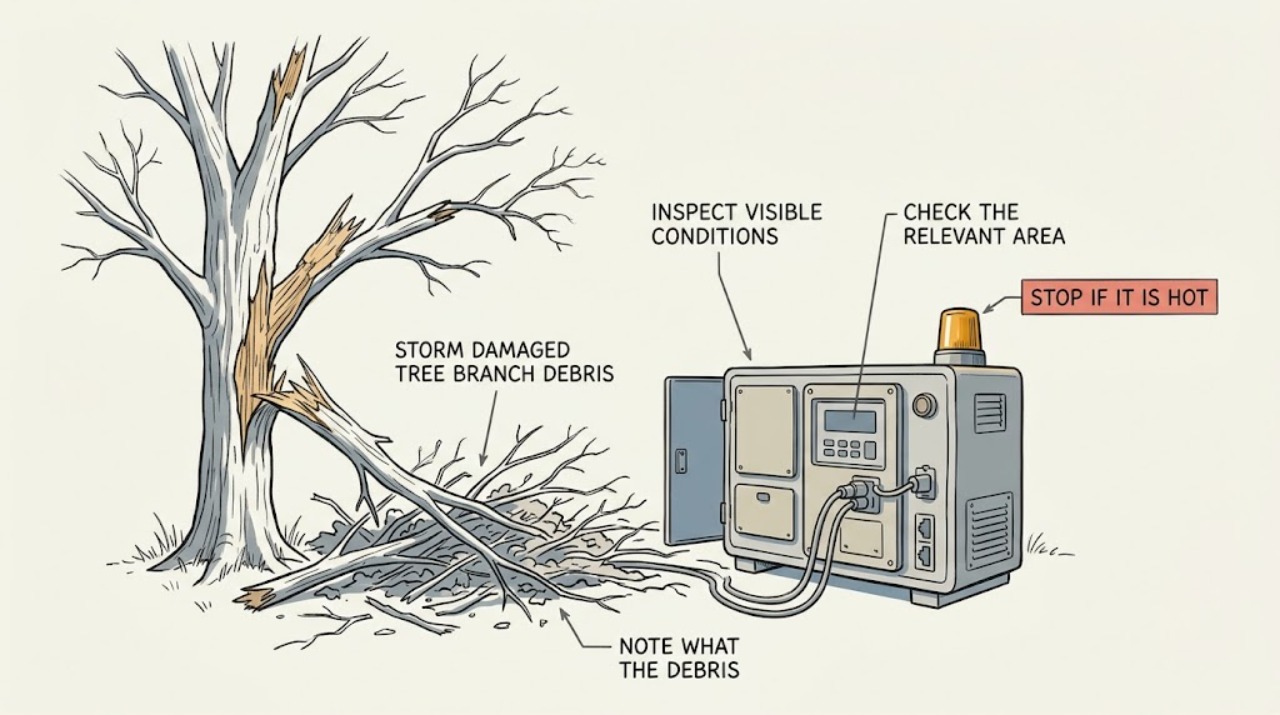
Treat storm-damaged branches and tree debris as a professional cleanup and hazard-assessment job, not a routine yard chore. From inside or another protected vantage, look for downed or low-hanging wires, branches suspended in the canopy, split or leaning trees, and debris affecting a structure, road, driveway, or utility access. Do not approach during the storm, cut, lift, drag, climb, drive over debris, or work near utilities. Keep people and vehicles away, contact the utility for electrical hazards, and arrange a qualified arborist or storm-debris service when the area is safe to access.
Work through in order
Diagnostic checks
Use only checks that match the exact appliance or system and its official guide.
-
Check 1
From a protected vantage, look for overhead or ground-level utility lines, damaged utility equipment, a branch resting on a line, or a tree contacting a line. Do not walk toward it, touch anything, drive over it, or assume a quiet line is safe.
Expected result: A visible wire, damaged utility equipment, or tree-to-line contact makes the area an electrical hazard. No visible wire does not prove that a concealed or distant utility hazard is absent.
Next step: Keep everyone and vehicles away, report the hazard to the appropriate utility or local emergency authority, and tell the tree service that utilities may be involved. Share only a photo taken from a safe distance.
Stop if: Stop all approach and cleanup if any wire, utility equipment, sparking, smoke, or line contact is visible or suspected.
Why this matters
Why: Utility involvement changes the first call: the utility or emergency authority must address the electrical hazard before tree cleanup. A tree service should not be asked to work into an unresolved line hazard.
-
Check 2
Without entering the yard or debris area, observe the tree and canopy for hanging limbs, a split trunk or branch union, an uprooted or leaning trunk, branches caught above the ground, or movement that continues in wind.
Expected result: Suspended limbs, a leaning or uprooted tree, fresh splits, and movement indicate overhead or stored-energy hazards. A pile that looks settled from a distance may still contain tensioned or supported branches.
Next step: Keep the exclusion area wider than the visible debris and give the provider the tree's location, whether the trunk is leaning or uprooted, and whether any limbs remain suspended.
Stop if: Do not approach, climb, cut, pull, lift, or drag any branch or tree that is suspended, split, leaning, uprooted, or moving.
Why this matters
Why: The visible condition cannot establish that a limb is safe to cut or pull. These signs call for an arborist or storm-response crew with the training and equipment to control the hazard.
-
Check 3
From a safe distance, note what the debris or tree is affecting: roof, wall, vehicle, fence, road, driveway, sidewalk, neighboring property, utility access, or an entry route. Do not enter a damaged structure or move debris to reveal the impact.
Expected result: Debris on or against a structure, blocking a road or access route, or restricting utility access raises urgency. Ground debris that is isolated and away from people and utilities may still require service, but it is a different dispatch description.
Next step: Photograph the overall scene only from a protected position and tell the service provider what is blocked or contacted, whether the property can be accessed without entering debris, and whether anyone is trapped or injured.
Stop if: If a building is damaged, an entry route is blocked, or people are in danger, leave the area and contact the appropriate emergency authority rather than arranging hands-on cleanup.
Why this matters
Why: Impact and access determine whether the situation needs emergency coordination, utility clearance, structural assessment, or scheduled arborist cleanup. A visual estimate is not a structural safety determination.
-
Check 4
Check conditions from shelter or another already safe location: whether wind, lightning, heavy rain, falling limbs, flooding, or unstable ground is still present. Do not approach during active storm conditions to improve the assessment.
Expected result: Ongoing severe weather or unstable ground means the hazard assessment is not ready for homeowner access. A calmer appearance does not remove a hanging-limb or energized-line hazard.
Next step: Wait for official local guidance and safer conditions, keep the exclusion area in place, and tell the provider whether the storm is ongoing or the site remains inaccessible.
Stop if: Stop the check and stay sheltered if wind, lightning, flooding, falling objects, or unstable footing makes the vantage unsafe.
Why this matters
Why: Weather and ground conditions determine when a qualified responder can safely assess the scene; the homeowner should not turn a remote check into a cleanup attempt.
-
Check 5
From the same protected vantage, classify the visible scope without touching it: one small ground-level branch, multiple limbs, a large branch or trunk section, an uprooted tree, or debris spread across several areas.
Expected result: A large, suspended, uprooted, entangled, or multi-area condition indicates a higher-complexity storm response. A small-looking piece may still be connected to a larger unstable tree or line.
Next step: Report the number of affected trees, general locations, access limitations, and whether any debris is elevated or entangled. Wait for professional instructions before any site entry.
Stop if: Do not attempt cleanup based on a size estimate when attachment, utility proximity, or stability is uncertain.
Why this matters
Why: Scope helps the provider send the right assessment and equipment, but size alone does not make a branch safe for homeowner removal.
Use your observations
Decision map
Find the observation that best matches what you see, then follow the next safe action.
-
PATH 01Next step
What you see
A utility line or utility equipment is down, low, damaged, or in contact with a tree or debris.
Do this next
Keep clear and contact the appropriate utility or emergency authority. Do not approach, touch, drive over, or ask an ordinary cleanup crew to work on the line hazard.
-
PATH 02Next step
What you see
A tree is leaning or uprooted, a limb is hanging or split, or debris is elevated, moving, or entangled.
Do this next
Treat it as a professional arborist or storm-response job. Keep the exclusion area in place and provide remote photos and location details without entering the area.
-
PATH 03Next step
What you see
The tree or debris has struck a building, vehicle, road, driveway, fence, or access route.
Do this next
Do not move it to restore access. Contact the appropriate emergency, utility, property, or structural service as applicable, then arrange qualified tree-debris assessment.
-
PATH 04Next step
What you see
The storm or dangerous conditions are still active, or the ground and access route are unstable.
Do this next
Stay sheltered or in a known safe area and wait for official guidance and safer conditions. Do not approach for a closer inspection.
-
PATH 05Next step
What you see
The debris is visibly isolated on the ground, away from utilities and structures, and the area is confirmed safe for a professional to access.
Do this next
Arrange a qualified cleanup provider and describe the location, volume, access, and any nearby hazards. Do not cut, lift, drag, or burn the debris yourself.
Helpful context
Understand the symptom
Why storm debris is different
A branch on the ground may be connected to a partially attached limb, a bent tree, hidden tension, or a utility line. Downed wires can remain energized even when they are quiet, and a hanging limb can fall without warning. The first useful decision is whether the site can be approached at all; cleanup comes only after utility and tree hazards have been assessed by the appropriate professionals.
Keep the first check remote
Use a view from inside, a doorway, or a location already known to be clear and stable. Do not enter the debris field to get a closer photo, move a small branch, cover the pile, or determine whether a line is energized. If you cannot see the area safely, report that limitation to the service provider rather than trying to improve the view.
Only after diagnosis
Potential parts
- tarp
Consider this only if a qualified responder or local emergency guidance says a temporary cover can be placed from a safe, stable location after the hazard is cleared; it is not a reason to approach a damaged tree.
Match the cover to the affected surface and approved temporary-protection method; do not climb, stretch over a roof, or secure a tarp near utility lines. - barrier-tape
Consider this only when it can be placed without entering the debris field and only to help mark an already-established exclusion area while professional help is arranged.
Barrier tape does not restrain a tree or protect against energized lines; keep the boundary well away from the hazard and follow local responder instructions.
When checks do not resolve it
Need a professional?
Arrange qualified storm-debris or arborist service for any hanging, split, leaning, uprooted, elevated, entangled, or structure-affecting tree or branch. Contact the utility or emergency authority first for any downed, low, damaged, or suspected line hazard. Treat active danger, injury, blocked emergency access, smoke, or structural instability as urgent.
Have this ready
- Provide the property location, remote photos if safe, number and general position of affected trees, whether debris is on a structure or access route, whether any limb remains suspended, utility proximity or line contact, current weather, and whether the area can be accessed without entering debris.
Common questions
FAQ
Can I clear a few storm branches myself if they look small?
Do not decide from size alone. A small visible branch can be connected to a hanging limb, unstable tree, or utility line. Keep the area clear and obtain professional guidance when attachment, stability, or utility proximity is uncertain.
What should I do if a branch is touching a power line?
Stay away and treat the line and nearby tree or ground as energized. Keep people and vehicles clear and contact the appropriate utility or emergency authority. Do not touch, cut, pull, or drive over the line or debris.
Should I approach the yard to take better photos for a tree service?
No. Use a photo from inside or another already safe vantage, and tell the provider if the area cannot be safely approached. A remote description is safer than entering a debris field.
When is storm branch debris an emergency?
Treat downed or suspected utility lines, active falling hazards, injury, blocked emergency access, fire or smoke, damaged structures, and unstable or inaccessible areas as urgent. Contact the appropriate emergency or utility authority before arranging cleanup.
Read the exact guide
Official sources
- Tornado Preparedness and Response - Response/RecoveryOccupational Safety and Health Administration · Supports identifying falling limbs, blocked or slippery access, electrical hazards, and the need to report hazards and leave specialized cleanup to trained workers.
- Line-Clearance Tree Trimming OperationsOccupational Safety and Health Administration · Supports keeping unqualified people away from overhead-line tree work and reserving line-clearance operations for trained, qualified personnel under appropriate conditions.
- After the storm: A woodland owner's guide to managing wind-damaged forestsUniversity of Minnesota Extension · Supports prioritizing safety, recognizing hanging limbs, downed lines, and unstable trees, documenting damage from a safe standpoint, and consulting qualified forestry or arborist help.
- Working Safely Around Downed Electrical WiresOccupational Safety and Health Administration · Supports treating downed or low-hanging lines as potentially energized, keeping away from lines and nearby objects, and contacting appropriate utility personnel.
Community feedback
Share a repair observation
Share a plain-text repair observation. Accepted observations are published automatically; this page may take a moment to update.