
On this page
Start here
Quick answer
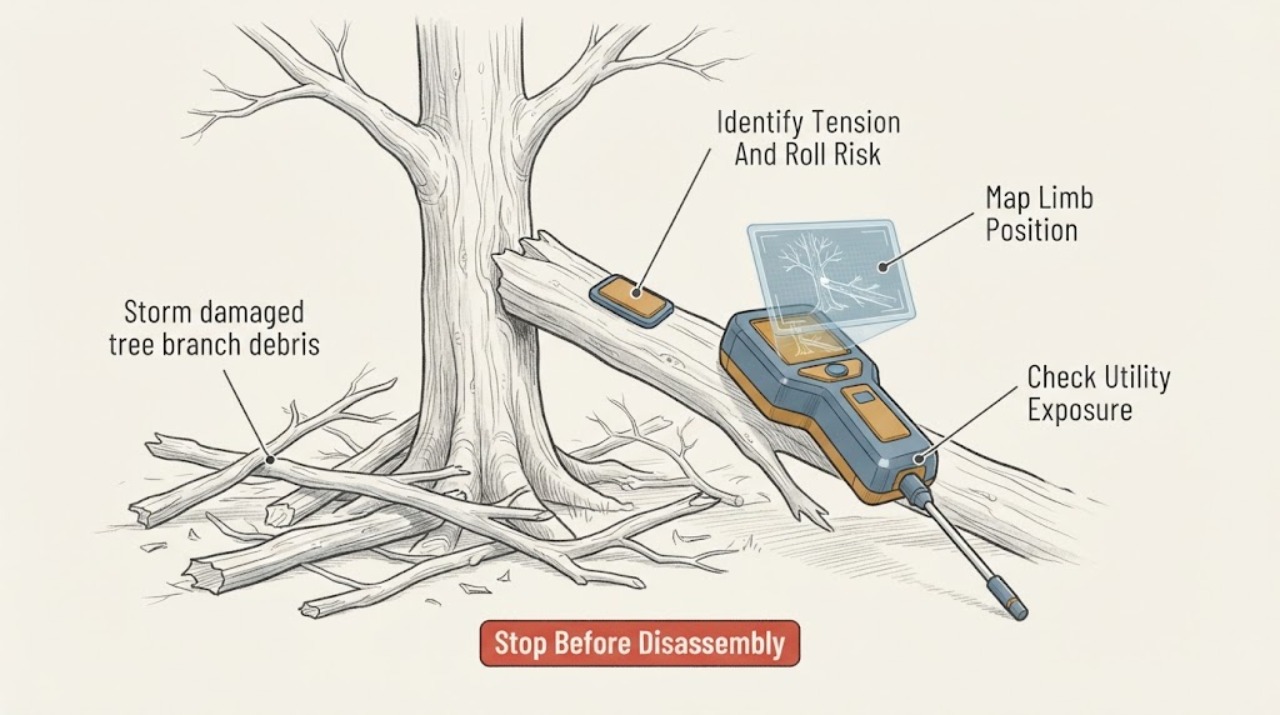
Treat large limbs left by a storm as a live fall, crush, roll, and stored-tension hazard, not as ordinary yard debris. From inside, a vehicle, or another stable position outside the likely fall area, determine whether the limb is hanging, partly attached, wedged, bent, resting on a structure, or near a utility line. Keep people, pets, vehicles, and traffic out of the limb's possible movement and drop area. Never approach, pull, drag, climb, or cut it. Contact the utility company first when a line or service connection is involved, and request a qualified storm tree crew with the equipment and traffic or utility coordination needed for large-limb removal. Call emergency services for an immediate threat to people, a building, or a blocked public route.
Before you begin
Safety first
- The reader must remain outside the possible movement area and must not approach, touch, drag, climb, rope, cut, chip, or load the limb.
Work through in order
Diagnostic checks
Use only checks that match the exact appliance or system and its official guide.
-
Check 1
From inside, a vehicle, or a stable position well away from the tree, photograph the full limb and record whether it is hanging, partly attached, wedged, supported by another branch, resting on the ground, or bearing on a roof, fence, vehicle, or other object.
Expected result: A suspended, partly attached, wedged, or elevated end means the limb can move without warning. A fully grounded-looking piece may still be loaded if another end is trapped or the supporting tree is bent.
Next step: Send the full-view photograph and the direction of the possible movement to a qualified storm tree crew before anyone enters the area.
Stop if: Do not walk closer for a better photograph, touch the branch, climb the tree, or stand beneath a hanging limb.
Why this matters
Why: Position and support determine the fall, crush, and roll assessment; a visual description is not permission to approach or handle the limb.
-
Check 2
From outside the exclusion area, look for bent or twisted wood, a split hinge, bark still attached at one end, a branch pinned under another object, an elevated tip, a slope, or a round section that could roll.
Expected result: Bent, twisted, pinned, or partially attached wood may release stored tension or kick sideways when disturbed. A sloped site or round limb can let heavy material roll beyond the visible debris pile.
Next step: Expand the exclusion area to include the possible release and roll paths, and tell the provider exactly which feature was observed.
Stop if: Do not pull, push, lever, climb over, drag, throw a rope around, or cut any limb under tension.
Why this matters
Why: Large-limb tension and roll risk require a trained crew to choose a controlled sequence and equipment; the condition is not equivalent to a small branch that can be hand-carried.
-
Check 3
From a safe location, check whether the limb touches, rests on, crosses, or could fall onto an overhead power line, service drop, communications cable, pole, transformer, or building electrical connection.
Expected result: Yes or uncertain means stay clear, keep others away, and report the hazard to the utility or emergency authority; a downed or contacted line must be treated as energized. No visible utility contact allows a tree professional to assess the remaining structure and access, but does not make the limb safe to handle.
Next step: Give the utility the address, line location, and storm condition, then tell the tree crew whether the utility has cleared the work area.
Stop if: Never touch the line or a limb, fence, puddle, or vehicle that may be connected to it; do not drive or walk into a line area.
Why this matters
Why: Utility exposure changes the responsible first responder and adds electrocution and fire risk to the falling-limb hazard.
-
Check 4
From a protected viewpoint, record contact or threatened contact with the roof, windows, siding, foundation, vehicles, fences, gas equipment, driveway, street, sidewalk, or an emergency access route, and note any active water entry or visible structural damage.
Expected result: A limb on a roof or structure, a blocked public route, active water entry, or damage to an access route raises urgency. A limb isolated in an open yard still requires a controlled removal plan when it is large, elevated, heavy, or under tension.
Next step: Keep the affected route closed, use emergency services for an immediate threat, and include the structure and access photographs in the service request.
Stop if: Do not enter a damaged building area, climb onto a roof, move a vehicle under the limb, or attempt to free it from a structure.
Why this matters
Why: The exposure determines whether the crew needs immediate stabilization, structure protection, traffic control, or additional trades after the limb is made safe.
-
Check 5
From a safe position, identify the largest plausible drop, swing, and roll area and keep people, pets, vehicles, and traffic outside it; note whether a professional crew can reach the site without crossing the debris or utility hazard.
Expected result: A large or uncertain movement area, narrow access, steep ground, nearby structures, wet conditions, or a blocked road points to professional equipment and a controlled work plan. A clear access route does not remove stored-tension or falling-object risk.
Next step: Tell the provider the access route, exclusion limits, parking or traffic constraints, and whether the branch is over a structure or utility.
Stop if: Do not approach to place barriers, move debris, clear a path, or make the site accessible if doing so enters the possible movement area.
Why this matters
Why: The isolation boundary is part of the repair decision: the crew needs room for controlled lowering, lifting, chipping, or removal, not just a path to the visible branch.
-
Check 6
Ask whether the provider has storm-damage experience and can supply the required access, rigging, lifting, traffic, and utility coordination for a large limb at this location.
Expected result: Yes supports a scoped removal visit after the utility and emergency hazards are addressed. No, an uncertain answer, or a plan based on homeowner cutting or hand-dragging means do not proceed with that provider or method.
Next step: Provide the photographs, limb position, tension and roll clues, utility status, structure exposure, exclusion area, and access constraints when requesting service.
Stop if: Do not accept instructions to cut, climb, drag, or approach the limb before the site is assessed by a qualified crew.
Why this matters
Why: Large limbs need a controlled removal plan matched to weight, tension, drop path, structures, and line exposure; a general cleanup quote may not cover those hazards.
Use your observations
Decision map
Find the observation that best matches what you see, then follow the next safe action.
-
PATH 01Safety boundary
What you see
A limb touches or threatens a power line, there are sparks or fire, a structure is actively failing, or people cannot remain outside the hazard area.
Do this next
Keep clear, warn others without approaching, call the utility or emergency service, and wait for the responsible authority to make the area safe.
Why this path and its safety boundary
Why it matters: Electrical, fire, crush, and public-safety response takes priority over tree cleanup.
Safety stop: Do not touch, move, cut, drive beneath, or approach the line or limb.
-
PATH 02Safety boundary
What you see
The limb is hanging, partly attached, wedged, bent, twisted, pinned, elevated at one end, or supported by another tree or object.
Do this next
Expand the exclusion area and request a qualified storm tree crew with appropriate rigging and access equipment.
Why this path and its safety boundary
Why it matters: Stored energy and sudden fall or sideways movement make this a controlled-removal job, not hand cleanup.
Safety stop: Do not pull, push, climb, rope, cut, or attempt to release the limb.
-
PATH 03Safety boundary
What you see
The limb is on or over a roof, window, vehicle, gas equipment, driveway, sidewalk, street, or emergency route, or it has caused active water entry.
Do this next
Close the route, call emergency services for an immediate threat, and request a crew that can coordinate access and any follow-up structural or utility work.
Why this path and its safety boundary
Why it matters: The removal plan must protect the structure and keep a route or public area safe while the limb is controlled.
Safety stop: Do not free the limb, move a vehicle, climb, enter damaged areas, or cut around the contact point.
-
PATH 04Safety boundary
What you see
The limb appears fully grounded in an open area with no visible utility, structure, traffic, wildlife, or tension exposure, but it is too large or heavy for safe hand handling.
Do this next
Keep the area isolated and arrange a tree or storm-debris provider with suitable lifting, cutting, or hauling equipment.
Why this path and its safety boundary
Why it matters: The immediate electrical and drop risk may be lower, but weight, rolling, hidden tension, and equipment hazards still require a controlled cleanup plan.
Safety stop: Do not drag, roll, cut, or load the limb based on its apparent ground contact.
-
PATH 05Safety boundary
What you see
Wind, darkness, unstable ground, a blocked viewpoint, dense debris, or a hidden support prevents a safe determination of the limb's position or fall path.
Do this next
Wait for safe conditions, keep people and traffic away, and give the provider the best distant photographs and access limitations.
Why this path and its safety boundary
Why it matters: Uncertainty itself is a reason to preserve distance; a closer look can enter the hazard zone.
Safety stop: Do not enter the debris, use a ladder, climb, or operate equipment to improve the view.
Helpful context
Understand the symptom
Large limbs need a hazard assessment before cleanup
A large storm branch can be suspended, pinned, bent, or partly supported by another limb or structure. Its weight can shift suddenly, and the branch can fall, roll downhill, crush a vehicle or roof, or release stored tension. A limb lying on the ground is not automatically safe if one end is elevated, trapped, or under a bent tree. Observe from a protected location and leave the removal method to a trained tree crew.
Separate utility and structure exposure from ordinary debris
Look without approaching for contact with overhead lines, a service drop, pole, cable, roof, window, fence, vehicle, gas equipment, or a road. Do not touch a limb, line, fence, puddle, or vehicle that could be energized through contact with a line. Utility involvement changes who must make the area safe; a tree company should not be asked to work into an electrical hazard without utility coordination.
Isolate the route and tell the professional what equipment may be needed
Keep the entire possible movement and drop area empty, not just the spot where the branch is visible. Large-limb removal may require rigging, a chipper, lifting equipment, a bucket or other access system, and traffic control; the right setup depends on the limb's position, weight, tension, nearby structures, and overhead lines. Give the crew photographs from a safe distance, access limits, and the route that must remain closed.
Safety boundary
Stop conditions
- Do not approach, touch, pull, drag, roll, climb, rope, cut, chip, or load a large storm-damaged limb.
- Assume a line is energized and keep clear of a limb, fence, vehicle, puddle, or structure that may be in contact with it; report utility hazards to the utility or emergency authority.
- Keep people, pets, vehicles, and traffic outside the possible fall, swing, crush, and roll area, and do not enter it to place a barrier or clear access.
- Request a qualified storm tree or debris crew for large, suspended, tensioned, elevated, structure-contacting, route-blocking, or equipment-dependent limbs.
Only after diagnosis
Potential parts
- tarp
Consider only for temporary protection when a professional or emergency responder confirms it can be placed from a safe position without entering the limb or roof hazard.
A tarp does not stabilize a branch or replace roof, electrical, or structural service; never climb or approach the limb to install one. - barrier-tape
Consider only when it can be placed without approaching the possible movement area and only as a visual warning while the route remains physically avoided.
Barrier tape does not stop a falling or rolling limb and must not be used as permission to enter the exclusion area.
When checks do not resolve it
Need a professional?
Call the utility or emergency service immediately for a limb on a power line, sparks, fire, an immediate threat to people, a failing structure, or a blocked emergency or public route. Request prompt qualified tree service for any large, suspended, tensioned, elevated, structure-contacting, or equipment-dependent limb.
Safety scope: The reader must remain outside the possible movement area and must not approach, touch, drag, climb, rope, cut, chip, or load the limb.
Have this ready
- Address and distant photographs showing the whole tree, limb support, possible fall path, and nearby structures
- Whether the limb is hanging, partly attached, wedged, bent, twisted, pinned, elevated, or on the ground
- Utility lines, service drops, poles, transformers, gas equipment, fences, vehicles, roofs, windows, and road or sidewalk exposure
- The exclusion area already kept clear and any driveway, gate, traffic, slope, wet ground, or equipment access limitation
- Storm timing, active water entry, visible fire or sparks, and whether the utility or emergency authority has been contacted
Common questions
FAQ
Why is a large fallen limb not ordinary yard debris?
It can be partly supported, bent, pinned, elevated, or under stored tension, and it can fall, roll, crush, or swing when disturbed. Size and position can require rigging, lifting, traffic control, and trained personnel.
What if the limb is touching a power line?
Stay well clear and treat the line as energized. Keep others away, report it to the utility or emergency authority, and do not touch the limb, line, fence, vehicle, puddle, or structure that may be connected to it.
Can I drag a large branch out of the driveway?
No. A large branch can roll, pivot, or release tension, and moving it may expose a line or change the load on a structure. Close the route and ask a qualified storm tree crew to plan the removal.
How large should the exclusion area be?
It must include the possible drop, swing, crush, and roll paths, which depend on the limb, supporting tree, slope, nearby objects, and tension. When those paths are uncertain, stay farther away and let the crew set the work boundary.
What photographs help the tree service?
From a protected location, take a full view and separate views of the limb's support, tension clues, utility lines, structure contact, blocked route, ground slope, and the safest access path. Do not move closer to improve a photograph.
Read the exact guide
Official sources
- Response/RecoveryOccupational Safety and Health Administration · The page addresses disaster response rather than ordinary yard cleanup; it supports recognizing electrocution, falls, falling or crushing limbs, equipment, and heavy-lifting hazards and using trained workers and suitable equipment.
- What to Do to Protect Yourself From Electrical HazardsCenters for Disease Control and Prevention · Supports keeping clear of fallen or overhead lines and reporting them to the power company during storm cleanup; it does not replace local emergency instructions.
- Tree Trimming & Removal SafetyOccupational Safety and Health Administration · Supports utility coordination, hazard assessment, exclusion, trained tree work, and avoiding unstable or tensioned limbs; OSHA's workplace guidance is not a homeowner removal procedure.
- Chain Saw SafetyCenters for Disease Control and Prevention · Supports the decision to keep homeowners and bystanders away from storm-damaged limbs and to treat bent or twisted branches as stored-tension hazards; it does not authorize the reader to operate a chainsaw.
Community feedback
Share a repair observation
Share a plain-text repair observation. Accepted observations are published automatically; this page may take a moment to update.