
On this page
Start here
Quick answer
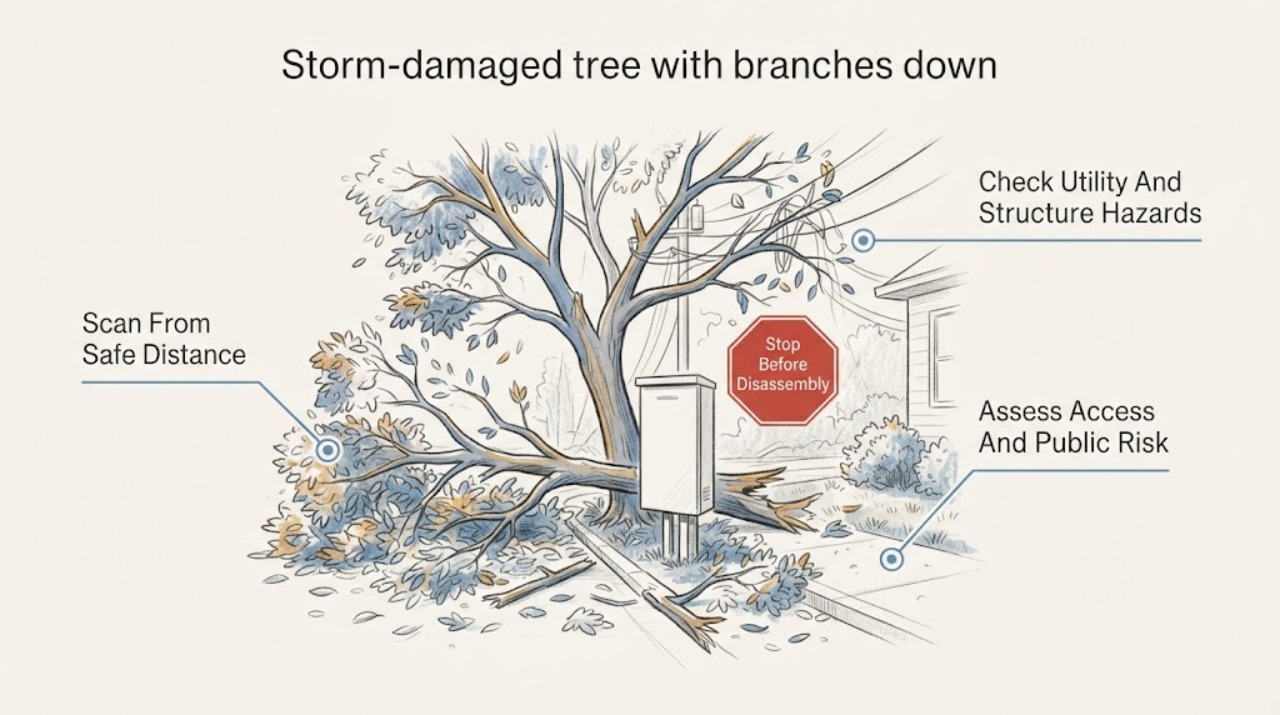
Keep everyone away from the fallen or hanging branches and do not cut, climb, pull, or move them. From a safe location, look for downed or contacted power lines, a leaning or suspended trunk, branches against a building or vehicle, blocked access, gas or structural damage, and any continuing weather risk. Treat every line as energized and report a line or public hazard to the utility or emergency authority; arrange an urgent qualified tree-removal service for the tree and debris. Take ground-level photos only when safe, keep the site isolated, and tell the provider what is suspended, what is damaged, and whether utilities or structures are involved.
Work through in order
Diagnostic checks
Use only checks that match the exact appliance or system and its official guide.
-
Check 1
From a stable location outside the debris and beneath-limb area, scan the entire tree and surrounding ground without walking closer. Note whether branches are fully on the ground, hanging, caught in another tree, leaning with the trunk, or suspended above a path, roof, vehicle, or fence.
Expected result: A fully grounded small branch is different from a branch under tension, suspended in the canopy, attached to a leaning trunk, or resting on a structure.
Next step: Keep the area cordoned off, photograph the overall scene from the same safe position, and request urgent tree-removal assessment.
Stop if: Stop observing and retreat if the tree shifts, branches move, wind increases, debris slides, or you would need to walk under a limb or step onto unstable ground.
Why this matters
Why: Suspension, tension, leaning, or contact with property means the load can shift without warning and is not a safe cleanup task for an untrained person.
-
Check 2
Without touching the tree, line, pole, fence, or structure, look from a safe distance for power or communication lines on the ground or contacted by a limb, damaged poles, sparks, smoke, gas odors, roof or wall impact, broken windows, and water entering a building.
Expected result: A line that is down or touching a branch, a damaged utility support, smoke or sparking, a gas odor, or structural impact is a utility or emergency hazard rather than ordinary yard debris.
Next step: Stay away, warn others from outside the area, and contact the electric utility or emergency authority for a line, fire, gas, or public-safety hazard. Tell the tree service that utilities or a structure are involved.
Stop if: Do not approach, touch, drag, inspect up close, or cross a path near a downed line or an object contacting one.
Why this matters
Why: Storm conditions can leave an apparently inactive line energized and a damaged structure unstable. The hazard must be reported and isolated by the responsible authority before tree work is considered.
-
Check 3
From outside the hazard area, note whether the branches block a public sidewalk, road, driveway, entrance, fire-access route, or neighbor's property, and whether the remaining tree or limbs could fall toward people, traffic, or buildings.
Expected result: A private branch lying clear of people is different from debris blocking public access or a tree that threatens a route, occupied structure, or vehicle.
Next step: Keep people and vehicles out, use visible ground-level warning barriers only if that can be done without approaching the tree, and report blocked public access to the responsible authority. Arrange urgent professional assessment.
Stop if: Stop if placing a barrier would require entering debris, stepping beneath branches, crossing a line path, or moving the tree or limbs.
Why this matters
Why: Public access and immediate fall exposure raise the urgency and may require local authority or utility coordination before a contractor can enter.
-
Check 4
From a safe, dry position, take wide and close-enough photographs without zooming into a hazardous area: the tree base, broken branch points, suspended limbs, property impact, utility context, access blockage, and any visible cracks or soil movement. Record when the storm occurred and whether the tree is still moving.
Expected result: Photos showing a split trunk, uprooted or lifted soil, a hanging limb, a branch on a line, or a structure impact give the service provider different preparation information than photos of ground debris only.
Next step: Send the photos and a short hazard description to the tree-removal provider, utility, insurer, or authority that is handling the relevant risk.
Stop if: Do not use a ladder, climb, enter a roof or tree, move debris for a better angle, or stand in the fall path to take a photograph.
Why this matters
Why: Documentation helps the provider plan a qualified response while the site remains untouched. It does not establish that a tree is stable or safe to enter.
-
Check 5
From indoors or another protected location, monitor whether wind, rain, lightning, flooding, darkness, or changing debris makes the site less stable or less visible. Note new movement, additional limbs down, rising water, or a change in the line or structure condition.
Expected result: Ongoing severe weather, reduced visibility, new movement, or additional damage means the original scene assessment is no longer reliable.
Next step: Stay indoors or well clear until conditions improve, update the utility or tree service, and do not attempt a temporary tie, cut, or cleanup.
Stop if: Stop all outdoor observation during lightning, high wind, flooding, or any event that prevents a stable retreat.
Why this matters
Why: A tree service needs a current hazard report; a previously grounded branch can become unstable as wind, water, or another limb changes the load.
Use your observations
Decision map
Find the observation that best matches what you see, then follow the next safe action.
-
PATH 01Next step
What you see
A tree, limb, pole, or other object is touching a power line, or a line is down nearby.
Do this next
Assume it is energized. Keep everyone away, do not touch the line or tree, and contact the electric utility or emergency authority. Do not schedule tree work in that area until utility coordination makes it safe.
-
PATH 02Next step
What you see
There is smoke, sparking, a gas odor, fire, a damaged structure, broken window, or water entering a building.
Do this next
Leave the hazard area and contact the appropriate emergency or utility authority. Do not enter, climb, cover, or stabilize the structure or tree yourself.
-
PATH 03Next step
What you see
A limb is hanging, caught in another tree, under visible tension, or attached to a leaning or partially uprooted trunk.
Do this next
Treat the site as unstable and keep it isolated. Request urgent qualified tree-removal service; do not pull, cut, climb, or move any part.
-
PATH 04Next step
What you see
Branches block a public route, emergency access, shared entrance, or traffic path.
Do this next
Stay outside the debris and report the blockage to the responsible local authority or property manager while arranging professional removal.
-
PATH 05Next step
What you see
The observed material is fully grounded, no remaining tree or limb is moving or leaning toward people or structures, and no utility or structural hazard is visible.
Do this next
Keep the area clear and arrange tree-removal or storm-cleanup service. Do not assume the remaining tree is safe merely because one branch is on the ground.
Helpful context
Understand the symptom
The first decision is whether the scene is safe to approach
A storm-damaged tree can remain loaded even when one branch is already on the ground. A broken limb may be suspended in another tree, a trunk may be leaning against a structure, or a branch may be touching a line. The useful homeowner task is to observe and report from outside the hazard area; removal, cutting, climbing, and line-clearance work require trained professionals and the right utility coordination.
Protect people and the property while waiting
Keep children, pets, neighbors, and vehicles away. Do not enter a blocked driveway or walk beneath hanging limbs to retrieve belongings. If a roof, window, or other building area is damaged, keep people out of the affected area and report the damage; do not climb onto the structure or attach anything to the tree.
Safety boundary
Stop conditions
- Do not cut, climb, pull, drag, chip, burn, or move storm-damaged branches or a leaning tree, even if a limb appears partly detached.
- Assume downed or contacted power lines are energized. Do not touch the line, tree, pole, fence, vehicle, or other object in contact with it.
- Stay out for lightning, high wind, flooding, unstable ground, smoke, sparking, gas odor, structural damage, blocked public access, or any suspended limb.
- Do not use ladders, lifts, ropes, power tools, or temporary ties around the tree. Use a qualified tree-removal professional and the utility or emergency authority when applicable.
Only after diagnosis
Potential parts
- barrier tape
Consider this only when a safe ground-level placement can isolate people from the site without approaching the tree, lines, unstable ground, or debris; it is a visual warning, not a restraint.
Use only in a location that does not block emergency access or imply the tree is secured, and follow local authority or property-manager directions. - protective tarp
Consider this only for a safe, ground-level temporary cover for separated property or debris as directed by a qualified responder; never attach it to, climb toward, or pull against a damaged tree or roof.
Confirm that the cover will not create wind load, conceal a hazard, contact utilities, or obstruct inspection and emergency access.
When checks do not resolve it
Need a professional?
Arrange urgent qualified tree-removal service for any hanging, suspended, leaning, split, uprooted, or structure-contacting tree or branch, and for storm debris blocking access. Contact the electric utility or emergency authority first when a line is down or contacted, or when there is fire, sparking, gas odor, structural damage, or a public hazard. Provide the location, ground-level photos, utility and structure observations, access blockage, weather conditions, and whether the tree or branches are still moving.
Common questions
FAQ
Can I cut a fallen branch if it is already on the ground?
Do not assume a grounded branch is safe. First look from outside the debris for tension, a connected or leaning trunk, suspended limbs, utility contact, unstable ground, and structural damage. Arrange professional removal rather than cutting or moving it yourself.
What should I do if a storm-damaged branch touches a power line?
Assume the line is energized. Keep everyone away and do not touch the branch, tree, line, pole, fence, vehicle, or anything in contact with it. Contact the electric utility or emergency authority and wait for utility coordination before tree work.
Is a leaning tree after a storm safe if it is not moving right now?
No. A leaning, split, uprooted, suspended, or partially supported tree can shift later as wind or additional limbs change the load. Keep the area isolated and request urgent qualified tree-removal assessment.
Can I put a tarp over storm damage?
Only use a temporary cover when a qualified responder directs a safe ground-level placement. Do not climb, attach a tarp to a damaged tree or roof, pull against a branch, conceal a utility hazard, or block inspection or emergency access.
What photos and details should I send to a tree-removal service?
From a safe distance, send the overall tree, broken points, suspended or leaning sections, soil movement, property impact, utility context, blocked access, and whether anything is still moving. Include weather and access conditions and any utility or emergency instructions.
Read the exact guide
Official sources
- Tree Trimming & Removal SafetyU.S. Occupational Safety and Health Administration · Government safety quick card used only for stop-use and professional-handoff guidance; no cutting or climbing procedure is provided here.
- Line-Clearance Tree Trimming OperationsU.S. Occupational Safety and Health Administration · Government qualification and hazard guidance used to exclude line-contact tree work from DIY instructions; utility and qualified line-clearance personnel govern actual operations.
- Tornado Preparedness and Response - Response/RecoveryU.S. Occupational Safety and Health Administration · Government post-storm safety guidance used for observation and stop-use decisions; local emergency and utility instructions take precedence.
Community feedback
Share a repair observation
Share a plain-text repair observation. Accepted observations are published automatically; this page may take a moment to update.