
On this page
Start here
Quick answer
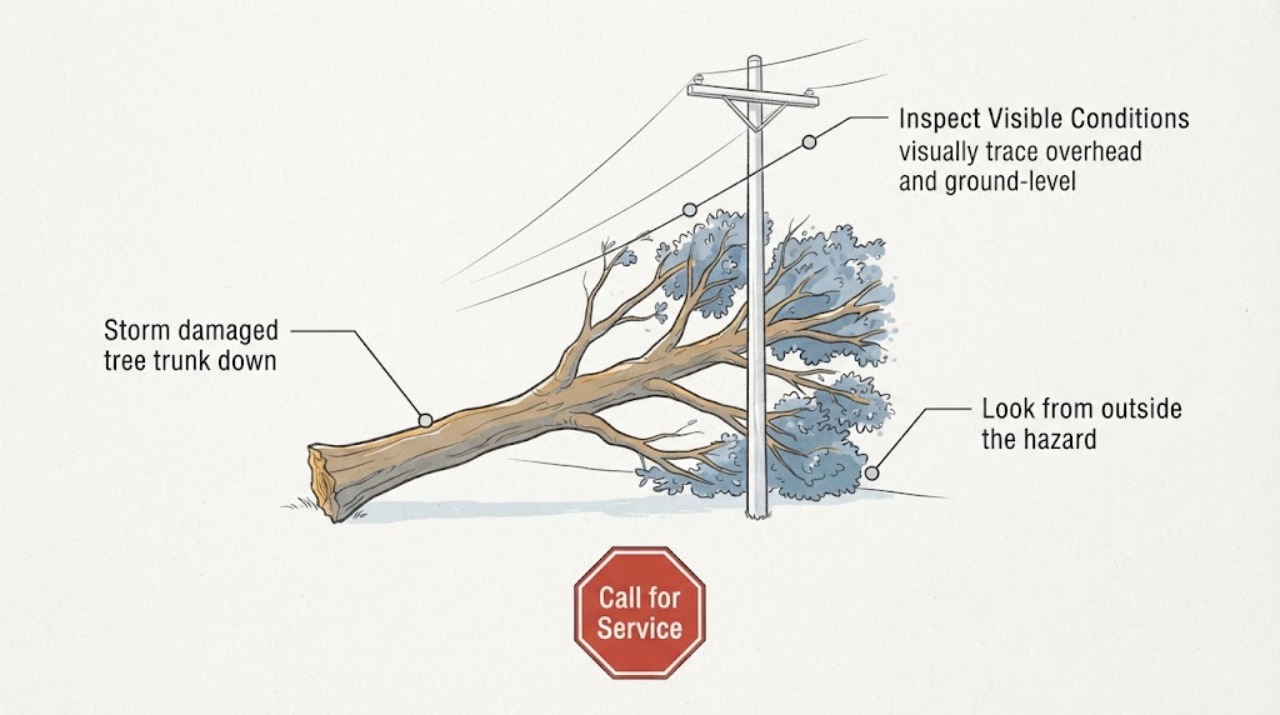
Treat a storm-downed trunk as unstable debris, not a normal cleanup project. Stay out of the fall area and do not cut, pull, climb, drive over, or move the trunk. From a safe location, look for downed or low wires, contact with a building or vehicle, hanging limbs, an uprooted or leaning root plate, blocked public access, and movement or tension. Assume any electrical line is energized; contact the utility or emergency service for a line hazard, then arrange an arborist or qualified tree-removal professional for assessment and removal.
Before you begin
Safety first
- This is an observation-only guide. Do not climb, use a ladder, operate a chainsaw, cut or move the trunk, pull with a vehicle or rope, enter a roof or damaged structure, touch wires or connected objects, drive over lines, or work in active severe weather. Tree removal and any utility-line clearance require trained professionals and the responsible utility authority.
Work through in order
Diagnostic checks
Use only checks that match the exact appliance or system and its official guide.
-
Check 1
From a stable location well away from the trunk and any leaning or hanging material, look at the whole scene without entering beneath the canopy or approaching the root plate.
Expected result: Note whether the trunk is fully on the ground, still attached to a standing tree, resting in another tree, leaning, partly suspended, or surrounded by broken or hanging limbs; note whether wind or rain is still moving the scene.
Next step: Keep the area clear and request prompt assessment by a qualified arborist or tree-removal professional. If the position is changing or threatens people, structures, or public access, escalate to emergency assistance.
Stop if: Stop observing and move farther away if the tree shifts, a limb drops, the ground gives way, weather worsens, or getting a better view would require crossing the fall area, climbing, or using a ladder.
Why this matters
Why: A suspended, leaning, connected, or moving trunk remains an active fall and tension hazard even if the main trunk looks accessible. Continuing weather increases uncertainty.
-
Check 2
From a distant position, visually trace overhead and ground-level utility routes near the trunk without touching any line, branch, fence, puddle, vehicle, or other object.
Expected result: Record whether a wire is down, low, slack, hidden in the tree, attached to a branch, or near the trunk; also note damaged poles, electrical equipment, arcing, smoke, or a power outage if visible.
Next step: Keep everyone away, do not drive over the area, and contact the responsible utility or emergency service from a safe location. Tell the tree professional that utility contact is suspected and wait for the responsible authority before any tree work.
Stop if: Stop immediately if any line is down or low, a branch touches a line, the ground nearby may be energized, or smoke, fire, or arcing is present; never approach to identify the line type.
Why this matters
Why: A line or object in contact with the tree may be energized even when it is quiet or not sparking. This is a utility and emergency hazard, not a tree-cutting task.
-
Check 3
Look from outside the hazard area toward buildings, vehicles, fences, roads, sidewalks, driveways, and other occupied or public spaces near the trunk.
Expected result: Note whether the trunk or branches are on a roof or structure, have struck a vehicle, block a roadway or access route, threaten a window or service, or have caused visible damage or instability.
Next step: Keep people and vehicles out of the affected area and report immediate life-safety or public-access hazards to the appropriate emergency or property authority. Arrange professional tree assessment; do not climb onto a roof or enter under the tree to inspect damage.
Stop if: Stop if inspection would require entering a damaged building, walking under suspended limbs, moving debris, crossing a blocked road, or approaching a damaged utility service.
Why this matters
Why: A structure, vehicle, public route, or occupied area changes the response priority and may require emergency coordination, utility involvement, or a tree professional with specialized equipment.
-
Check 4
From safe ground-level distance, look at the exposed root plate and surrounding soil only if they are visible without approaching the trunk or stepping onto disturbed ground.
Expected result: Note whether roots or soil are lifted, the trunk base is cracked or split, the soil is saturated or undermined, nearby trees are leaning, and the trunk appears to be bearing against another object.
Next step: Share these observations with an arborist and keep the entire area closed to people and pets until assessed. Do not test stability by pushing, pulling, cutting, tying, or driving against the trunk.
Stop if: Stop if the soil is soft or collapsing, the root plate moves, another tree is leaning, the trunk rolls, or you would need to step onto the root ball, debris, slope, or wet ground.
Why this matters
Why: Root heaving, saturated soil, cracks, splits, and bearing contact can indicate additional movement or another tree becoming unstable. A visual clue cannot show how stored forces will release.
-
Check 5
Record the scene from a safe position and review the event history without touching the tree or debris.
Expected result: Capture the storm timing, approximate location, affected structures or utilities, visible trunk and limb positions, access limitations, and photographs that do not require zooming by entering the hazard area.
Next step: Give the information to the responding utility, emergency service, property manager, or tree professional. Keep the original exclusion area in place and wait for their instructions.
Stop if: Stop documentation if it requires crossing a line, entering a road or structure, standing below a limb, climbing, using a drone near lines, or returning during active severe weather.
Why this matters
Why: A clear timeline and distant images help the utility, emergency coordinator, insurer, and arborist prioritize hazards without encouraging a second inspection in an unstable area.
Use your observations
Decision map
Find the observation that best matches what you see, then follow the next safe action.
-
PATH 01Safety boundary
What you see
A downed or low wire, a branch touching a wire, damaged electrical equipment, smoke, fire, or arcing is visible or suspected.
Do this next
Keep people and vehicles well away, treat all lines and nearby objects as energized, and contact the responsible utility or emergency service from a safe location. Tell the tree professional not to begin until the utility hazard is addressed by the responsible authority.
Why this path and its safety boundary
Safety stop: Do not approach, touch, move, cut, drive over, or attempt to identify or de-energize any line.
-
PATH 02Safety boundary
What you see
The trunk or limbs are on a roof, building, vehicle, public route, fence, or other structure, or access is blocked.
Do this next
Keep the area closed and coordinate emergency or property assistance as needed, followed by a qualified arborist or tree-removal professional for controlled assessment and removal.
Why this path and its safety boundary
Safety stop: Do not climb onto a roof, enter a damaged structure, walk beneath the tree, or pull debris away from a structure.
-
PATH 03Safety boundary
What you see
The trunk is suspended, leaning, attached to another tree, under visible tension, surrounded by hanging limbs, or near an uprooted or shifting tree.
Do this next
Treat it as an active fall hazard, keep everyone outside the exclusion area, and request an urgent professional assessment. Provide the position and movement observations without attempting to stabilize it.
Why this path and its safety boundary
Safety stop: Do not use a chainsaw, rope, vehicle, winch, ladder, or hand force to cut, pull, brace, or release the trunk.
-
PATH 04Safety boundary
What you see
The trunk appears fully down on private ground and no utility, structure, traffic, movement, or unstable-ground hazard can be ruled out from a safe distance.
Do this next
Keep the area restricted and arrange a qualified arborist or tree-removal professional to confirm the scene and plan removal. Continue to avoid handling even apparently loose sections until assessed.
Why this path and its safety boundary
Safety stop: Do not treat a quiet or fully grounded appearance as permission for homeowner cutting, hauling, or cleanup.
-
PATH 05Safety boundary
What you see
Severe weather continues, visibility is poor, or the scene cannot be viewed without entering an unstable, wet, dark, or obstructed area.
Do this next
Wait in a safe location, keep others away, and provide the known location and hazard description to the appropriate response service or tree professional when communication is safe.
Why this path and its safety boundary
Safety stop: Do not return to document, inspect, or secure the tree during active wind, lightning, flooding, or other dangerous conditions.
Helpful context
Understand the symptom
Storm force can leave a trunk resting on another tree, a roof, a vehicle, or utility equipment. Broken limbs may continue moving, and wood under tension can react unexpectedly when cut or moved. A trunk that appears fully down can still be connected to a standing stem or loaded branch, so its appearance is not proof that the area is safe.
The useful homeowner task is a distant scene assessment and a clear handoff. Stay on a stable, dry surface outside the apparent fall area; keep people and pets away; photograph only from a safe position; and provide the professional the location, structures affected, utility observations, and whether the scene is still changing. Arborists have the training and equipment for storm-damaged tree assessment and removal.
Do not improvise with a chainsaw, rope, vehicle, ladder, winch, or tarp placed against the tree. Do not touch wires, branches touching wires, fences, or wet objects that could be energized. If a road, home, public walkway, or utility service is threatened, treat access and life safety as the priority and wait for the responsible emergency, utility, or tree professional.
Only after diagnosis
Potential parts
- barrier tape
Consider this only to mark an exclusion boundary from a safe, dry position after the scene is already outside the hazard area; it cannot restrain a tree, protect against utility hazards, or replace professional control.
Use only where placement does not require approaching the trunk, wires, roadway, unstable soil, or damaged structure; follow local site-control instructions from the responding professional. - outdoor tarp
Consider this only for temporary protection of a clearly accessible, unenergized property area after a professional or responsible authority confirms it can be placed without contact with the tree or lines.
Confirm size, attachment points, wind conditions, and the professional's plan; never throw, tie, climb, or tension a tarp over a storm-damaged tree or near utilities.
When checks do not resolve it
Need a professional?
Request emergency or utility help immediately for downed or low wires, smoke, fire, arcing, or a tree touching electrical equipment. Arrange urgent qualified tree service for a trunk on a structure or roadway, suspended or tensioned wood, hanging limbs, root-plate movement, blocked access, or any tree that cannot be confirmed stable from a safe distance.
Safety scope: This is an observation-only guide. Do not climb, use a ladder, operate a chainsaw, cut or move the trunk, pull with a vehicle or rope, enter a roof or damaged structure, touch wires or connected objects, drive over lines, or work in active severe weather. Tree removal and any utility-line clearance require trained professionals and the responsible utility authority.
Common questions
FAQ
Can I cut up a storm-downed tree myself?
Do not start cutting from this guide. Storm-damaged trunks and limbs can be under tension, connected to standing trees, or touching utilities. Keep the area clear and have a qualified arborist or tree-removal professional assess and remove it.
What if a fallen trunk is touching a power line?
Stay well away and treat the line, tree, ground, and nearby objects as energized. Do not touch or drive over anything in the area; contact the responsible utility or emergency service and wait for its direction before any tree work.
Is a trunk safe once it is lying flat?
Not necessarily. It may still be attached, loaded against another tree or structure, or connected to hanging limbs and disturbed roots. Observe only from a safe distance and let a qualified professional confirm stability.
Should I put a tarp over storm damage?
Do not climb or place a tarp on a roof or tree. Temporary protection is appropriate only when a responsible professional confirms it can be placed from a safe, unenergized position without touching the tree, wires, or unstable structures.
Read the exact guide
Official sources
- Storm-Related Tree DamageInternational Society of Arboriculture (TreesAreGood.org) · The ISA homeowner guidance identifies moving uprooted trees, tensioned limbs, electrical contact, height, structures, and cutting equipment as storm-damage hazards and recommends staying clear and using a professional arborist.
- Managing Hazards and RiskInternational Society of Arboriculture (TreesAreGood.org) · ISA explains that storms can damage property or utility lines and recommends assessing damage, taking safety precautions, resisting DIY work, and hiring an ISA Certified Arborist.
- Working Safely Around Downed Electrical WiresOccupational Safety and Health Administration · OSHA warns that downed or low wires may remain energized, can energize trees and other nearby objects, and must not be approached or treated as safe merely because they are quiet or not sparking.
Community feedback
Share a repair observation
Share a plain-text repair observation. Accepted observations are published automatically; this page may take a moment to update.