
On this page
Start here
Quick answer
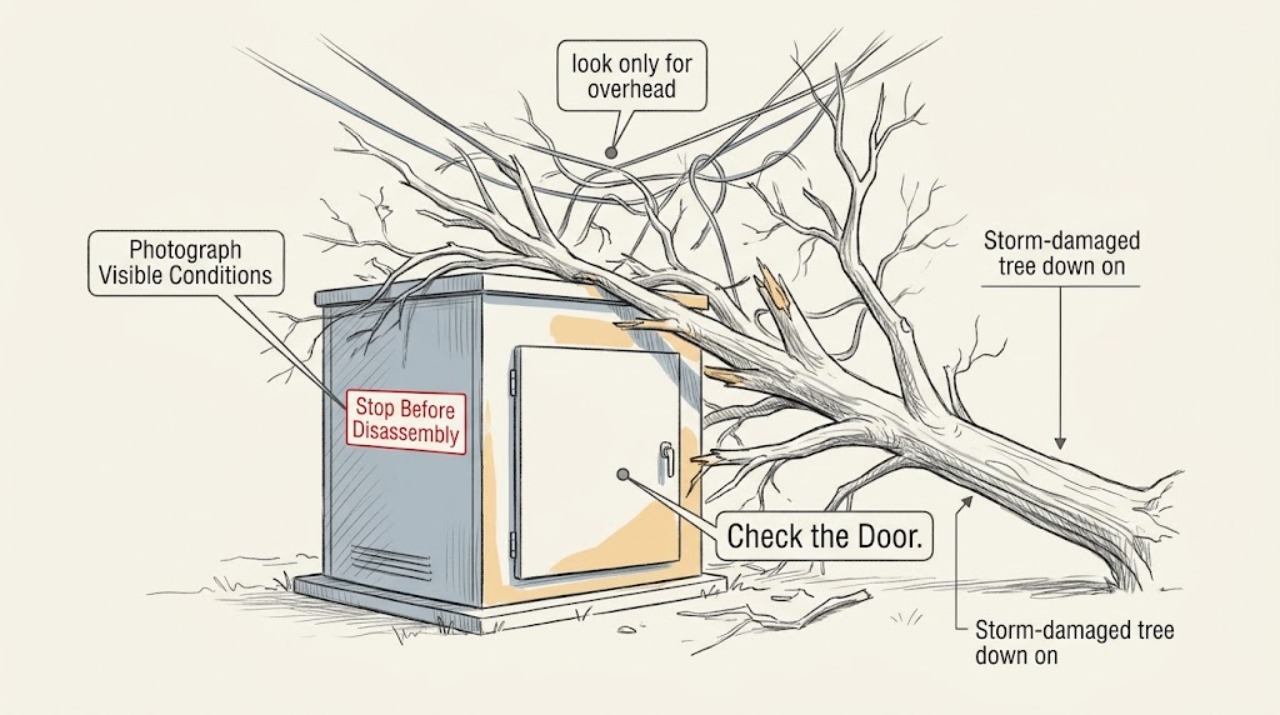
A storm-damaged tree resting on a house, garage, shed, vehicle, or other structure is an emergency scene, not a homeowner chainsaw job. From a wide, stable location, check only whether power lines or gas infrastructure may be involved, whether the tree or structure is still moving, whether walls/roof/ceiling have shifted, and whether people can leave without passing the tree. Assume downed lines and branches touching them are energized; do not touch the tree, wires, roof, vehicle, or debris, and do not cut, pull, climb, or use a ladder. Keep people out, call the electric utility or emergency services for utility hazards, arrange qualified tree-removal and structural assessment, and document the scene from a safe distance. A tree that looks fully down can still be under tension and can shift when cut or moved.
Before you begin
Safety first
- Observation and scene isolation only. No chainsaw, cutting, climbing, pulling, winching, ladder, roof access, debris movement, utility contact, vehicle attachment, structural propping, or entry beneath the tree.
Work through in order
Diagnostic checks
Use only checks that match the exact appliance or system and its official guide.
-
Check 1
From a wide, stable location outside the tree's possible fall or slide path, keep people and pets away and note whether the tree is on a roof, wall, porch, vehicle, fence, or other structure; whether branches are suspended; and whether the trunk, root plate, structure, or debris is still moving. Do not approach for a closer photograph.
Expected result: The tree or structure is moving, a limb is hung overhead, the root plate is lifted, debris blocks the only exit, or the scene appears stationary but the tree remains supported by the structure.
Next step: Create an exclusion zone from the safe side without entering the hazard area and call qualified tree-removal service; use emergency services when people are trapped, injured, or in immediate danger.
Stop if: Stop observing if wind, rain, lightning, shifting debris, falling limbs, or unstable ground makes the location unsafe.
Why this matters
Why: Movement, suspended limbs, lifted roots, and structural support indicate stored energy and a changing load. A stationary appearance does not make the tree safe to touch or cut.
-
Check 2
From a safe distance, look only for overhead or ground-level electrical lines, service drops, utility poles, gas-meter or gas-line damage, sparks, arcing, smoke, or a line hidden beneath the tree. Treat every line as energized and do not touch, step over, move, spray, or cut the tree or debris.
Expected result: A line is down, a branch or trunk is contacting a line, a service connection is pulled or damaged, a utility pole leans, gas odor is present, or no utility hazard is visible from the safe location.
Next step: For electrical or gas danger, keep everyone back and contact the utility or emergency service according to local procedure. Only after the utility declares its side safe should qualified tree and structural professionals plan removal.
Stop if: Stop immediately for sparks, smoke, arcing, hissing, gas odor, fire, a downed line, or any need to cross the tree or debris to reach the utility.
Why this matters
Why: Any possible utility contact changes tree removal into coordinated utility and emergency work. No visible line hazard does not rule out a concealed service drop, underground service, or gas damage.
-
Check 3
From outside and from an interior location that is clearly safe to occupy, note roof or wall displacement, broken windows, ceiling sag, new cracks, water entry, damaged doors, fallen masonry, or a tree pressing against an occupied room. Do not enter beneath a supported tree, walk onto a damaged floor or roof, or touch wet electrical equipment.
Expected result: The building remains weather-tight and visually stable, or there is a sagging roof/ceiling, shifted wall, widening crack, broken utility, active water, or blocked escape route.
Next step: Leave and keep others out if the structure shifts, the ceiling sags, utilities are damaged, or exit routes are compromised. Request emergency or structural assessment before tree removal; do not prop, brace, tarp, or enter on your own.
Stop if: Stop for a bulging ceiling, falling material, strong gas odor, smoke, electrical contact, unstable floor, or any need to pass beneath the tree.
Why this matters
Why: Structural movement or a blocked/unsafe exit can make the building unsafe regardless of the tree's species or size. A roof dent without visible interior damage still needs a professional inspection because concealed framing or membrane damage may exist.
-
Check 4
From outside the exclusion zone, record whether the trunk is split, bent, suspended by another tree, pinned against the structure, or connected to a lifted root plate, and whether nearby trees or limbs are also damaged. Do not pull a branch, release a rope, move a vehicle, climb the tree, or make a relief cut.
Expected result: The trunk or limb is under visible bend, a split is open, the tree is hung up, a root plate is lifted, nearby trees are leaning, or the tree is fully on the ground with no visible tension from the safe view.
Next step: Give the arborist or qualified tree-removal crew the photos and direction of lean/tension. Keep the exclusion zone in place until the crew has assessed the entire tree and surrounding stand.
Stop if: Stop for wind, rain, lightning, falling bark or limbs, or any need to stand within the tree's reach or operate cutting equipment.
Why this matters
Why: Bend, split, hang-up, root movement, and nearby lean are indicators of stored mechanical energy and secondary impact risk. A fully grounded appearance still does not authorize cutting because hidden tension and structural loading may remain.
-
Check 5
From a safe location, capture wide photos and notes showing the structure, tree orientation, utility context, access/exit constraints, weather, time of storm, visible damage, and whether occupants or vehicles are trapped. Contact the utility/emergency service first when lines or gas may be involved, then request coordinated qualified tree-removal and structural assessment.
Expected result: The utility has isolated its hazard, emergency responders have cleared the scene, the tree crew can access it without crossing the hazard, or access remains blocked or uncertain.
Next step: Keep the site undisturbed and follow the professionals' exclusion and evacuation instructions. Do not begin cleanup, chainsaw work, roof repair, or debris hauling while the tree is on or against the structure.
Stop if: Stop documenting if conditions change or if getting a better view requires crossing the boundary, entering the structure, or handling debris.
Why this matters
Why: A clear handoff lets utility, structural, insurance, and tree professionals plan the order of isolation, stabilization, removal, temporary protection, and repair. Uncertain access is a service-planning problem, not a reason to improvise.
Use your observations
Decision map
Find the observation that best matches what you see, then follow the next safe action.
-
PATH 01Next step
What you see
A trunk, branch, debris pile, or structure may be touching an overhead line or service drop, a pole is damaged, or sparks, arcing, or smoke are visible.
Do this next
Keep everyone away and contact the utility or emergency services. Do not approach, touch, cut, spray, move, or drive over the tree or line, even if power appears off.
Why this path and its safety boundary
Why it matters: The scene is an electrical emergency and tree work cannot safely begin until the utility controls the electrical hazard.
-
PATH 02Next step
What you see
The roof, wall, ceiling, floor, or foundation appears shifted or cracked, water is entering, an exit is blocked, or the tree is supporting a damaged portion of the building.
Do this next
Evacuate if safe, keep people out, and request emergency or structural assessment coordinated with a qualified tree-removal crew. Do not brace, tarp, climb, or enter to retrieve belongings.
Why this path and its safety boundary
Why it matters: The structure may be unstable or exposed to secondary collapse; removing the tree without a sequence could worsen the load.
-
PATH 03Next step
What you see
The trunk is bent or split, limbs are suspended, the tree is hung in another tree, the root plate is lifted, or nearby trees are also leaning.
Do this next
Keep the exclusion zone and call a trained, qualified tree-removal professional. Do not make a relief cut, attach a vehicle, pull with a rope, or climb the tree.
Why this path and its safety boundary
Why it matters: Stored mechanical energy and secondary-tree hazards are likely; a cut or pull could cause sudden movement, kickback, or falling material.
-
PATH 04Next step
What you see
The tree appears fully grounded and no utility or structural hazard is visible from a safe distance, but it remains on, against, or over a structure.
Do this next
Arrange qualified tree-removal and structural inspection before moving the tree or repairing the building. Keep people out from beneath it and document any new movement after weather changes.
Why this path and its safety boundary
Why it matters: The immediate risk may be lower than a live-line or moving-tree scene, but the tree's weight, hidden tension, roof loading, and access hazards remain unresolved.
-
PATH 05Next step
What you see
Wind, lightning, rain, unstable ground, darkness, blocked roads, or a need to cross the tree/debris prevents a safe view or safe exit.
Do this next
Retreat to a stable safe location, keep others away, and wait for emergency/utility/tree professionals to establish access. Do not operate a saw or heavy equipment.
Why this path and its safety boundary
Why it matters: Conditions are too hazardous for even a closer inspection; storm restoration work requires special planning and trained personnel.
Helpful context
Understand the symptom
Treat the tree and structure as one unstable load
A trunk or large limb on a roof, wall, porch, or vehicle may be supporting part of the structure while the structure is also restraining the tree. Root plates, split trunks, hung limbs, damaged rafters, and concealed tension can change without warning. Do not assume that a tree lying flat is free of stored energy or that removing one branch will make the rest safe.
Power-line contact changes the response
A branch touching a line, a line hidden under a tree, or a line pulled onto a structure must be treated as energized until the utility confirms otherwise. OSHA assigns line-clearance work near energized conductors to trained, qualified workers and warns about storm conditions, equipment approach, and tensioned branches. Keep everyone away and let the utility and trained tree crew coordinate.
Do not enter a damaged building just to inspect
A shifted roof, cracked wall, broken window, sagging ceiling, water entering near electricity, or gas odor can make the building unsafe even when the tree appears stationary. Photograph only from a safe location. Structural, electrical, gas, and tree professionals need to establish the exclusion zone, stabilize the site, remove the load in a controlled sequence, and inspect secondary damage.
Safety boundary
Stop conditions
- Do not approach, touch, cut, pull, winch, climb, or move a tree or branch that is on a structure, under tension, hung up, or near a utility line.
- Do not enter beneath the tree, onto a damaged roof/floor, or into a structure with shifting walls, a bulging ceiling, active water near electricity, gas odor, or a blocked escape route.
- Stop for wind, lightning, rain, falling limbs, sparks, smoke, fire, gas odor, downed lines, injury, trapped people, or any change in the tree/structure; retreat and obtain emergency, utility, structural, and qualified tree service.
Only after diagnosis
Potential parts
- temporary weatherproofing or roof-protection system
Consider only after a qualified structural/roof professional confirms that temporary protection can be installed without entering an unstable area or changing the tree's load.
Covering, attachment, wind loading, and water management depend on the structure and damage; do not climb or install a tarp as a homeowner response. - professional tree-removal rigging or lifting equipment
Consider only as part of a qualified arborist's engineered removal plan for a tree supported by a structure, under tension, or near utilities.
Rigging, cranes, ropes, anchor points, and cut sequence are site-specific and require trained operators; no homeowner lifting or cutting is appropriate. - temporary structural stabilization or shoring
Consider only when a structural professional determines that stabilization is required before or during tree removal.
Loads, foundations, framing, and access must be evaluated on site; never improvise a prop, jack, tie, or brace against a damaged structure.
When checks do not resolve it
Need a professional?
Call emergency services or the electric/gas utility immediately for utility contact, fire, gas odor, trapped occupants, injury, or imminent collapse. For every tree resting on a structure, arrange qualified tree-removal and structural assessment before cutting, pulling, climbing, or entering the affected area.
Safety scope: Observation and scene isolation only. No chainsaw, cutting, climbing, pulling, winching, ladder, roof access, debris movement, utility contact, vehicle attachment, structural propping, or entry beneath the tree.
Common questions
FAQ
Can I cut the tree into smaller pieces if it is already down on the roof?
No. A tree on a structure can be supporting a roof or wall and can retain stored tension in bent or split wood. Cutting can release the load suddenly or worsen structural damage. Keep clear and use a qualified tree-removal crew coordinated with structural professionals.
What if the tree is touching a power line but the neighborhood has no power?
Treat the line as energized anyway. Do not touch, cross, move, or cut the tree or line. Keep people away and contact the electric utility or emergency services; only trained utility and line-clearance personnel should coordinate that work.
Should I enter the house to check the damage under the tree?
Only remain inside if it is clearly safe and you can leave without passing beneath or near the tree. A shifted roof, bulging ceiling, cracking wall, active water near electricity, gas odor, or blocked exit means leave and keep everyone out until emergency or structural professionals assess it.
Is a fully grounded tree on a garage or shed safe to remove?
Not automatically. It may still load the structure, contain hidden tension, have suspended limbs, or sit near utilities and fragile roofing. A qualified arborist must assess the tree, access, removal sequence, and nearby structure before work starts.
What should I do while waiting for the tree crew?
Keep people and pets out, maintain a wide exclusion zone, stay away from lines and unstable branches, document from a safe distance, and follow utility, emergency, structural, and tree-professional instructions. Do not tarp, brace, pull, climb, saw, or move debris yourself.
Read the exact guide
Official sources
- Tree Trimming & Removal SafetyOccupational Safety and Health Administration · Official OSHA tree-removal safety card used for utility assumptions, hazard assessment, tensioned/broken trees, equipment, weather, and trained-worker boundaries.
- Maintain trees and remove hazards to reduce severity or extent of wind and ice damageUSDA Climate Hubs · Official USDA urban-forestry guidance used for storm-failure risk, property and utility impacts, tree-risk factors, and prompt hazard management; it does not authorize homeowner removal.
- eTool: Electric Power Generation, Transmission, and Distribution - Overhead Line Work - Line-Clearance Tree Trimming OperationsOccupational Safety and Health Administration · Official U.S. workplace guidance for trained line-clearance tree trimmers; used to define why a homeowner must not approach trees near energized lines and why storm work requires specialized personnel.
Community feedback
Share a repair observation
Share a plain-text repair observation. Accepted observations are published automatically; this page may take a moment to update.