
On this page
Start here
Quick answer
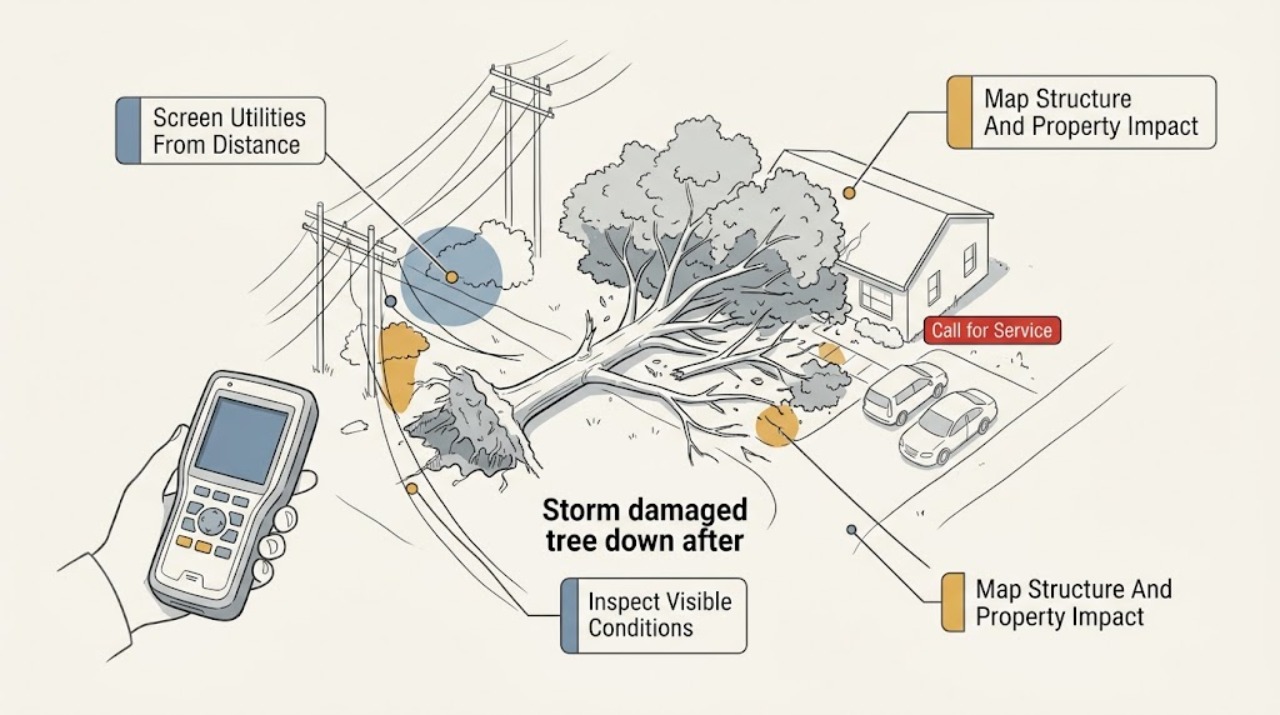
Do not approach or work on a storm-damaged tree yourself. From a safe indoor location or the far edge of the property, document whether power or communication lines, gas or other utilities, a roof or structure, vehicles, a public road, or a blocked access route are involved. Also look for hanging limbs, a leaning or lodged tree, an upturned root plate, and remaining canopy that could still fall. Keep people, pets, and vehicles away; do not cut, climb, lift, drag, pull with a vehicle, or place a ladder near the tree. If any utility, structure, unstable tree, continuing storm, or unclear hazard is present, contact the utility or emergency authority as appropriate and a qualified tree-removal professional.
Work through in order
Diagnostic checks
Use only checks that match the exact appliance or system and its official guide.
-
Check 1
From indoors, a vehicle with a closed door, or the far edge of a clear property area, visually check the sky, tree, fence line, and ground for overhead or downed electrical or communication lines, utility poles, gas indicators, or branches touching a line.
Expected result: Record no visible utility involvement, a line or pole near the tree, a line hidden by branches, or an unknown utility condition; do not use a tool, ladder, vehicle, or hand to improve the view.
Next step: Keep everyone away, report suspected downed lines through the appropriate emergency or utility channel, and tell the tree-removal professional exactly what was visible from the safe location.
Stop if: Stop immediately for a downed, low, sparking, or branch-contacting line, gas odor, smoke, fire, or any need to cross the hazard area.
Why this matters
Why: Any line involvement or uncertainty makes the area a utility hazard and requires the responsible utility or emergency authority before tree work; a clear view of the tree does not authorize cutting.
-
Check 2
From a safe distance, visually scan the fallen trunk, broken limbs, root plate, remaining standing tree, and canopy without stepping under branches or approaching the base.
Expected result: Note hanging limbs, a leaning or partially lodged trunk, an uprooted root plate, branches under visible tension, a tree resting on another tree or object, or a remaining canopy with broken limbs.
Next step: Photograph the whole tree and the surrounding canopy from the safe boundary, then request a qualified tree-removal hazard assessment.
Stop if: Do not enter the drop zone, touch the root plate, stand beneath limbs, climb, cut, tie, winch, or use a vehicle to pull the tree.
Why this matters
Why: These patterns can move or release unexpectedly and are not suitable for homeowner cutting, pulling, lifting, climbing, or stabilization; even a tree on the ground may not be stable.
-
Check 3
From a safe boundary, document whether the tree or limbs contact a roof, wall, porch, fence, vehicle, shed, pool, road, sidewalk, driveway, or other occupied or public area.
Expected result: Classify the impact as no structure contact, property damage without immediate collapse signs, a roof or wall load, blocked public access, blocked private access, or an unknown contact hidden by the tree.
Next step: Keep occupants out of damaged or compressed structures, avoid the blocked route, photograph from a safe distance, and contact the appropriate emergency, property, insurance, or tree professional channels.
Stop if: Stop for roof or wall movement, broken glass, a damaged vehicle, a blocked emergency route, or any request to enter or stabilize the impact area.
Why this matters
Why: A structure or public-route impact may require emergency coordination, structural or traffic control assessment, and a specialized removal sequence; moving a limb can worsen damage.
-
Check 4
From shelter, observe whether wind, lightning, heavy rain, flooding, ice, poor visibility, unstable ground, or other storm conditions remain, and whether a professional could reach the site without crossing hazards.
Expected result: Record calm and clear conditions with an open access route, continuing adverse weather, soft or flooded ground, a blocked route, or an access condition that cannot be judged safely.
Next step: Stay sheltered until authorities say it is safe, provide the access limitation to the professional, and keep the area controlled without attempting a temporary removal.
Stop if: Do not begin storm-time work, drive near the tree, cross floodwater, climb, use equipment, or ask others to enter an unsafe route.
Why this matters
Why: Continuing storm conditions or unsafe access can make tree work more hazardous and can delay professional response; calm weather does not remove stored tree or utility hazards.
-
Check 5
Decide whether utilities, structures, remaining canopy, root or trunk stability, weather, and access are all clearly documented from a safe distance with no immediate emergency hazard.
Expected result: Answer yes only when all conditions are clear and the area can remain isolated; answer no for any line, gas, structure, instability, continuing storm, blocked route, or unknown condition.
Next step: For no, leave the area and use the call checklist. For yes, preserve the perimeter and provide the photos, impact map, access information, and storm timing to the tree professional.
Stop if: Do not cut, lift, drag, climb, pull with a vehicle, operate a chainsaw, or place a tarp on a roof or tree without qualified direction and safe access.
Why this matters
Why: Yes supports a documented request for a qualified tree-removal assessment; no requires emergency or utility coordination first and does not support homeowner cleanup.
Use your observations
Decision map
Find the observation that best matches what you see, then follow the next safe action.
-
PATH 01Safety boundary
What you see
A line is down, low, hidden in the tree, touching a branch, or its status cannot be confirmed.
Do this next
Keep people, pets, vehicles, and equipment away and contact the responsible utility or emergency authority; request tree work only after utility hazards are addressed by qualified personnel.
Why this path and its safety boundary
Safety stop: Do not touch, move, cut, drive over, or approach the line, tree, fence, water, or other potentially energized object.
-
PATH 02Safety boundary
What you see
The tree is on a roof or structure, blocks a public road or emergency route, or has damaged a vehicle or occupied area.
Do this next
Keep occupants out of the affected area, contact emergency or road authorities when access or life safety is involved, and arrange qualified tree and structural assessment.
Why this path and its safety boundary
Safety stop: Do not move the tree or enter a compressed, damaged, or blocked structure or route.
-
PATH 03Safety boundary
What you see
The trunk is lodged, the root plate is lifted, limbs are hanging or under tension, or another standing tree is supporting the fallen tree.
Do this next
Isolate a larger perimeter than the visible trunk footprint and call a qualified tree-removal professional with the photographs and stability observations.
Why this path and its safety boundary
Safety stop: Do not approach the base, cut a limb, climb, tie, winch, lift, drag, or use a vehicle to change the load.
-
PATH 04Safety boundary
What you see
Storm conditions continue or the site cannot be reached without crossing flooding, unstable ground, blocked access, or another hazard.
Do this next
Remain sheltered, follow local warnings, and give the professional the access limitation so the response can be scheduled safely.
Why this path and its safety boundary
Safety stop: Do not perform storm-time work, drive around barriers, cross floodwater, or ask unqualified people to enter the site.
Helpful context
Understand the symptom
A fallen tree is still a moving hazard
A trunk that looks settled can be held by branches, a root plate, another tree, a structure, or stored tension in broken wood. Storm damage can also leave hanging limbs and a remaining canopy that may fall later. A photograph from far away is useful; an approach to inspect a cut point, root ball, or branch tension is not.
Utilities change the response
A line may be hidden in branches or may re-energize as the utility system is restored. Treat any overhead or downed electrical line as live and keep away from the tree, fence, water, vehicle, or other object that could be energized. Do not touch, move, cut, or drive over a line or a branch that may be in contact with it.
Wait for a professional access plan
Tree removal after a storm can involve traffic control, structural assessment, utility coordination, climbing or lifting equipment, and wood under pressure. The homeowner's useful role is to secure the perimeter, record the site from a safe distance, and give the professional an accurate hazard map.
Only after diagnosis
Potential parts
- barrier tape
Consider only as a visible perimeter aid when it can be placed from a safe route without entering the hazard zone; it does not stabilize or make the tree safe.
Use only where local conditions permit safe placement and do not treat tape as a substitute for utility, emergency, or tree-professional control. - tarp
Consider only when a qualified professional determines that a temporary cover can be placed safely without climbing, approaching utilities, or loading a damaged structure.
A tarp is not a roof repair or tree restraint; confirm the surface, wind, attachment method, and professional scope before any placement.
When checks do not resolve it
Need a professional?
Call the utility or emergency authority for any downed or contacted line, gas odor, fire, blocked public or emergency route, or immediate structure danger. Call a qualified tree-removal professional for every storm-damaged tree with hanging limbs, a lodged or uprooted trunk, structure or vehicle contact, remaining canopy damage, or uncertain stability.
Have this ready
- Provide the property location, safe-distance photos, utility observations, structure or route impact, trunk and canopy stability observations, weather and access conditions, whether the tree is on a roof or vehicle, and any known hazards without approaching to collect more information.
Common questions
FAQ
Can I cut up a tree that fell in my yard after a storm?
Not as a homeowner diagnostic or cleanup step. Broken trunks and limbs can be under pressure, supported by other trees, or near energized lines. Isolate the area, document it from a safe distance, and call a qualified tree-removal professional.
What should I do if a fallen tree is touching a power line?
Stay away and treat the line and connected objects as energized. Keep people, pets, vehicles, and tools clear and contact the responsible utility or emergency authority. Do not touch, cut, or drive over the tree or line.
Is a tree on the ground safe if it is no longer moving?
No. A root plate, lodged trunk, hanging limb, or remaining canopy can shift later, and storm damage may conceal tension. A qualified tree professional should assess it before anyone approaches or moves it.
Can I put a tarp over a roof damaged by a tree?
Only if a qualified professional determines that the roof and access are safe and the cover can be placed without climbing near hazards. Do not climb, enter a damaged structure, or approach the tree to place a tarp.
Read the exact guide
Official sources
- Waste Debris Removal and Reduction: Tree TrimmingOccupational Safety and Health Administration · Supports the article's professional-service boundary, safe-distance observations, utility coordination, controlled access, and avoidance of climbing, cutting, lifting, and equipment use by unqualified occupants.
- Tree Trimming SafetyOccupational Safety and Health Administration · Supports observing broken or leaning trees, recognizing pressure and lodged-tree hazards, assuming power lines are energized, and requiring a work-area hazard assessment; it is not a homeowner cutting manual.
Community feedback
Share a repair observation
Share a plain-text repair observation. Accepted observations are published automatically; this page may take a moment to update.