
On this page
Start here
Quick answer
Treat a storm-split branch union or trunk as an urgent falling-tree hazard. From a distant, sheltered position, observe the split, tree lean, lifted soil or root plate, hanging limbs, threatened structures, and any nearby utility lines. Keep people, pets, vehicles, and passersby out of the target area. Do not climb, use a chainsaw, pull with a rope, touch a hanging branch, or approach a power line; contact a qualified arborist for the tree and the utility or emergency service for any line contact or blocked emergency route.
Work through in order
Diagnostic checks
Use only checks that match the exact appliance or system and its official guide.
-
Check 1
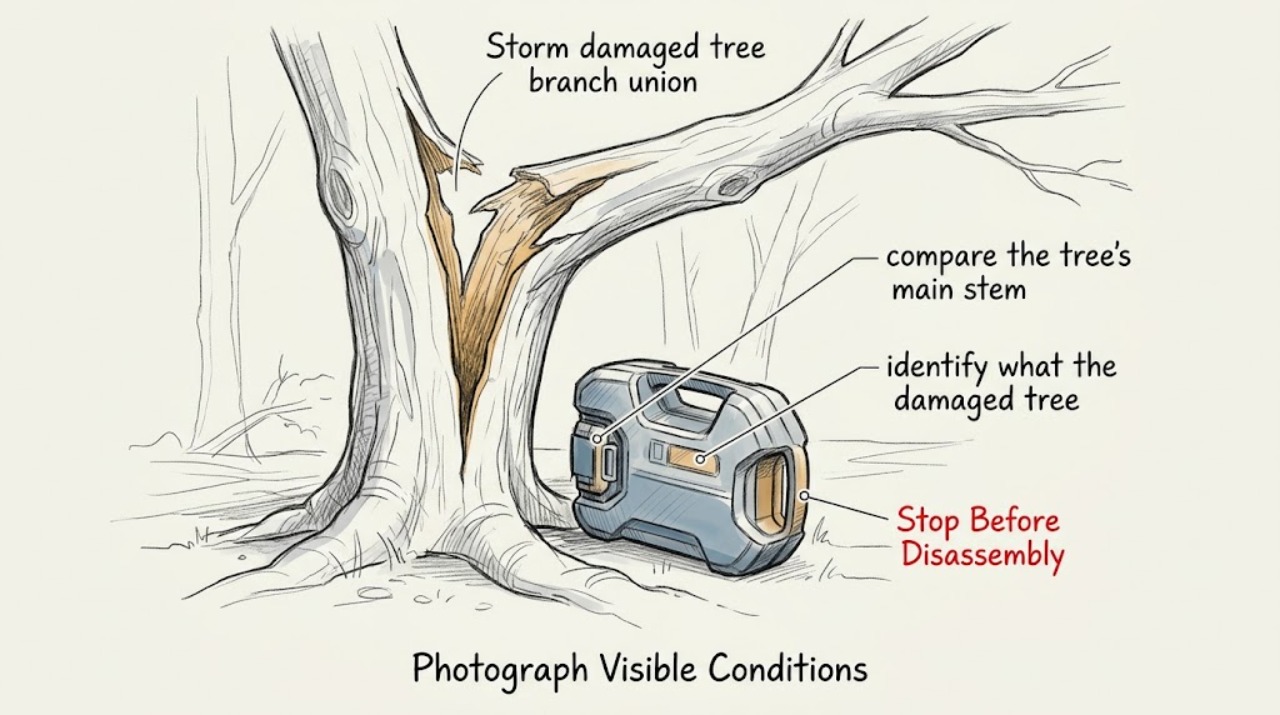
From a distant location with a clear exit route, photograph the whole storm-damaged tree and the branch-union or trunk split without approaching, touching, or walking beneath the canopy.
Expected result: Note whether the split is open, widening, freshly exposed, accompanied by a hanging limb, or connected to a stem that has separated from the trunk; record visible movement only from a safe distance.
Next step: Keep the image and exact location for the arborist, and keep the area isolated until qualified personnel assess it.
Stop if: Stop immediately if observing requires entering the canopy, approaching a hanging limb, crossing a barrier, or standing in the likely fall area.
Why this matters
Why: An open or changing split and any partially attached limb indicate an unstable load and an urgent professional assessment. A closed-looking split does not prove stability.
-
Check 2
From a safe ground-level position, compare the tree's main stem with nearby vertical references and inspect the soil surface around the base without walking onto disturbed ground or probing roots.
Expected result: Look for a new lean, lifted or cracked soil, an exposed root plate, heaving ground, or a base that has shifted since the storm.
Next step: Report the direction and apparent change to the arborist and extend the exclusion area toward the lean and likely fall path.
Stop if: Stop if the ground is unstable, flooded, icy, under tension from fallen material, or if a closer view would require contact or climbing.
Why this matters
Why: A new lean or root-plate movement can make the entire tree unstable, not just the split branch union. The absence of visible soil movement does not rule out internal breakage.
-
Check 3
From outside the hazard area, identify what the damaged tree could reach if a limb or stem moved: occupied rooms, roads, driveways, walkways, vehicles, fences, neighboring property, and overhead utility lines.
Expected result: Record whether any target area is occupied, whether access is blocked, and whether a broken limb is resting on or close to a utility line or service connection.
Next step: Move people and vehicles away only along a safe route, keep the hazard zone closed, and contact the utility or emergency service for line contact or an obstructed emergency route; contact an arborist for the tree assessment.
Stop if: Stop and do not approach if a line is down, low, entangled, or touching the tree, fence, vehicle, water, or ground.
Why this matters
Why: A threatened structure, public route, or utility line increases urgency and changes who must respond. A limb touching a line can energize the tree or nearby ground, even if there is no visible spark.
-
Check 4
Observe the tree and split only from shelter and during calm, visible conditions; compare a later view from the same safe position without creating wind, load, or contact.
Expected result: Note whether branches sway independently, the split changes, bark or wood falls, or the trunk and root area remain still; record recent wind, rain, ice, or lightning conditions.
Next step: Send the time-stamped observations to the arborist and keep the boundary in place until the tree is professionally assessed.
Stop if: Stop observing during wind, rain, lightning, falling debris, darkness, or any visible movement toward people or property.
Why this matters
Why: Movement, falling fragments, or worsening separation means the hazard is active and should not be approached. A still image during calm weather is only a snapshot, not a stability clearance.
-
Check 5
From a safe distance, document whether the split tree has blocked an emergency route, damaged a building, contacted a service line, or left debris that people might try to move; do not clear, drag, cut, or stabilize any tree material.
Expected result: Record the blocked route or damaged asset, whether fire or emergency access is impaired, and whether any debris is under tension or resting on another object.
Next step: Keep the route and debris isolated and report the exact hazard to emergency services or the responsible utility when applicable, while arranging an arborist for tree work.
Stop if: Stop if anyone would need to pass under, climb over, pull, cut, or drive through the damaged tree or debris.
Why this matters
Why: Blocked emergency access or a tree under tension can require emergency coordination rather than a routine tree appointment. Debris can shift when disturbed even after the storm appears to have passed.
Use your observations
Decision map
Find the observation that best matches what you see, then follow the next safe action.
-
PATH 01Safety boundary
What you see
A broken limb or trunk is touching, near, or suspended on an overhead utility line, or a line is down or low to the ground.
Do this next
Keep everyone away, do not drive over or approach the line, and contact the responsible utility or emergency service from a safe location. Arrange arborist work only after the utility hazard is addressed.
Why this path and its safety boundary
Why it matters: Treat the line and anything it touches as energized; the tree may also conduct electricity. This is an electrical emergency boundary, not ordinary tree work.
Safety stop: Do not touch the line, tree, fence, vehicle, puddle, or debris connected with it, and do not use a ladder, rope, saw, or other tool nearby.
-
PATH 02Safety boundary
What you see
The split is open or widening, a limb is hanging, the trunk is leaning, the root plate is lifted, or pieces are falling.
Do this next
Evacuate and isolate the target area along a safe route, keep people and vehicles out, and request urgent arborist assessment or emergency response when property or access is threatened.
Why this path and its safety boundary
Why it matters: The tree is visibly unstable and can fail without warning; the likely fall area must be treated as occupied by the hazard.
Safety stop: Do not approach, touch, pull, cut, climb, brace, or attach a rope to any part of the tree.
-
PATH 03Safety boundary
What you see
The tree is not visibly moving, no line or structure is threatened, and the split can be documented from a distant safe position.
Do this next
Maintain the boundary, save the photos and timing, and schedule prompt arborist inspection; do not treat stillness as a clearance.
Why this path and its safety boundary
Why it matters: The hazard may be stable at this moment, but a split union still needs professional evaluation before the area is reopened or any material is moved.
Safety stop: Stop if weather worsens, the split changes, debris falls, or safe viewing would require entering the canopy.
-
PATH 04Safety boundary
What you see
The tree or debris blocks an emergency route, threatens a public road, or has damaged a building or vehicle.
Do this next
Keep the route closed and contact the appropriate emergency or property-response service, then provide the arborist with the same hazard map and photographs.
Why this path and its safety boundary
Why it matters: Response priority is set by the immediate access and life-safety risk, not by whether the split looks repairable.
Safety stop: Do not clear the route yourself or drive beneath suspended limbs.
Helpful context
Understand the symptom
Why a split union is urgent
A branch union is a structural connection where limbs or stems meet. Storm loading can leave a split under changing tension even when the tree is not moving at the moment. A partially attached limb, leaning trunk, lifted root plate, or damaged line can change without warning. A ground-level view can document the hazard, but it cannot make the tree safe or determine how the load should be released.
Set a safe boundary before observing
Stay outside the apparent fall area and use a route that does not pass under the canopy or near damaged utilities. If the storm is still active, visibility is poor, or wind is moving the tree, stop observing. The purpose of this page is to support an arborist or utility handoff, not to provide cutting, rigging, climbing, or stabilization instructions.
Only after diagnosis
Potential parts
- barrier-tape
Consider this category only for marking a ground-level exclusion boundary when the area can be marked from a safe position without approaching the tree, lines, or falling material.
Barrier tape is only a visual warning and cannot restrain a tree or make a fall area safe; use emergency or professional coordination when the boundary cannot be established safely.
When checks do not resolve it
Need a professional?
Request urgent arborist assessment for any split branch union or trunk after a storm, especially when the tree leans, a limb hangs, the root plate moves, material falls, or a structure, route, or utility is threatened.
Have this ready
- Give the arborist distant photographs, exact location, split and lean direction, root or soil observations, hanging or falling material, target areas, utility-line proximity, weather timing, and blocked-access details.
Common questions
FAQ
Can I cut or pull a storm-split branch union myself?
No. Do not climb, use a chainsaw, pull with a rope, brace, or touch a hanging or split limb. Document it from a distant safe position, isolate the fall area, and call a qualified arborist.
What if the split tree touches a power line?
Stay away and treat the line, tree, nearby ground, and connected objects as energized. Do not approach because there is no spark. Contact the responsible utility or emergency service from a safe location, and wait for utility clearance before tree work.
What information helps an arborist assess storm damage?
Provide distant photographs, the split and lean direction, root or soil movement, hanging or falling material, threatened structures and routes, utility-line proximity, weather timing, and any blocked access. Keep the area isolated until the assessment.
Read the exact guide
Official sources
- Winter Weather Hazards and PrecautionsOccupational Safety and Health Administration, U.S. Department of Labor · General storm-recovery hazard context; local emergency procedures and utility instructions control response.
- OSHA Tree Trimming SafetyOccupational Safety and Health Administration, U.S. Department of Labor · Safety boundary and professional-work context only; not a homeowner cutting, climbing, or rigging procedure.
- Working Safely Around Downed Electrical WiresOccupational Safety and Health Administration, U.S. Department of Labor · Electrical exclusion guidance for storm-damaged trees and wires; not a tree-removal method.
Community feedback
Share a repair observation
Share a plain-text repair observation. Accepted observations are published automatically; this page may take a moment to update.