
On this page
Start here
Quick answer
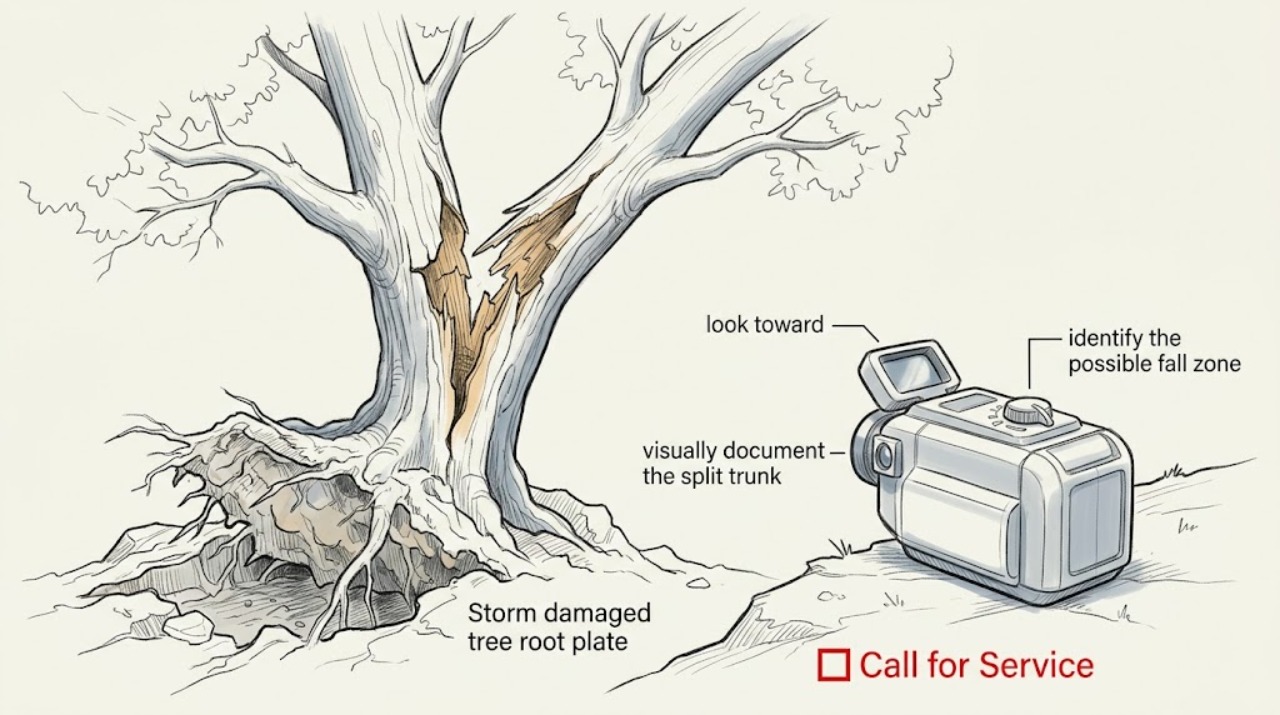
Treat a storm-damaged tree with a lifted or split root plate and split trunk as an urgent hazard, not a homeowner repair. From a distant, stable location, record soil cracking or lifting, the tree's lean and trunk split, the fall zone, nearby buildings and utilities, and any movement or noise. Keep everyone and pets well outside the possible fall area; do not approach the root plate, climb, cut, pull, brace, or rig the tree. Contact a qualified arborist for hazard assessment, and contact the utility provider or emergency services first if the tree or branches involve power lines, a road, or an immediate life-safety threat.
Work through in order
Diagnostic checks
Use only checks that match the exact appliance or system and its official guide.
-
Check 1
From a distant, stable ground position, look toward the base without approaching the root plate or soil mound and note whether the ground is lifted, cracked, displaced, or newly exposed around the trunk.
Expected result: Record visible soil fissures, a raised mound on one side of the lean, exposed roots, a gap under the root plate, or no visible ground change; do not touch, step on, or test the soil.
Next step: Increase the exclusion area, photograph the base from the same safe position, and request an urgent arborist hazard assessment with the location and storm timing.
Stop if: Stop observing and move farther away if the soil or root plate shifts, the tree moves, wind increases, branches fall, or the safe standing area becomes unstable.
Why this matters
Why: Lifting, cracking, exposed roots, or a changing mound are visible signs consistent with root-zone failure and reduced anchoring, not a condition to correct by hand.
-
Check 2
From well outside the possible fall area, visually document the split trunk and overall lean without walking beneath the canopy, touching the trunk, or trying to view the split from the opposite side.
Expected result: Note whether the split is vertical or horizontal, whether it appears to widen or move, whether the trunk is newly leaning, and whether large limbs are hanging or separated; record only what is visible from the safe viewpoint.
Next step: Keep people and pets out of the canopy and fall area, preserve the photos, and give the arborist the direction of lean and the apparent split location for planning.
Stop if: Do not continue if the trunk shifts, a crack opens, limbs drop, or the tree is under tension near a path, structure, vehicle, or person.
Why this matters
Why: A new or moving split, a pronounced lean, or hanging limbs indicates a potentially unstable tree or tree part. A quiet appearance does not prove that stored forces have released.
-
Check 3
From a safe public or property location, identify the possible fall zone and note buildings, vehicles, fences, roads, occupied areas, neighboring trees, and overhead utility lines without entering the zone or moving anything.
Expected result: Record what could be struck if the tree or a split section moves, whether access routes are blocked, and whether any wire is present, sagging, arcing, or contacted; do not approach a wire to identify it.
Next step: Keep the zone isolated, warn others from a safe distance, and provide the arborist or utility provider with the location, photographs, and hazards visible from outside the zone.
Stop if: Immediately move away and keep others away for a downed or arcing line, smoke, fire, falling limbs, a blocked road, or an immediate threat to people.
Why this matters
Why: A target in the fall zone increases urgency, and any contact or suspected contact with a utility line creates a separate electrical hazard that requires utility or emergency response.
-
Check 4
From a protected ground-level position, observe only whether the tree, root plate, trunk split, or nearby branches move or make new sounds during ordinary safe conditions; do not wait close to the tree for a test or create movement.
Expected result: Record any swaying independent of normal wind, cracking, popping, soil movement, fresh debris, or a change since the storm, along with the time and weather.
Next step: Stop watching from nearby, enlarge the exclusion area, and send the time-stamped record to the arborist so the assessment can account for changing conditions.
Stop if: Stop immediately for movement, cracking, falling material, gusting wind, rain, lightning, or any urge to approach for a closer look.
Why this matters
Why: Movement or new cracking suggests the hazard is changing; no observed movement during a short view does not establish stability.
-
Check 5
Prepare a service record from safe observations: address or location, storm date, tree position, root-plate and trunk-split views, lean direction, fall-zone targets, utility presence, blocked access, and any visible changes.
Expected result: Separate confirmed exterior observations from unknown conditions such as internal wood fibers, root extent, tension, stability, and whether the tree can be retained.
Next step: Request urgent professional tree-risk evaluation and follow instructions to maintain the exclusion zone until the hazard is controlled.
Stop if: Do not perform cutting, climbing, pulling, bracing, anchoring, rope work, stump work, or root-plate handling while preparing the record.
Why this matters
Why: A clear record lets a qualified arborist choose an assessment and removal or preservation plan without a homeowner entering a hazardous work area.
Use your observations
Decision map
Find the observation that best matches what you see, then follow the next safe action.
-
PATH 01Next step
What you see
The root plate is lifted or the soil is cracked, moving, or newly displaced around a leaning tree.
Do this next
Treat the tree as an urgent instability hazard, expand the exclusion zone, and contact a qualified arborist for assessment and controlled removal or other professional disposition.
-
PATH 02Next step
What you see
The trunk split is widening, moving, horizontal, or accompanied by hanging limbs or fresh falling debris.
Do this next
Keep everyone outside the canopy and possible fall area and request urgent arborist service. Do not cut or try to separate the split yourself.
-
PATH 03Next step
What you see
The tree or any branch is touching, near, or possibly pulling on an overhead utility line.
Do this next
Do not approach, touch, prune, or move anything. Keep people away and contact the utility provider; use emergency services for fire, arcing, a downed line, or an immediate public danger.
-
PATH 04Next step
What you see
The possible fall zone includes a home, occupied area, road, vehicle, fence, or access route.
Do this next
Isolate the area from a safe position and tell the arborist exactly what could be struck. Do not enter to move property or create an access path.
-
PATH 05Next step
What you see
No root lifting or movement is visible from a distant view, but the trunk is split after the storm.
Do this next
Do not treat the absence of visible movement as clearance. Keep the area restricted and arrange professional evaluation because split-trunk and hidden root conditions cannot be safely confirmed from the ground.
-
PATH 06Next step
What you see
Wind, rain, lightning, unstable ground, falling debris, or another immediate hazard prevents safe observation.
Do this next
Withdraw to a secure location, keep others away, and wait for emergency or qualified professional direction. Do not return for photographs until conditions are safe.
Helpful context
Understand the symptom
Why the root plate changes the risk
Storm loading can damage the root system that anchors a tree. North Carolina Forest Service guidance identifies root-plate lifting, soil cracking, and movement around a lean as signs of root-zone failure, while University of Connecticut Extension identifies root damage, cracks, and splits as factors arborists consider in failure risk. A split trunk can also remain under changing tension even when it appears still, so a distant record is safer than an attempt to stabilize or cut it.
Set the boundary before documenting
Stay on stable ground outside the suspected fall area and use a phone camera or written notes from there. Do not step onto a lifted root plate or soil mound, test it for softness, touch the trunk or branches, enter a damaged structure, or move vehicles and debris near the tree. New York State guidance recommends professional tree care for work that cannot be performed from ground level and warns against work near power lines.
Only after diagnosis
Potential parts
- barrier-tape
Consider a visible barrier only if a professional or site-safety plan confirms that it can be placed from a safe location without entering the fall area; it is not a stabilizer and cannot make the tree safe.
Use only a clearly visible, temporary exclusion marker suited to the site and local safety direction; never attach it to the tree, utility equipment, or a damaged structure.
When checks do not resolve it
Need a professional?
Contact a qualified arborist urgently for any storm-damaged tree with root-plate lifting, soil cracking, a new lean, a split trunk, movement, or targets in its possible fall zone. Contact the utility provider first for a tree or limb near a power line; use emergency services for fire, arcing, a downed line, a blocked public route, or an immediate threat to life.
Have this ready
- Provide the location, storm timing, safe-distance photographs, lean direction, root-plate and split-trunk observations, movement or sound changes, possible fall-zone targets, utility-line status, access restrictions, and any immediate damage.
Common questions
FAQ
Can I stand on the lifted root plate to check the tree?
No. Do not step on, touch, or test the lifted root plate or soil mound. Observe from a distant stable location, isolate the area, and have a qualified arborist assess it.
Does a split trunk always mean the whole tree must be removed?
Only an on-site qualified assessment can decide the disposition. A split trunk with root-plate lifting, movement, a new lean, or targets in the fall zone is urgent; do not attempt to repair, brace, or cut it while waiting.
What if the tree is near a power line?
Keep away and do not touch, prune, move, or approach the tree or line. Contact the utility provider, and use emergency services for arcing, fire, a downed line, or an immediate danger.
What should I tell the arborist?
Share the location, storm timing, safe-distance photos, direction of lean, root-plate and trunk-split observations, movement or new sounds, possible fall-zone targets, utility lines, blocked access, and any immediate damage.
Read the exact guide
Official sources
- Disaster Preparedness | Extension ForestryUniversity of Connecticut Extension Forestry · General residential and community tree-risk guidance; it does not replace an on-site arborist assessment.
- Caring For Urban TreesNew York State Department of Environmental Conservation · General urban tree-care guidance; local utility and emergency procedures take priority for an active hazard.
- Storm-damaged Tree AssessmentNorth Carolina Forest Service · General storm-damaged tree assessment guidance; the site, tree, utilities, and professional access plan remain specific to the property.
Community feedback
Share a repair observation
Share a plain-text repair observation. Accepted observations are published automatically; this page may take a moment to update.