
On this page
Start here
Quick answer
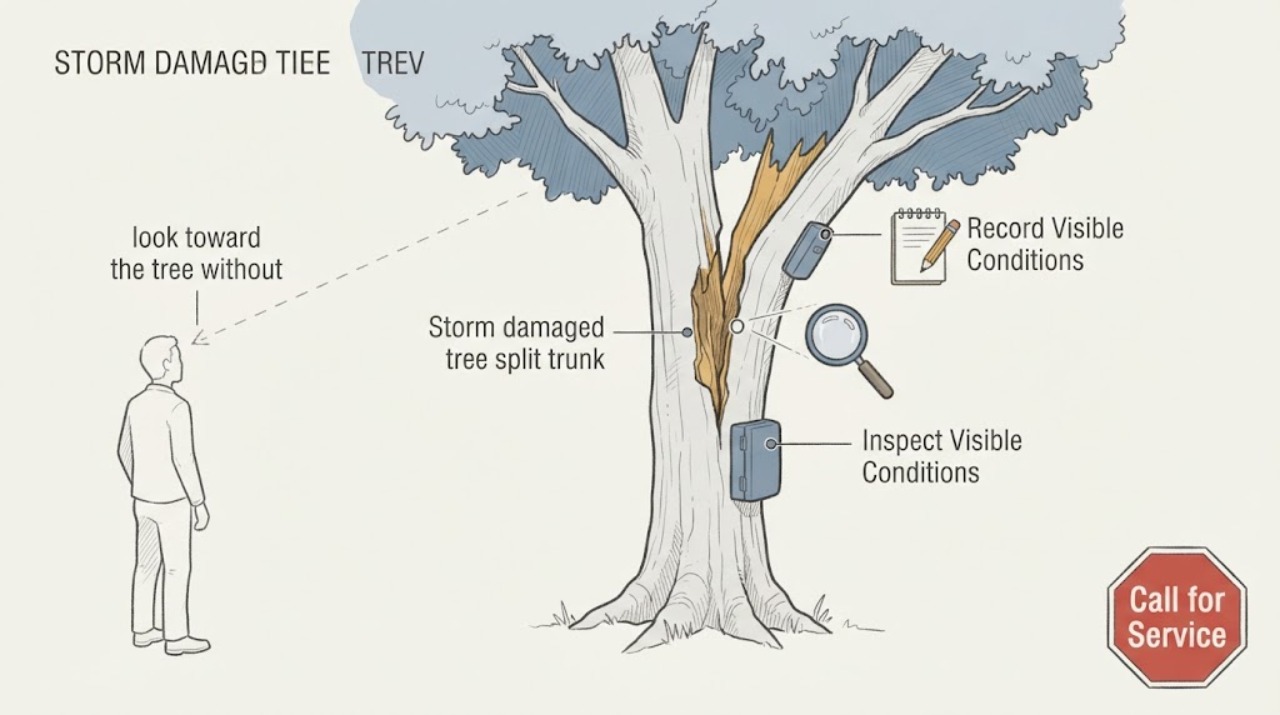
Do not try to repair or remove a storm-damaged tree with a split trunk yourself. From inside a building or another already safe location, check only whether the tree or hanging parts are near people, structures, roads, or utility lines, and note whether the split trunk is leaning or still attached. Keep people, pets, and vehicles out of the area. If a line is down or touching the tree, stay away and contact the utility company or emergency services from a safe location; otherwise arrange an urgent assessment by a qualified arborist or tree-removal professional. Do not approach under the canopy, climb, cut, pull, rig, cable, or move the tree.
Work through in order
Diagnostic checks
Use only checks that match the exact appliance or system and its official guide.
-
Screen the scene from a safe location
From inside a building or another location already outside the tree's fall and debris area, look toward the tree without walking under the canopy or crossing an established exclusion boundary. Check only the visible relationship between the tree, people areas, structures, roads, and overhead lines.
Expected result: Note whether a limb or trunk section is on a roof, against a structure, over a road or walkway, or visibly touching, sagging toward, or lying on a utility line. Also note active wind, rain, flooding, or other conditions that could change the scene.
Next step: If utilities, a public route, or a structure are involved, keep everyone away and contact the responsible utility, emergency service, or local authority from a safe location. Otherwise continue only with the distant observations below and arrange an arborist assessment.
Stop if: Stop all observation and move farther away if the tree shifts, a limb drops, wind increases, the safe vantage is uncertain, or any line may be involved.
Why this matters
Why: A utility-line contact, blocked public route, damaged occupied structure, or movement during the observation is an immediate hazard, not a homeowner cleanup task. A tree clear of those visible contacts still needs professional assessment if the main trunk is split.
-
Record the visible split without approaching
From the same protected location, use ordinary visual observation or a camera zoom to record where the main trunk appears split. Do not approach for a measurement, touch the tree, place a person under it, or test whether either section will move.
Expected result: Note whether the crack runs through the main stem, whether two trunk sections remain partly attached, whether one section is hanging or leaning, and whether the split is directed toward a building, road, fence, or other occupied area.
Next step: Send the location and distant photographs to a qualified arborist or tree-removal service and describe the direction of the split and any nearby targets. Do not ask a non-specialist to stabilize it or make a trial cut.
Stop if: Stop if getting a better view would require entering the canopy area, walking on debris or soft ground, climbing, moving a branch, or standing in the likely fall path.
Why this matters
Why: A split through the main trunk or a partly attached section indicates a potentially unstable tree and supports urgent professional evaluation. A crack that cannot be seen clearly from a safe place is still unresolved; lack of a clear view does not make the tree safe.
-
Look for visible lean and ground movement
From a safe, distant vantage, compare the tree's current lean with nearby vertical references such as a building edge or fence line, and look at the ground without approaching the base. Do not probe soil, pull roots, brace the trunk, or move debris.
Expected result: Look for a new lean, lifted or heaved soil, exposed roots, a shifted root plate, fresh ground cracks, or a crown that has changed position. Record whether the ground is saturated or the tree is resting against another tree or structure.
Next step: Add these observations to the service request and keep the area excluded. If the lean or ground movement is changing, move people farther away and treat the situation as urgent.
Stop if: Stop if the ground is unstable, the tree is moving, debris blocks the safe route, or the only way to see the base would be to enter the hazard area.
Why this matters
Why: Lean or ground movement can indicate reduced root stability in addition to the trunk split. A tree resting on another tree, a structure, or a line needs a professional and possibly utility or emergency response; it should not be treated as a simple fallen-branch cleanup.
-
Document the hazard for responders
From a protected location, take a few wide photos that show the whole tree, the split, nearby structures, access obstacles, and any visible line or road conflict. Keep people, pets, and vehicles out of the frame and outside the exclusion area; do not return to collect close-up images.
Expected result: Record the time of the observation, recent storm conditions, visible changes, and whether the tree is on private property or affects a shared route. Avoid photographing keys, access codes, or unnecessary personal information.
Next step: Provide the photos and the observed utility, structure, road, lean, and split details through the appropriate service channel. Remain outside the area until the responsible professional declares the scene safe.
Stop if: Stop documenting if visibility requires approaching, if the scene changes, or if any person or animal would need to enter the exclusion area.
Why this matters
Why: Wide context helps an arborist, utility, emergency service, or insurer triage the request without sending a homeowner into the hazard zone. Photos cannot certify structural safety or replace an on-site professional assessment.
Use your observations
Decision map
Find the observation that best matches what you see, then follow the next safe action.
-
PATH 01Safety boundary
What you see
The tree or a limb is touching a power line, a line is down or sagging, or the split tree is entangled with utility equipment.
Do this next
Stay away and keep everyone else away from the tree, line, and surrounding ground. Contact the utility company and emergency services through the appropriate local channel from a safe location; tree work near utilities belongs to the utility and qualified line-clearance professionals.
Why this path and its safety boundary
Safety stop: Do not approach, touch, move, cut, pull, or drive under the tree or line, and do not assume a line is safe because it appears inactive.
-
PATH 02Safety boundary
What you see
The main trunk is split or partly attached and the tree threatens a building, road, walkway, fence, parked area, or another tree, but no utility contact is visible.
Do this next
Keep the area excluded and request urgent assessment by a qualified arborist or tree-removal professional. Share wide photos and the direction of the lean or split; let the professional determine whether removal, stabilization, or another response is appropriate.
Why this path and its safety boundary
Safety stop: Do not enter the canopy or fall area, climb, cut, cable, rig, pull, or attempt to brace the trunk.
-
PATH 03Safety boundary
What you see
The tree is visible from a safe distance, no immediate utility or public-route conflict is visible, and the scene is not changing.
Do this next
Keep people, pets, and vehicles away and arrange a qualified arborist assessment as soon as practical. Continue monitoring only from the same safe location and report any new lean, movement, hanging section, or utility conflict.
Why this path and its safety boundary
Safety stop: If wind, rain, ground movement, a new crack, or a change in the tree's position appears, stop monitoring and move farther away before updating the professional.
Helpful context
Understand the symptom
Why a split trunk is treated as a hazard
A split in the main trunk can leave heavy sections supported by damaged wood and changing tension. Storm conditions can also leave hanging limbs, shifted roots, saturated soil, or nearby trees that are unstable. A photograph from a safe distance can help a professional understand the scene, but a homeowner cannot establish a safe work zone by approaching the tree or testing the split.
Keep the first response simple
Stay on the protected side of a building or behind an existing safe boundary. Keep people, pets, and vehicles away without entering the hazard area, and avoid the site during wind, rain, or poor visibility. The priority is to report immediate utility, roadway, building, or public-safety hazards and let qualified responders decide how the tree will be handled.
Only after diagnosis
Potential parts
- barrier-tape
Consider this category only if a qualified responder confirms that a boundary can be marked from an already safe location without approaching the damaged tree or crossing the hazard area.
Use only a clearly visible, weather-appropriate barrier selected for the site and local response plan; tape does not stop falling limbs or make a tree safe.
When checks do not resolve it
Need a professional?
Arrange urgent tree-removal or arborist assessment for any split main trunk, partly attached trunk section, leaning tree, hanging limb, exposed or shifted root area, or tree affecting a structure, road, walkway, or other occupied area. Contact the utility or emergency service first when lines, public access, or immediate life and property hazards are involved.
Have this ready
- Provide the property location through the normal service channel, wide photos taken from a safe distance, whether the trunk is split or partly attached, the apparent lean, nearby structures or routes, any visible utility involvement, recent storm conditions, and whether the scene is still changing. Do not enter the hazard area to obtain measurements.
Common questions
FAQ
Can I pull the split trunk back together or brace it myself?
No. A split trunk can contain hidden tension and unstable weight. Stay outside the hazard area and have a qualified arborist assess it; do not cable, pull, brace, climb, or cut the tree yourself.
What if the split tree is near a power line?
Treat the line and the tree as hazardous, keep people and vehicles away, and contact the utility or emergency service from a safe location. Do not approach to identify whether the line is energized or to move a branch.
Does a split trunk always mean the tree must be removed?
A qualified professional must assess the exact tree, damage, targets, and site conditions. A homeowner should treat a split main trunk as a serious structural hazard and should not decide that it is safe based on a distant visual check alone.
Read the exact guide
Official sources
- Storm-Related Tree DamageIllinois Department of Natural Resources · Supports the safe-distance approach and referral to an arborist for structural and removal decisions.
- Storm Damage and Natural DisturbanceUniversity of New Hampshire Cooperative Extension · Supports staying away from damaged trees and wires, avoiding work during changing conditions, and seeking qualified professional help.
- Tree trimming and removal safety: Plan the work. Protect the crew.Texas Department of Insurance · Used for the general warning that storm-damaged or power-line-adjacent tree work requires qualified professionals; the homeowner article does not reproduce worker procedures.
- How to Manage Storm-Damaged TreesIowa State University Extension and Outreach · Supports prioritizing split main trunks and hazards near structures or utilities, and referring severe damage to an arborist; it does not authorize homeowner work on this tree.
Community feedback
Share a repair observation
Share a plain-text repair observation. Accepted observations are published automatically; this page may take a moment to update.