
On this page
Start here
Quick answer
For a storm-damaged tree with a split trunk and hanging limb, first isolate the entire likely fall area from a distant ground position. Look for movement or falling debris, people and property below, blocked routes, and contact with overhead lines; assume any line or touching object is energized. Record storm timing, movement, split and root or soil changes, and structures at risk without approaching. A suspended limb can drop even when it looks quiet, so do not approach, climb, pull, brace, rope, or cut it. Call emergency services or the utility for immediate hazards and arrange urgent qualified tree-risk or removal service for the assessment and controlled plan.
Before you begin
Safety first
- Request a remote-first tree-risk assessment that accounts for the split trunk, suspended limb, potential tension, fall zone, structures and public routes, root or soil movement, and utility exposure. Qualified tree professionals and the electric utility determine isolation, access, coordination, and controlled removal or stabilization.
Work through in order
Diagnostic checks
Use only checks that match the exact appliance or system and its official guide.
-
Check 1
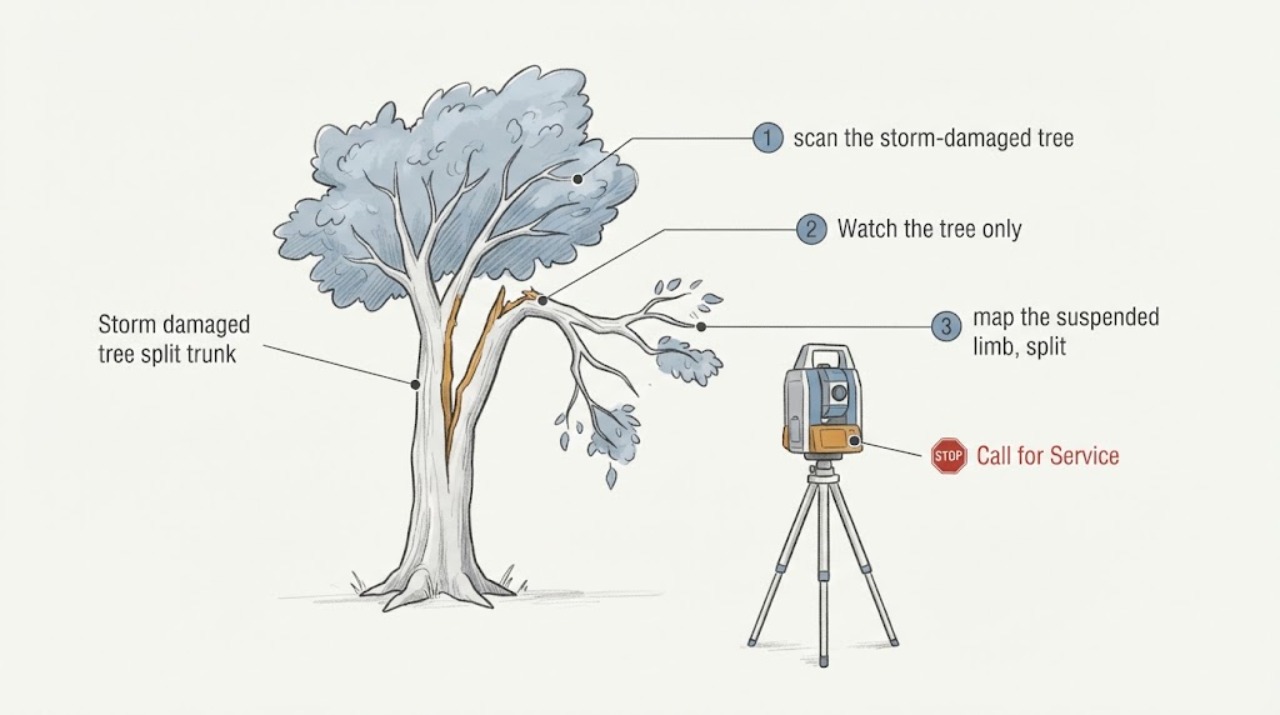
From well outside the suspected fall area, scan the storm-damaged tree and the ground around it for a suspended limb, fallen branches, a leaning trunk, broken roots, blocked paths, vehicles, buildings, people, pets, or utility lines. Keep the observation at distant ground level.
Expected result: Record whether the limb is suspended, resting on another branch or structure, moving in wind, or changing position, and identify every person, property, road, and utility exposure in the likely fall area.
Next step: Keep people and pets away, photograph the whole tree and exposed property from a safe location, and request urgent qualified tree-removal or arborist assessment when the limb is over a travel path, occupied area, or structure.
Stop if: Do not approach, walk beneath, touch, pull, brace, rope, climb, or cut any part of the tree or limb.
Why this matters
Why: A hanging limb can move or drop even when the split trunk looks unchanged, so the area below and around it needs isolation before a closer inspection or cleanup is considered.
-
Check 2
Watch the tree only from a distant, stable ground position during safe daylight conditions and note movement after a gust, rain, or other weather change. Compare photos taken from the same viewpoint rather than testing the limb or trunk.
Expected result: Record no visible movement, intermittent movement, fresh debris, widening separation, bark failure, or a new lean, without estimating stability from still photographs alone.
Next step: Record the time, weather, movement, and visible crack or separation and keep the exclusion area in place until a qualified professional assesses and removes or secures the hazard.
Stop if: Stop observing and move farther away if the limb shifts, the trunk settles, debris falls, wind increases, lightning is present, or the safe viewpoint is no longer stable.
Why this matters
Why: A limb that sways, drops debris, opens a crack, or changes after wind is an active falling-object risk; a quiet period does not prove the suspended wood is stable.
-
Check 3
From outside the exclusion area, map the suspended limb, split trunk, and likely fall direction against roofs, walls, windows, fences, vehicles, roads, walkways, and neighboring property. Use a long-lens photo or zoom only; do not enter the drop zone to measure or mark it.
Expected result: Record which structures or routes are beneath or beside the limb, whether access or evacuation is obstructed, and whether any branch is resting on a roof, fence, vehicle, or other support.
Next step: Mark the hazard boundary from a safe perimeter with visible barrier tape only if you can do so without approaching the tree, and tell the tree professional exactly what is exposed.
Stop if: Do not enter the fall area to place tape, move property, inspect a roof, or retrieve debris; use emergency or site-management help when a road or public route is blocked.
Why this matters
Why: A hanging limb over an occupied or high-consequence area raises the urgency and the size of the isolation zone even if the trunk is still standing; an open ground area may allow scheduled professional work but not user removal.
-
Check 4
From a distant position, look for overhead lines, service drops, poles, or downed conductors touching or near the tree, limb, fence, water, or ground. Treat every line as energized and keep the full area clear without trying to identify voltage or the line owner.
Expected result: Record line contact, sagging, sparks, outage, arcing, or a line that cannot be clearly separated from the limb, and note whether the hazard crosses a driveway or public area.
Next step: Notify the electric utility or emergency services from a safe location and tell the tree contractor about the line exposure. Wait for the responsible utility to make the area safe before tree work is planned.
Stop if: Do not approach, touch, drive beneath, pull a branch away, use a ladder, or use a tool near any downed or potentially energized line.
Why this matters
Why: A branch or split trunk contacting a line can energize the tree and nearby objects, and lines may be re-energized without warning; this changes the response from ordinary tree service to utility-led emergency coordination.
-
Check 5
From the same distant ground viewpoint, inspect the visible trunk base and surrounding soil for a widening split, uprooted roots, lifted soil, a leaning crown, fresh cracks, or a broken stem below the hanging limb. Do not probe the trunk, test tension, or touch the soil or roots.
Expected result: Record whether the trunk is upright or leaning, the visible split direction, soil heave, exposed roots, broken limbs, and any change since the storm.
Next step: Keep the full fall area empty and provide the photos to a qualified arborist or tree-removal professional for a risk assessment and controlled removal plan.
Stop if: Stop if visibility requires approaching, circling the trunk, climbing, moving debris, digging, bracing, or working during wind, rain, lightning, or darkness.
Why this matters
Why: A split that continues into the trunk or a lifted root plate can make the whole tree unstable, not just the suspended branch; a hidden internal failure remains possible even when the base looks normal.
-
Check 6
Prepare a remote service handoff with wide and zoomed photos, the storm time, movement observations, suspended-limb and split-trunk locations, the isolation boundary, structures or lines at risk, and whether access is blocked. Do not attempt cleanup before the assessment.
Expected result: Confirm what was observed remotely and what remains hidden, including the side of the tree that could not be viewed and any property or public exposure.
Next step: Request qualified tree-risk assessment and removal or stabilization planning, with utility coordination when applicable, and follow the provider's instructions for keeping the site empty.
Stop if: Do not turn the handoff into a DIY cutting, rigging, pulling, bracing, climbing, or debris-hauling task.
Why this matters
Why: The professional needs to know that wood is suspended and under possible tension, not merely that a branch fell; this determines the equipment, utility coordination, exclusion area, and urgency.
Use your observations
Decision map
Find the observation that best matches what you see, then follow the next safe action.
-
PATH 01Next step
What you see
The hanging limb is moving, dropping debris, or suspended over people, a home, vehicles, a walkway, or a public route.
Do this next
Evacuate or isolate the exposed area from a safe route, keep everyone out of the fall zone, and request urgent tree-removal or emergency response. Do not wait for a quiet interval or attempt to stabilize the limb.
-
PATH 02Next step
What you see
The limb, trunk, or fallen branch touches an overhead line, service drop, pole, fence, water, or another object that could be energized.
Do this next
Assume the line and anything touching it are energized. Stay well away, notify the electric utility or emergency services, and do not approach until the responsible utility makes the area safe for qualified tree work.
-
PATH 03Next step
What you see
The split reaches the trunk, the crown leans, roots or soil are lifted, or the limb is resting on another tree or structure.
Do this next
Keep the entire potential fall area empty and arrange urgent qualified arborist or tree-removal assessment. A suspended or supported limb may release unexpectedly; do not pull, prop, tie, or cut it.
-
PATH 04Next step
What you see
The hanging limb appears quiet and is over unoccupied ground with no visible utility exposure, but its attachment or tension cannot be confirmed remotely.
Do this next
Maintain a clearly isolated area and schedule qualified assessment before cleanup. Still photographs and a quiet period do not make climbing, cutting, or dragging safe.
-
PATH 05Next step
What you see
Only ground debris is visible and no suspended wood, line contact, structure exposure, or trunk movement can be safely ruled out.
Do this next
Keep the site undisturbed and ask a professional to check the standing tree and canopy before debris removal. Do not pull or cut fallen pieces because they may be under tension or supporting another limb.
-
PATH 06Next step
What you see
Weather, darkness, blocked access, distance, or property boundaries prevent a reliable remote view.
Do this next
Increase the exclusion distance and wait for safe conditions or professional access. Do not enter neighboring property, climb for a better view, or approach through wind, rain, lightning, or unstable ground.
Helpful context
Understand the symptom
Isolate the hanging limb first
A split trunk with a hanging limb is an active overhead hazard, not just a cosmetic storm injury. Stay outside the likely fall area and first look for movement, falling debris, structures or public routes beneath the limb, and any line contact. A quiet limb can still release without warning, so the safe decision is based on exposure and professional assessment rather than a user stability test.
Observe without testing tension
Use only distant, ground-level observations. Compare photos from the same viewpoint, note wind-related movement and changes at the split, and look for a leaning crown, lifted roots, or soil heave. Never approach, climb, pull, brace, rope, or cut the tree or limb. If a line is down or touching the tree, assume it is energized and call the utility or emergency services from well away.
Let the exposure set the urgency
A limb suspended over a home, vehicle, walkway, or road needs more urgent isolation than a similar split over open ground. Send a qualified tree professional wide and zoomed photos, the storm timeline, movement notes, line exposure, and access limits. The professional determines whether utility coordination, controlled removal, or another safe plan is appropriate; household tools and temporary supports are not substitutes.
Only after diagnosis
Potential parts
- barrier tape
Consider this only to mark an already safe perimeter from outside the fall area; tape does not stop a limb, protect against power lines, or replace emergency isolation and qualified tree assessment.
Use visible marking only where local site conditions permit and never approach the tree, road, line, or debris to place it.
When checks do not resolve it
Need a professional?
Call emergency services or the electric utility immediately for a downed or contacting line, fire, sparks, blocked public route, imminent movement, or danger to people. Arrange urgent qualified tree-removal service for any hanging limb, split trunk, leaning tree, lifted roots, structure exposure, or uncertain stability.
Safety scope: Request a remote-first tree-risk assessment that accounts for the split trunk, suspended limb, potential tension, fall zone, structures and public routes, root or soil movement, and utility exposure. Qualified tree professionals and the electric utility determine isolation, access, coordination, and controlled removal or stabilization.
Have this ready
- Wide and zoomed photos from a distant ground position showing the tree, split, hanging limb, likely fall direction, and exposed structures or routes
- Storm timing, wind or rain conditions, movement, falling debris, crack changes, leaning, root exposure, or soil heave observed without contact
- Any overhead or downed line, service drop, pole, fence, water, building, vehicle, walkway, or public-road exposure
- The boundary kept empty, blocked access, property limits, and the side of the tree that could not be viewed safely
- Confirmation that no one approached, climbed, pulled, braced, roped, cut, or moved the tree or debris
Common questions
FAQ
What should I do first with a storm-damaged tree and hanging limb?
Stay outside the likely fall area and photograph the suspended limb, split, movement, structures, roads, and utility lines from a distant ground position. Keep people and pets out and call urgent qualified help when anything is exposed.
Can I tell from the ground whether the hanging limb is stable?
No. A hanging limb can shift or fall after a quiet period, especially when wind or rain changes. Do not test it by pulling, pushing, bracing, tying, climbing, or cutting; have a qualified professional assess it.
What if the limb is touching a power line?
Assume the line and any touching tree or object are energized. Stay well away, keep others away, and notify the electric utility or emergency services. Do not drive beneath, touch, or move the limb.
How large should the exclusion area be?
Keep the full potential fall area empty, including the space around the structure or route below it. The professional needs the exposure information to set the work zone and urgency, even if the tree is not currently moving.
What should I tell the tree-removal professional?
Provide wide and zoomed photos from a safe distance, storm timing, movement and debris observations, split and limb locations, line or structure exposure, access limits, and what you did not touch or alter.
Read the exact guide
Official sources
- Inspection Guidance for Tree Care and Tree Removal OperationsOccupational Safety and Health Administration · Official OSHA tree-care guidance used for falling-object, climbing, damaged-tree, and electrical hazards; homeowners should remain at distant ground level and use qualified tree professionals.
- eTool : Electric Power Generation, Transmission, and Distribution - Overhead Line Work - Line-Clearance Tree Trimming OperationsOccupational Safety and Health Administration · Official OSHA guidance used for power-line contact, storm restoration, approach hazards, and the qualified-worker boundary; it does not authorize homeowner tree work or set a site-specific exclusion distance.
Community feedback
Share a repair observation
Share a plain-text repair observation. Accepted observations are published automatically; this page may take a moment to update.