
On this page
Start here
Quick answer
A storm-damaged tree with a split trunk is a fall-zone and structural-stability emergency assessment, not a hanging-limb trimming job. From far away at ground level, record when the wind event occurred, whether the trunk or crown is still moving, the split's height and direction, the root plate and crown condition, overhead wires, nearby buildings, roads, and people or pets in the potential fall zone. Do not approach, cut, brace, tie, climb, or move anything. Keep everyone out of the fall zone and call qualified tree-removal service; involve the utility or emergency responders when wires or immediate structures are threatened.
Before you begin
Safety first
- This article is distant ground observation only. Do not approach, touch, cut, climb, brace, tie, pull, drag, move debris, use a ladder, or operate equipment around the tree.
Work through in order
Diagnostic checks
Use only checks that match the exact appliance or system and its official guide.
-
Check 1
From far away at ground level, record the wind event, the time the split or lean was first noticed, later gusts, rain or soil saturation, and whether the tree has changed position since then.
Expected result: Classify the condition as newly split, unchanged since the storm, progressively leaning, or still moving; record uncertainty rather than approaching to confirm it.
Next step: Keep people and pets out of the potential fall zone and request urgent qualified tree-removal assessment.
Stop if: Stop observing during active wind, lightning, falling debris, or any need to move closer or enter the fall zone.
Why this matters
Why: A split that is moving or worsening has a different immediate risk from a stable-looking split, but neither can be declared safe by a homeowner observation.
-
Check 2
Using zoom or binoculars from a distant stable position, note the split's height and direction, trunk lean, crown spread, broken limbs, root-plate lifting, soil cracks, and exposed roots.
Expected result: Record whether the split runs through the main stem, whether the crown is attached on both sides, whether the root plate has lifted or shifted, and whether any part is hanging or moving.
Next step: Give the location and photos to a qualified arborist or tree-removal professional; do not test the trunk, crown, root plate, or split by touch or force.
Stop if: Stop for any cracking sound, movement, falling material, unstable soil, or a view that requires climbing or entering the drop zone.
Why this matters
Why: A main-stem split, separated crown, lifted root plate, or changing lean indicates a whole-tree stability question rather than an isolated hanging limb.
-
Check 3
Map the likely fall zone from the distant viewpoint, including buildings, vehicles, roads, sidewalks, fences, play areas, people, pets, and access paths beneath or beside the tree.
Expected result: Mark which occupied or critical areas overlap the tree's lean and crown reach, and whether wind direction could move the crown toward another area; do not estimate a safe buffer by standing under it.
Next step: Close or block access from a safe location and tell the professional exactly what spaces must remain clear.
Stop if: Do not enter the zone to move vehicles, retrieve belongings, place tape, or inspect the base.
Why this matters
Why: A fall-zone overlap turns a tree assessment into an immediate site-control issue even if the split looks small. A clear-looking yard does not eliminate risk from the root plate or crown.
-
Check 4
Check from a distant ground position whether the tree, split trunk, crown, or fallen limbs are near or contacting overhead power, communications lines, poles, buildings, roofs, windows, or other structures.
Expected result: Record line contact or sag, sparks, arcing, damaged poles, crushed structures, blocked roads, and whether the tree's movement could reach them; never assume a line is deenergized.
Next step: Keep everyone away, report downed or contacted lines to the utility or emergency services, and request qualified tree-removal assessment.
Stop if: Stop immediately for any line contact, sparks, smoke, fire, damaged structure, blocked emergency route, or active movement.
Why this matters
Why: Power-line contact requires utility and qualified tree-work coordination, while structure or road impact may require emergency or municipal response. These hazards distinguish this page from routine limb trimming.
-
Check 5
After the wind event and from a distant safe position, compare the tree's base, surrounding soil, drainage, and crown position with earlier photos or known normal conditions.
Expected result: Note fresh soil heave, cracks, exposed roots, saturated ground, new lean, broken crown material, or a changed drainage path; do not dig, probe, water, or brace the root area.
Next step: Add the changes to the service request and keep the area closed until a professional assessment.
Stop if: Stop for soft or collapsing ground, new cracking, movement, falling limbs, or any need to approach the trunk base.
Why this matters
Why: Root-plate movement or saturated and disturbed soil can make a previously standing tree less stable and expand the fall zone.
-
Check 6
Use the remote observations to decide whether this is an urgent qualified tree-removal and utility-coordination call rather than a hanging-limb or homeowner cutting task.
Expected result: Answer yes for a split main trunk, continued movement, root-plate lift, crown separation, fall-zone overlap, line or structure risk, or any uncertainty; answer no only when a qualified professional has already inspected and released the area.
Next step: Send the event timeline, fall-zone map, distant photos, utility and structure observations, and access limits to the professional before anyone approaches the tree.
Stop if: Do not approach, cut, climb, brace, tie, pull, drag, or operate equipment around the tree.
Why this matters
Why: A split trunk after wind can fail unpredictably. Only qualified professionals determine stabilization, sectional removal, whole-tree removal, utility coordination, traffic control, and whether any retention is safe.
Use your observations
Decision map
Find the observation that best matches what you see, then follow the next safe action.
-
PATH 01Next step
What you see
The split trunk or crown is still moving, the lean is increasing, or new cracking or falling material is observed.
Do this next
Leave the area, keep the fall zone empty, and request urgent tree-removal or emergency assessment. Do not wait for a closer look.
-
PATH 02Next step
What you see
The root plate is lifted or shifted, soil is cracking or heaving, or the ground is saturated near the trunk.
Do this next
Treat the whole tree as unstable and keep away from the base and crown. Have a qualified arborist or removal crew assess it; do not brace or anchor it yourself.
-
PATH 03Next step
What you see
Any portion of the tree or fallen material contacts, approaches, or may reach an overhead power or communications line.
Do this next
Keep far away and contact the utility or emergency services. Only coordinated qualified utility and tree crews should control the line and tree hazard.
-
PATH 04Next step
What you see
The trunk or crown threatens a building, roof, vehicle, road, sidewalk, fence, play area, or occupied space.
Do this next
Close the affected access from a safe location and request urgent professional site control and tree-removal assessment; do not move vehicles or belongings beneath it.
-
PATH 05Next step
What you see
The split is not visibly moving from the distant viewpoint, but its attachment, root condition, or likely fall zone cannot be confirmed.
Do this next
Keep the area closed and schedule qualified inspection. A stable-looking tree is not cleared for approach, cutting, support, or normal use.
-
PATH 06Next step
What you see
Only a detached or hanging limb is visible and the trunk, root plate, crown, lines, and surrounding structures show no split or movement.
Do this next
This may belong to a separate hanging-limb assessment, but do not approach until a qualified professional confirms the tree and fall zone are safe. Any main-stem split returns to this urgent path.
Helpful context
Understand the symptom
A split trunk changes the hazard path
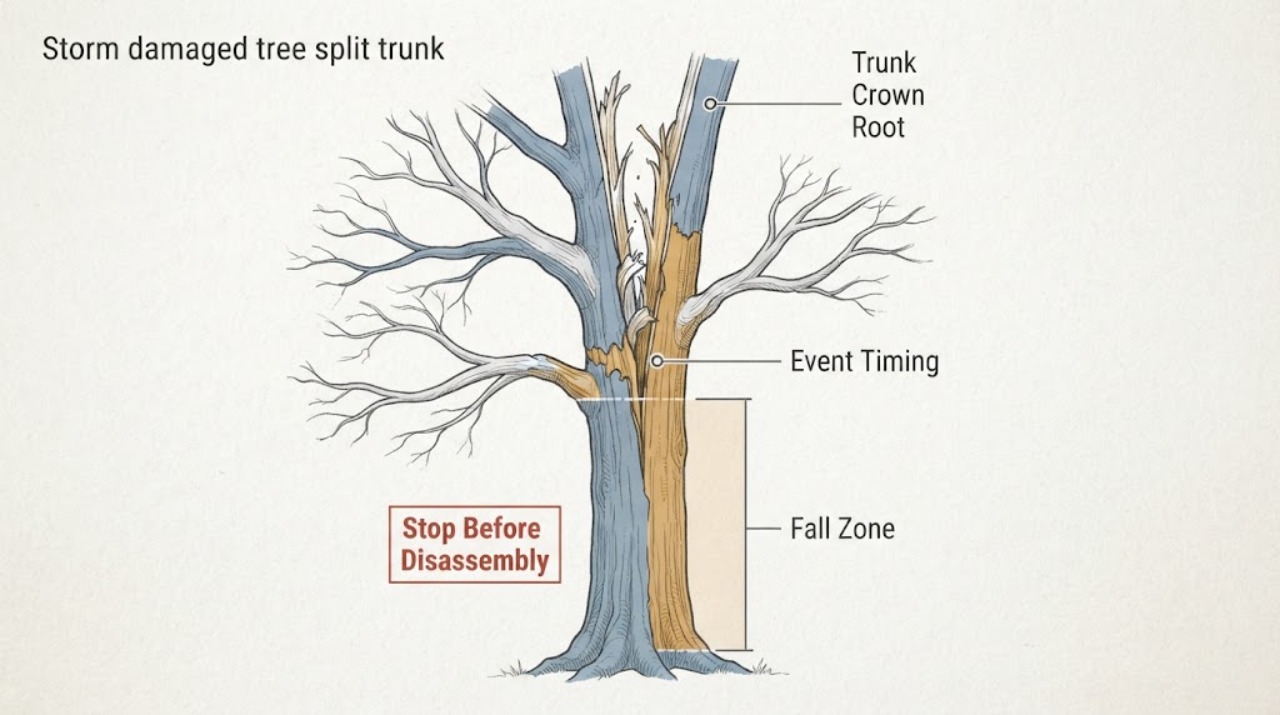
A hanging limb page focuses on a suspended branch. A wind-split trunk can transfer movement through the whole stem and crown, shift the root plate, and fall toward wires, buildings, roads, or occupied space. The key observations are event timing, continued movement, the likely fall zone, and the surrounding hazards—not a close look at the split.
Observe only from a distant ground boundary
Use a camera or binoculars from a stable location well outside the possible fall zone. Do not walk toward the trunk, test movement, touch the bark, place a hand or tool in the split, climb, cut, brace, tie, pull, or use a ladder. During active wind, lightning, or falling debris, shelter indoors and wait for qualified guidance.
Map the fall zone and connected hazards
From a safe distance, note the trunk's lean, crown spread, root-plate lifting or soil cracking, broken limbs, overhead or nearby power lines, structures, vehicles, roads, sidewalks, and places where people or pets may enter. Treat a line that may be contacted by the tree as energized and keep clear; only the utility and qualified tree professionals coordinate that hazard.
Let professionals choose stabilization or removal
A qualified arborist or tree-removal crew must assess whether the tree can be safely retained, stabilized, dismantled, or removed and what utility coordination, traffic control, equipment, and permits are required. Do not improvise a support or buy a saw, rope, brace, or tie based on a distant visual assessment.
Safety boundary
Stop conditions
- Do not approach the tree or debris. Do not cut, climb, brace, tie, pull, drag, or move any part of it.
- Do not enter the fall zone, use a ladder, stand below the crown, or attempt to inspect the root plate at close range.
- Keep away from power or communications lines and report contact, sparks, smoke, fire, damaged structures, or blocked emergency routes to the utility or emergency services.
- Shelter during active wind or lightning and keep people and pets clear until qualified professionals release the area.
Only after diagnosis
Potential parts
- barrier-tape
Consider temporary site-control material only when a qualified professional or emergency responder directs a safe boundary; it cannot stabilize or make a split tree safe.
Use the professional's site-control plan and local requirements; do not enter the fall zone to install it.
When checks do not resolve it
Need a professional?
Request urgent qualified tree-removal assessment for a split main trunk, continued movement, root-plate lift, crown separation, fallen or hanging material, a threatened structure or road, or any uncertainty about the fall zone. Contact the utility or emergency responders immediately for line contact, sparks, smoke, fire, blocked emergency routes, or immediate danger.
Safety scope: This article is distant ground observation only. Do not approach, touch, cut, climb, brace, tie, pull, drag, move debris, use a ladder, or operate equipment around the tree.
Common questions
FAQ
How is a wind-split trunk different from a hanging limb?
A hanging limb is a branch-specific hazard. A split trunk can transfer movement through the main stem, crown, and root plate and may bring down the whole tree. Record the trunk split, lean, movement, root condition, and fall zone from far away and request tree-removal assessment.
What should I record after wind splits a tree trunk?
Record when the wind event and split were noticed, whether the tree continues to move, split direction and height, crown and root-plate changes, soil cracking or saturation, lines and structures nearby, and all spaces inside the likely fall zone. Use distant photos only.
Can I cut off the split section or brace the trunk?
No. Do not approach, cut, climb, brace, tie, pull, or test the tree. A split tree may fail unpredictably, and professional stabilization or removal requires a site and fall-zone assessment.
What if the tree is near a power line?
Keep everyone away and treat the line as energized. Contact the utility or emergency services for line hazards and request coordinated qualified tree service. Do not touch the tree, debris, or line, and do not move anything beneath it.
When is a storm-damaged split tree an emergency?
Treat continued movement, new cracking, a lifted root plate, falling material, a threatened structure or road, line contact, smoke or fire, or an occupied fall zone as urgent. Leave the area and keep others clear rather than taking a closer look.
Read the exact guide
Official sources
- Inspection Guidance for Tree Care and Tree Removal OperationsOccupational Safety and Health Administration · Occupational tree-care safety guidance used to define why a storm-split tree requires qualified site assessment and why lines, falling objects, climbing, and cutting are outside user checks.
- During a High Wind EventNational Weather Service · General weather safety used to set the observation boundary during active wind and falling-debris conditions; it does not assess a particular tree.
Community feedback
Share a repair observation
Share a plain-text repair observation. Accepted observations are published automatically; this page may take a moment to update.