
On this page
Start here
Quick answer
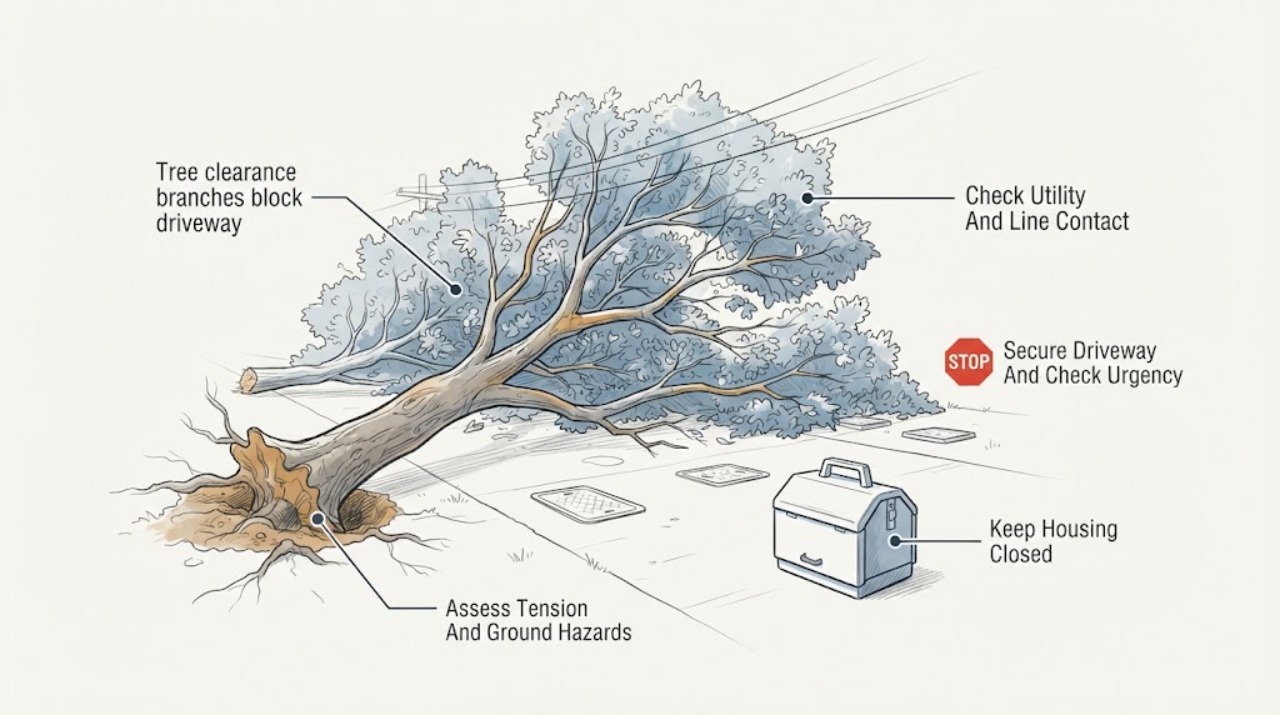
A branch blocking a driveway is first an access and falling-object hazard, not a routine pruning job. Keep people, vehicles, and pets out of the drop zone; do not drive under or around a hanging branch, move a limb caught on a wire, or start a chainsaw. From a safe distance, check whether the tree or branch is leaning, under tension, partially attached, near overhead lines, across a public road, or blocking emergency access. Report a branch on or near a power line to the utility or emergency services and use a qualified line-clearance tree professional. If there are no utility hazards but the branch is large, elevated, storm-damaged, supported by another limb, or too heavy to move without equipment, use a qualified arborist. Only a small, fully detached piece on stable ground with a clear route might be handled as ordinary debris; a blocked driveway can still conceal tension, sharp breakage, unstable trunk or root failure, and should not be cut based on appearance alone.
Before you begin
Safety first
- This article supports safe remote observation, documentation and access control only. Do not touch utility lines or connected branches, enter a drop or tension zone, climb, use a chainsaw, pull with a vehicle, or reopen the driveway until qualified clearance confirms safety.
Work through in order
Diagnostic checks
Use only checks that match the exact appliance or system and its official guide.
-
Check 1
Stop vehicles and people before the blocked section, place a barrier at a safe distance if you can do so without entering the fall zone, and view the tree from outside the canopy and branch path.
Expected result: Record whether the driveway is the only access, whether emergency vehicles are blocked, whether a branch is hanging or partially attached, whether the trunk is leaning or uprooted, and whether branches or debris are still moving.
Next step: Keep the route closed and contact emergency services or the appropriate road authority if emergency access is blocked or the tree threatens people or structures. Otherwise arrange a qualified arborist or tree-removal professional to assess the blockage.
Stop if: Do not drive under the canopy, stand beneath hanging limbs, pull a branch with a vehicle, or enter the area while wind, lightning, unstable ground, or falling debris is present.
Why this matters
Why: A blocked emergency route or an unstable hanging tree is urgent; wind, rain, and partially attached material can change the hazard after the first observation. A fully detached branch on the ground is lower risk than a suspended or tensioned branch, but it still may be too heavy or sharp to move safely.
-
Check 2
From a safe distance, identify overhead electrical, communications, service-drop, lighting, and visible utility lines near the branch without touching the tree, line, fence, vehicle, or wet ground.
Expected result: Note whether a limb rests on, crosses, pulls, or is within the potential reach of a line; whether a line is down or sagging; and whether power, lights, or nearby equipment are behaving abnormally.
Next step: Keep everyone away, report downed or contacted lines to the utility and emergency services, and request a qualified line-clearance tree professional. Tell responders that a tree is blocking the driveway and identify the safest alternate approach.
Stop if: Do not touch or move the limb, use a ladder or pole saw, drive over a line, or cut a tree near a line; do not assume de-energization until the utility confirms the safe condition.
Why this matters
Why: Any tree or branch contacting or close to an energized line is a utility and line-clearance operation, not homeowner chainsaw work. A line that appears dead can still be energized, and a branch can carry the hazard beyond the visible contact point.
-
Check 3
From outside the drop and retreat paths, inspect the visible branch and tree base for signs of stored tension or unstable support without stepping over or under the obstruction.
Expected result: Look for a bent or twisted limb, a split, a hung-up branch, a branch trapped beneath another object, a cracked trunk, an uprooted or lifted root plate, broken support limbs, steep or slippery ground, vehicles or structures in the fall path, and sharp broken ends.
Next step: Photograph the condition from safety and give the arborist the branch position, tree height estimate, targets, slope, and access constraints. Keep the driveway closed until the tension and fall plan are professionally controlled.
Stop if: Do not cut a spring pole, climb, throw a rope, pull with a vehicle, cut overhead, or stand on the downhill or compression side of a bent limb.
Why this matters
Why: A bent, suspended, split, uprooted, or supported branch can move violently when released; a target in the fall path or poor footing removes the margin for ordinary cleanup. No visible tension does not establish that a branch is safe to cut.
-
Check 4
From a safe position, document the blocked driveway, adjacent vehicles, structures, fences, gates, drainage, sidewalk or road, and any visible damage before clearance begins.
Expected result: Record whether the branch blocks a public road or only private access, whether vehicles can be moved without entering the drop zone, whether the driveway surface or gate is damaged, and whether rainwater or debris is creating a secondary slip or drainage hazard.
Next step: Keep a clear record and ask the responding professional how to establish a safe temporary access route. Protect only movable items that can be reached without entering the tree or line hazard.
Stop if: Do not move a vehicle by driving beneath the tree, operate a winch or loader without a qualified plan, or enter a public roadway to move branches without traffic control.
Why this matters
Why: The access owner, utility, road authority, emergency service, arborist, and insurer may have different responsibilities. Moving vehicles or debris before documentation can expose people to falling material and make the original condition harder to assess.
-
Check 5
After qualified clearance, inspect the driveway and remaining tree from the ground before reopening the route to vehicles or pedestrians.
Expected result: Check for suspended branches, cracked or hanging leaders, a leaning or root-lifted trunk, hidden wire contact, saw debris, sharp stubs, damaged pavement or gates, unstable soil, and remaining obstructions or blocked drainage.
Next step: Keep access restricted until the arborist or property professional confirms the route is clear and safe; schedule follow-up pruning, removal, stump or surface repair only from the documented assessment.
Stop if: Do not reopen the driveway if the tree is still moving or leaning, a line remains involved, debris is under tension, or the route has unprotected holes, sharp material, or structural damage.
Why this matters
Why: Removing the branch that blocked access does not prove that the tree or site is stable. Storm damage can affect neighboring limbs and roots, and cleanup equipment may leave hazards on the route.
Use your observations
Decision map
Find the observation that best matches what you see, then follow the next safe action.
-
PATH 01Safety boundary
What you see
A branch or trunk is touching, resting on, pulling toward, or close to an overhead utility line, or a line is down or sagging across the driveway.
Do this next
Keep people and vehicles away, contact the utility and emergency services, and request qualified line-clearance tree workers after the utility establishes the safe electrical condition.
Why this path and its safety boundary
Why it matters: This is an electrical and line-clearance emergency boundary; the tree, vehicle, fence, wet ground, and nearby metal can become energized.
Safety stop: Do not touch, cut, pull, drive over, or approach the branch or line, and do not rely on a visual assumption that it is de-energized.
-
PATH 02Safety boundary
What you see
The branch is bent, split, hung up, partially attached, supported by another limb, or connected to a tree with a cracked trunk or lifted root plate.
Do this next
Close the driveway and have a qualified arborist or tree-removal professional create the fall, rigging, exclusion and access plan.
Why this path and its safety boundary
Why it matters: Stored energy and unstable support can cause sudden movement or a change in the tree's fall direction; this is beyond ordinary driveway debris handling.
Safety stop: Do not cut, pull with a vehicle, climb, throw a rope, stand under the branch, or work during wind, lightning, icing, or other adverse weather.
-
PATH 03Safety boundary
What you see
The branch blocks the only driveway, emergency vehicle access, a public road, sidewalk, gate, or a route needed to evacuate or reach a residence.
Do this next
Notify emergency services or the road authority when their access is affected, identify an alternate route, and keep the work zone closed until qualified clearance or traffic control is in place.
Why this path and its safety boundary
Why it matters: The blockage has an access and response consequence in addition to property damage; unplanned cutting can make the route less safe.
Safety stop: Do not drive around barriers, move the branch into a roadway, or let bystanders enter the drop or equipment zone.
-
PATH 04Safety boundary
What you see
The material is fully detached, on stable ground, away from utility lines and structures, not under tension, and can be left in place without blocking emergency access.
Do this next
If the piece is small enough to move without lifting strain or tools, use a clear route and keep others away; otherwise arrange a tree-cleanup professional. Reassess the remaining tree for storm damage before reopening the driveway.
Why this path and its safety boundary
Why it matters: This is lower risk than a hanging or connected branch, but sharp ends, hidden nails or cables, weight, unstable footing and saw injury hazards can remain.
Safety stop: Stop if the branch is heavier, longer, tangled, slippery, supported, close to a line, or more unstable than it appeared.
-
PATH 05Safety boundary
What you see
Wind, lightning, icing, rain, darkness, unstable ground, poor visibility, or nearby traffic prevents a reliable hazard assessment.
Do this next
Keep the driveway closed, use remote communication and visible barriers only from safe ground, and wait for safer conditions or request emergency/qualified response.
Why this path and its safety boundary
Why it matters: Conditions can hide lines and tension and can change the fall path or footing; even trained line-clearance work has weather limits.
Safety stop: Do not start a chainsaw, climb, drive a vehicle into the work zone, or work beneath branches in adverse weather.
Helpful context
Understand the symptom
A blocked driveway may contain stored movement
A branch that looks settled can be bent, twisted, hung up, or supported by another limb. When cut, a spring pole or partially attached branch can release suddenly and strike someone. The trunk or root plate may also shift, and the remaining canopy can contain branches that fall without warning. Treat the driveway as a work zone until the tree and route have been assessed.
Power lines change the job completely
A line may be energized even when it is hard to see, and a branch can transfer electrical contact to tools, vehicles, fences, or wet ground. OSHA distinguishes line-clearance tree work from ordinary pruning and requires specialized qualifications and approach controls near energized lines. Do not rely on a visual estimate, a rubber handle, or an assumption that the line is a communications cable; call the utility or a qualified line-clearance provider.
Restore access only after the hazard is removed
Moving the first visible branch may expose another suspended limb, an unstable trunk, a damaged fence or driveway edge, or a blocked drainage route. After professional removal, inspect the access route from the ground, keep vehicles out until the surface and overhead canopy are clear, and arrange follow-up tree assessment if the remaining tree was storm-damaged.
Safety boundary
Stop conditions
- Do not cut or move any branch that touches, rests on, or is close to a power or utility line; contact the utility and qualified line-clearance personnel.
- Do not stand under hanging limbs, bent or split branches, an uprooted tree, or a branch supported by another object; keep the driveway closed.
- Do not use a chainsaw from a ladder, tree, vehicle, roof, or above shoulder height, and do not cut directly overhead or work alone.
- Do not pull branches with a vehicle, winch, rope or loader unless a qualified professional has planned and controlled the operation; stored tension can release suddenly.
- Stop in wind, lightning, icing, rain, darkness, unstable footing or poor visibility, and call emergency responders if the obstruction blocks emergency access or creates an immediate life-safety hazard.
Only after diagnosis
Potential parts
- temporary driveway barrier or reflective warning marker
Consider this category only to control access while qualified clearance is pending and when it can be placed from a safe position without entering the tree, line or roadway hazard.
Choose a visible, stable barrier appropriate to the private drive or road authority; it is an access-control aid, not a substitute for traffic control or hazard removal. - tree support or cabling system
Consider this only if a qualified arborist determines that the remaining tree has a supportable structural defect and that cabling, bracing or another treatment is appropriate.
The arborist must select the system, attachment points, load and inspection plan for the species, structure and defect; do not install a brace or cable based on a photograph. - driveway or gate repair material
Consider this only after the tree hazard is removed and a qualified inspection confirms that the blockage or removal operation damaged pavement, drainage, fencing or a gate.
Match the existing surface, grade, drainage, gate hardware and local requirements; restore access only after the remaining tree and route are confirmed safe.
When checks do not resolve it
Need a professional?
Call the utility and emergency responders for downed or contacted power lines, fire, injury, an imminent tree or branch strike, or a blocked emergency route. Arrange a qualified line-clearance tree professional for any branch near utilities, and a qualified arborist or tree-removal professional for hanging, tensioned, uprooted, large, elevated, storm-damaged or structure-threatening branches. A fully detached small branch on stable ground may be ordinary debris only when it is clearly outside utility, traffic, structural and tension hazards.
Safety scope: This article supports safe remote observation, documentation and access control only. Do not touch utility lines or connected branches, enter a drop or tension zone, climb, use a chainsaw, pull with a vehicle, or reopen the driveway until qualified clearance confirms safety.
Common questions
FAQ
Can I cut a branch that is blocking my driveway?
Only a fully detached, small piece on stable ground and clearly away from utility lines, structures, traffic and tension may be ordinary debris. A hanging, split, bent, large, elevated, storm-damaged or connected branch needs a qualified arborist; never cut a branch near a power line yourself.
What if a tree branch is touching a power line across the driveway?
Keep people and vehicles away and contact the utility and emergency services. Do not touch, cut, pull, drive over or approach the branch or line. Line-clearance work requires specialized qualification, and the utility must establish the safe electrical condition.
Why are storm-damaged branches dangerous even when they look still?
A bent, twisted, hung-up or partially supported branch can hold stored energy and release suddenly when cut or pulled. A cracked trunk, lifted root plate, unstable ground or hidden hanger can also change the fall path. Keep the driveway closed until a professional assesses it.
Can I pull the branch away with my vehicle?
Do not pull a connected, hung-up or tensioned branch with a vehicle, winch or rope. The branch, trunk or root plate can move unpredictably, hit the vehicle or release toward a person or line. A qualified tree professional must plan and control any mechanical removal.
When can I reopen a driveway after tree clearance?
After the blocking material is removed, inspect from the ground for remaining hanging limbs, a leaning or root-lifted tree, utility contact, sharp debris, holes, drainage problems and surface damage. Keep access restricted until qualified clearance confirms the route and remaining tree are safe.
Read the exact guide
Official sources
- Chain Saw SafetyCenters for Disease Control and Prevention · CDC public safety guidance for tree removal after disasters; the same hazards apply to a driveway blockage after wind or storm damage.
- Working Safely with ChainsawsOccupational Safety and Health Administration · OSHA chainsaw safety fact sheet for workers; it supports a homeowner stop boundary and does not authorize untrained tree removal.
- eTool: Electric Power Generation, Transmission, and Distribution - Overhead Line Work - Line-Clearance Tree Trimming OperationsOccupational Safety and Health Administration · OSHA workplace requirements and guidance for line-clearance tree trimming; homeowners should use the same boundary by stopping work and contacting qualified utility or tree professionals.
- Maintain trees and remove hazards to reduce severity or extent of wind and ice damageU.S. Department of Agriculture, Climate Hubs · USDA Climate Hubs guidance for urban and developed sites; a qualified arborist or local authority must assess a particular tree and right-of-way.
Community feedback
Share a repair observation
Share a plain-text repair observation. Accepted observations are published automatically; this page may take a moment to update.