
On this page
Start here
Quick answer
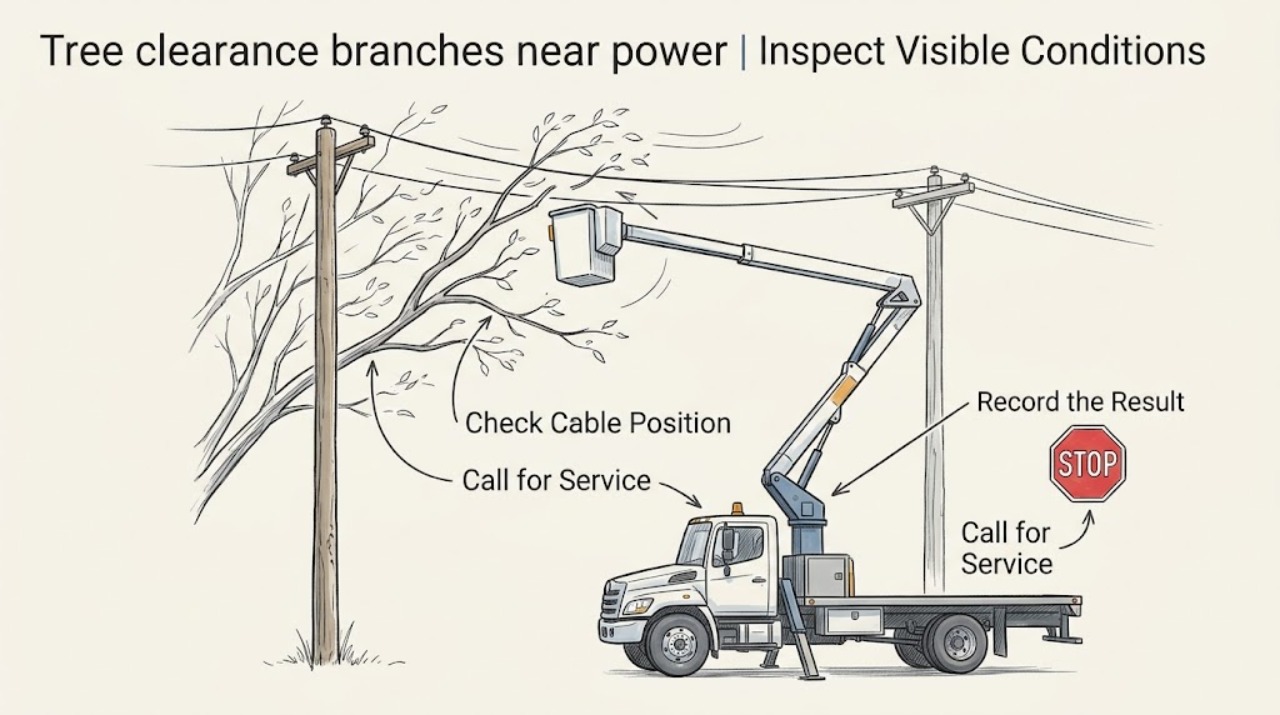
Do not trim, climb, touch, or measure a moving branch near an overhead power line. From a safe location, note whether the branch is merely moving near the line, touching it, caught on it, or has brought a line down. Wind can move branches and conductors into one another even when the clearance looks acceptable in still air, and high winds make tree work more hazardous. Treat every power line as energized, keep people and tools away, and contact the electric utility for a hazard evaluation. If a branch is on a line, a line is down or sagging, there are sparks or fire, or the tree is failing, leave the area and call emergency services and the utility. Any trimming or removal near the line belongs to trained, line-clearance-qualified professionals.
Before you begin
Safety first
- Only trained, line-clearance-qualified professionals working under utility coordination should approach, trim, remove, or rig vegetation near energized lines. The homeowner should remain outside the hazard area and should not assume a line is de-energized.
Work through in order
Diagnostic checks
Use only checks that match the exact appliance or system and its official guide.
-
Check 1
From a location well away from the tree and line, observe the branch during normal movement or from a safe recorded observation after the wind eases; do not enter the drop zone, walk beneath it, or use a ladder, pole, drone, or measuring tool.
Expected result: The branch stays clear, swings toward the line, brushes or contacts the line, or the line itself appears to move, sag, or change position.
Next step: Keep everyone away and report the observation to the utility. If there is contact, a downed or sagging line, or arcing, leave the area and use emergency and utility reporting channels.
Why this matters
Why: Movement toward or contact with the line means a static visual gap cannot establish safety. A line that moves or sags may be energized and may indicate a utility hazard.
-
Check 2
Look up from the safe vantage point and identify whether the conductors appear to be electric distribution or transmission lines, a service drop, or a communications cable; do not assume a line is harmless because it is lower or thinner.
Expected result: The line type is clear, multiple line types are present, or the line type cannot be identified.
Next step: Treat every overhead line as energized and report the location to the electric utility. Do not trim or remove vegetation based on an assumed line type; let the utility and qualified crew determine the work boundary.
Why this matters
Why: Different lines and voltages have different owners and clearance requirements. Uncertainty increases rather than reduces the electrical risk, especially when a branch can move between lines.
-
Check 3
From a safe distance, check whether any branch, trunk, vine, fence, vehicle, or other object is touching a power line, and look for flashes, smoke, fire, a fallen conductor, or a new outage; do not touch the tree, object, ground nearby, or line.
Expected result: There is no contact or electrical sign, or there is contact, a fallen or sagging line, arcing, smoke, fire, or an outage associated with the tree.
Next step: For contact, a fallen or sagging line, arcing, smoke, or fire, leave by the route you used, keep others away, and call 911 and the utility. Do not return until utility or emergency personnel say it is safe.
Why this matters
Why: Contact or electrical signs make this an emergency electrical hazard, even if no sparks are visible. A lack of visible contact does not make planned cutting safe.
-
Check 4
From the same safe location, note visible signs that the tree or limb may fail, such as a hanging or broken limb, a split trunk, a strong lean, root lifting, dead wood, or a branch repeatedly moving toward the line; do not approach to test its strength.
Expected result: The tree looks stable from a distance, or there is a hanging/broken limb, split, lean, root disturbance, dead section, or movement that could reach the line or a structure.
Next step: Keep people, vehicles, and pets outside the potential fall area and request an urgent utility and qualified tree-professional evaluation. Do not rope, brace, cut, climb, or pull the limb.
Why this matters
Why: Failure signs increase the chance that wind will change the fall path or send a limb into the line. A tree that looks stable from one angle still requires a qualified assessment when it can reach electrical equipment.
-
Check 5
Record the street or property location, the nearest pole or tower identifier if it can be read from a safe position, the direction of branch movement, and whether wind, lightning, ice, or storm damage is present; take photos only from the safe position.
Expected result: The location and utility equipment can be described clearly, or the site is too obscured or unsafe to document without approaching.
Next step: Report the hazard through the utility's emergency or vegetation-safety channel, using 911 first for immediate danger. Do not enter the site to obtain a better photograph or read a tag.
Why this matters
Why: Clear location and movement information helps the utility route the report and distinguish a planned vegetation issue from an active electrical emergency. An unsafe or obscured site is a reason not to investigate further.
-
Check 6
Before any planned tree work or removal, tell the utility and the tree contractor that branches move near the line and ask who will determine de-energizing, clearance, access, and the work date; do not schedule a general yard crew to cut first.
Expected result: The utility has confirmed ownership and a safety plan, or no qualified line-clearance plan or utility coordination exists.
Next step: Proceed only under the utility's and qualified line-clearance crew's instructions. If coordination is absent or high winds persist, postpone the work and keep the area clear.
Why this matters
Why: Only a utility-coordinated, line-clearance-qualified plan can account for line voltage, movement, equipment reach, fall direction, and changing weather. A general arborist or homeowner plan does not establish electrical clearance.
Use your observations
Decision map
Find the observation that best matches what you see, then follow the next safe action.
-
PATH 01Next step
What you see
The branch moves toward an overhead line in wind but is not visibly touching it, and there are no sparks or outage.
Do this next
Stay away from the tree and report the location to the utility for evaluation and qualified line-clearance scheduling. Do not use a ladder, pole pruner, rope, or saw.
Why this path and its safety boundary
Why it matters: This is a planned line-clearance hazard, not a safe DIY pruning opportunity; the moving clearance can disappear as wind or conductor movement changes.
-
PATH 02Next step
What you see
A branch or tree is touching a line, a line is down or sagging, or there are flashes, smoke, fire, or a new outage.
Do this next
Leave the area, keep people and pets away without touching the tree or line, call 911 and the utility, and do not return until responders confirm it is safe.
Why this path and its safety boundary
Why it matters: Assume the line and anything touching it are energized. This is an immediate electrical and possibly fire hazard rather than a routine tree-service request.
-
PATH 03Next step
What you see
A hanging, broken, split, leaning, or root-disturbed tree or limb can reach the line or a structure, especially during continuing wind.
Do this next
Create distance from the potential fall area and request urgent assessment by the utility and a line-clearance-qualified tree professional. Do not brace, pull, climb, or cut it.
Why this path and its safety boundary
Why it matters: The failure path is unpredictable and may put the line, roadway, home, or responders at risk even before contact occurs.
-
PATH 04Next step
What you see
The line type or ownership is uncertain, several overhead lines are present, or the property service drop crosses the tree's movement path.
Do this next
Treat all lines as energized and ask the electric utility to identify the hazard and coordinate any disconnect or line-clearance work. Keep tools and equipment away.
Why this path and its safety boundary
Why it matters: Unknown voltage and ownership prevent a reliable clearance decision; service drops can still be hazardous even when they appear to serve only one building.
-
PATH 05Next step
What you see
The tree is not currently contacting the line, but planned trimming or removal would place a person, tool, vehicle, or falling limb near it, or high winds are continuing.
Do this next
Postpone the work, keep the site clear, and use only a utility-coordinated, trained line-clearance tree crew after conditions improve and the work plan is confirmed.
Why this path and its safety boundary
Why it matters: The proposed work itself creates the hazard, and adverse weather can make an otherwise engineered job unsafe.
Helpful context
Understand the symptom
Wind changes the hazard, not just the appearance
A branch that appears separate from a line while still can sweep into it as the tree moves. Conductors can also sway or sag, and a tree with dead or weakened limbs can shed material during gusts. Do not walk under the branch to estimate a gap, pull a limb away, or wait beside the tree for a closer look. Observe only from a location where the tree, branch, line, and any object touching them cannot reach you.
A visible gap is not permission to do the work
For an unqualified person, OSHA describes a minimum approach distance of at least 10 feet for overhead lines up to 50 kV, with greater distances for higher voltages; the actual utility clearance and work plan can be more demanding. This is a safety boundary, not a homeowner pruning rule. Because voltage, line ownership, branch movement, equipment, and fall direction are not safely established from a casual view, arrange utility coordination and qualified line-clearance tree work instead of relying on a tape measure or pole pruner.
Use the observation to choose the urgency
A branch moving near a line without contact needs a planned evaluation; contact, a downed or sagging line, smoke, arcing, or a rapidly failing tree needs immediate exclusion of the area. Report the exact location, line condition, wind or storm condition, and what is moving from a safe vantage point. A utility can determine whether its equipment is involved and coordinate de-energizing or other controls with a qualified tree crew.
Safety boundary
Stop conditions
- Do not trim, remove, climb, rope, brace, pull, or touch a tree or limb near an overhead power line.
- Do not use a ladder, pole tool, saw, vehicle, crane, chipper, or other equipment near the line, and do not measure the clearance by reaching or walking beneath the branch.
- Stop observing and leave the area for any downed or sagging line, contact, arcing, smoke, fire, outage, severe wind, lightning, ice, or rapidly failing tree.
- Do not touch a fallen line, the tree or object touching it, or nearby ground; keep others away and wait for utility or emergency personnel.
When checks do not resolve it
Need a professional?
Request utility evaluation and qualified line-clearance tree service for wind-moving branches near the line, dead or structurally compromised trees within the possible fall path, or any planned pruning or removal near overhead electrical equipment.
Safety scope: Only trained, line-clearance-qualified professionals working under utility coordination should approach, trim, remove, or rig vegetation near energized lines. The homeowner should remain outside the hazard area and should not assume a line is de-energized.
Have this ready
- Provide the location, nearest pole or tower identifier if safely visible, line type if known, whether the branch touches or only approaches the line, direction of movement, tree failure signs, current wind or storm conditions, outage or electrical signs, and safe photos taken from a distance.
Common questions
FAQ
Can I trim a branch that only swings near a power line when the wind blows?
No. Wind can remove a visible gap and can move the conductor as well as the branch. Stay away and have the utility evaluate it and coordinate a trained line-clearance tree crew.
Is 10 feet enough clearance for a tree near a power line?
Do not use 10 feet as permission to do the work. OSHA gives at least 10 feet as a baseline for unqualified workers around lines up to 50 kV, with greater distances for higher voltages; utility requirements, equipment movement, and fall paths may require more.
What should I do if a branch is touching the power line?
Assume the line is energized. Do not touch the branch, tree, line, or anything in contact with it. Keep everyone away, leave the area, and call 911 and the electric utility.
Can a tree be dangerous if it is not touching the line?
Yes. A moving or failing branch can reach the line during wind, and electricity can make nearby objects hazardous. A safe-looking gap from one angle does not replace a utility and qualified line-clearance assessment.
Should I wait until the wind dies down before cutting the branch?
Do not cut it yourself even after the wind eases. High winds, lightning, ice, and storm damage can make the job hazardous; let the utility and trained line-clearance professionals determine when and how work can proceed.
Read the exact guide
Official sources
- eTool : Electric Power Generation, Transmission, and Distribution - Overhead Line Work - Line-Clearance Tree Trimming OperationsOccupational Safety and Health Administration · Primary safety source for the professional boundary, approach-distance baseline, specialized training, insulated equipment, and adverse-weather restrictions around energized lines.
- Tree Trimming & Removal SafetyOccupational Safety and Health Administration · Public safety guidance used for avoiding DIY trimming near lines, weather and hazard assessment, downed-tree caution, and trained line-clearance work.
- Power Line Safety for Tree WorkersDuke Energy · Utility guidance used for the 10-foot rule, line-clearance qualification, checking line voltage with the utility, and emergency response after line contact or a fallen line.
- How Close Is Too CloseSouthwestern Power Administration, U.S. Department of Energy · Government transmission-line guidance used for treating lines and contacting objects as energized, not touching trees near lines, and reporting downed or damaged transmission lines.
- Trees and PowerlinesPG&E · Utility guidance used for wind-related line movement, utility vegetation hazard reporting, line-clearance-qualified crews, and the distinction between distribution, transmission, and service-drop wires.
Community feedback
Share a repair observation
Share a plain-text repair observation. Accepted observations are published automatically; this page may take a moment to update.