
On this page
Start here
Quick answer
Branches near or touching a power line are an electrical hazard, not a DIY trimming job. From a distant, safe location, document which branches appear closest, whether a line is sagging or already contacted, and whether wind, ice, or a damaged tree changes the risk. Do not approach the line, climb, use a ladder, cut or pull a branch, or assume a line is de-energized. If a branch is touching a line, a line is down or arcing, or a limb is suspended or moving, move people away without approaching the hazard and contact the utility or emergency services as appropriate. Arrange clearance through the utility and a qualified line-clearance tree professional.
Before you begin
Safety first
- Do not approach or touch a line or a branch contacting it; do not climb, use a ladder, cut, pull, rope, strike, or move branches; do not work during dangerous weather; and do not treat a general landscaper or homeowner as qualified for line-clearance work.
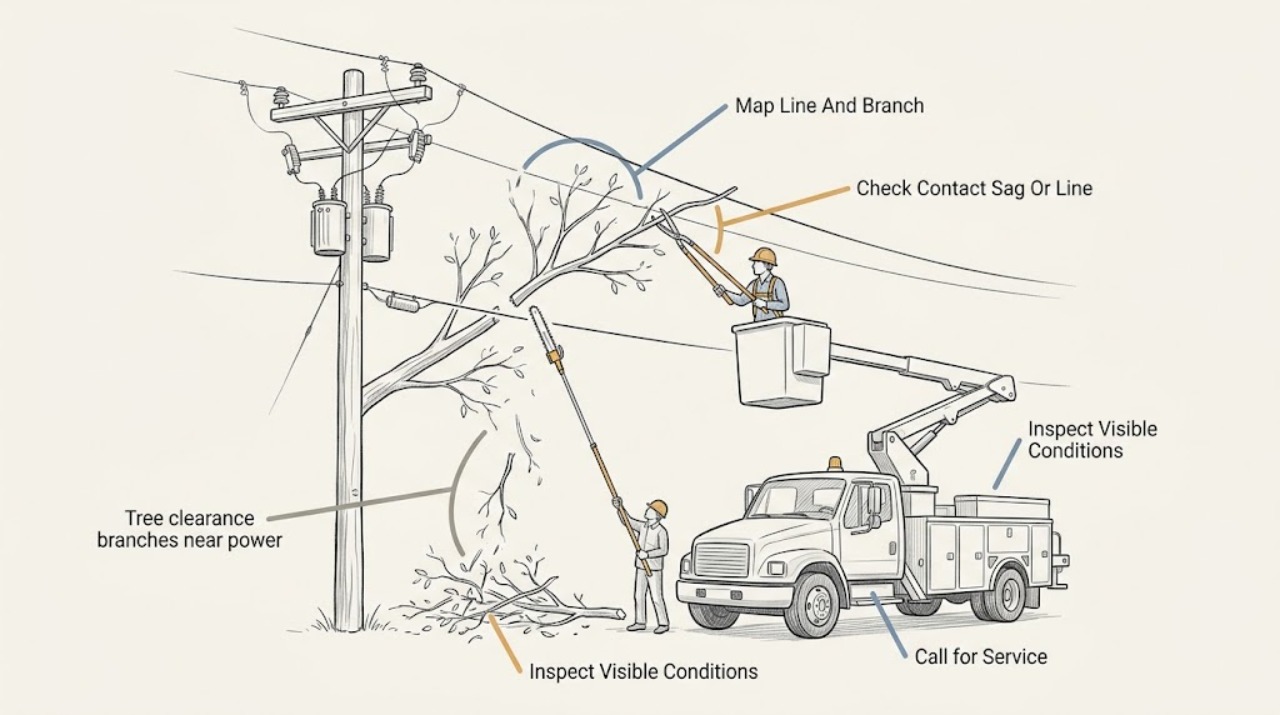
Work through in order
Diagnostic checks
Use only checks that match the exact appliance or system and its official guide.
-
Check 1
From a safe location well away from the tree and conductors, look only at the overall route of the power line and the branch canopy; do not walk closer, stand beneath the line, climb, use a ladder, or touch the tree or line.
Expected result: Record which side of the tree the line appears to pass, which branches are visually closest, and whether the concern is a branch near the line, apparent contact, or a line that has fallen.
Next step: Use the safe landmark and branch location in a utility report or professional service request. Keep everyone away from the tree, line, and any fallen material.
Stop if: Stop observing and move farther away if you would need to approach, cross under the line, reposition a ladder or vehicle, or touch vegetation or debris to see better.
Why this matters
Why: A branch that appears close enough to raise concern requires utility and qualified line-clearance review; apparent contact or a fallen conductor is an immediate hazard. A distant view cannot establish an electrical clearance or make trimming safe.
-
Check 2
From the same distant position, observe the conductor and surrounding branches without attempting to test, lift, push, pull, or separate anything.
Expected result: Note visible contact, a branch hanging on or across the line, unusual sag, a line on the ground, sparks, smoke, a flash, or a changed line position; do not assume silence means the line is safe.
Next step: Withdraw without approaching the hazard, keep people and pets away, and contact the electric utility or emergency services according to the immediate danger. Do not report from beside the line or enter a cordoned area.
Stop if: Stop immediately for sparks, smoke, fire, arcing, a downed or low conductor, a branch on the conductor, or any possibility that a person, vehicle, or animal is in contact.
Why this matters
Why: Contact, arcing, a downed line, or a sudden change indicates an electrical emergency rather than ordinary tree maintenance. OSHA states that conductors and objects contacting them must be treated as energized and that emergency tree work requires utility-owner coordination.
-
Check 3
From a sheltered, distant position, observe whether wind, ice, rain, or a recent storm is moving the canopy or changing the branch position; do not inspect during an active storm or approach a swaying tree.
Expected result: Record whether the branch is stable, rubbing, swinging toward the conductor, split, uprooted, hung up, or newly down after weather, and note the weather condition and time.
Next step: Keep the area isolated and provide the weather and movement history to the utility and qualified tree professional. Wait for their direction rather than returning to inspect during changing conditions.
Stop if: Stop and retreat if wind, lightning, ice, rain, branch movement, cracking sounds, or falling material makes the observation unsafe.
Why this matters
Why: Movement, storm damage, a split limb, or an uprooted tree can make the hazard dynamic and increase the chance of contact or falling material. OSHA advises against line-clearance work in adverse weather conditions that make the work hazardous.
-
Check 4
From outside the hazard area, look for fallen limbs, damaged supports, blocked access, standing water, fencing, or people and animals that could be exposed; do not move, cut, drag, or step over any tree material near the line.
Expected result: Note whether debris reaches a walkway or driveway, whether a line may be down among branches, whether the tree is leaning or uprooted, and whether the public can accidentally enter the area.
Next step: Use distance, barriers that can be placed without approaching the hazard, and clear communication to keep others away; report the exact access and exposure concern to the utility or emergency services.
Stop if: Stop if isolating the area would require approaching the line, crossing a fallen conductor, moving a branch, entering a wet area near the line, or directing someone into the hazard.
Why this matters
Why: Ground debris and a leaning or uprooted tree can hide an energized conductor or change the fall zone. The presence of people, vehicles, or animals makes isolation and utility coordination more urgent.
-
Check 5
From a safe location, assemble the information a utility or qualified line-clearance tree professional will need: nearest location, line route, tree and branch position, contact or movement, weather history, and visible damage. Do not provide a cutting plan or attempt a clearance measurement.
Expected result: Confirm whether the issue is routine proximity, apparent contact, storm damage, a downed line, or immediate fire/arcing risk, and record only observations you can make without approaching.
Next step: Request utility guidance and line-clearance service. Ask that the work be handled by personnel qualified for tree operations near energized conductors and follow their site-control instructions.
Stop if: Stop all further observation and escalate immediately if the status changes to contact, arcing, fire, a downed line, a suspended limb, or an unstable tree.
Why this matters
Why: A precise hazard description helps the utility determine line ownership, isolation, and coordination needs. It does not authorize a homeowner, general landscaper, or unqualified worker to work near the line.
Use your observations
Decision map
Find the observation that best matches what you see, then follow the next safe action.
-
PATH 01Next step
What you see
A branch appears merely near a line, with no contact, arcing, downed conductor, or active storm visible from a safe distance.
Do this next
Submit a routine utility tree-clearance request and arrange a qualified line-clearance tree professional. Do not trim, climb, measure from below, or use a ladder.
-
PATH 02Next step
What you see
A branch is touching, hanging on, or crossing a power line, or the line's position has changed.
Do this next
Treat it as energized, withdraw and isolate the area without approaching, and contact the utility. Use emergency services for immediate danger such as fire, arcing, injury, or a public exposure.
-
PATH 03Next step
What you see
A line is down, a branch is on the line, or a person, vehicle, or animal may be in contact.
Do this next
Do not touch the person, vehicle, animal, line, tree, or nearby puddle. Keep others away from a much greater distance and contact emergency services and the utility; wait for their instructions.
-
PATH 04Next step
What you see
Wind, lightning, ice, rain, cracking, swinging limbs, or an uprooted or split tree makes conditions dynamic.
Do this next
Do not inspect or schedule hands-on work during the hazardous condition. Retreat to shelter, report the changing risk, and wait for utility and qualified-professional coordination.
-
PATH 05Next step
What you see
The line appears clear but the tree, branch, or surrounding structure is damaged or the route cannot be confidently identified.
Do this next
Treat the uncertainty as a reason for a professional assessment. Provide photos only from a safe position and do not let a general tree service begin work until line-clearance responsibility is confirmed.
Helpful context
Understand the symptom
Why distance and authorization matter
A tree or branch can conduct electricity, and contact can be direct or indirect through tools, equipment, or other objects. OSHA treats line-clearance tree work near energized conductors as specialized work with qualification, approach-distance, equipment, and weather requirements. The homeowner's role here is to observe from well away from the hazard and provide an accurate handoff, not to calculate a working clearance or perform trimming.
Make the observation from a safe place
Stay on stable ground away from the tree, conductors, and any fallen limbs. Do not walk beneath the line to inspect it, touch the tree, move debris, use binoculars from an exposed position, or reposition a vehicle or ladder for a closer view. Treat every power line as energized, including a line that appears insulated, quiet, or disconnected.
Clearance work belongs in the service handoff
A useful request includes the nearest safe address or landmark, the line's apparent route, branch locations, contact or sag observations, weather conditions, and whether the tree is on private property or in a utility corridor. The utility can determine its line ownership and safe coordination; a qualified line-clearance tree professional can plan the tree work under the applicable utility procedure.
When checks do not resolve it
Need a professional?
Call the electric utility and a qualified line-clearance tree professional whenever branches are near a power line, especially when contact, storm damage, sag, movement, or uncertain line ownership is involved. Use emergency services for fire, arcing, injury, or an immediate public hazard.
Safety scope: Do not approach or touch a line or a branch contacting it; do not climb, use a ladder, cut, pull, rope, strike, or move branches; do not work during dangerous weather; and do not treat a general landscaper or homeowner as qualified for line-clearance work.
Have this ready
- Provide the nearest safe location or landmark, apparent line route, branch location, whether contact or sag is visible, weather and storm history, tree stability observations, access hazards, and photos taken without approaching or entering the hazard area.
Common questions
FAQ
Can I cut a branch that is close to a power line if it is on my property?
No. Property ownership does not make line-clearance work safe or authorize unqualified trimming. Stay back and contact the utility and a qualified line-clearance tree professional.
What should I do if a branch is touching a power line?
Treat the line and branch as energized. Do not touch, pull, cut, or approach them. Move people and pets away without entering the hazard area and contact the utility; use emergency services for fire, arcing, injury, or immediate public danger.
Is a quiet or insulated-looking line safe to approach?
No. A visual appearance or lack of sound does not establish that a line is de-energized. Keep your distance and let the utility determine its status.
What information helps a tree-clearance service request?
Provide a safe landmark, the apparent line route, branch location, contact or sag observations, storm and weather history, tree movement or damage, and access hazards. Take photos only from a safe position and do not enter the line area.
Read the exact guide
Official sources
- 1910.268 TelecommunicationsOccupational Safety and Health Administration, U.S. Department of Labor · OSHA regulation text for covered work; used here for the safety principle that conductors and contacting branches or objects must be treated as energized and that utility coordination is required.
- Line-Clearance Tree Trimming OperationsOccupational Safety and Health Administration, U.S. Department of Labor · OSHA eTool for line-clearance tree trimming; this article uses it to establish the professional-service boundary, not as a homeowner work manual.
- OSHA Tree Trimming SafetyOccupational Safety and Health Administration, U.S. Department of Labor · OSHA quick card; the public-facing guidance here limits the reader to distant observation and service escalation rather than cutting or removal instructions.
Community feedback
Share a repair observation
Share a plain-text repair observation. Accepted observations are published automatically; this page may take a moment to update.