
On this page
Start here
Quick answer
Treat every overhead power line as energized and keep people, branches, tools, ladders and equipment away. OSHA describes line-clearance tree work as work near energized lines and says unqualified workers must maintain at least 10 feet of approach distance for lines covered by that guidance; higher-voltage lines require greater, voltage-specific distances. A branch does not need to be touching a wire to be dangerous because wind can move limbs and lines can sag. Do not prune, climb, throw a rope, use a pole saw, place a ladder, operate a chipper or fell a tree toward the line. From the ground, document the line, tree, weather and contact risk, then contact the utility and arrange a trained line-clearance tree professional. If a branch or tree is touching a line, a line is down, or there are sparks, fire or a power outage, clear the area and follow utility or emergency instructions without touching the tree, line or anything in contact with it.
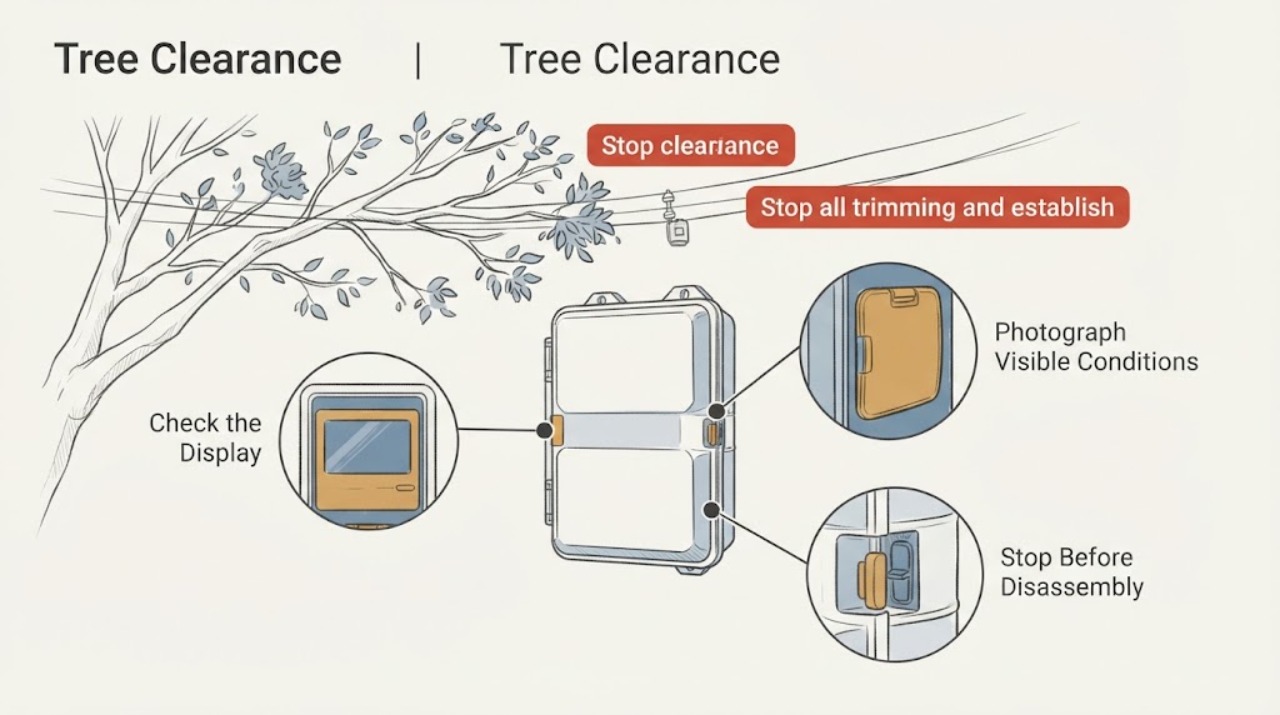
Work through in order
Diagnostic checks
Use only checks that match the exact appliance or system and its official guide.
-
Check 1
Stop all trimming and establish a no-entry area from a safe ground position. Assume every overhead line is energized; do not touch the line, branch, trunk, fence, vehicle, tool or other object that may be in contact with it, and keep people and pets away.
Expected result: The branch is merely close to the line, is moving toward it in wind, is touching it, or the line is down or visibly damaged.
Next step: For close branches, continue only with ground-level documentation and contact the utility and a trained line-clearance tree professional. For contact or a downed line, clear the area and follow utility or emergency instructions from a safe location.
Stop if: Stop immediately for any contact, arcing, smoke, fire, fallen line, damaged pole, electrical noise, storm activity or a person or animal in the hazard area.
Why this matters
Why: Proximity is enough to require a line-clearance decision; actual contact or a downed line is an immediate electrical hazard. The tree, branch and surrounding objects may become energized even when no spark is visible.
-
Check 2
From the ground, photograph the tree and line without zooming into a position that requires approaching the hazard. Record whether the line is on neighborhood poles or high towers, the branch location, apparent movement, tree lean, broken limbs, nearby structures and whether wind, ice, lightning or other severe weather is present.
Expected result: The line is a local distribution line, a larger transmission line, or its type is uncertain; the tree is stable, leaning or storm-damaged; and weather is calm or adverse.
Next step: Send the ground-level record to the utility and qualified tree professional. Do not use the photograph to estimate a safe working distance or decide that a pole saw or ladder can reach the branch.
Stop if: Stop any observation that requires climbing, walking beneath a suspended limb, entering a storm-damaged area, or moving a vehicle or equipment close to the line.
Why this matters
Why: Line type and conditions affect who coordinates vegetation work and what clearance rules apply. Leaning trees, broken limbs and adverse weather increase the chance that a cut or gust will move material into the line; a calm view does not eliminate movement or sag risk.
-
Check 3
Measure or estimate only from a safe location how far the closest branch, trunk, tool path and possible fall path are from the line, without using a pole, tape, ladder or thrown object. Treat the closest point and the branch's movement in wind as the controlling concern, not the distance from the worker's feet alone.
Expected result: Any branch, trunk, tool path or fall path is within the public's safe exclusion area, the distance is uncertain, or the tree could swing or fall toward the line.
Next step: Do not trim or fell the tree. Ask the utility which coordination or de-energization process applies and hire a trained line-clearance tree crew that can determine voltage, approach distance, equipment and fall control.
Stop if: Stop if you would need to approach within 10 feet, use a ladder or aerial device, handle a branch near a conductor, or make a cut that could change the branch or tree's direction.
Why this matters
Why: The hazard is determined by the tree and anything being used or removed, not just where a person stands. Uncertainty and possible movement make the work a line-clearance job; a visual gap on one side does not establish a safe route.
-
Check 4
Check from a safe position whether the utility has marked or scheduled vegetation work, whether a right-of-way or easement is visible in property documents, and whether the affected line serves the home or is a larger transmission route. Do not assume an easement, utility visit or prior trim authorizes private cutting.
Expected result: The utility has an active vegetation plan or contact, the property documents mention a right-of-way, or responsibility and line ownership remain unclear.
Next step: Contact the utility that owns or operates the line and ask for the safe coordination path. Give the utility and tree professional the photos, location, property information and any deadline, outage or storm details.
Stop if: Stop if anyone asks an untrained person to clear the line, if ownership cannot be confirmed, or if work would occur during high wind, thunder, lightning, ice or other adverse weather.
Why this matters
Why: Utilities primarily decide how vegetation is managed around their lines, subject to applicable local rules and agreements. A property owner's obligation or a utility's right to trim does not remove the electrical and tree-work hazards.
-
Check 5
Prepare a line-clearance service handoff with the exact location, photos from a safe distance, line type if known, tree species or size if safely observable, branch or trunk contact status, weather, outage or sparks, access constraints and the intended result. Keep the area isolated until the utility and trained tree professional confirm a safe plan.
Expected result: The branch is clear but encroaching, touching the line, storm-damaged or under tension, or the whole tree could fall into the line.
Next step: Wait for the utility and qualified line-clearance tree professional to establish the work method and clearance. Do not resume cutting because the line appears quiet or power is temporarily out.
Stop if: Stop all work and keep clear for contact, a downed line, smoke, fire, a damaged pole, a suspended limb, storm movement or any request for untrained assistance inside the clearance zone.
Why this matters
Why: The professional plan may involve utility coordination, de-energization, specialized insulated equipment, fall protection, a second worker or a different removal method. These decisions depend on line voltage, tree condition and site hazards and cannot be replaced by homeowner tools.
Use your observations
Decision map
Find the observation that best matches what you see, then follow the next safe action.
-
PATH 01Next step
What you see
Branches are near but not touching a neighborhood line, and the distance, tree stability or movement in wind is uncertain.
Do this next
Do not trim, climb or use a pole tool. Document from the ground, contact the local utility and arrange a trained line-clearance tree professional; the utility or local authority determines the coordination path.
-
PATH 02Next step
What you see
A branch, trunk or fallen tree is touching a line, or the line is down, arcing, smoking or associated with a damaged pole.
Do this next
Clear everyone from the area and follow utility or emergency instructions from a safe location. Do not touch the tree, line, fence, vehicle, tool or water that may be energized, and do not attempt to free or cut the branch.
-
PATH 03Next step
What you see
The tree is leaning, split, storm-damaged or under limb tension, or severe weather is present even though no contact is visible.
Do this next
Keep out of the fall and drop zone and postpone any tree work. Have the utility and trained tree professional assess line clearance, fall direction, weather and any required isolation or specialized equipment.
-
PATH 04Next step
What you see
The line is a larger transmission route, responsibility is unclear, or a right-of-way or utility work notice is involved.
Do this next
Contact the line owner or utility and check applicable local agreements before arranging work. Do not interpret a right-of-way as permission for an untrained person or ordinary tree contractor to work near energized conductors.
Helpful context
Understand the symptom
This is not ordinary branch trimming. A line that looks clear on a calm day can move in wind, and conductors can sag as conditions change. OSHA's quick card says to assume all power lines are energized and to use trained, experienced line-clearance tree trimmers for work within 10 feet; the exact minimum approach distance can be greater depending on line voltage and the work. Keep the homeowner decision at the level of recognizing risk and calling the right utility or tree professional.
Responsibility and clearance rules depend on the line and location. Lines on neighborhood poles are generally distribution facilities, while high towers are generally transmission facilities; the utility and applicable state or local authority determine vegetation-management arrangements. A right-of-way or easement may also affect who coordinates the work, but it never makes an untrained person safe to work on a tree near a line.
A tree can remain dangerous after a storm even when the line is not visibly broken. Broken limbs under tension, wet bark, unstable roots and hidden contact can change the hazard as soon as a branch is cut or moved. Do not try to free a branch, pull it away with a rope or use a ladder while waiting for utility instructions.
Safety boundary
Stop conditions
- Stop immediately for any branch or tree contact with a line, a downed line, arcing, sparks, smoke, fire, damaged utility equipment, storm movement or an injured person.
- Do not approach within 10 feet of an energized line as an unqualified person; greater voltage-specific distances may apply, and the line should not be assumed de-energized because it is quiet or the neighborhood has lost power.
- Do not use a ladder, pole saw, rope, chain, chipper, bucket or other equipment to reach, pull or control a branch near the line, and do not enter a fall zone or move a vehicle beneath the hazard.
When checks do not resolve it
Need a professional?
Contact the electric utility before arranging any branch trimming, tree removal or equipment access near an overhead power line; the utility can explain ownership, right-of-way and any de-energization or coordination process., Use a trained, experienced line-clearance tree professional for work near energized lines. Ordinary pruning experience, insulated-looking tools or a clear day do not substitute for line-clearance training and approach-distance control., Clear the area and follow emergency or utility instructions immediately for a touching or fallen line, sparks, smoke, fire, damaged pole, outage with tree contact or anyone who may be in contact with the tree or line., Do not trim, climb, rope, fell, chip, use a ladder or operate an aerial device near the line as a homeowner, and do not work during lightning, high wind, ice or other hazardous weather.
Common questions
FAQ
How close is too close for tree branches near a power line?
For an unqualified person, OSHA's line-clearance guidance uses at least 10 feet for lines covered by that rule, with greater distances for higher voltages. The distance applies to people, branches, tools, ladders and equipment, and a trained line-clearance professional must determine the applicable approach distance. Do not measure with a pole or tape near the line.
Can I trim a branch that is close to but not touching the power line?
No. Wind can move the branch and the conductor, and the fall or tool path can enter the hazard even if the current gap looks clear. Contact the utility and use a trained line-clearance tree professional rather than a ladder, pole saw or rope.
What should I do if a tree branch is touching a power line?
Keep everyone away and treat the tree, line and anything touching them as energized. Do not touch, cut, pull, climb or drive beneath the hazard. Follow utility or emergency instructions from a safe location, especially if there are sparks, smoke, fire, a fallen line or a damaged pole.
Does a utility right-of-way mean I can cut the tree myself?
No. A right-of-way describes rights and responsibilities, not homeowner electrical training. FERC notes that utilities and local authorities determine vegetation-management arrangements, while OSHA requires specialized line-clearance practices near energized conductors. Ask the line owner how work must be coordinated.
Can tree clearance near power lines be done after a storm?
Only trained line-clearance personnel working under the applicable utility and safety procedures should assess it. High wind, lightning, ice, unstable trees and limbs under tension make the work more hazardous. Wait, isolate the area and follow utility instructions instead of starting cleanup yourself.
Read the exact guide
Official sources
- OSHA TREE TRIMMING SAFETYOccupational Safety and Health Administration · OSHA tree-trimming safety quick card on energized-line assumptions, 10-foot line-clearance boundary, trained trimmers, weather, equipment and storm hazards
- eTool: Electric Power Generation, Transmission, and Distribution - Overhead Line Work - Line-Clearance Tree Trimming OperationsOccupational Safety and Health Administration · OSHA line-clearance tree-trimming requirements, qualification levels, minimum approach distances, insulated equipment and adverse-weather restrictions
- Tree Trimming and Vegetation Management Landowners FAQFederal Energy Regulatory Commission · FERC landowner guidance on utility vegetation management, transmission versus distribution lines, right-of-way, wind movement, conductor sag and utility coordination
Community feedback
Share a repair observation
Share a plain-text repair observation. Accepted observations are published automatically; this page may take a moment to update.