
On this page
Start here
Quick answer
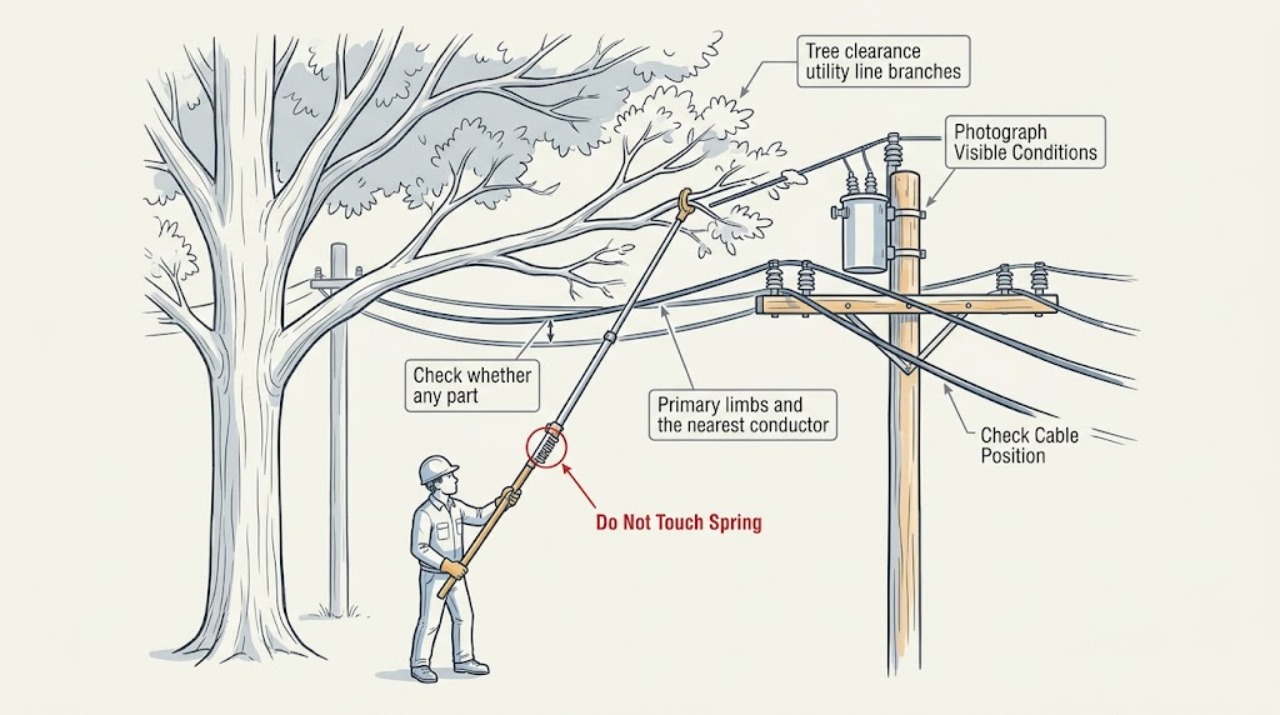
Treat every overhead power line as energized and keep people, ladders, tools, vehicles, and branches away. Do not trim, climb, tie back, cut, or pull a branch near a line, and do not assume a line is safe because it looks like a communications cable or because power is out. From the ground, document the line and tree condition only; contact the utility for its clearance procedure and hire a qualified line-clearance tree professional. If a tree or branch is touching a line, downed, sparking, or blocking a road, keep clear and report it urgently.
Before you begin
Safety first
- Do not climb, trim, cut, tie, pull, measure by reach, use ladders/poles/ropes, touch a line or tree, move fallen limbs, or assume a line is safe because power appears off or it resembles communications cable.
Work through in order
Diagnostic checks
Use only checks that match the exact appliance or system and its official guide.
-
Check 1
From the ground and well away from the tree, photograph the whole tree, line route, poles, and the nearest branch without using a ladder, pole, drone, or measuring tool.
Expected result: Record whether branches are merely near the line, visibly touching, hanging, broken, moving in wind, or down on the ground; note sparks, smoke, sag, or a damaged pole.
Next step: Keep everyone out, provide the utility with the location and photos from safety, and wait for instructions; otherwise request a qualified line-clearance assessment.
Stop if: Stop and retreat for any contact, spark, smoke, buzzing, downed/sagging line, fire, or unstable tree.
Why this matters
Why: Contact, damage, or movement changes this from a routine service request to an electrical emergency; apparent distance alone cannot establish a safe work zone.
-
Check 2
Check whether any part of the tree, branch, tool, ladder, vehicle, or person would need to enter the line area to inspect or trim; do not test the gap physically.
Expected result: Answer yes if access or work would bring anything near the conductor; answer no only if the observation remains entirely ground-based and distant.
Next step: For yes, stop and contact the utility and qualified line-clearance tree service; for no, continue recording the condition without approaching.
Stop if: Stop whenever wind, rain, ice, darkness, unstable footing, or changing branch movement makes the scene harder to judge.
Why this matters
Why: A yes places the job within electrical line-clearance hazards and requires utility coordination and trained workers; a no supports documentation only, not DIY pruning.
-
Check 3
Identify the line route and surrounding property conditions visually, without touching poles, guy wires, fences, equipment, or vegetation.
Expected result: Note whether the line appears to serve the property, crosses a public route, runs to a neighboring property, or is accompanied by a communications-looking cable; record nearby buildings, driveways, and access constraints.
Next step: Give the utility and tree professional the route, address, access limits, and ownership uncertainty; do not contact or move infrastructure yourself.
Stop if: Stop if determining the route would require entering a fenced electrical area, crossing a drop zone, or approaching the conductor.
Why this matters
Why: The responsible utility or owner may differ, and a line that looks non-electrical cannot be declared safe by appearance. Access and drop zones affect the qualified crew's plan.
-
Check 4
Review the weather and tree timeline from a safe location, including recent wind, ice, lightning, storm damage, construction, or new branch growth.
Expected result: Record whether the condition is stable, worsening, hanging, split, uprooted, or newly contacting the line, and whether people or traffic must pass below it.
Next step: For an unstable or worsening condition, keep the area clear and report it urgently; for a stable condition, arrange a planned line-clearance assessment.
Stop if: Stop observation for high wind, lightning, ice, falling debris, or any movement toward the line or public route.
Why this matters
Why: Adverse weather and storm-loaded or broken trees increase falling and electrical hazards; urgent utility coordination may be needed before any scheduled trimming.
-
Check 5
Prepare a service handoff with the address, safe photos, line and tree location, contact/damage status, weather timeline, access restrictions, and any utility report number; do not plan cuts or a felling direction yourself.
Expected result: Note whether the request concerns pruning, a dead or hazardous tree, storm response, or a branch already on a line, and whether the property owner or utility has given instructions.
Next step: Ask for a written work plan covering utility coordination, de-energizing or protection, approach distances, drop-zone control, weather limits, and cleanup.
Stop if: Stop all DIY work if the proposed remedy involves climbing, chainsaw use, a bucket/lift, rope work, electrical-line contact, or moving a fallen tree.
Why this matters
Why: The scope determines whether utility crews, line-clearance arborists, emergency responders, or a property tree professional must coordinate; ordinary tree-removal equipment is not a substitute for line-clearance qualification.
Use your observations
Decision map
Find the observation that best matches what you see, then follow the next safe action.
-
PATH 01Next step
What you see
A branch or tree is touching a power line, the line is down/sagging, or there are sparks, smoke, fire, or buzzing.
Do this next
Retreat, keep people and vehicles away, and contact the utility or emergency services from a safe location. Do not touch the tree, line, fence, vehicle, or puddle.
-
PATH 02Next step
What you see
Branches are near but not visibly touching an apparently energized line.
Do this next
Do not trim or estimate a safe clearance. Contact the utility and a qualified line-clearance tree professional for a coordinated assessment.
-
PATH 03Next step
What you see
The line may be a communications line or its owner is uncertain.
Do this next
Treat it as energized until the responsible utility confirms otherwise. Keep tools and people away and request utility identification and clearance guidance.
-
PATH 04Next step
What you see
Storm, ice, high wind, lightning, split trunk, uprooting, or a hanging limb is present.
Do this next
Keep the area clear and report the hazard urgently. Wait for qualified utility/line-clearance personnel; do not cut or pull the limb.
-
PATH 05Next step
What you see
Work would require a ladder, tree climbing, pole saw, chainsaw, rope, aerial lift, or entry into the line area.
Do this next
Stop homeowner work. Require a trained line-clearance tree crew and utility coordination, including hazard assessment, approach distances, and any authorized de-energizing.
-
PATH 06Next step
What you see
The condition is stable and no contact or storm damage is visible.
Do this next
Submit safe photos and location details for a planned professional clearance assessment; do not schedule ordinary pruning that ignores the line hazard.
Helpful context
Understand the symptom
This is a utility-clearance job
Branches near a power line are not an ordinary pruning project. OSHA defines line-clearance tree trimming as work near energized lines and requires specialized training, hazard assessment, approach distances, and equipment controls. A homeowner cannot determine safety from a photograph or by estimating a gap. The utility and a qualified line-clearance tree professional must coordinate the work, ownership, access, and any de-energizing or protection.
Observation-only scope
Stay on the ground or inside a building at a safe distance. Use a zoomed camera and note the line route, branch movement, storm damage, and whether anything is touching. Do not measure by reaching, throw a rope, use a pole or ladder, climb the tree, cut with a saw, move a fallen branch, or approach a downed line. Keep children, pets, and vehicles away from the drop zone.
Stop and report immediately
If a branch or tree contacts a line, the line is down or sagging, there are sparks, smoke, buzzing, fire, a damaged pole, or a line crosses a road or access path, leave the area and call the utility or emergency services from a safe location. Do not touch the tree, fence, vehicle, puddle, or other object that could be energized. OSHA warns that a limb or branch contacting an energized line can electrocute a worker.
When checks do not resolve it
Need a professional?
Contact the utility urgently for any branch or tree touching a line, downed or sagging conductor, sparks, smoke, fire, damaged pole, or obstruction of a public route. For branches merely near a line, arrange a qualified line-clearance tree professional before any trimming or removal.
Safety scope: Do not climb, trim, cut, tie, pull, measure by reach, use ladders/poles/ropes, touch a line or tree, move fallen limbs, or assume a line is safe because power appears off or it resembles communications cable.
Have this ready
- Provide the address, safe ground-level photos, line route and nearest branch, whether contact or sag is visible, storm/weather timeline, public-access or drop-zone concerns, property/utility ownership uncertainty, and any report number.
Common questions
FAQ
Can I trim a branch that is close to a power line?
No. Do not estimate the gap or use a pole saw, ladder, rope, or chainsaw. Contact the utility and a qualified line-clearance tree professional to coordinate the work.
Is a line safe if the neighborhood power is out?
Assume it is energized. A line can be re-energized or have other sources, and appearance cannot establish its status. Keep clear and contact the utility.
What if the branch is already touching the line?
Retreat and keep everyone away from the tree, line, fences, vehicles, and puddles. Report it urgently to the utility or emergency services from a safe location; do not touch or move it.
What if it looks like a telephone or communications cable?
Do not rely on appearance. Treat an unidentified overhead cable as energized until the responsible utility confirms the route and safe procedure.
Can a regular tree-removal crew handle branches near wires?
Ask specifically for line-clearance tree qualifications and utility coordination. Ordinary pruning tools or climbing experience do not replace the electrical hazard assessment, approach-distance controls, and trained equipment required for the job.
Read the exact guide
Official sources
- OSHA TREE TRIMMING SAFETYOccupational Safety and Health Administration · General U.S. safety quick card; qualified utility and tree professionals must apply site-specific procedures.
- Inspection Guidance for Tree Care and Tree Removal OperationsOccupational Safety and Health Administration · U.S. occupational safety guidance; it supports the homeowner safety boundary and is not a pruning specification.
- Line-Clearance Tree Trimming OperationsOccupational Safety and Health Administration · U.S. occupational safety guidance; local utility procedures and jurisdictional requirements also apply.
Community feedback
Share a repair observation
Share a plain-text repair observation. Accepted observations are published automatically; this page may take a moment to update.