
On this page
Start here
Quick answer
Treat any tree branch that touches, hangs over, or may fall onto a power line as an electrical and falling-object hazard, not a routine pruning job. From a safe ground position, document the branch and line without touching, climbing, using a ladder, or trying to measure the clearance. Keep people and pets away, contact the electric utility first, and use a trained line-clearance tree professional for work near energized lines. Call emergency services for a downed line, arcing, smoke, fire, or an immediate danger to people or traffic.
Before you begin
Safety first
- Limit homeowner activity to safe ground-level observation and reporting. Do not touch or measure the line, climb the tree, use a ladder, pole, saw, rope, drone, or aerial equipment near it, or assume that a line is de-energized or insulated.
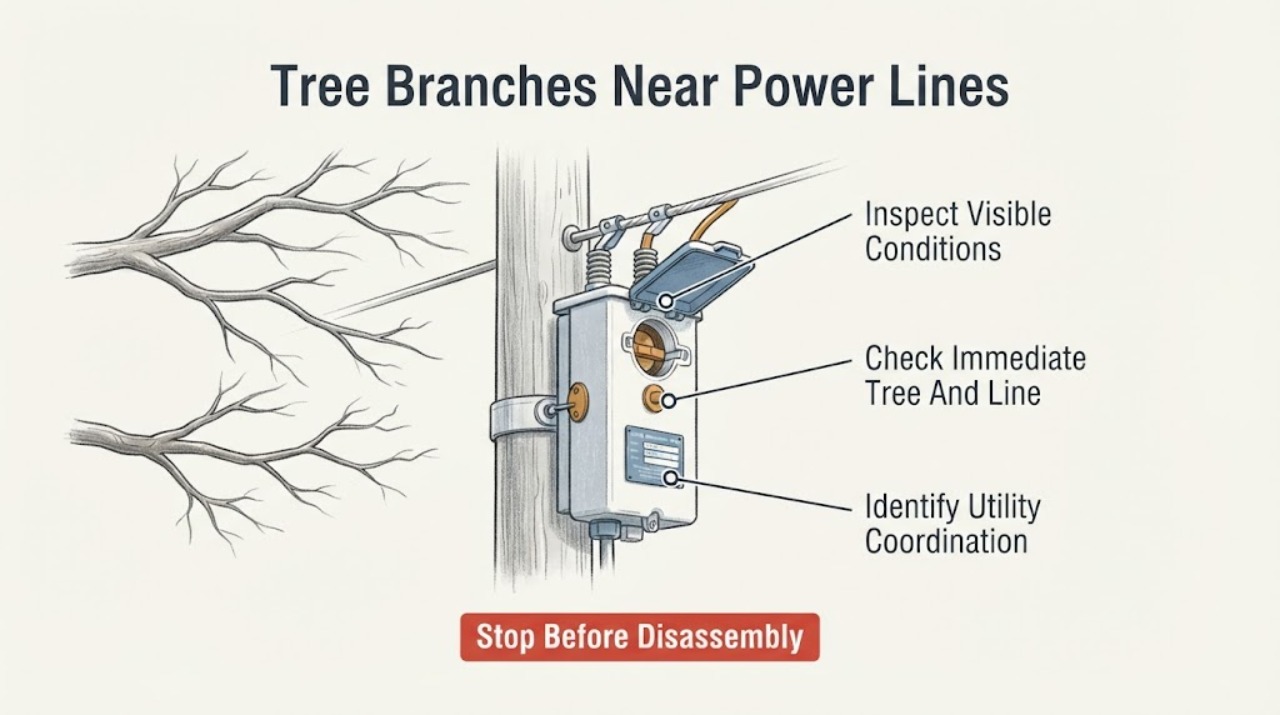
Work through in order
Diagnostic checks
Use only checks that match the exact appliance or system and its official guide.
-
Check 1
From a stable position on the ground and well away from the line, photograph the tree and power line together, then use the camera view to record whether a branch is touching the line, hanging above it, growing toward it, or separated from it. Do not use a ladder, pole, tape measure, drone, or any object to approach the line or branch.
Expected result: The branch is visibly contacting or overhanging the line, appears close enough that the distance is uncertain, or is clearly away from the line from the safe viewpoint.
Next step: Keep everyone clear and contact the electric utility before arranging any trimming. Do not try to improve the clearance yourself.
Why this matters
Why: Contact or uncertain clearance must be treated as an energized-line hazard. A visibly separated branch still needs a qualified decision if pruning would bring a person, tool, or falling limb toward the line.
-
Check 2
From the same safe location, look for a downed or sagging line, arcing or sparking, smoke, fire, a broken limb resting on the line, a hanging branch, a split trunk, a leaning tree, or a blocked driveway or roadway. Do not touch the tree, branch, line, fence, vehicle, or puddle near the suspected electrical hazard.
Expected result: No immediate hazard is visible, or there is contact, arcing, smoke, fire, a downed line, a broken limb under load, or an unstable tree.
Next step: Move people and pets away without crossing the suspected hazard area. Call 911 for immediate danger to life, fire, or blocked public access, and call the utility for the electrical hazard; do not resume inspection from closer range.
Why this matters
Why: A downed or visibly energized line and a limb under tension can change the situation from planned vegetation management to an emergency scene. An apparently quiet line must still be treated as energized.
-
Check 3
From a safe distance, record the line's route, nearby poles or towers, transformer or service equipment, and whether the branch is on private property or near a public road. Use the utility name on a bill or the local utility's published emergency channel rather than guessing who owns the line.
Expected result: The local electric utility and line route are identifiable, or the line type and responsible owner are uncertain.
Next step: Report the location and photos to the utility and ask what clearance or contractor-coordination process applies. Do not hire a general tree cutter to work in the line hazard before that coordination is complete.
Why this matters
Why: Neighborhood distribution lines and larger transmission lines can fall under different rules and ownership arrangements. The utility is the first contact for confirming the line, any right-of-way, and whether it will coordinate de-energizing or line-clearance work.
-
Check 4
Prepare a ground-level service record with the branch location, tree condition, recent storm or wind, line contact or near-contact, access limits, nearby people or vehicles, and the date and weather. Note whether the work would require climbing, a ladder, an aerial lift, traffic control, or a drop zone, without entering those areas.
Expected result: The scene is calm and accessible for a utility and qualified arborist to plan, or wind, lightning, ice, storm damage, falling limbs, or limited access makes the area unsafe.
Next step: Send the record to the utility and a qualified line-clearance tree professional, and wait for their site plan. Keep the area closed until hazards are controlled.
Why this matters
Why: Weather, falling-object exposure, access, and the tree's stability affect the work plan. OSHA guidance requires hazard assessment and trained line-clearance workers for work near power lines; unsafe weather or unstable trees increase urgency.
Use your observations
Decision map
Find the observation that best matches what you see, then follow the next safe action.
-
PATH 01Next step
What you see
A branch touches the line, hangs over it, or the safe viewpoint cannot establish a clear separation.
Do this next
Treat the line as energized and stop all pruning, climbing, and approach while the utility evaluates the hazard.
Why this path and its safety boundary
Why it matters: Wind, line movement, voltage, and the branch's fall path can make an apparently small gap unsafe; a homeowner cannot establish working clearance by visual guesswork.
-
PATH 02Next step
What you see
The line is down, arcing, smoking, burning, or in contact with a broken limb or tree, or the area threatens people, vehicles, or a roadway.
Do this next
Leave the area by the route you used to approach, keep others away, and request emergency and utility response.
Why this path and its safety boundary
Why it matters: The line may energize nearby objects or the tree may move suddenly; further inspection or tree work can create fatal electrical or falling-object exposure.
-
PATH 03Next step
What you see
The tree is near the line but there is no visible contact or immediate emergency, and the utility can identify the line and coordinate the work.
Do this next
Use the utility's vegetation-management process and a qualified line-clearance tree professional rather than a general homeowner pruning plan.
Why this path and its safety boundary
Why it matters: Clearance must account for voltage, line sag and sway, tree movement, falling limbs, and future growth; the safe method may include utility de-energizing or other controls.
-
PATH 04Next step
What you see
A storm has left a split, leaning, hanging, or tension-loaded tree or limb near the line, or wind, lightning, ice, or poor access is ongoing.
Do this next
Postpone approach and keep the drop zone and line area clear until emergency responders, the utility, and qualified tree personnel assess it.
Why this path and its safety boundary
Why it matters: A damaged tree can fail unpredictably, and adverse weather increases movement of both branches and conductors.
Helpful context
Understand the symptom
A branch can move in wind, the line can sag with heat and load, and a falling limb can make contact even when the scene looks clear on a calm day. Do not assume a line is insulated, de-energized, or a communications cable from appearance.
Your useful homeowner contribution is a safe report: show where the branch is relative to the line, whether it is broken or under tension, whether the tree is leaning, and whether the area is accessible to people or vehicles. The utility and qualified tree professional decide the clearance method and work controls.
OSHA describes line-clearance tree trimming as work near energized lines and uses a 10-foot threshold in its general safety guidance; greater distances can apply to higher-voltage lines. Treat that as a professional safety boundary, not permission to approach a line to measure it.
When checks do not resolve it
Need a professional?
Contact the electric utility before any trimming when branches are near a power line. Use a trained line-clearance tree professional for work within the utility's clearance zone or whenever climbing, cutting, rigging, traffic control, or an aerial lift would be needed.
Safety scope: Limit homeowner activity to safe ground-level observation and reporting. Do not touch or measure the line, climb the tree, use a ladder, pole, saw, rope, drone, or aerial equipment near it, or assume that a line is de-energized or insulated.
Have this ready
- Provide the utility and professional with the address or safe location description, ground-level photos, line route and pole or tower context, branch contact or clearance observation, tree lean or breakage, recent weather, access limits, blocked roads, and any visible emergency condition.
Common questions
FAQ
Can I trim a branch that is close to a power line if it is on my property?
Do not trim it yourself. Contact the electric utility first; work near energized lines requires utility coordination and trained line-clearance tree professionals, regardless of who owns the land.
How much clearance should a tree have from a power line?
The required clearance depends on voltage, line type, movement, weather, growth, and local rules. OSHA's general guidance uses at least 10 feet for unqualified workers around many overhead lines, with greater distances for higher voltages. Do not approach to measure it; ask the utility to determine the applicable clearance.
What should I do if a branch is touching a power line?
Stay away and keep people and pets away. Do not touch the branch, tree, line, fence, vehicle, or nearby water. Contact the utility, and call 911 for fire, arcing, a downed line, or immediate danger to life or traffic.
Can a general tree service remove branches near power lines?
Use a qualified line-clearance tree professional coordinated with the electric utility. A general crew may not have the training, equipment, or work controls required for energized-line clearance.
Read the exact guide
Official sources
- eTool: Electric Power Generation, Transmission, and Distribution - Line-Clearance Tree Trimming OperationsOccupational Safety and Health Administration · Tree pruning, trimming, removal, and brush clearing near energized overhead power lines; local utility and jurisdiction requirements also apply
- Tree Care Work: Falls and Falling Object HazardsOccupational Safety and Health Administration · Tree care operations involving climbing, ladders, aerial lifts, rigging, drop zones, and nearby electrical lines
- Tree Trimming and Vegetation Management Landowners FAQFederal Energy Regulatory Commission · Landowners asking about trees near electric transmission or distribution facilities; state and local rules govern many residential distribution lines
- OSHA TREE TRIMMING SAFETYOccupational Safety and Health Administration · General tree trimming and removal safety, including work near power lines and storm-damaged trees
- Tree Trimming and Vegetation Management InformationCalifornia Public Utilities Commission · California-specific utility and vegetation guidance; homeowners elsewhere should follow their local utility and jurisdiction rules
Community feedback
Share a repair observation
Share a plain-text repair observation. Accepted observations are published automatically; this page may take a moment to update.