
On this page
Start here
Quick answer
Treat every overhead conductor as energized and keep people, tools, vehicles, and fallen limbs away. From a safe ground position, document which crown branches are close to or touching a line, whether a line is down, and whether weather or movement is changing the hazard. Do not climb, cut, pull, or try to create clearance yourself. Arrange an urgent assessment by the electric utility and a qualified line-clearance tree professional; a downed, arcing, or contacted line is an emergency.
Before you begin
Safety first
- Do not climb, cut, pull, touch the tree or conductor, move a fallen limb, or enter the suspected energized area. The utility and qualified line-clearance tree professionals decide isolation, approach distances, equipment, and work sequence.
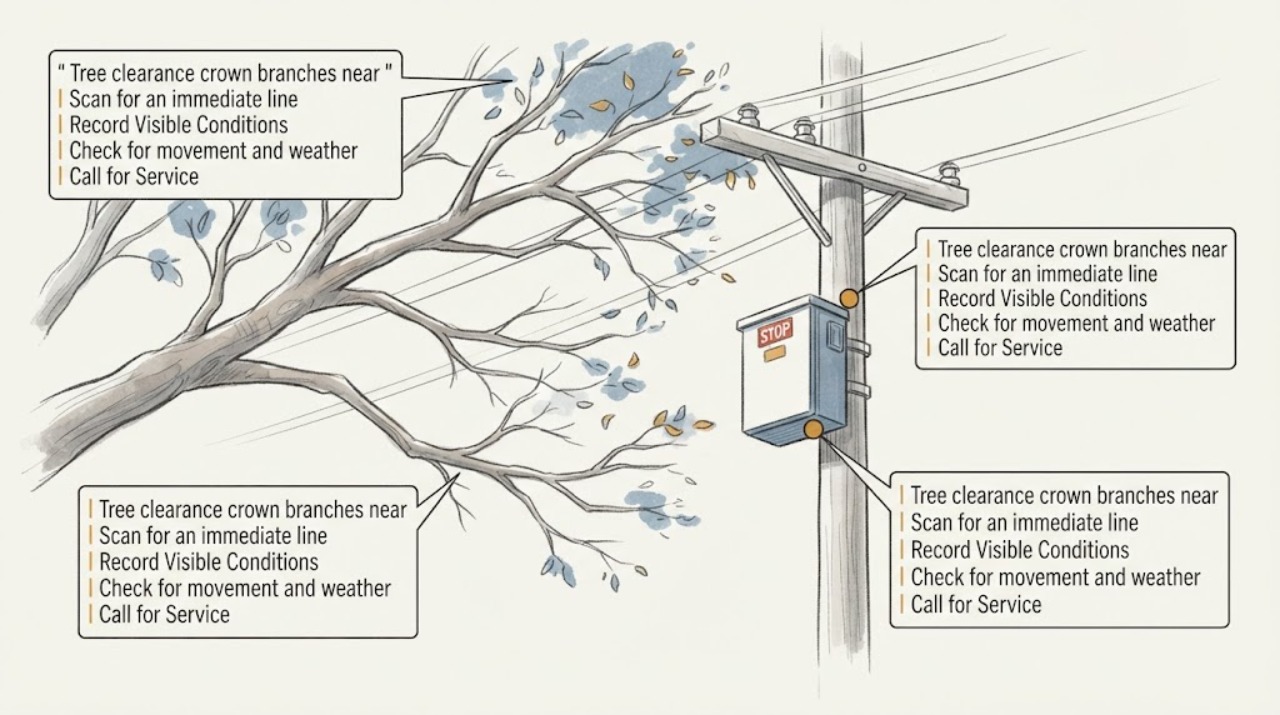
Work through in order
Diagnostic checks
Use only checks that match the exact appliance or system and its official guide.
-
Scan for an immediate line hazard from the ground
From a safe location, look without stepping toward the tree for a downed conductor, arcing, smoke, sparks, a line touching the crown, or a limb resting on a line. Keep people and pets away and do not touch the tree, fence, vehicle, or any object that may be energized.
Expected result: The line is down, sparking, smoking, visibly contacting the tree, or the hazard cannot be separated from a safe viewing position.
Next step: Move farther away without touching the hazard, warn others away, and contact the electric utility or emergency responders. Do not enter the area to retrieve property or inspect the limb.
Stop if: Stop all inspection immediately if there is contact, arcing, smoke, a downed line, or any doubt that the area is safe.
Why this matters
Why: The scene may be energized and can change without warning; the tree, nearby objects, or ground may also carry current.
-
Record which part of the crown is involved
From the same safe position, note whether the concern is an outer tip, a high leader, a side branch, a dead or split limb, or a broad section of crown that sways toward the conductor. Use a camera only from where you can stand safely; do not move beneath the crown.
Expected result: A specific branch or crown section is consistently near the line, moves toward it, is split or hanging, or cannot be distinguished because of foliage or the viewing angle.
Next step: Send the observation and photos to the utility and qualified line-clearance tree professional so they can coordinate the order of utility isolation and tree work.
Stop if: Stop observing and retreat if wind increases, the crown shifts, a limb starts to fall, or the line relationship becomes less clear.
Why this matters
Why: A moving, damaged, or poorly visible crown needs a site-specific hazard assessment; a still photograph cannot establish a safe working distance or predict fall direction.
-
Check for movement and weather that can change clearance
Watch the crown from a safe distance for a short period and note wind gusts, rain, ice, lightning, recent storm damage, or a branch that repeatedly approaches the line. Do not time this by waiting under the tree or beside the conductor.
Expected result: The crown or branch moves toward the line, the tree is storm-damaged, or adverse weather is present; otherwise the crown appears stable only during the brief observation.
Next step: Keep the area clear and tell the utility and tree professional exactly what moved and under what weather condition. Treat an approaching storm or worsening movement as urgent escalation.
Stop if: Stop the observation when weather worsens, the crown moves unpredictably, or you would need to get closer for a better view.
Why this matters
Why: A static gap is not proof of safe clearance. OSHA identifies high winds, icing, and thunder or lightning as conditions that make line-clearance work hazardous.
-
Document ground access without entering the hazard
From outside the suspected hazard area, note gates, fences, parked vehicles, structures, slopes, narrow access, and where people normally walk. Record whether a branch could fall onto a home, road, or service entrance, but do not move objects or set up equipment.
Expected result: Access is restricted, a public route or occupied structure is exposed, or the crew would need equipment near the conductor; alternatively, the work area is visible but still requires professional control.
Next step: Tell the responding professionals about the access and exposed areas, keep bystanders out, and follow their instructions about temporary exclusion zones.
Stop if: Stop documenting if doing so requires crossing a fence, entering beneath the crown, touching anything near the line, or directing traffic yourself.
Why this matters
Why: Access and fall-zone constraints affect the utility/tree crew's hazard assessment and equipment plan; they do not make self-clearance safe.
-
Prepare a precise professional handoff
Write down the address or site identifier, which crown section is involved, the line's apparent route, observed movement or contact, weather, damage, and whether anyone has already approached the tree. Keep the notes factual and do not estimate voltage or clearance by measurement.
Expected result: The report identifies a possible energized-line interaction, unstable limb, changing movement, or an uncertainty that cannot be resolved from the ground.
Next step: Request urgent service and provide the observations. Wait for the utility/tree professionals to define the safe work zone and sequence; do not resume access until they release it.
Stop if: Stop the homeowner process here: any work on or near the crown or conductor is professional-only.
Why this matters
Why: The utility and qualified line-clearance crew need the hazard description to coordinate isolation, qualified personnel, equipment, and a job briefing.
Use your observations
Decision map
Find the observation that best matches what you see, then follow the next safe action.
-
PATH 01Safety boundary
What you see
A conductor is down, arcing, smoking, or touching the tree or another object.
Do this next
Arrange qualified service and follow the exact model guidance.
Why this path and its safety boundary
Safety stop: No further inspection or tree work is allowed when contact or a downed line is present.
-
PATH 02Safety boundary
What you see
The crown moves toward the line, or a limb is split, hanging, or storm-damaged.
Do this next
Arrange qualified service and follow the exact model guidance.
Why this path and its safety boundary
Safety stop: Retreat if movement changes, weather worsens, or a closer view would be needed.
-
PATH 03Safety boundary
What you see
Foliage, darkness, structures, access limits, or the viewing angle prevents a confident ground-level assessment.
Do this next
Arrange qualified service and follow the exact model guidance.
Why this path and its safety boundary
Safety stop: Never cross a barrier, enter beneath the crown, or approach the line to resolve uncertainty.
-
PATH 04Safety boundary
What you see
High wind, ice, rain, lightning, or a worsening storm is present or approaching.
Do this next
Arrange qualified service and follow the exact model guidance.
Why this path and its safety boundary
Safety stop: Any worsening weather ends the observation and escalates the situation.
Helpful context
Understand the symptom
The crown is the upper spread of branches, so a branch can move into a conductor in wind even when it looks clear from one angle. OSHA defines line-clearance tree work as work on trees near energized lines and describes specialized training, hazard assessment, and minimum approach requirements for that work. Those requirements are for qualified crews, not a homeowner clearance method.
Use the checks below only from ground level and outside the suspected hazard area. Do not rely on an assumed voltage or on a utility line appearing insulated. If you cannot clearly see the whole crown and line relationship without getting closer, record that uncertainty and leave the assessment to the utility or qualified tree crew.
Give the responding crew the line location, the side of the crown involved, visible contact or movement, access constraints, and any signs of a split limb or unstable tree. OSHA also calls for a job briefing before line-clearance work and for work to stop in hazardous weather, so the crew should confirm its own work plan and weather conditions before starting.
After the utility and tree professionals finish, stay out of the work zone until they release it. Ask what was removed or made safe, whether any conductor or pole hardware was damaged, and what follow-up monitoring is needed after the next windy period.
When checks do not resolve it
Need a professional?
Arrange urgent service when crown branches are near a power line, especially when there is movement, storm damage, restricted visibility, or a possible contact. Use emergency utility channels for a downed, arcing, smoking, or contacted line.
Safety scope: Do not climb, cut, pull, touch the tree or conductor, move a fallen limb, or enter the suspected energized area. The utility and qualified line-clearance tree professionals decide isolation, approach distances, equipment, and work sequence.
Have this ready
- Which side or section of the crown is involved
- Whether the line is down, touching the tree, arcing, or only nearby
- Observed movement, split or hanging limbs, weather, and recent storm damage
- Safe access constraints and any home, road, or public area exposed
Common questions
FAQ
Can I trim the branch from the ground if it looks more than a few feet from the line?
No. A visual gap changes with wind, voltage, branch movement, and the tool or equipment used. Keep out of the area and have the utility or a qualified line-clearance tree professional assess it.
What should I do if a branch is already touching the conductor?
Assume the line and nearby objects may be energized. Keep people away, do not touch or move the branch or tree, and contact the utility or emergency responders through their urgent channels.
Does a still crown mean the tree is safe to work on?
No. Still conditions do not establish a safe approach distance or reveal hidden damage. Record what you can see from the ground and leave the work plan to qualified professionals.
What information helps the responding crew?
Provide the crown section and line route, any contact or movement, split or hanging limbs, weather, recent storm damage, access constraints, and exposed people or structures.
Read the exact guide
Official sources
- Line-Clearance Tree Trimming OperationsOccupational Safety and Health Administration · Use for qualified-worker requirements, approach-distance concepts, hazard assessment, job briefings, and weather limitations; it is not a homeowner work procedure.
- Tree Trimming: Contact with Downed Lines and Live Electrical EquipmentOccupational Safety and Health Administration · Use for treating conductors as energized, keeping away from downed lines and energized objects, and utility coordination; it does not authorize homeowner tree work.
- Inspection Guidance for Tree Care and Tree Removal OperationsOccupational Safety and Health Administration · Use for recognizing shock hazards from branches, tools, and equipment near overhead lines and for the need to maintain safe distances; it is not a homeowner clearance method.
Community feedback
Share a repair observation
Share a plain-text repair observation. Accepted observations are published automatically; this page may take a moment to update.