
On this page
Start here
Quick answer
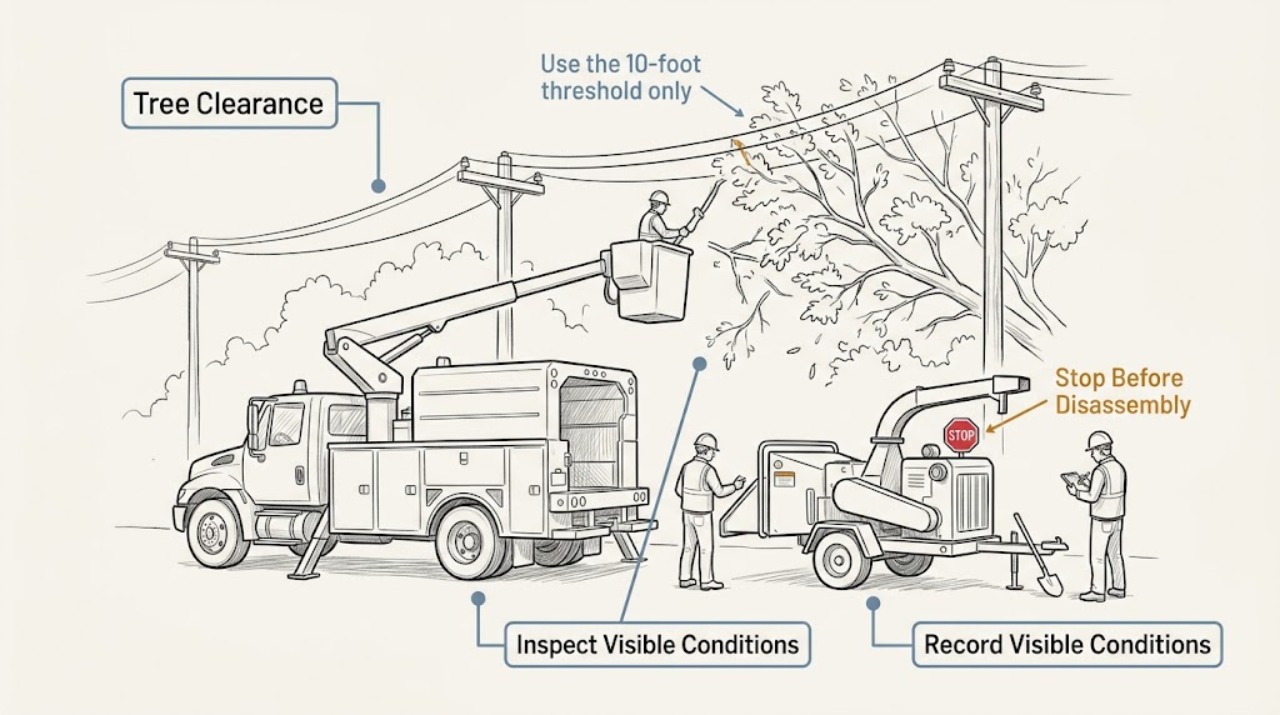
Treat branches or brush growing toward an overhead power line as an electrical hazard even when nothing is touching today. From the ground, identify whether the line is a neighborhood distribution line or a larger transmission line, note whether growth is dead, broken, moving, or already contacting the conductor, and stop if the distance is uncertain. OSHA treats tree work within 10 feet of an energized line as line-clearance work: unqualified workers must stay at least 10 feet away, and greater distances apply to higher voltages. Do not climb, use a ladder or pole saw, throw a rope, or cut, pull, or chip vegetation near the line. Contact the utility that owns the line and use a trained, experienced line-clearance tree professional; local rules and right-of-way terms determine who manages the vegetation and how far it is pruned.
Work through in order
Diagnostic checks
Use only checks that match the exact appliance or system and its official guide.
-
Check 1
Stop pruning, climbing, mowing under the canopy, and moving ladders or equipment toward the line. From a safe ground position, look for a conductor that is touching vegetation, a branch that can swing into it, a downed or sagging line, sparks, smoke, or a damaged pole; keep everyone and pets away from the area.
Expected result: The line is down, arcing, smoking, visibly damaged, or in contact with a branch, or the line remains overhead with branches only approaching it.
Next step: For a downed, arcing, smoking, or contacted line, clear the area without touching the tree, line, fence, vehicle, or other potentially energized object and contact the utility or emergency service according to local emergency guidance. Otherwise continue only with ground-level observations and arrange utility/tree-professional coordination.
Stop if: Stop immediately for any line contact, arcing, smoke, crackling, a damaged pole, or a branch that has fallen onto the line.
Why this matters
Why: Contact, damage, or electrical activity is an immediate electrical and fire hazard. Approaching overgrowth without those signs is still line-clearance work when the branch or tool could enter the minimum approach distance.
-
Check 2
From the ground and without a ladder, pole, tape, drone, thrown object, rope, or other tool, record whether the vegetation is on the homeowner's side, in a pole corridor, or under a high-voltage tower; note healthy growth, deadwood, broken limbs, lean, and movement in the current weather.
Expected result: The line type or ownership is unclear, the branch distance cannot be judged without approaching, the tree is split or leaning, or growth moves toward the conductor in wind.
Next step: Keep clear and give the utility and a line-clearance tree professional the location, photographs taken from a safe position, and the observed condition. Do not try to improve the view by climbing or handling the tree.
Stop if: Stop the inspection if visibility would require entering the canopy, approaching the conductor, or standing beneath a suspended or broken limb.
Why this matters
Why: Uncertainty, tree instability, and movement can change the fall or contact path. A ground photograph and location are useful for triage, but a photograph cannot establish a safe clearance or authorize cutting.
-
Check 3
Use the 10-foot threshold only as a safety boundary, not as a homeowner trimming allowance: if any branch, person, ladder, tool, rope, or equipment could come within 10 feet of an energized line, or if the voltage and distance are unknown, stop the work. Do not try to measure the gap with an extendable tool.
Expected result: The vegetation is clearly well away from the line and no planned work could bring a person or tool closer, or the gap is near 10 feet, shrinking with growth, affected by wind, or impossible to confirm safely.
Next step: If the boundary is uncertain or could be entered, do not trim or remove the vegetation; have the utility identify the line and coordinate trained line-clearance work. If it is clearly outside the hazard area, still ask the utility or qualified tree professional about mature clearance before planting or pruning toward it.
Stop if: Stop for an uncertain voltage, uncertain distance, wind-driven movement, sag, or any need to put a body, tool, or equipment within the boundary.
Why this matters
Why: OSHA's 10-foot minimum applies to unqualified workers around systems at 50 kV and below, with greater distances for higher voltages; line-clearance workers use specialized training, voltage information, and approach controls. A visual gap that seems adequate today may not account for sag, sway, or future growth.
-
Check 4
Identify the likely line owner from a safe location and contact the local utility or applicable authority about vegetation management, planned trimming, an easement or right-of-way, and whether the line is distribution or transmission. Give the location and explain that branches are overgrowing toward the line; do not assume a previous visit or property ownership transfers the work to you.
Expected result: The utility confirms an upcoming vegetation inspection or work order, directs the concern to another line owner or local regulator, or cannot identify responsibility from the initial report.
Next step: Record the utility's instructions and keep the area clear until the responsible party assesses it. If responsibility is disputed, provide the right-of-way or property information to the utility and the relevant local or state authority; do not cut while waiting for an answer.
Stop if: Stop any proposed cutting when ownership, permission, line status, or the applicable right-of-way is unresolved.
Why this matters
Why: FERC says vegetation decisions are primarily made by the electric utility subject to state/local requirements and right-of-way terms. Transmission and distribution lines can follow different programs, so the first contact may need to route the report.
-
Check 5
Prepare a handoff for a trained line-clearance tree professional: include the address or safe location description, ground-level photographs, line type if known, tree species or approximate size, dead or broken limbs, recent weather, and whether the utility has been contacted. Keep people out of the drop zone while waiting.
Expected result: The professional or utility can confirm a safe work plan, de-energization or other utility coordination, approach controls, and a method that accounts for falling limbs, ropes, equipment, and future regrowth.
Next step: Follow the utility and professional's written or verbal safety boundary and do not assist from within the work zone unless specifically trained and assigned. After work, monitor for new growth and report renewed encroachment rather than trimming it yourself.
Stop if: Stop and postpone the work for high winds, lightning, icing, unstable trees, an uncoordinated utility, or a crew that cannot explain its line-clearance controls.
Why this matters
Why: A safe clearance plan requires more than a cut location. OSHA identifies hazard assessment, training, approach distances, weather limits, and specialized equipment as part of line-clearance work.
Use your observations
Decision map
Find the observation that best matches what you see, then follow the next safe action.
-
PATH 01Safety boundary
What you see
Is the line down, arcing, smoking, damaged, or already contacted by the tree?
Do this next
Treat the scene as an energized-line emergency. Keep everyone away, do not touch the tree, line, fence, vehicle, or tools, and contact the utility or emergency service using local emergency guidance.
Why this path and its safety boundary
Why it matters: Visible contact or electrical activity changes the task from vegetation planning to immediate hazard isolation.
Safety stop: Keep the work stopped and continue only with a safe ground-level classification of the overgrowth and line owner.
-
PATH 02Next step
What you see
The branches are growing toward a line but are not touching it; the gap is near 10 feet, changing with wind, or cannot be safely confirmed.
Do this next
Keep tools and people out of the approach area, report the overgrowth to the utility, and have trained line-clearance professionals assess and perform any work.
Why this path and its safety boundary
Why it matters: This pattern is consistent with a developing clearance hazard, not permission for routine homeowner pruning. Line sag, sway, and future growth can reduce the apparent gap.
-
PATH 03Next step
What you see
The tree is split, dead, leaning, storm-damaged, or carrying a suspended limb near the line.
Do this next
Leave the drop zone and keep vehicles and equipment away. Request coordinated utility and qualified tree assessment; postpone work during high winds, lightning, icing, or other dangerous weather.
Why this path and its safety boundary
Why it matters: Tree instability adds an unpredictable fall and contact path even if the current branch-to-line gap appears large.
-
PATH 04Next step
What you see
The line appears to be a distribution line on poles, a transmission line on towers, or an unknown service with unresolved ownership or right-of-way.
Do this next
Contact the utility first and request the responsible line owner, vegetation plan, and applicable right-of-way information. Do not trim while responsibility or the safe method is unresolved.
Why this path and its safety boundary
Why it matters: The responsible utility, governing rules, and vegetation program can differ. FERC's transmission guidance does not replace local rules for distribution lines, and a right-of-way does not make unqualified cutting safe.
Helpful context
Understand the symptom
Overgrowth is a clearance problem, not a routine pruning job
A branch can be separated from a conductor on a cool, calm day and still become a hazard as it grows, bends in wind, or the line sags with heat and load. A home owner's view is not enough to establish a safe working distance. Treat every overhead line as energized, keep people and equipment away, and do not turn a visual inspection into a trimming attempt.
The line type changes who to contact
Lines on poles in front of a home are usually distribution lines; tall towers with several conductors are more often transmission lines, although appearance is not definitive. The utility or the applicable state or local authority can identify the owner and explain the vegetation plan. A right-of-way or easement may affect access and responsibility, but it is not permission for an unqualified person to work close to an energized line.
Leave the cutting method to line-clearance professionals
OSHA's tree-trimming guidance calls for a hazard assessment, appropriate approach distances, trained line-clearance workers, insulated equipment where applicable, and weather limits. Those controls cover the electrical path as well as falling limbs, ropes, ladders, aerial equipment, and chippers. If the growth is within 10 feet, the line type is unknown, or a branch could move into the line, keep the area clear and arrange the utility and qualified tree service assessment.
Safety boundary
Stop conditions
- Stop immediately for a downed, arcing, smoking, damaged, or tree-contacted line; clear the area without touching the tree, line, fence, vehicle, or tools and contact the utility or emergency service under local guidance.
- Do not trim, climb, measure with an extendable tool, throw a rope, or move a ladder, pole saw, aerial device, saw, chipper, or other equipment when it could enter the minimum approach distance.
- Postpone all work for high winds, lightning, icing, unstable or storm-damaged trees, suspended limbs, or a work plan that lacks utility coordination and trained line-clearance controls.
- Stop when line ownership, voltage, distance, permission, or right-of-way responsibility is unclear; ask the utility or applicable local authority rather than guessing.
Common questions
FAQ
Can I trim branches that are growing toward a power line if they are not touching it yet?
No. Do not trim, climb, use a ladder or pole saw, throw a rope, or move equipment toward the line. Growth, wind, and line sag can change the clearance, and OSHA treats work within 10 feet of an energized line as line-clearance work. Report the overgrowth to the utility and use trained line-clearance tree professionals.
What does overgrowth near a power line mean if there is still visible space?
Visible space today does not prove safe mature clearance. FERC explains that wind can move conductors and trees and heat can make lines sag; utilities may prune beyond a minimum to account for future growth and movement. Ask the utility to assess the corridor instead of judging the gap from a ladder or tool.
Is 10 feet a safe distance for a homeowner to work near an overhead line?
Use 10 feet as a reason to stop, not as permission to work. OSHA states that unqualified workers must maintain at least 10 feet from overhead lines for systems at 50 kV and below, with greater distances for higher voltages; specialized line-clearance workers and controls apply near energized lines. If voltage or distance is uncertain, stay farther away and contact the utility.
Who is responsible for clearing branches in my yard near the power line?
It depends on the utility, line type, right-of-way agreement, and state or local requirements. FERC says the operating utility primarily decides vegetation-management methods, while its federal reliability role focuses on certain transmission facilities; distribution-line issues generally follow local utility and state processes. Contact the utility first and request the applicable right-of-way information.
What should I do if a storm makes a branch touch or fall onto the line?
Do not touch the branch, line, fence, vehicle, or tools, and do not assume the line is dead. Keep people and pets away, leave the area, and contact the utility or emergency service under local emergency guidance. Trained line-clearance crews must handle the electrical and falling-tree hazards; do not attempt storm cleanup at the line.
Read the exact guide
Official sources
- eTool : Electric Power Generation, Transmission, and Distribution - Overhead Line Work - Line-Clearance Tree Trimming OperationsOccupational Safety and Health Administration · U.S. workplace safety requirements and practices for line-clearance tree trimming near energized overhead power lines
- Tree Trimming and Vegetation Management Landowners FAQFederal Energy Regulatory Commission · U.S. transmission vegetation-management, utility responsibility, line classification, right-of-way, wind/sag, and landowner guidance
- OSHA TREE TRIMMING SAFETYOccupational Safety and Health Administration · OSHA tree trimming and removal safety quick card covering energized lines, hazard assessment, weather, equipment, and falling-tree hazards
Community feedback
Share a repair observation
Share a plain-text repair observation. Accepted observations are published automatically; this page may take a moment to update.